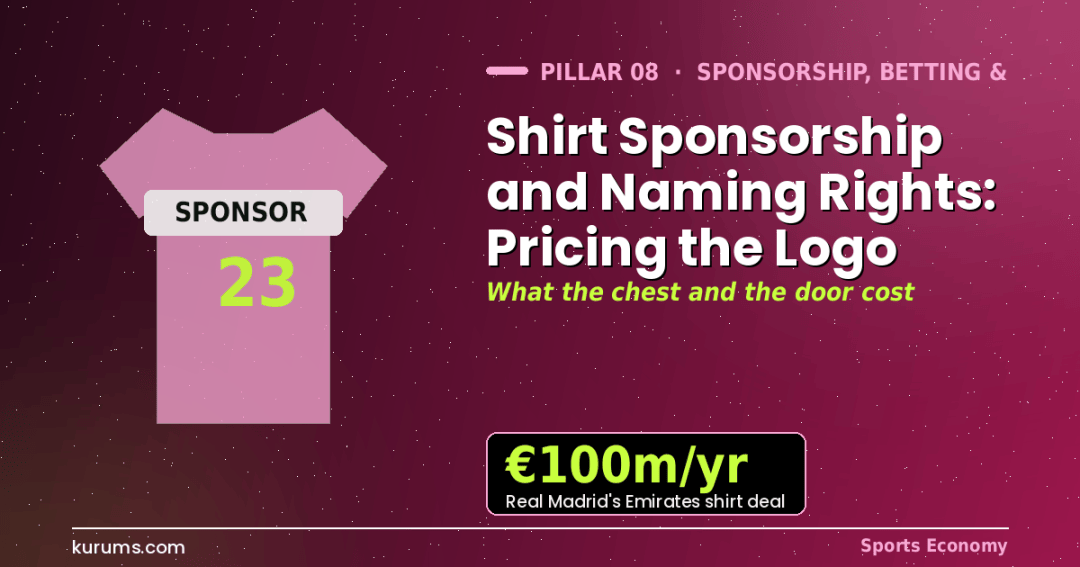
Real Madrid’s Emirates renewal, reported at close to €100 million a season from 2026/27, is the most expensive shirt sponsorship in football; its Adidas kit deal is worth roughly €120 million a year on top. Premier League front-of-shirt deals total £444 million for 2026/27 (Ampere Analysis), up 8 percent despite the gambling ban. In the NBA, one jersey patch now fetches over $50 million a year (Golden State’s 2026 deal with Iren), and the league’s 30 patches generate about $294 million a season. Stadium names run from $2.5 million a year for a minor-league ballpark to about $35 million a year for Crypto.com Arena’s $700 million, 20-year contract.
Shirt sponsorship and naming rights are the two most valuable single assets a sports property can sell, because both put a brand inside every broadcast frame for years. Their prices are set by audience reach, scarcity and the willingness of a small group of airlines, banks, technology companies and betting operators to outbid one another. This article explains how the logo on the chest and the name over the door are valued in 2026, using disclosed deals and the estimates of the data firms that track them. It is part of the Sports Economy hub and builds on our overview of how big the global sponsorship market is and our analysis of betting partnerships, the category now being pushed off the shirt in several markets.
What is the most expensive shirt deal in football?
Real Madrid’s Emirates renewal at close to €100 million a season for five years from 2026/27, reported by AS and Sportcal. Barcelona (Spotify), Manchester United (Snapdragon) and PSG (Qatar Airways) earn around €70 million each.
How much is a stadium name worth?
From about $8 million a year (Northwest Stadium, Washington) to roughly $35 million a year (Crypto.com Arena, Los Angeles). In Europe, Allianz pays Bayern about €13 million a year, Chobani pays Fenerbahçe €10 million, and Tottenham’s stadium remains unnamed after seven years.
What makes a sleeve or patch worth $50 million?
Scarcity plus reach. The NBA allows one patch per team; Golden State’s 2026/27 deal with Iren at more than $50 million a year replaced Rakuten’s $20 million, and the league’s patches now total about $294 million a season.
How is a shirt sponsorship priced?
A shirt sponsorship is priced from the audience the shirt reaches across broadcast, social media and retail, adjusted for the club’s global fanbase, league exposure, Champions League participation and the number of rival bidders. Top European clubs command €60 million to €100 million a year; mid-table Premier League clubs £5 million to £12 million.
The exposure case is arithmetic. A chest logo appears in every broadcast, highlight clip, press conference and replica shirt. Measurement firms convert those seconds into an equivalent advertising cost, and the biggest clubs produce media value in the hundreds of millions of dollars a season; the sponsor pays 30 to 50 percent of that because logo exposure cannot be targeted like digital advertising.
The distribution of fees is steep. SalaryLeaks’ compilation of 2025/26 Premier League deals shows Manchester City’s Etihad package at about £67.5 million, Manchester United’s Snapdragon deal at £60 million, Arsenal and Liverpool at about £50 million and Tottenham’s AIA deal at £40 million; the rest of the league ranges from £25 million (Newcastle, Sela) down to £3.5 million (Burnley), for a total of roughly £408 million. The top five clubs take two-thirds of the money. Ampere Analysis puts the 2026/27 total at £444 million, up 8 percent, driven by Arsenal’s improved Emirates terms and Chelsea’s new deal with Circle.
Spain’s leader sets the global ceiling. Real Madrid’s June 2026 renewal with Emirates, reported by Spanish daily AS and Sportcal at close to €100 million a season through 2030/31, replaced a deal worth €70 million to €80 million. The day after, the club extended Adidas to 2034 at an estimated €120 million a season covering football, basketball and youth teams. Barcelona’s Spotify deal, extended to 2030, is worth around €70 million a year, with a separate naming component for the stadium. No other sport has a comparable single asset: in the NFL, teams cannot sell game-shirt sponsorship at all.
What is the difference between a front-of-shirt, sleeve and kit-supplier deal?
The front-of-shirt partner pays for the chest logo; the sleeve partner pays for a smaller patch at roughly 10 to 25 percent of the chest fee; the kit supplier pays a guaranteed royalty for manufacturing and selling the shirt, often the largest contract of the three at the biggest clubs.
Kit-supplier deals are frequently misread as sponsorship. Adidas does not pay Real Madrid €120 million for exposure; it pays a minimum guarantee against royalties on replica sales and licensed product, and the deal is profitable for Adidas when shirt sales exceed the guarantee. Manchester United’s ten-year Adidas contract, signed in 2023 at a reported £900 million, and Liverpool’s 2025 switch to Adidas on a reported £60 million-a-year basis work the same way. The economics of that merchandise are covered in our companion article on merchandise and licensing.
Sleeve sponsorship was introduced in the Premier League in 2017/18 and in most European leagues shortly after, creating a second-tier asset that now generates £5 million to £20 million a year at the top clubs. The sleeve has become the refuge for categories restricted on the chest: when the Premier League’s voluntary ban on gambling front-of-shirt sponsors took effect for 2026/27, Aston Villa, Everton and Brentford moved betting partners to sleeves and training kit rather than losing them.
Training kit, back-of-shirt and shorts sponsorship complete the inventory where leagues allow them; the Süper Lig permits more positions than England, which is why Galatasaray and Fenerbahçe shirts carry four or five brands.
| Asset | Property and partner | Reported value per year | Term |
|---|---|---|---|
| Front of shirt | Real Madrid – Emirates | c. €100m | 2026/27–2030/31 |
| Front of shirt | Manchester United – Snapdragon | £60m | from 2024/25 |
| Front of shirt | Liverpool – Turkish Airlines | c. £60m | 5 years from 2027/28 |
| Kit supplier | Real Madrid – Adidas | c. €120m | to 2034 |
| Jersey patch | Golden State Warriors – Iren | >$50m | multi-year from 2026/27 |
| Arena naming | Crypto.com Arena, Los Angeles | c. $35m ($700m total) | 20 years from 2021 |
| Stadium naming | SoFi Stadium, Los Angeles | c. $31m ($625m total) | 20 years from 2020 |
| Stadium naming | Allianz Arena, Munich | c. €13m (€130m total) | 10 years to 2033 |
| Stadium naming | Chobani Stadium, Fenerbahçe | €10m | 5+5 years from 2025 |
| Stadium naming | Northwest Stadium, Washington Commanders | c. $8–9m | from 2024 |
Why are jersey patches worth so much in the NBA?
Because the NBA allows exactly one patch per team, the patch is small and the league’s audience is young, global and valuable to technology and finance brands. GlobalData estimates the 30 patches produced about $286 million in 2024/25 and roughly $294 million in 2025/26, and the Warriors’ 2026 Iren deal set a record at more than $50 million a year.
The patch programme began in 2017/18 as a three-year pilot with deals in the $5 million to $20 million range; Rakuten’s Warriors contract at about $20 million a year was the benchmark for most of the period. The league is now, in SportBusiness’s phrase, in a third generation of patch deals, with eight-figure annual fees common and the Lakers reported at $30 million a year. The Iren deal, reported by Sportico, doubled the previous record and shows AI and cloud brands using sport for awareness as crypto exchanges did in 2021.
The NHL, MLB and WNBA have followed with their own patch and helmet-advertising programmes; Major League Baseball’s patches, introduced in 2023, sell for roughly $5 million to $15 million a year. The NFL remains the exception, permitting patches only on practice jerseys to protect the value of its league-wide partners. For the NBA, the patch is a case study in asset creation: a league that had no shirt sponsorship a decade ago built a near-$300 million revenue line without adding a single minute of broadcast time.
How are stadium naming rights valued?
Naming rights are valued on annual media exposure, the number and mix of events at the venue, the catchment population, and the term, which is typically 10 to 25 years. The headline total can mislead; divide by the term, and the range runs from about $2.5 million to $35 million a year.
The largest contracts are in Los Angeles. Crypto.com paid a reported $700 million for 20 years from 2021 to rename the former Staples Center, home of the Lakers, Clippers and Kings; AEG’s executives have said the real figure is higher. SoFi’s 20-year, $625 million deal for the Rams’ and Chargers’ stadium and Intuit’s 23-year, $500 million contract for the Clippers’ new arena complete a cluster in which three venues within twenty kilometres generate more than $90 million a year in naming fees. The common factor is event density: an arena hosting two NBA teams, an NHL team and 100-plus concerts delivers far more exposure than a football ground used 25 times a year.
That is why American naming fees exceed European ones even for comparable audiences. Allianz’s extension at Bayern Munich to 2033, reported by Calcio e Finanza at about €130 million over ten years, is one of Europe’s biggest yet amounts to a third of SoFi’s annual fee. Everton sold the name of its new stadium to law firm Hill Dickinson in 2025 for a reported £10 million a year; Chobani agreed €10 million a year for Fenerbahçe’s Kadıköy ground in July 2025 on a five-plus-five-year term; and RAMS Global’s five-year deal for Galatasaray’s stadium and Tüpraş’s deal for Beşiktaş both sit around €8 million to €9 million a year after inflation adjustments, according to CNBC-e. Tottenham, which opened its £1 billion stadium in 2019 reportedly seeking £25 million or more a year, had still not sold the name by October 2026.
The gap is also cultural. A Kroll survey of European football found that the Bundesliga has sold the names of almost all its top-flight grounds, while the Premier League, La Liga and Serie A have sold a minority, because fans and local councils resist renaming historic venues. New-build stadiums carry no such baggage, which is why Arsenal (Emirates), Manchester City (Etihad), Everton and the Gulf-funded venues sold names from day one.
What does the sponsor get for the money?
Beyond the logo, a shirt or naming partner typically receives category exclusivity, hospitality allocations, player access, rights to use club marks in advertising, digital content, and, in naming deals, signage throughout the venue and on transport maps. The intangible return is association with a loved institution.
The strategic part is harder to price. Emirates has used shirt deals with Arsenal, Real Madrid, AC Milan and Benfica since 2006 to build awareness in markets where the airline did not yet fly; Etihad’s deal with Manchester City was tied to Abu Dhabi’s broader investment in the club and the city. Turkish Airlines, whose Liverpool deal begins in 2027/28 at a reported £60 million a year, is buying the most-watched shirt in English football to support a network that already flies to more countries than any other airline. For these buyers, the shirt is an export-promotion budget as much as advertising. Clubs also use these deals internally; the recruitment angle is examined in our piece on sponsorship as an employer-branding tool.
What happens when a sponsor fails or a category is banned?
The club must find a replacement, often at a lower price and sometimes while still displaying a defunct brand. Enron Field lasted two years of a 30-year deal; crypto sponsors vanished within two seasons; and the Premier League’s 2026/27 gambling ban removed £67 million of front-of-shirt money, offset by £75 million from other categories.
Sponsor failure is a recurring event. Houston’s ballpark has had four names in 25 years. Banc of California paid a $20.1 million termination fee in 2020 to exit the LAFC stadium deal early. Crypto.com’s Los Angeles contract survived the 2022 crypto crash, but several smaller exchange deals in football and Formula 1 did not, and clubs that had budgeted the income spent two seasons replacing it.
Regulation is the more predictable threat. Italy banned gambling sponsorship in 2019, Spain followed in 2021, Belgium and the Netherlands restricted it in 2023 and 2025, and the Premier League’s voluntary front-of-shirt ban took effect in 2026/27. Ampere Analysis found gambling sponsorship across all Premier League assets fell £92 million year on year, with betting deals down more than 20 percent, though the clubs most exposed were the smaller ones for whom a £10 million betting partner was the best available offer. The lesson, explored in our guide to UEFA’s financial rules, is that squad-cost ratios now make lost commercial income a sporting problem as well as a financial one.
Where is the next growth in shirt and naming revenue?
Growth is coming from technology and AI brands replacing crypto and gambling, from women’s teams selling separate shirt partners, from new-build and renovated venues in the Gulf, the United States and Türkiye, and from leagues creating additional inventory such as sleeves, patches and virtual signage.
Technology is the clearest trend. Snapdragon (Qualcomm) at Manchester United, Circle at Chelsea, Iren at the Warriors and the surge of AI and cloud brands in Formula 1 show that chip, software and infrastructure companies are using sport to reach consumers and enterprise buyers at once. In the women’s game, clubs including Arsenal, Chelsea and Barcelona now sell women’s-team shirt and sleeve rights separately, often to different brands, a practice that did not exist five years ago.
Venue naming has room to grow in Europe simply because so many grounds remain unsold. Tottenham’s eventual deal, whenever it lands, will reset the English benchmark; the Bundesliga shows what a fully named league looks like; and the Süper Lig’s three Istanbul giants have each sold their stadium names since 2023, generating a combined €27 million or so a year that did not exist before. In the United States, every new stadium opens with a name attached, and the renovations funded by public money, such as Charlotte’s $1.3 billion Bank of America Stadium programme, come with renewed naming terms, a dynamic discussed in our article on stadium financing.
Frequently Asked Questions
Which club has the biggest shirt sponsorship deal?
Real Madrid. Its Emirates renewal, signed in June 2026 and reported by AS and Sportcal at close to €100 million a season through 2030/31, is the largest front-of-shirt deal in world football. Barcelona (Spotify), Manchester United (Snapdragon) and Paris Saint-Germain (Qatar Airways) are reported at around €70 million a year, and Liverpool’s Turkish Airlines deal from 2027/28 at about £60 million.
How much do stadium naming rights cost?
Between roughly $2.5 million and $35 million a year depending on event volume, market size and term. Crypto.com Arena ($700 million over 20 years) and SoFi Stadium ($625 million over 20 years) in Los Angeles are the most expensive. In Europe, Allianz Arena is reported at about €13 million a year, Chobani Stadium in Istanbul at €10 million and Everton’s Hill Dickinson Stadium at £10 million.
Why has Tottenham never sold its stadium name?
Reports since 2019 suggest the club has sought £25 million or more a year, a figure no brand has yet paid for a football-only venue in Europe. Tottenham has instead sold stand naming and other partnerships and hosts NFL games and concerts to raise the venue’s profile. Under the Premier League’s squad-cost rules, the missing income is increasingly a sporting constraint as well as a financial one.
Are gambling shirt sponsors banned in the Premier League?
From the 2026/27 season, under a voluntary agreement among clubs, gambling brands cannot appear on the front of Premier League shirts, though they may still appear on sleeves, training kit and perimeter advertising. Ampere Analysis estimates the ban removed £67 million of front-of-shirt income, more than replaced by £75 million from other categories, but total gambling sponsorship across all assets fell by £92 million.