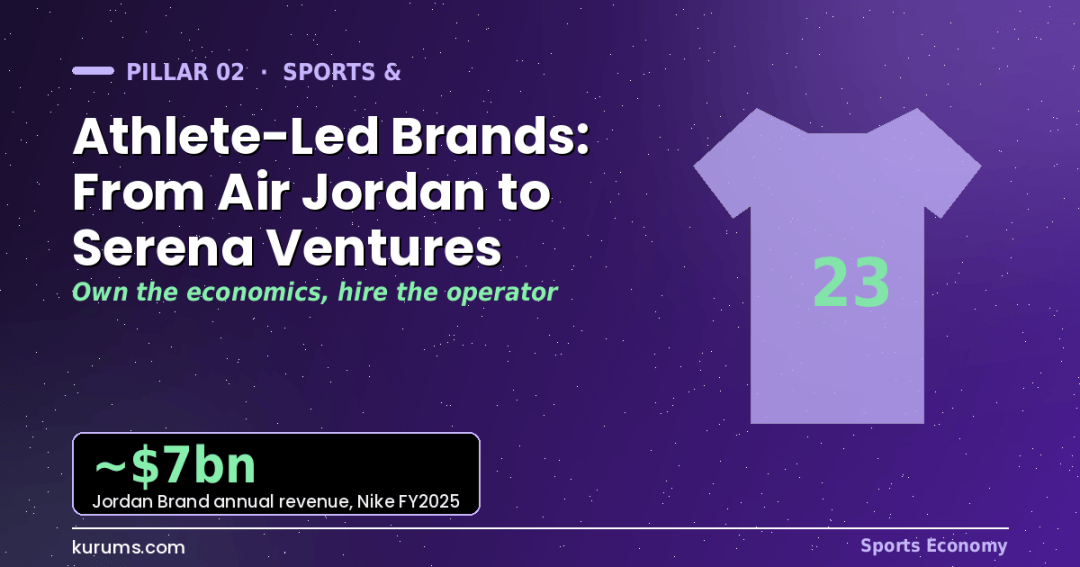
Athlete-led brands range from a royalty line inside a multinational to a venture fund with institutional investors, and the economics differ at every step. Jordan Brand, the original, generates roughly $7bn a year by Sportico’s reading of Nike’s fiscal 2024 and 2025 results, with a 16% decline reported in the latter year, and pays Michael Jordan an estimated $250–300m annually. David Beckham’s brand company reached roughly $100m of revenue in 2025, after he sold 55% of it to Authentic Brands Group for a reported $250m. Roger Federer’s roughly 3% of On was worth more than $375m in 2025. Serena Ventures manages a $111m fund with institutional limited partners. Kobe Bryant’s $6m BodyArmor stake was reported at about $200m when Coca-Cola bought the brand in 2021.
Athlete-led brands case studies show how a signature-shoe royalty in 1984 became, forty years later, a template that covers footwear, media, drinks, supplements, club ownership and venture capital. This article is part of the Sports Economy hub and builds on our analysis of the athlete as entrepreneur and of sportstech start-ups. It works through seven cases and draws out what each adds to the model.
How big is the largest athlete brand?
Jordan Brand turned over roughly $7bn a year in Nike’s fiscal 2024 and 2025 by Sportico’s count, around 15% of Nike’s total, having roughly doubled between 2020 and 2024. Sportico estimates Michael Jordan’s royalty income at $250–300m a year, four decades after the first Air Jordan shipped.
What is the fastest-growing athlete-brand model?
Equity-for-endorsement and direct-to-consumer launches. Federer’s On stake, Beckham’s IM8 (about $60m in its first full year, targeting $200m in 2026) and LeBron James’s Fulwell Entertainment all convert attention into owned revenue rather than fees.
What do the failures have in common?
Category mismatch and dependence on the athlete’s calendar. Brands built in a category where the athlete has no authority, or run by the athlete’s friends rather than operators, rarely survive the end of the playing career.
How did Air Jordan become a $7bn brand?
By giving the athlete a share of revenue on a product line rather than a fee, then letting the line outgrow the athlete. Jordan Brand became a separate Nike division in 1997, expanded into lifestyle, women’s and international sales, and roughly doubled between 2020 and 2024 before a 16% fall in fiscal 2025.
The original 1984 contract, as retold in Nike’s own history and in Sportico’s reporting, paid Jordan a base plus a royalty on Air Jordan sales at a time when Converse and Adidas were offering flat fees. Sportico’s reading of Nike’s fiscal 2024 results showed Jordan Brand growing 6%, the strongest of any Nike division, with revenue having roughly doubled since 2020 on retro releases, women’s lines and international expansion. Fiscal 2025 reversed the trend: Sportico reported a 16% decline as Nike cut retro supply to protect scarcity and group revenue fell 10% to $46.3bn. Jordan’s own income, which Sportico estimates at about $250m in 2024 and $300m in 2025, is almost entirely Nike royalties, more than twenty years after his last game; Forbes values him at $3.8bn, including proceeds from selling a majority stake in the Charlotte Hornets at a $3bn valuation in 2023.
Why is David Beckham the template for a licensing company?
Because he turned a personal endorsement book into a corporate asset, sold part of it to a professional owner and kept the upside. DRJB Holdings reached about $100m of revenue in 2025; Authentic Brands Group bought 55% for a reported $250m in 2022; and his separate Inter Miami stake, acquired through a $25m option, is worth more than $300m.
Beckham’s brand business began under Simon Fuller’s XIX Entertainment. In 2019 he bought out Fuller’s one-third interest for roughly $50m, according to Forbes, and consolidated everything under DRJB Holdings, founded with Victoria Beckham in 2014. By early 2022 the business had about $66m of annual sales; Authentic Brands Group, owner of Reebok and Sports Illustrated, bought 55% for $250m in cash and stock, leaving Beckham 45% and creative control. Fortune’s October 2025 reading of UK filings shows DRJB with $92.3m revenue and $44.9m profit, up 44%.
Inter Miami sits alongside the brand business: the $25m expansion option negotiated in his 2007 LA Galaxy contract was exercised in 2014, and after Lionel Messi’s 2023 arrival Forbes’ May 2026 valuation of roughly $1.4bn put Beckham’s 26% stake above $300m, making him Britain’s first athlete billionaire. The ABG deal is the model’s key move. It converted an illiquid personal asset into cash plus shares in a company Forbes says has since risen from about $13bn to $20bn in value, and put professional licensing managers in charge of growth. Beckham then launched owned brands: IM8, the supplement business co-founded in 2024 with Nasdaq-listed Prenetics, reported about $60m of first-full-year revenue and targets $200m in 2026 according to Forbes; Studio 99 made the 2023 Netflix documentary that paid him $21m and led to a three-year first-look deal.
What did Roger Federer and On prove about equity-for-endorsement?
That a minority stake in the right growth company outperforms any fee, and that the same stake carries concentration risk. Federer’s roughly 3% of On was worth more than $375m in August 2025 and made him a billionaire; a single earnings miss in August 2026 cut his net worth by about $52m and removed the title.
Federer left Nike in 2018, signed a ten-year Uniqlo deal reported at $300m, and in 2019 joined On, then a small Zurich running-shoe company, as co-owner and product collaborator rather than endorser. On listed in New York in September 2021 and became one of the fastest-growing sportswear companies in the world, with second-quarter 2026 net sales of 850.4m Swiss francs, up 13%, at a 65.4% gross margin.
Forbes’ August 2025 estimate put Federer’s stake at about 3%, worth more than $375m against a market capitalisation near $15bn, enough to lift his net worth to $1.1bn and make him the seventh athlete billionaire. Forbes’ August 2026 recalculation, after On missed sales expectations and its shares fell about 19% in a day, put the stake at roughly 2.5% and his net worth at $952m.
Against prize money of about $131m across 24 years, the On stake alone produced more than double that from a company he neither founded nor ran. But wealth concentrated in one listed stock carries the risk described in our article on athlete income and wealth management.
| Case | Model | Scale (latest reported) | Who runs it | Main risk |
|---|---|---|---|---|
| Air Jordan (1984) | Royalty on a Nike division | ~$7bn revenue/yr; ~$300m/yr to Jordan | Nike | No control; partner’s product decisions |
| Beckham / DRJB (2014) | Licensing holding company, 55% sold to ABG | ~$100m revenue 2025; IM8 targeting $200m 2026 | ABG and DRJB executives | Brand fatigue; dependence on personal profile |
| Federer / On (2019) | Equity stake in a listed sportswear company | ~2.5–3% of On; $375m+ at 2025 peak | On’s founders and executives | Single-stock concentration |
| LeBron James / SpringHill (2007) | Media operating company; merged into Fulwell Entertainment 2025 | $725m valuation at 2021 raise; 50/50 merger | Maverick Carter, Leo Pearlman (co-CEOs) | Studio overhead in a contracting TV market |
| Serena Ventures (2014; fund 2022) | Venture fund with institutional LPs | $111m fund; 16 personal unicorns; 85+ companies | Alison Rapaport Stillman, GP | Unproven fund-level returns |
| Durant / 35V and Boardroom (2016) | Investment firm plus media company | 100+ investments; Hugging Face $250k reported at $60m+ | Rich Kleiman | Early-stage portfolio volatility |
| Kobe Bryant / BodyArmor (2014) | Early equity in a challenger consumer brand | $6m stake reported at ~$200m on $5.6bn Coca-Cola sale, 2021 | BodyArmor founders; later Coca-Cola | Binary outcome; most challengers fail |
What does LeBron James’s SpringHill show about athlete media companies?
That an athlete can build a real production business, and that production businesses need scale to survive. SpringHill raised at a $725m valuation in 2021 with backers including RedBird, Fenway Sports Group, Nike and Epic Games, reportedly lost about $28m in 2023, and merged 50/50 with Fulwell 73 in early 2025 to form Fulwell Entertainment.
James and Maverick Carter founded SpringHill Entertainment in 2007 and built it into the three-brand SpringHill Company in 2020, combining the studio with Uninterrupted, an athlete-voice platform, and The Robot Company, a marketing consultancy. The 2021 raise, led by RedBird with Fenway Sports Group, Nike, Epic Games, Main Street Advisors and UC Investments, valued the group at a reported $725m.
The subsequent history is the useful part. The scripted and unscripted television market contracted from 2022 as streamers cut spending, and press reports in 2024 put SpringHill’s losses at roughly $28m for the previous year. Merger talks with Fulwell 73, the British producer of the Grammy Awards part-owned by James Corden and Eldridge, were reported in November 2024 and closed in February 2025, with Carter and Fulwell’s Leo Pearlman as joint chief executives; the combined company cut UK staff within months.
The media model works as an athlete brand because the athlete’s story and network supply content a studio would pay for; but a studio’s cost base does not care who founded it, and the way through a contraction was scale, which meant giving up half the company. Compare the economics in our article on the sports media-rights market.
How does Serena Ventures differ from a celebrity angel portfolio?
In structure, team and accountability. Williams wrote more than 60 personal angel cheques over nine years, 16 of which reached unicorn status by her own count, then raised a $111m institutional fund in 2022 with Norwest, CapitalG, LionTree and the Kapor Foundation as limited partners and a professional general partner running it.
The angel phase ran from roughly 2013. Fortune’s 2019 profile counted 34 companies and about $6m deployed, with Billie, Daily Harvest and MasterClass among the top performers. By 2022 the personal portfolio included 16 companies that had crossed $1bn in valuation, among them MasterClass (valued at $2.75bn in 2021) and Esusu, the rent-reporting fintech that reached unicorn status in 2022. Those were seed-stage personal cheques written in the most generous venture market in history.
The fund phase began in March 2022 with the $111m close. Alison Rapaport Stillman, hired from JPMorgan’s asset-management arm in 2018 to run Williams’ family office, became general partner; the investment team was four people, all women; and the strategy, as described to Fortune, was 60% seed, 20% pre-seed and 20% Series A, with both Williams and Stillman required to vote yes on every cheque. Roughly three-quarters of portfolio founders come from historically under-represented backgrounds.
What the case adds is accountability. A celebrity angel answers to no one; a general partner answers to limited partners who expect audited reporting and, eventually, distributions. Serena Ventures has not published fund-level returns and its first fund is still within the normal holding period, so whether athlete-led funds outperform remains open. Williams has meanwhile launched the Wyn Beauty line and taken minority stakes in the Miami Dolphins, Angel City FC and the WNBA’s Toronto Tempo, placing her on every rung of the ladder above.
What do Durant’s 35V and Bryant’s BodyArmor add?
Two ends of the risk spectrum. Kevin Durant’s Thirty Five Ventures has made more than 100 early-stage investments since 2016 and built a media company, Boardroom, alongside them. Kobe Bryant’s single $6m cheque into BodyArmor in 2014 was reported at about $200m when Coca-Cola bought the brand for $5.6bn in 2021, the best-known single-bet return in athlete investing.
35V, founded by Durant and Rich Kleiman in 2016, is a diversified early-stage portfolio. Reported positions include Coinbase, WHOOP, Overtime, SeatGeek and The Players’ Tribune, team stakes in the Philadelphia Union, Premier Lacrosse League, Gotham FC and a Major League Pickleball franchise bought in 2022, and, according to 2025 reports, a $250,000 early position in Hugging Face valued at more than $60m after the AI company’s acquisition. Durant’s playing income, more than $500m in career salary plus a lifetime Nike contract, funds the structure, which is why 35V can take venture risk without outside limited partners.
Bryant’s BodyArmor stake is the concentrated version. He invested roughly $6m in 2014 in a sports-drink challenger to Gatorade, took an active role in marketing and recruiting other athlete investors, and held the position through Coca-Cola’s 2018 minority purchase and its 2021 acquisition of the remainder at a $5.6bn valuation. The reported $200m value, realised by his estate after his death in 2020, is the number every athlete investor cites, and a reminder that challenger brands fail far more often than they sell to Coca-Cola.
Which athlete-led brands fail, and why?
Most of them, for three recurring reasons: the category has nothing to do with the athlete’s credibility, the operating team is the athlete’s entourage, and the brand’s revenue depends on the athlete’s continued visibility. The survivors in this article all avoided at least two of the three.
Category mismatch is the most common. The celebrity-spirits and beauty booms of 2018–2024 produced dozens of athlete-fronted tequila, wine and skincare lines, most since wound down. The ones that worked, such as Beckham’s Haig Club whisky under Diageo or Lewis Hamilton’s Almave non-alcoholic agave spirit with Casa Lumbre, had a credible operating partner and a plausible link to the athlete’s public identity. Tiger Woods, ending his 27-year Nike relationship in 2024, launched Sun Day Red with TaylorMade, a golf company, rather than a fashion house, for the same reason.
The entourage problem is structural. A brand run by the athlete’s friends lacks the licensing, retail and finance expertise that DRJB, Nike or ABG supply, and tends to spend the athlete’s money rather than raise anyone else’s. Cristiano Ronaldo’s CR7 portfolio, spanning hotels, fragrance, a gym chain and a YouTube channel that passed 70 million subscribers within a year of its 2024 launch, is the largest personal brand in sport by audience, with Sportico counting about $60m of 2025 endorsement income on top of a $200m Al-Nassr salary, but it remains structured around Ronaldo personally rather than as a DRJB-type institution.
Visibility dependence is the third. Endorsement-driven brands lose revenue when the athlete stops playing; equity and licensing businesses do not. Türkiye illustrates it in miniature: Süper Lig stars at Galatasaray and Fenerbahçe command large followings, but few have converted them into owned companies with professional management, so their commercial value tracks form and transfer status. The athletes who built lasting brands, as league and employer transition programmes now teach, started the conversion while still playing.
What should a company take from these case studies?
That the athlete brand is a distribution business with a licensing wrapper, and that the same logic applies to any founder-led or personality-led company. Negotiate equity when leverage is highest, hire operators early, stay in a category where the founder’s authority is real, and plan for the day the founder is no longer the story.
For brands considering an athlete partnership, the cases argue for equity over fees, because equity aligns the athlete with growth rather than appearances, and for a defined operating role: On got a product collaborator in Federer, Nike a design partner in Jordan, BodyArmor a marketer in Bryant.
For founders, the point is the separation of brand from person. Beckham’s DRJB can be sold because it is a company; Jordan’s royalty cannot because it is a contract. Buyers from ABG to the firms in our piece on private equity in sport pay for exactly that separation.
Frequently Asked Questions
How much does Michael Jordan earn from Jordan Brand?
Sportico estimates roughly $250m in 2024 and about $300m in 2025, almost all from Nike royalties, against Jordan Brand revenue of roughly $7bn a year. Nike does not disclose the royalty rate and Jordan does not own the brand; the figures are estimates built from the division’s reported revenue and reported contract terms.
Is Serena Ventures a real venture fund or a celebrity vehicle?
A real fund. Its $111m first fund, closed in March 2022, has institutional limited partners including Norwest Venture Partners, CapitalG, LionTree and the Kapor Foundation, a general partner, Alison Rapaport Stillman, who previously worked in JPMorgan asset management, and a formal investment process in which both she and Williams must approve each deal. Fund-level returns have not yet been published; Williams’ 16 personal unicorns predate the fund.
Why did David Beckham sell part of his brand company?
To convert an illiquid personal asset into cash and shares, and to bring in professional licensing management. Authentic Brands Group paid a reported $250m in cash and stock for 55% of DRJB Holdings in 2022; Beckham kept 45% and creative control, drew about $36.5m from the business in its latest filed year, and used the freed capital and attention to launch owned brands such as IM8, which is targeting $200m of revenue in 2026.
What was Kobe Bryant’s return on BodyArmor?
Reports put his roughly $6m investment in 2014 at about $200m when Coca-Cola completed its purchase of BodyArmor at a $5.6bn valuation in 2021, a return realised by his estate. It is the most cited single athlete investment, and the most misleading as a guide: Bryant worked on the brand’s marketing for years, and most challenger consumer brands never reach a strategic sale.