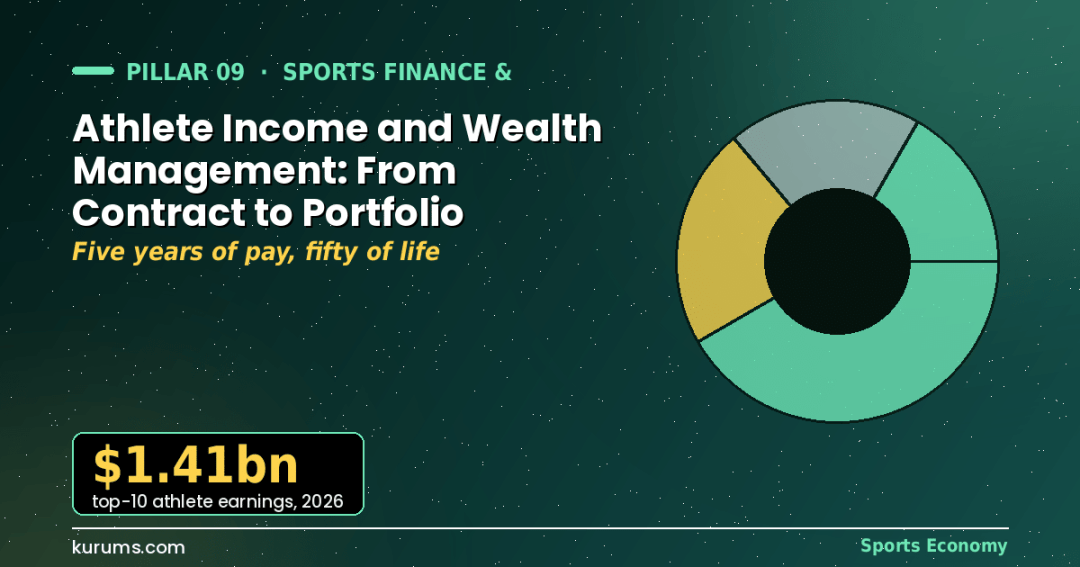
The ten highest-paid athletes earned about $1.41bn in Forbes’ 2026 list, 36% of it off the field, led by Cristiano Ronaldo at $300m. Shohei Ohtani earned $125m in endorsements against a salary of $2.6m because $68m a year of his $700m Dodgers contract is deferred to 2034–2043. Most athletes earn far less for far shorter: careers last three to five years in the major leagues, taxes can take half of a pay cheque earned in a dozen jurisdictions, and a US study found roughly one in six NFL players filed for bankruptcy within twelve years of retiring.
Athlete income and wealth management is a specialist discipline because the athlete’s financial life runs backwards: peak earnings arrive in the twenties, the career ends when most professionals are starting to earn seriously, and the money comes with agents, image-rights companies, multi-state tax returns and a queue of people offering deals. This article, part of the Sports Economy hub, sets out where athlete income comes from, how contracts and tax work, why so many athletes run out of money and how the best-advised ones build portfolios. It complements our profile of the athlete as entrepreneur and our analysis of sport as an asset class.
How much do top athletes earn?
Forbes’ 2026 list puts Cristiano Ronaldo at $300m, Canelo Álvarez at $170m and Lionel Messi at $140m; the top ten combined earned $1.41bn, of which $513m came from endorsements and business.
Why does contract structure matter as much as the headline?
Ohtani’s $700m deal pays $2m a year now and $68m a year from 2034; Bobby Bonilla’s deferred $5.9m became $29.8m paid through 2035 at 8% interest. Timing, guarantees and deferrals decide what the athlete keeps.
What is the biggest risk?
Not bad investments but a short career combined with high fixed spending. A US academic study found about 16% of NFL players filed for bankruptcy within 12 years of retirement, regardless of how much they had earned.
Where does athlete income actually come from?
From four streams: playing contracts or prize money, endorsements and licensing, appearance and media fees, and, for a growing minority, equity in businesses and teams. For the top ten earners in 2026, Forbes attributes 64% to competition and 36% to off-field income; for most professionals the salary is everything.
Forbes’ 2026 ranking shows the spread. Ronaldo’s $300m is $235m from his Al Nassr contract, reported at around €200m a year including commercial components, plus $65m in endorsements. Messi splits evenly at $70m and $70m. LeBron James earned $52.8m on the court and $85m off it; Stephen Curry $59.7m and $65m. At the extreme, Ohtani’s $127.6m was $2.6m in salary and $125m in endorsements, the highest endorsement figure on the list, because almost all of his Dodgers pay is deferred. Boxing is the mirror image: Canelo Álvarez made $160m of his $170m in the ring.
Below the top ten the picture changes quickly. The NBA’s salary cap for 2025/26 is $154.6m per team and its supermax contracts, such as Jayson Tatum’s five-year $315m extension, go to a handful of players; most rosters turn over within a few seasons. In football, a Championship squad player in England or a mid-table Süper Lig professional in Türkiye earns a comfortable but finite living that must cover the decades after the boots come off. College athletes in the United States are the newest earners, through the $2.8bn House v NCAA settlement and name, image and likeness deals that valued Caitlin Clark at $3.4m while still at Iowa.
The off-field share grows with fame and with the athlete’s willingness to be a brand. Our article on athlete-led brands traces how Michael Jordan’s Nike royalties, Serena Williams’ venture fund and LeBron James’ media company turned endorsement income into owned assets; Williams’ career prize money was $94.8m and her wealth is a multiple of that.
How are playing contracts structured, and why do deferrals matter?
A contract’s headline value is rarely what the athlete receives on schedule. Guarantees, signing bonuses, option years, performance clauses and deferred payments all move money in time, and in the United States deferrals have become a tool for club payroll management and player tax planning.
Ohtani’s December 2023 deal with the Los Angeles Dodgers is the defining case. Of $700m over ten years, $680m is deferred: he receives $2m a season from 2024 to 2033 and roughly $68m a year from 2034 to 2043, according to the terms reported at signing. The structure lowers the Dodgers’ luxury-tax payroll today and gives Ohtani a guaranteed income that starts after his playing days, by which point he may no longer be a California tax resident. The trade-off is credit risk and inflation: a dollar in 2043 is worth less than a dollar in 2024, and the Dodgers must still be solvent to pay it; MLB’s escrow rules are the athlete’s protection.
Bobby Bonilla’s arrangement with the New York Mets shows the opposite calculation. When the Mets released him after 1999 they owed $5.9m; instead of paying it, they agreed to pay just over $1.19m every 1 July from 2011 to 2035, with the deferral effectively earning 8% interest, for a total of $29.8m. The Mets expected to earn more than 8% elsewhere; they did not. For Bonilla, a modest buyout became a 25-year annuity.
In the NFL, where contracts are mostly non-guaranteed, the signing bonus is the real money and the later years are often illusory; in European football, contracts are fully guaranteed but shorter, and the transfer fee paid between clubs is not the player’s income at all, though agents’ fees and loyalty bonuses attach to it. The NBA sits in between, with guaranteed deals of up to five years. Our explainer on how the transfer market works covers the European machinery.
| Athlete (Forbes 2026) | Total | On-field | Off-field | Off-field share |
|---|---|---|---|---|
| Cristiano Ronaldo (football) | $300m | $235m | $65m | 22% |
| Canelo Álvarez (boxing) | $170m | $160m | $10m | 6% |
| Lionel Messi (football) | $140m | $70m | $70m | 50% |
| LeBron James (basketball) | $137.8m | $52.8m | $85m | 62% |
| Shohei Ohtani (baseball) | $127.6m | $2.6m | $125m | 98% |
Source: Forbes’ 2026 list of the world’s highest-paid athletes. Ohtani’s on-field figure reflects his deferred Dodgers contract, not its face value.
What does tax do to an athlete’s income?
It takes a large and unusually complicated share. A US athlete pays federal tax plus “jock tax” in every state and city where they play; a European footballer faces top marginal rates of 45% to 50% in England, Spain or Germany; and image rights, endorsements and prize money are each taxed under different rules.
The jock tax is the American peculiarity. California began taxing visiting players aggressively in 1991 and most states with major teams followed, so a player files returns in a dozen or more jurisdictions a year based on “duty days” spent in each. Dez Bryant faced roughly $10,000 of California tax for each day the Cowboys trained in Oxnard in 2017, and a quarterback could owe $150,000 to Ohio for a training camp. The burden falls on everyone who travels with the team; some MLS professionals earning around $35,000 a year file in 15 to 20 states. Pittsburgh’s 3% “facility usage fee” on visiting athletes was struck down by Pennsylvania’s Supreme Court in 2025.
Residence is therefore the first wealth-management decision. Florida, Texas, Washington and Nevada levy no state income tax, which is one reason the Dallas Cowboys and Miami Dolphins can offer the same nominal contract as a California team and deliver more net pay. In Europe, Spain’s “Beckham law” once allowed foreign players a flat 24% rate for six years, Italy’s impatriate regime offered similar relief until it was narrowed, and the UK taxes a share of global endorsement income for non-resident athletes competing there. Türkiye’s foreign players benefit from a flat withholding regime that is one of the Süper Lig’s recruiting tools.
Image rights are the second layer. Many footballers hold their commercial rights in a company that licenses them to the club and to sponsors, taxed at corporate rather than personal rates; tax authorities in England and Spain have challenged the split where it looks artificial, and several high-profile players have paid settlements. The rule advisers apply is that the image-rights company must do real commercial work and the split must reflect what a sponsor would pay for the image alone.
Why do so many athletes run out of money?
Because the career is short, spending is set at peak-income levels, the entourage is expensive and the advice is often poor. The evidence is weaker than the folklore, but the best study available still found roughly one in six NFL players bankrupt within twelve years of their final game.
The folklore comes from a 2009 Sports Illustrated investigation that reported 78% of NFL players and 60% of NBA players in financial distress within a few years of retiring; those figures were anecdotal. A 2015 National Bureau of Economic Research study by Carlson, Kim, Lusardi and Camerer tracked every player drafted between 1996 and 2003 and found that about 15.7% had filed for bankruptcy within 12 years of retirement, and that the probability did not fall with higher career earnings or longer careers. The problem is real, smaller than the headline and unrelated to how much the athlete made.
The mechanics are consistent across sports. Income arrives early and ends abruptly: the average NFL career is widely put at a little over three years, the NBA’s at around four and a half, and even a durable footballer is finished by 35. Spending is set by the peak year and by comparison with teammates, and it includes houses, cars, family support and a staff of agents, trainers and advisers. Add a divorce and a few illiquid investments in restaurants or a friend’s start-up, and a $20m career can be gone by 40.
Fraud is the other recurring theme. The NFL Players Association created its Financial Registration Program in 2002 after investment schemes targeted players; it pre-screens advisers and remains the model other unions copy. The NBA’s collective bargaining agreement now allows players to invest up to 5% in a team through a league-approved fund, a sign that unions prefer channelling player money into regulated, diversified vehicles.
What does modern athlete income and wealth management look like?
A family office in miniature: a budget built on post-tax income, a reserve covering several years, tax residence and image-rights planning, insurance against career-ending injury, a diversified core portfolio and a capped allocation to private deals and equity-for-endorsement deals.
The first layer is cash-flow management. Advisers map every contract payment, bonus, endorsement instalment and tax due date on a calendar and hold a reserve, often two to three years of expenses, in cash or short-dated bonds, because sports income is binary: a cruciate injury can end it in a day. Loss-of-earnings and disability insurance, bought through specialist underwriters, protects the contract itself.
The second layer is structure. Image rights, endorsement income and speaking fees are typically routed through a company; retirement savings use whatever tax-deferred vehicles the home country offers; and for the biggest earners, trusts and holding companies manage estate questions. The NFL and NBA pension and 401(k) schemes, expanded under the 2011 and 2020 collective agreements, provide a floor that is often a journeyman’s only savings.
The third layer is investment, where athletes have changed most in a decade. Equity-for-endorsement deals, where the athlete takes shares instead of fees, are now standard for established stars; Serena Williams’ venture fund and LeBron James’ media business are the famous examples, and James became the first active NBA player to pass $1bn in career earnings, with $529m of it from salary by 2022. Below that level, the growth area is pooled sports funds that let players own slices of franchises. Our piece on private equity in sport explains how those funds work.
How do women athletes and college athletes fit into this picture?
They are the fastest-growing segment, with the widest gap between headline and reality. Women’s sports revenue reached about $2.35bn globally in 2025 by Deloitte’s estimate, and NIL money has turned college stars into earners, but the typical professional woman and college athlete still earn modest, short-lived incomes.
At the top, the economics now resemble the men’s: Caitlin Clark’s college NIL valuation of $3.4m exceeded her WNBA rookie contract many times over, and her endorsement portfolio, reported to include an eight-year Nike deal, puts her among the highest-paid women in sport. The WNBA’s 2025 expansion fees of $250m a team and PwC’s finding that 91% of executives expect double-digit growth in women’s sport mean the salary side will follow. Because $2.35bn of global women’s sports revenue is still a small fraction of the men’s game, the off-field share of a top woman athlete’s income is usually higher than a man’s at the same level.
College athletes in the United States are a new category entirely. The House v NCAA settlement of $2.8bn created direct revenue sharing of up to $20.5m a school a year, on top of NIL deals that run from a few thousand dollars to the millions. The wealth-management issues arrive before a professional contract: tax on NIL income, agent and collective contracts, and the reality that most college athletes will never play professionally, so the NIL money is the whole career. Our article on the United States sports economy looks at how college sport became a paid market.
What can CFOs and founders learn from athlete finance?
That a short, lumpy, high-value income stream should be managed like a project with a finite life, not a salary. Founders with vesting equity, bankers with bonus cycles and anyone selling a company face the same problem: convert a windfall into a lifetime.
The athlete playbook translates directly: budget from post-tax, post-fee cash; separate the operating entity from the family balance sheet; decide tax residence deliberately; insure the income-producing asset; keep most capital liquid and cap each private bet. And recognise that the people offering deals are paid on the deal, not on your outcome. In the other direction, athletes are now serious capital allocators: fund managers raising sports vehicles target athlete investors, and the next decade of sportstech funding will include athletes as limited partners as well as products.
Frequently Asked Questions
Who is the highest-paid athlete in the world in 2026?
Cristiano Ronaldo, at $300m according to Forbes’ 2026 list, made up of $235m from his Al Nassr contract and $65m in endorsements, his sixth time at the top. Canelo Álvarez ($170m), Lionel Messi ($140m), LeBron James ($137.8m) and Shohei Ohtani ($127.6m) complete the top five; the top ten together earned about $1.41bn.
Why does Shohei Ohtani earn only $2m a year in salary?
Because his ten-year, $700m Dodgers contract defers $680m. He receives $2m a season from 2024 to 2033 and about $68m a year from 2034 to 2043. The structure reduces the Dodgers’ luxury-tax payroll now and gives Ohtani a post-career income that may be taxed in a different state. His 2026 earnings of $127.6m were almost entirely endorsements.
What is the jock tax?
A state or city income tax on the share of a visiting athlete’s salary earned while playing there, calculated on “duty days”. California started it in 1991 and most US states with major teams followed; Florida, Texas and Washington have no state income tax. Players, coaches and travelling staff can file 15 to 20 state returns a year, and a single training camp can cost a star six figures.
Do most athletes really go broke after retiring?
Not most, but many. A 2009 Sports Illustrated report claimed 78% of NFL players were in financial trouble within a few years; a 2015 NBER study using court records found about 15.7% of NFL players filed for bankruptcy within 12 years of retirement, and that higher earnings did not reduce the risk. Short careers, peak-level spending and poor advice are the causes.
Discover more from Kurums | Business Intelligence
Subscribe to get the latest posts sent to your email.