
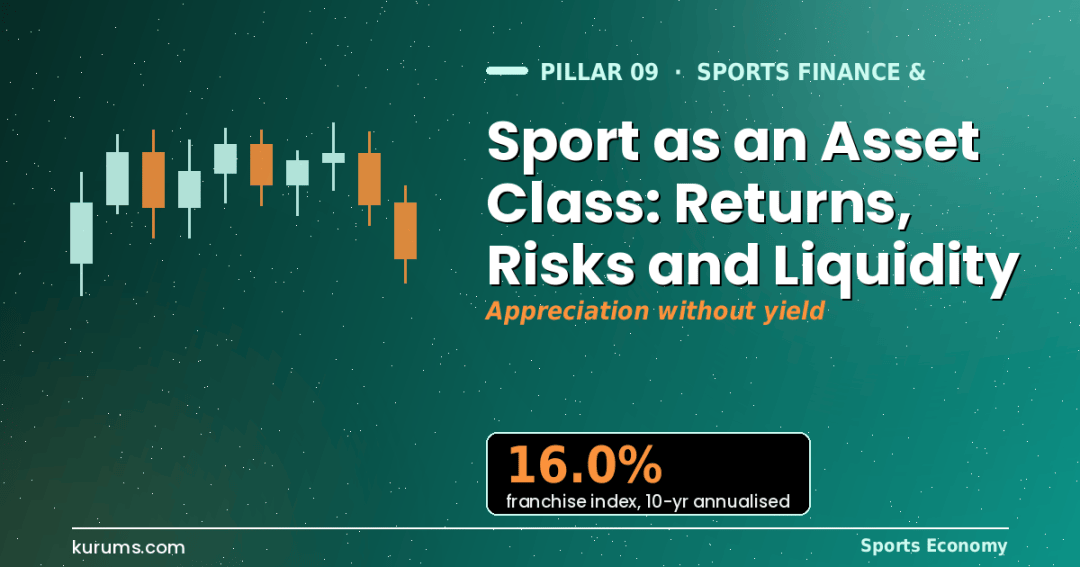
North American sports franchises have compounded at roughly 13% a year since 1961 and at 14.9% to 16% a year over the decade to 2026, according to the Ross-Arctos Sports Franchise Index, against 12.5% for the S&P 500. The four big leagues are worth about $463bn combined. The catch is that almost none of that return is cash: median franchise EBITDA is about $44m on $442m of revenue, minority stakes carry no vote and exits need league approval. Sport is an asset class in the sense that art and farmland are: real, appreciating and hard to sell.
Sport as an asset class is a phrase that would have drawn laughter from a pension trustee in 2010. In 2026 it is a line item: Oregon’s public employees’ fund committed $150m to Arctos’ third sports fund in April, Maryland and Kentucky pension schemes have invested, KKR paid $1.4bn to buy Arctos outright and the CFA Institute has published a primer on the sector. This article, part of the Sports Economy hub, asks what the returns have been, where they came from, what the risks are and how an investor can get in and out. It draws on our companion pieces on private equity in sport and why franchise valuations keep rising.
What have sports franchises returned?
The Ross-Arctos index shows 14.9% annualised appreciation for the four big North American leagues over the ten years to March 2025 and 16.0% to March 2026, versus 12.5% for the S&P 500; half the long-run gain came from revenue growth and half from rising multiples.
What does the return consist of?
Almost entirely capital appreciation. Median EBITDA margins have risen from roughly minus 1% in the mid-1990s to about 10%, but a $5bn franchise earning $44m yields under 1%.
What is the biggest risk?
Liquidity. Control sales happen a few times a year across all leagues, minority stakes can only be sold to league-approved buyers, and the secondary market for fund interests is thin.
What returns has sport delivered as an asset class?
Double-digit annual appreciation for decades. The Ross-Arctos Sports Franchise Index, built with the University of Michigan’s Ross School of Business, records about 13% compound growth in North American franchise values since 1961, 14.9% a year for the decade to March 2025 and 16.0% for the decade to March 2026.
The index is the closest thing the sector has to a benchmark. Penn Mutual Asset Management’s July 2025 note compares its 14.9% ten-year figure with 12.5% annualised for the S&P 500 over the same period, and Fortune’s July 2026 analysis reports that total returns for the four leagues have beaten the index since 2014. Alternatives Watch’s September 2025 account of an Arctos presentation adds that the combined value of the four leagues reached roughly $463bn by early 2025, up around $270bn since 2019.
The decomposition matters more than the headline. According to the same Arctos material, about half of the long-run growth came from rising revenue and half from expanding multiples. Median franchise revenue rose from about $48m in 1995 to about $442m in 2025 and median EBITDA reached roughly $44m, compounding at 12.3% a year since 1999. The other half is the price buyers pay per dollar of revenue, which went from about three times in NBA sales of 2010–12 to 16 times for the Lakers in 2025.
Individual exits confirm the pattern. Blue Owl’s Dyal HomeCourt reportedly returned 158% on its Phoenix Suns stake when the team was sold at $4bn in 2023; Arctos’ investors have seen the Golden State Warriors marked from $5.5bn at entry in 2021 to more than $11bn on Sportico’s 2025 list. The sample is small, but the direction has been consistent.
Where does the return actually come from?
From contracted media money that grows faster than inflation, from scarcity in closed leagues, from real estate around the venue and, increasingly, from new buyer classes willing to pay higher multiples. Cash yield plays almost no part.
The media contract is the foundation. The NBA’s $76bn to $77bn national deal with Amazon, Disney and NBC, a 2.7-fold increase on its predecessor, raises each team’s distribution from $103m to $143m in year one and about $281m by 2034/35, which is why Sportico’s NBA valuations rose 20% in a year to an average of $5.51bn. The CFA Institute’s 2025 primer notes that media contracts typically run seven to eleven years and season-ticket renewals commonly exceed 80%, a revenue profile closer to a toll road than a media company. Our article on the NFL and NBA media deals explains how those contracts set the price of sport.
Scarcity is the second engine. There are 124 franchises in the four major leagues, no relegation, a fixed membership and a vote of existing owners required for every sale. Expansion fees, which Sportico expects to reach around $6bn for the NBA’s next entrants, reset the floor for every incumbent. European football lacks this, which is why Forbes values Real Madrid at about 7.5 times revenue and an average NFL franchise at 13.4 times.
Real estate is the third. SoFi Stadium, the Battery around the Atlanta Braves’ ballpark, Arctos’ $288m development near Neyland Stadium and Atlético Madrid’s €800m district around the Metropolitano all try to capture the land value a stadium creates. Arctos notes that forgoing naming rights at Fenway Park costs the Red Sox roughly $30m a year.
| Route into sport | Examples | Minimum / access | Liquidity | Main drawback |
|---|---|---|---|---|
| Direct minority stake in a franchise | Limited partners in NFL, NBA, MLB ownership groups | Tens of millions; league vetting | Very low; sale only to approved buyers | No vote, no dividend, capital calls possible |
| Closed-end sports private equity fund | Arctos Fund II ($4.1bn), Harbinger Fund I ($450m), RedBird | $1m–$5m; qualified purchasers | Low; 7–12 year life; thin secondaries | Fees on NAV-based marks; back-ended distributions |
| Listed team or league company | Manchester United (MANU), MSG Sports (MSGS), Atlanta Braves Holdings (BATRA), Formula One Group (FWONA), Juventus, Galatasaray | One share | Daily | Discount to private marks; dual-class control |
Fund figures are from Dakota’s 2026 review and the Angel Investors Network’s 2026 guide.
How correlated is sport with other assets?
Private franchise values show low measured correlation with public equities because they are marked rarely and move on league-specific events; listed sports stocks trade with market sentiment. The low correlation is partly real and partly an artefact of infrequent pricing.
The case for diversification rests on how sports revenue behaves. Media contracts are fixed for seven to eleven years, ticket renewals run above 80% and league revenue sharing smooths any one team’s results, so franchise cash flows barely moved in the 2008 recession and recovered quickly from the 2020 shutdown. Sponsorship, projected at $92bn globally in 2025, is cyclical but contracted.
The counter-argument is that the marks are stale. A franchise is valued by Forbes or Sportico once a year and by a transaction once a decade, so its apparent volatility is low in the way a house’s is: you do not see the price fall because nobody is selling. The Angel Investors Network’s 2026 guide is blunt that reported fund NAVs are modelled estimates. Public proxies tell a different story: Manchester United listed at $14 in 2012, a $2.3bn valuation, and its shares have spent most of the years since near that level despite Forbes’ valuation rising to $7.2bn, while Madison Square Garden Sports faced an activist campaign in 2026 to spin out the Knicks and Rangers because the stock traded below their estimated value.
Sport is therefore a low-correlation asset in the way private real estate is: the business is stable, the marks are smooth and the true volatility shows up only when you need to sell. Assume higher correlation at exit than the numbers suggest.
What are the risks of investing in sport?
Illiquidity, lack of control, stale marks, media-rights dependence, regulatory shocks, capital calls and the possibility that the tailwinds of the past decade, low rates and institutional entry, are fully priced. Each has a recent example.
Liquidity is the first and largest. A fund investor in an NFL stake cannot sell for six years and then only to a league-approved buyer; an NBA minority holder needs the controlling owner’s consent and the league’s vetting; a closed-end fund interest trades, if at all, in a thin secondary market at a discount. Capital calls are the quieter version: league rules can require minority owners to fund losses.
Media-rights risk is the most concrete. Diamond Sports’ 2023 bankruptcy rejected local television contracts for thirteen MLB, NBA and NHL teams; PwC’s 2026 Global Sports Survey of 517 executives forecasts a slight fall in media-rights revenue in mature markets; and the next NFL negotiation after the 2029 opt-out will test whether streaming platforms keep bidding. The CFA Institute adds that player costs can outpace revenue and over-commercialisation erodes fan loyalty.
Regulatory and political risk is larger in Europe. Germany’s fans killed a €1bn league-level deal in 2024; UEFA’s squad-cost rules cap what owners can spend; and the UK’s new football regulator can block an owner. Our explainer on UEFA’s financial rules covers the regime. Finally, the tailwinds of 2015–2025, near-zero rates and the opening of leagues to funds, have both been used and are, as the Angel Investors Network puts it, at least partly priced in.
How can an investor get exposure to sport?
Through five routes: a direct minority stake, a closed-end sports fund, an evergreen vehicle, a listed team or league company, or sports credit. The first two need millions and patience; the last two are accessible but capped or discounted.
Direct stakes remain the preserve of the very wealthy. A limited-partner slice of an NBA or NFL ownership group costs tens of millions, requires league approval and comes with no vote; the attraction is the mark-up at the next control sale. Dedicated funds are the institutional route: Dakota’s 2026 review counts Arctos positions in 15 franchises, its second fund closed at $4.1bn with pension money from Oregon, Maryland and Kentucky, and Harbinger closed a $450m first fund in April 2026 targeting seven-to-ten-year exits. Minimums start at $1m.
Evergreen vehicles are the newest answer to the liquidity problem. Ares’ SME Opportunities fund, with about $870m of core assets by July 2026, accepts monthly subscriptions at net asset value and offers quarterly repurchases of up to 3% of shares, subject to approval; it is credit-heavy, which caps the upside but produces the yield equity stakes lack. Our article on club debt, bonds and stadium loans covers the credit side.
Listed equities are the only route with daily liquidity. Manchester United trades on the NYSE under MANU, with class A shares carrying a tenth of the Glazers’ class B votes; Madison Square Garden Sports (MSGS) holds the Knicks and Rangers; Atlanta Braves Holdings (BATRA) was split out of Liberty Media in 2023; the Formula One Group (FWONA) owns F1 and, since July 2025, 84% of MotoGP’s parent Dorna; and Juventus, Borussia Dortmund and Türkiye’s big four trade at home. The Green Bay Packers’ 538,967 “shareholders” are the exception: their shares, last sold at $300 in 2021/22, pay no dividend, cannot be traded and carry no equity.
Is European football a different asset class from American sport?
Yes, in every way that matters to an allocator. European clubs offer control, higher revenue and brand reach but open leagues, relegation and political veto; North American franchises offer passive minority stakes in closed, cost-controlled, revenue-sharing systems. The multiples reflect it.
Forbes’ 2026 football list values Real Madrid at $9.5bn on $1.27bn of revenue and Manchester United at $7.2bn on $865m, and Deloitte’s 2026 Money League records the top twenty clubs earning €12.4bn, up 11%. Those are large, growing businesses, but they trade at roughly five to eight times revenue against 13 to 16 times in the NBA and NFL, because a bad season removes Champions League income, UEFA caps squad costs at 70% of revenue and a fan vote or government can block an owner. Apollo’s 55% purchase of Atlético Madrid at about €2.2bn in 2025 was priced at roughly five times revenue.
The flip side is that European control is available: a fund can own 55% of Atlético, all of AC Milan or a league’s commercial arm, as CVC does in Spain and France, in a way no American league permits. For an investor who wants operating leverage, Europe offers it; for one who wants a passive, league-protected annuity, America does. Türkiye is an instructive extreme: its big four clubs are listed, giving retail investors daily liquidity, but the shares have tracked results rather than fundamentals. Our article on football club valuations and comparison of closed and open leagues cover the gap.
So is sport as an asset class real?
It is an asset class in the way private real estate, infrastructure and art are: scarce, appreciating, uncorrelated on paper, illiquid in practice and institutionally held. It is not a substitute for public equity or credit, and its future returns depend on media rights and the next buyer.
The bull case is solid. Scarcity is permanent, media contracts are long, the buyer pool keeps widening, with the NBA allowing a fund to hold eight teams and MLB raising its cap to 20%, and the sector has compounded through two recessions and a pandemic. PwC’s 2026 survey still expects franchise values to grow 7.9% a year, and the dry powder raised by Apollo, Ares, Arctos and CVC tops $10bn.
The bear case is equally solid. The 16% of the past decade was built on multiple expansion that cannot repeat indefinitely, on interest rates that have since risen, and on institutional entry that has already happened. A fund holding capped minority stakes needs a bigger fund or a billionaire to sell to, and 7.9% a year is a very different proposition from 16% for an investor paying private-equity fees. The CFA Institute describes sports returns as stable and long-term rather than high, which is probably the right framing for the next decade.
For a CFO or family office, the practical conclusion is to treat sport as a satellite allocation sized for illiquidity, to prefer vehicles with diversified holdings and a stated exit mechanism, and to remember that the reported return is a mark rather than a price. The people who made the most money in sport were owners who bought early, held for decades and sold.
Frequently Asked Questions
What is the Ross-Arctos Sports Franchise Index?
A benchmark compiled by Arctos Partners with the University of Michigan’s Ross School of Business that tracks the aggregate value of NFL, NBA, MLB and NHL franchises. It reports annualised appreciation of 14.9% for the ten years to March 2025 and 16.0% to March 2026, against 12.5% for the S&P 500 over the earlier period. It measures estimated value, not realised cash returns.
Can a retail investor buy into a sports team?
Only through listed companies: Manchester United (MANU), Madison Square Garden Sports (MSGS), Atlanta Braves Holdings (BATRA), the Formula One Group (FWONA), Juventus, Borussia Dortmund and Türkiye’s big four, among others. Sports private equity funds require $1m or more and qualified-purchaser status. Green Bay Packers shares are a fan donation, not an investment.
Do sports franchises pay dividends?
Rarely, and never reliably. Median franchise EBITDA is about $44m on $442m of revenue, according to Arctos data, under 1% of a typical $4bn to $5bn valuation, and most owners reinvest in players, stadiums and debt service. Minority investors are paid at exit through appreciation; income-seeking investors should look at sports credit vehicles or stadium bonds.
Why do listed sports stocks trade below private valuations?
Because public shareholders get no control, often a fraction of the votes, no dividend and no share of the premium a control buyer pays. Manchester United’s class A shares carry a tenth of the Glazers’ voting rights and have traded near the 2012 IPO price while Forbes’ valuation tripled; MSG Sports faced activist pressure in 2026 to spin out the Knicks and Rangers because the shares sat below the teams’ value.
Discover more from Kurums | Business Intelligence
Subscribe to get the latest posts sent to your email.