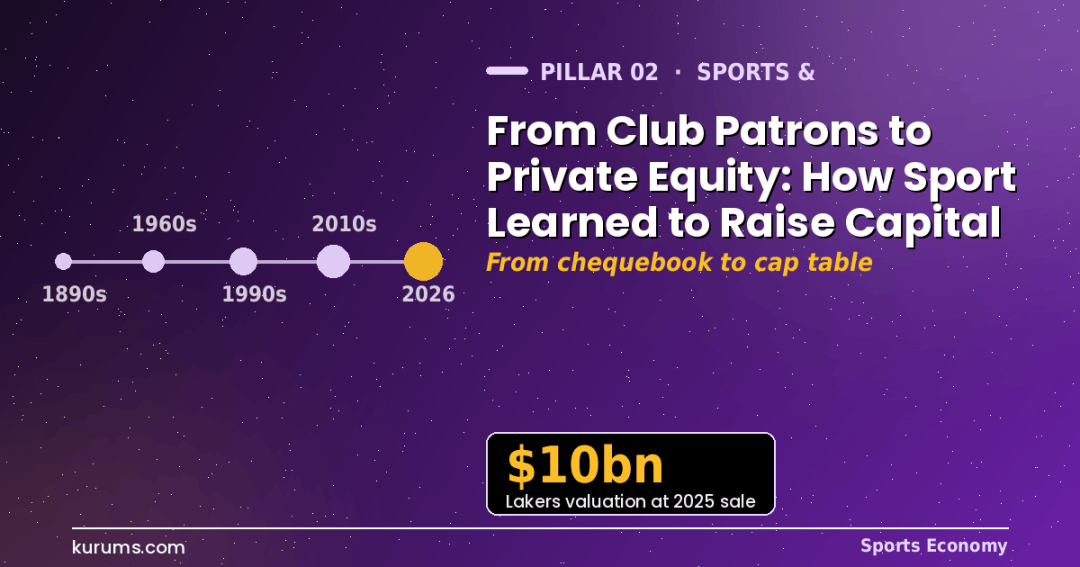
Sport financed itself for a century through members and local patrons; in twenty-five years that model has become a capital market. Deloitte’s 2026 Football Money League puts the top 20 clubs’ revenue above €12bn for the first time, with Real Madrid close to €1.2bn; the San Diego Padres changed hands in 2026 at a $3.9bn controlling-stake valuation, an MLB record, after the Boston Celtics ($6.1bn) and Los Angeles Lakers (about $10bn) reset the ceiling in 2025. Every major US league now admits private-equity funds, the NFL last, in August 2024, with a 10% cap per team. Sixth Street ($140bn-plus) bought into the Seattle Seahawks in September 2026; Arctos, the first fund approved across MLB, NBA, NHL and MLS, is now part of KKR. The patron has not disappeared, but he now sits beside a fund, a sovereign wealth vehicle and, increasingly, a listed one.
From club patrons to private equity sports capital traces how the money behind teams moved from the factory owner’s cheque book to institutional funds with limited partners, league-approved structures and exit horizons. This article is part of the Sports Economy hub and closes the Sports & Entrepreneurship pillar that began with the athlete as entrepreneur; it also sets up our detailed treatment of sportstech funding and exits.
Who owns sport now?
A mix of billionaire individuals, private-equity funds, sovereign wealth vehicles and, in a few cases, public shareholders. US franchise sales in 2025–2026 ran from $3.9bn (Padres) to about $10bn (Lakers); funds such as Arctos, Sixth Street, Ares and RedBird hold minority stakes across dozens of teams, and the NFL has admitted them since 2024.
Why did leagues open the door to funds?
Because valuations outran the number of individuals able to write a cheque. When a franchise costs $5bn, a buyer needs co-investors, and a seller of a 10% stake needs a market. Private equity supplied both, in exchange for league-set caps, no governance rights and long holding periods.
What does Europe do differently?
Open leagues with relegation, member-owned clubs in Germany and Spain, and sovereign or industrial owners rather than funds in many cases. Deloitte’s 2026 Money League shows the top 20 clubs at €12.4bn of revenue, up 11%, but the ownership structures remain more varied than in the US.
Who paid for sport before private equity?
Members, local businessmen and municipalities. English clubs were founded by churches, works teams and pubs and incorporated as limited companies in the 1890s with dividend caps; German and Spanish clubs were, and in many cases still are, member associations; American franchises were owned by brewers, newspaper publishers and the families that founded them.
The original owner was a patron, not an investor. Manchester United’s early survival depended on brewer John Henry Davies in 1902; Juventus has been controlled by the Agnelli family since 1923; Barcelona’s and Real Madrid’s socios still elect their presidents. The FA’s Rule 34, in force from the 1890s to the 1980s, capped dividends and barred director salaries, which made ownership a civic position rather than a business. The Green Bay Packers, owned by more than half a million non-dividend shareholders, are a surviving fossil of the same idea.
Sport’s first capital-markets moment came as broadcast money grew: Tottenham Hotspur listed in London in 1983 and Manchester United in 1991. But the patron model persists where it is protected by rules. Germany’s 50+1 regulation, examined in our Bundesliga playbook, requires members to hold majority voting rights. Spain’s Real Madrid, Barcelona, Athletic Club and Osasuna remain member-owned by law. In Türkiye, Galatasaray, Fenerbahçe, Beşiktaş and Trabzonspor combine member associations with subsidiaries listed on Borsa Istanbul, a hybrid that lets fans buy shares without the association ceding control, and that has left the clubs chronically indebted.
When did the billionaire replace the patron?
Between 2003 and 2010, as broadcast revenue made clubs large enough to interest global capital. Roman Abramovich’s purchase of Chelsea in 2003 for about £140m, the Glazer family’s leveraged buyout of Manchester United in 2005 for roughly £790m and Abu Dhabi’s acquisition of Manchester City in 2008 established three new owner types: the trophy buyer, the financial buyer and the state.
Abramovich’s Chelsea was the first club where the owner’s losses were effectively unlimited; he funded more than £1.5bn of spending over nineteen years and wrote off the loans when forced to sell in 2022. The Glazers were the opposite: their buyout loaded United with debt the club itself serviced, a structure that provoked two decades of protest and that leagues later cited when writing fund rules. The club’s 2012 New York listing at about $2.3bn and Sir Jim Ratcliffe’s 2024 purchase of 27.7% for roughly £1.25bn both showed that a club could be traded like any other asset.
Manchester City under Abu Dhabi, Paris Saint-Germain under Qatar from 2011 and Newcastle under Saudi Arabia’s PIF from 2021 introduced the sovereign owner, examined in our Gulf playbook; once a state would fund a club at a loss indefinitely, individuals who wanted to compete needed partners, and the partners who could write the cheques were funds. In the US the shift was generational. Franchise values rose from tens of millions in the 1980s to billions by the 2010s on the media deals described in our article on the NFL and NBA rights contracts; founding families faced estate-tax bills payable only by selling, and the pool of individuals able to pay $2bn in cash under league debt limits was small. Steve Ballmer’s $2bn purchase of the LA Clippers in 2014 looked extraordinary; by 2025 it would not have bought a mid-ranking NBA franchise.
Why did the leagues let private equity in?
Because the valuations they had created could no longer clear without institutional buyers. MLB admitted funds in 2019, the NBA formalised rules in 2021, the NHL and MLS followed, and the NFL, the last holdout, approved a list of funds in August 2024 with a cap of 10% per team and a minimum holding period.
The NBA’s 2021 framework set the template: a fund may hold up to 20% of a single team, funds in aggregate may hold up to 30% of a team, and a fund may hold stakes in multiple franchises, which had previously been forbidden. Owners gained a market for minority stakes, which had been hard to sell because they carried no control and no distributions; funds gained an asset whose values had risen for forty years without a sustained drawdown. Arctos Partners, founded in 2019, became the first platform approved to invest across MLB, NBA, NHL and MLS; its site lists representative investments from the Red Sox and Warriors to Paris Saint-Germain, and the firm is now part of KKR.
The NFL held out longest because its rules were strictest: a controlling owner had to hold at least 30% personally and corporate ownership was barred. In August 2024 the league approved Arctos, Ares Management, Sixth Street and a consortium including Blackstone, Carlyle, CVC and Dynasty Equity to buy up to 10% of any team, with the league taking a share of any profit on exit; Sixth Street, which reports more than $140bn of assets under management, announced a minority investment in the Seattle Seahawks in September 2026. The prices since confirm the logic: Dakota’s May 2026 report records the San Diego Padres control sale at a $3.9bn valuation, an MLB record, and NBA expansion to Las Vegas and Seattle for 2028–29 at expected fees of $7bn to $10bn, following the 2025 sales of the Celtics at $6.1bn and the Lakers at about $10bn. Why the numbers keep rising is examined in our article on franchise valuations.
| Era | Typical owner | What they wanted | Marker deal | Where it survives |
|---|---|---|---|---|
| 1880s–1980s: patron | Local industrialist, member association, family | Civic standing; dividends capped by rule | Agnelli family and Juventus, 1923 | German 50+1 clubs; Real Madrid, Barcelona; Green Bay Packers |
| 1983–2003: listed club | Public shareholders, founding directors | Growth capital for stadiums; liquidity for founders | Manchester United IPO, 1991 | Borsa Istanbul big four; Juventus, Ajax, Celtic; Man Utd (NYSE) |
| 2003–2015: billionaire and state | Oligarch, US family, Gulf sovereign | Trophies, soft power, leveraged returns | Chelsea 2003; Glazers 2005; Man City 2008; PSG 2011 | Most Premier League and Serie A clubs; Newcastle (PIF) |
| 2015–2024: private equity minority | Arctos, Sixth Street, RedBird, CVC, Ares | Uncorrelated appreciation; league-approved exit | CVC–LaLiga €1.99bn 2021; NFL approval Aug 2024 | All five major US leagues; Ligue 1, LaLiga, Serie A clubs |
| 2024–: institutional sport | Mega-funds, athlete-LP vehicles, KKR-owned Arctos | Scale, platform fees, continuation funds | Padres $3.9bn 2026; Harbinger $450m; CHAMP $500m | Emerging; NBA expansion at $7–10bn per team |
How does the European route differ from the American one?
Europe’s funds bought into leagues’ commercial subsidiaries rather than clubs, because open leagues with relegation make individual clubs riskier and member-ownership rules block control. CVC paid €1.99bn for 8.2% of LaLiga’s media revenue over 50 years in 2021 and €1.5bn for 13% of Ligue 1’s commercial arm in 2022; Germany’s clubs rejected the same model in 2024.
The league-level deal is a European invention born of necessity. A fund cannot buy Real Madrid, and a fund that buys a mid-table Serie A club can watch it relegated within two seasons. CVC’s answer was to buy a slice of the league’s aggregate revenue: the LaLiga Impulso deal gave the fund 8.2% of the league’s audiovisual income for 50 years in return for €1.99bn distributed to clubs as infrastructure loans, and the Ligue 1 deal gave it 13% of the league’s commercial company for €1.5bn. Deloitte’s 2026 Money League notes that Ligue 1 revenue fell partly because CVC-related income ceased: the capital was front-loaded and the cost is permanent. Germany showed the model’s limits: the DFL’s plan to sell about 8% of its media-rights company to CVC or Blackstone for roughly €1bn collapsed in February 2024 after weeks of fan protests, because the 36 clubs could not produce a two-thirds majority under 50+1, an episode covered in our article on closed and open league models.
Club-level private equity in Europe is mostly minority and mostly in the second tier of clubs by revenue. RedBird, which manages $21bn and holds stakes in Fenway Sports Group, Toulouse and the Rajasthan Royals, bought AC Milan outright in 2022 for about €1.2bn, one of the few majority acquisitions by a fund; Sixth Street took stakes in Real Madrid’s and Barcelona’s revenue streams rather than in the clubs; Ares lent to Chelsea’s 2022 buyers. Dakota’s May 2026 report lists Entrepreneur Equity Partners buying 16.4% of Benfica’s football company at an implied valuation near €250m, a €100m raise at Venezia, and Gamma Waves Partners, backed by the Agnelli, Chiellini and Benetton families, raising €55m toward a €100m target.
What do private-equity investors actually get from a sports stake?
Appreciation, scarcity and low correlation with public markets, in exchange for no cash yield, no control and an exit that depends on league approval. Franchise values across the US major leagues have risen in almost every year since the 1980s, and the asset count is fixed, which is the combination funds pay for.
The return case rests on history. Forbes’ and Sportico’s valuation series show NFL, NBA and MLB franchises compounding at low-to-mid double digits annually over two decades with far lower volatility than equities, because league revenues are contracted years ahead and the supply of teams does not change. A fund buying 10% of a franchise is buying a share of that appreciation plus the right to sell, under league rules, to the next buyer; it is not buying distributions, because most teams pay none. The investment thesis, examined in our article on sport as an asset class, is capital gain, not income.
Scarcity is the second element. There are 32 NFL teams and 30 each in the NBA, MLB and NHL, and expansions reset the market, as the NBA’s planned $7bn to $10bn fees will. Every minority stake is repriced when a new high is set. The constraints are equally real: league approval is required for entry and exit, caps limit position sizes, governance is barred, and in 2020, with stadiums closed, owners could not sell minority stakes at any price. For a limited partner the stake is a long-dated, non-yielding option on continued growth in media rights.
Where do athletes fit into the new capital structure?
As limited partners, co-investors and, increasingly, as owners of the leagues they play in. CHAMP, the L Catterton and Patricof Co vehicle, raised $500m in 2026 with more than 250 athletes committing over $50m between them; Unrivaled, the women’s basketball league founded by its players, raised $106m at a $650m valuation in August 2026 with athlete equity at its core.
The athlete as investor is the subject of the first article in this pillar; the athlete as source of institutional capital is newer. Courtside Ventures’ $100m third fund counted Shaquille O’Neal and Larry Fitzgerald among its backers; Will Ventures’ $150m second fund added dozens of athletes as limited partners; Apex Capital’s London fund closed roughly €50m in 2024. CHAMP pools athletes’ money into a single professionally run vehicle, and Mark Cuban’s Harbinger Sports Partners, which closed $450m toward a $750m target in 2026, targets the same minority-stake market as the big funds.
Athlete ownership of leagues is the structural novelty. Unrivaled, founded in 2023 by WNBA players Napheesa Collier and Breanna Stewart, gives players equity in the league itself, and its Series C in 2026 drew Bessemer, Ten Pillars Sports Fund, Carmelo Anthony, Alex Morgan and Trae Young. The Premier Lacrosse League, Athletes Unlimited and TGL, the golf league backed by Tiger Woods’ and Rory McIlroy’s TMRW Sports, use variants. The logic is the Jordan royalty applied to a league: the athletes supply the product, and ownership aligns them with its growth.
In traditional leagues active players still cannot own stakes in their own competition, but the pressure is visible. Dakota’s report notes that most professional athletes earn the majority of their lifetime income before age 30; routing some of it into the asset class they create is the obvious next step, and the funds above exist to do it.
What is the next stage of sports capital?
Larger and more institutional: continuation funds, sports credit strategies, league-level platforms and listed vehicles. Dakota’s May 2026 report lists a Domain Capital sports-credit strategy, Bruin Capital with more than $2bn raised including a $1bn strategic partnership, Pickleball Inc. taking $225m from Apollo and Dundon, and TPG buying Learfield for about $2bn in a single month.
Credit is one frontier: specialist lenders now lend against franchise equity, stadium revenues and media receivables, the market examined in our article on club debt, bonds and stadium loans. Platforms are another. Multi-club groups such as City Football Group, Red Bull and the collapsed 777 Partners applied a portfolio model to clubs; funds now apply it to leagues and properties. Bruin Capital’s purchase of about 15% of Matchroom at a valuation above £1bn and the Apollo–Dundon investment in pickleball treat the property, not the team, as the unit of investment. Our article on club valuations and multi-club ownership examines what has and has not worked.
The third is the public market in a new form. Manchester United, Juventus, Borussia Dortmund and the Turkish big four remain listed, but the newer vehicles differ: Atlanta Braves Holdings, spun out of Liberty Media in 2023, is a pure-play listed franchise, and the KKR acquisition of Arctos gives KKR shareholders indirect exposure to dozens of teams. If NBA expansion fees land near $10bn, the pool of individuals able to own a controlling stake will shrink further, and the league will face the question football faced in 1991: whether the public should own a piece.
Frequently Asked Questions
When did the NFL allow private equity to buy into teams?
In August 2024, the last of the major US leagues to do so. Owners approved Arctos, Ares Management, Sixth Street and a consortium including Blackstone, Carlyle, CVC and Dynasty Equity to buy up to 10% of any franchise, with minimum holding periods and the league taking a share of profits on exit. Sixth Street’s minority investment in the Seattle Seahawks, announced in September 2026, is among the deals that followed.
Why did CVC buy into leagues rather than clubs in Europe?
Because European clubs can be relegated and many cannot be bought. A slice of a league’s aggregate media revenue is far more stable than any club’s income. CVC paid €1.99bn for 8.2% of LaLiga’s audiovisual revenue over 50 years in 2021 and €1.5bn for 13% of Ligue 1’s commercial company in 2022. Germany’s clubs rejected a similar deal in February 2024 after fan protests, showing the limits of the model where members hold the vote.
Do private-equity stakes in teams pay dividends?
Rarely. Most franchises distribute little or nothing relative to their valuation, and league rules usually bar funds from governance. The return is capital appreciation realised on a league-approved sale to the next buyer, which is why fund holding periods are long and why continuation vehicles and credit strategies have grown. Investors should treat a minority stake as a non-yielding, illiquid position whose value depends on future media-rights growth.
How are Turkish clubs financed?
Through a hybrid: Galatasaray, Fenerbahçe, Beşiktaş and Trabzonspor are member associations that control listed sporting subsidiaries on Borsa Istanbul. Fans can buy shares, but the association retains control, which limits how much equity the listed vehicle can raise and has left the clubs reliant on bank debt and restructuring. Türkiye’s own sports economy is examined in detail in the hub’s country playbook.
Discover more from Kurums | Business Intelligence
Subscribe to get the latest posts sent to your email.