
Kurums · 10 free Procurement tools
Free Procurement Tools and Calculators
Ten tools for sourcing decisions and supplier reviews: compare vendors on more than price, see the full cost of ownership, set reorder points and report the savings you actually made.
- 10free tools
- No sign-up
- Your data stays in your browser
- Procurement department →
Compare and choose suppliers
Price, order and pay
Report spend and savings
Buying on total cost, not unit price
The lowest quote is often not the cheapest supplier. The total cost of ownership calculator adds years of running costs such as maintenance, licences and energy to the purchase price, and the vendor comparison tool scores two to four suppliers on price, lead time and quality together.
For repeat purchases, the volume price break calculator shows which price tier your order quantity falls into and the extended price, so you can see what ordering up to the next break would cost. The reorder point calculator tells you when to order so stock does not run out during the supplier's lead time.
When a supplier offers a discount for paying early, the early payment calculator shows what paying those days early costs you at your own cost of cash, so finance can set it against the discount on offer.
Frequently asked questions
Are these procurement tools free?
Yes. All ten tools are free and need no sign-up. Supplier names and prices you type stay in your browser.
How is a reorder point calculated?
Average daily use times supplier lead time in days, plus safety stock. The reorder point calculator shows the lead-time demand and the safety stock separately, so you can raise the buffer for less reliable suppliers.
Is a 2/10 net 30 discount worth taking?
Usually yes. Paying 20 days early to save 2% works out to an annual rate of roughly 37%, which is higher than most companies earn or pay on cash. The early payment calculator shows the cash cost of paying early at your own rate, so you can compare it with the discount in money terms.
How should procurement savings be reported?
Report savings against a stated baseline, such as the last price paid. The savings calculator gives the saving per unit, the annual saving at your expected volume and the percentage against the baseline, and shows a negative result as a cost increase.
Tools for other departments
Procurement guides on Kurums
Category Management in Purchasing: A Repeatable Process for Turning Spend Into Strategy
A Kurums Book Taste review of Category Management in Purchasing for procurement leaders who want sourcing decisions driven by market insight rather than by the next contract renewal date.
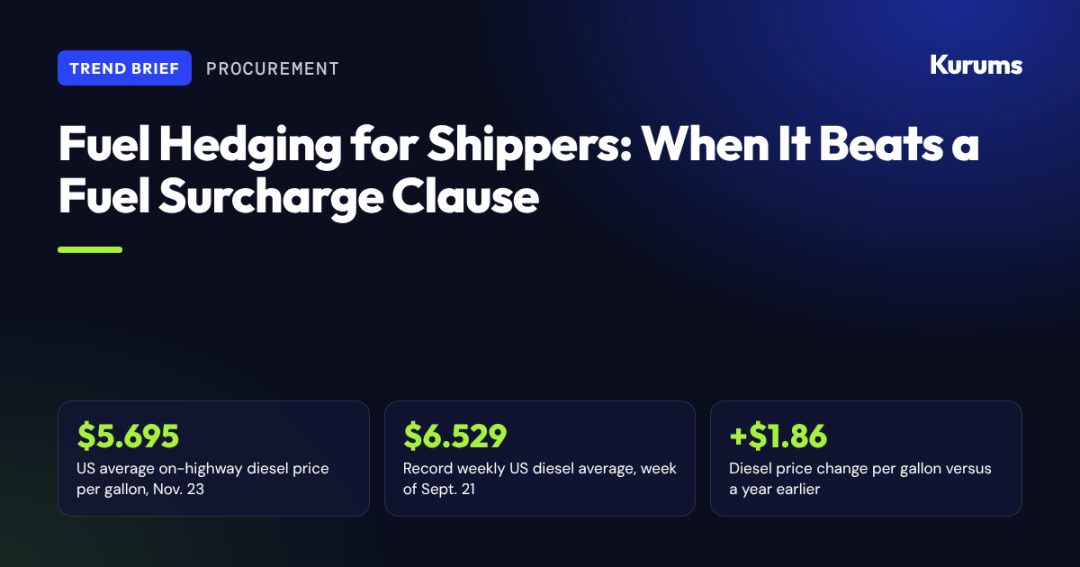
Fuel Hedging for Shippers: When It Beats a Fuel Surcharge Clause
Two beverage shippers told investors they are hedging fuel to steady transport costs. With diesel off its record but still far above last year, here is how procurement should weigh a hedge against surcharge clauses and fixed-fuel rates.
USTR Prepares Section 301 Tariffs on Excess Industrial Capacity, November 2026: Notes for Procurement
On November 25, 2026, USTR announced Section 301 determinations on excess industrial capacity for 14 economies; Mexico and Norway remain pending. New tariffs are proposed by country and are expected to honor existing trade-deal caps.
Logistics & Supply Chain Management: Competing as a Network, Not as a Single Buyer
A Kurums Book Taste review of Logistics & Supply Chain Management for procurement and operations leaders who need the supply base to deliver cost, speed and resilience at the same time.
EU-Indonesia Trade Deal Signed: 98.5% Tariff Cuts, a GSP Cliff and What Buyers Do Now
The EU and Indonesia signed their trade agreement on 21 November 2026, but no duty has changed yet. With Indonesia’s GSP preferences ending on 1 January 2027, buyers need a three-rate landed-cost plan.
LA-Long Beach Tentative Port Deal: Ratification Risk and Q1 2027 Freight Contracts
A tentative ILWU Local 26 deal averted a strike at LA-Long Beach. What is settled, what is not, and how buyers should set Q1 2027 freight terms.
FERC’s Large-Load Orders: What the Grid Operators’ November Filings Mean for Power Buyers
FERC’s large-load orders date from June, not November. This week’s grid operator filings set out the commitments, deposits and curtailment terms buyers will face.
FERC Orders Grid Operators to Reform Large-Load Rules, November 19, 2026: Notes for Procurement
On November 19, 2026, FERC issued show-cause orders requiring the six major regional grid operators to justify or reform their tariffs for connecting large loads such as data centers within 60 days. Procurement and energy teams should review power-procurement timelines and cost-allocation exposure.
LA-Long Beach Port Strike Risk and Diesel Costs: A Shipper Playbook
What is confirmed about the ILWU Local 26 strike threat at LA-Long Beach, where diesel stands, and a contingency checklist for shippers.
Results depend on the figures you enter; check them against your own records before you rely on them. Last updated: October 2026 · Kurums editorial team.