
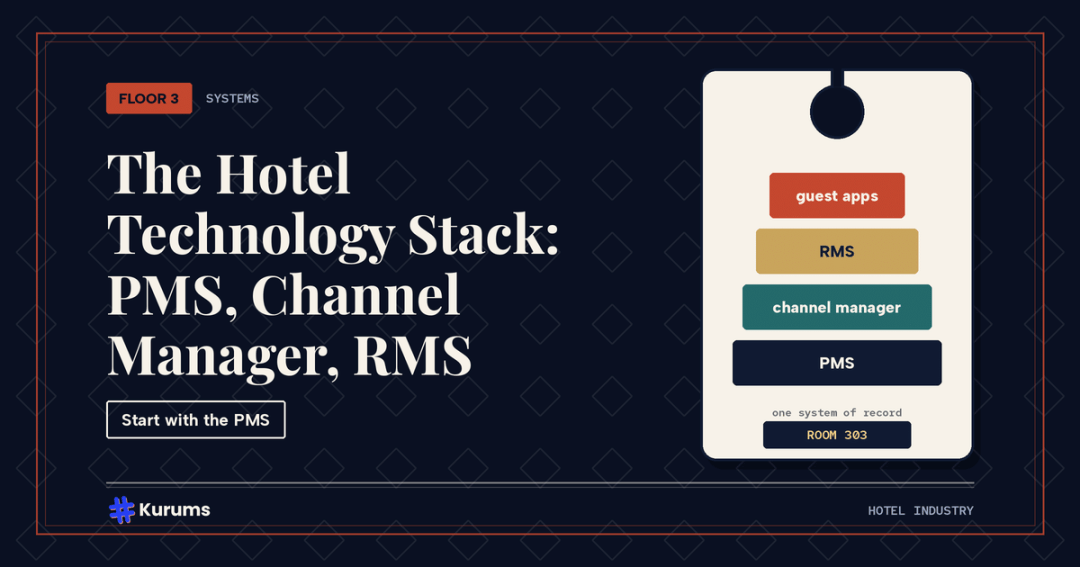
Every hotel needs a property management system (PMS) to hold reservations, rooms and guest bills. Around it sit a channel manager that sends rates and availability to booking sites, a booking engine that sells on the hotel's own website, payments, and, as hotels grow, a revenue management system (RMS), a central reservation system (CRS), point of sale, guest messaging and business intelligence. Small properties usually buy an all-in-one product. Larger hotels and groups combine specialist systems through integrations. Most vendors charge a monthly subscription that scales with rooms, and many do not publish prices. The choice that matters most is the PMS, because everything else connects to it.
Thirty years ago a hotel's technology was a server in the back office and a telephone. Today a guest may find the hotel on a metasearch site, book through an online travel agency, receive a message asking for an arrival time, check in on a phone, open the door with it and pay without visiting the desk. Each of those steps is a different piece of software. This guide maps the systems, explains how they connect and sets out how to choose them. It belongs to the Kurums hotel industry hub; the directory of vendors is in the Solutions Directory.
What is a PMS?
The property management system is the hotel's operating record: reservations, room inventory, check-in and check-out, housekeeping status, guest profiles and billing.
What does a channel manager do?
It keeps rates and availability identical across online travel agencies and other channels, and brings their bookings back into the PMS.
Do small hotels need all of this?
No. An all-in-one system covering PMS, channel manager, booking engine and payments is enough for most small properties.
How is hotel software priced?
Usually as a monthly subscription that rises with the number of rooms, sometimes with a fee per booking or a share of payment volume. Many vendors quote on request.
What systems make up a hotel technology stack?
| System | What it does | Who needs it |
|---|---|---|
| Property management system (PMS) | Reservations, room assignments, check-in and out, housekeeping, billing, reports | Every hotel |
| Channel manager | Distributes rates and availability to booking sites and returns reservations | Any hotel selling on more than one or two channels |
| Booking engine | Takes direct reservations on the hotel's website | Every hotel |
| Payments | Card processing, deposits, refunds, fraud tools | Every hotel |
| Revenue management system (RMS) | Forecasts demand and recommends or sets prices | Mid-size and larger hotels, or small ones via pricing tools |
| Central reservation system (CRS) | Holds rates and inventory for many hotels and connects to travel agents and corporate channels | Groups and chains |
| Point of sale (POS) | Restaurant, bar, spa and shop sales posted to the guest's bill | Hotels with outlets |
| Guest messaging and check-in | Pre-arrival messages, digital check-in, upsells, mobile keys | Optional, growing |
| CRM and loyalty | Guest database, email marketing, recognition | Groups, and independents focused on repeat business |
| Business intelligence and benchmarking | Dashboards and comparison with competitors | Managers and owners at any size |
The PMS sits in the middle. Each of the others either feeds it (bookings from channels and the website) or draws on it (prices, guest data, charges).
What does a property management system do?
The PMS replaced the paper reservations chart and the cash register. Its core functions are:
- Reservations. Creating, changing and cancelling bookings from every source.
- Inventory. Which rooms exist, which are sold, which are out of service.
- Front desk. Check-in, room assignment, room moves, check-out.
- Housekeeping. Room status, cleaning lists, maintenance requests.
- Guest profiles. Contact details, history, preferences.
- Billing. Room charges, taxes, extras, invoices, deposits and payments.
- Rates. Rate plans, restrictions, packages.
- Reporting. Occupancy, average daily rate, RevPAR, revenue by segment, night audit. These are the measures defined in hotel KPIs.
Older systems ran on a server at the property. Most new installations are cloud-based: the vendor hosts the software, the hotel uses it in a browser or app, and updates arrive automatically. The shift is visible at the top of the market too. Hyatt is moving more than 1,000 properties from an on-premise version of Oracle's OPERA to OPERA Cloud, according to trade press reports.
| Company | Type | Headquarters | Pricing | Known for |
|---|---|---|---|---|
| Cloudbeds | PMS and hospitality platform | San Diego, USA | By quote; plans Flex, One, Experience, Enterprise | Founded 2012; PMS, channel manager, booking engine and payments in one platform for independents |
| Mews | Cloud property management system | Amsterdam, Netherlands | By quote, by property type | Founded 2012; 15,000+ customers in 85 countries; $300m Series D in January 2026 |
| Oracle OPERA Cloud | Property management system for chains | Austin, USA | By quote | The long-standing chain standard; Hyatt is moving 1,000+ properties to OPERA Cloud |
| Apaleo | API-first property management platform | Munich, Germany | By quote | Open platform with an app store; used by serviced-apartment and hotel groups |
| Stayntouch | Cloud property management system | Bethesda, USA | By quote | Mobile-first PMS with self-service check-in |
| Guestline | Property management system | Shrewsbury, UK | By quote | Part of The Access Group; PMS, channel manager and payments |
| protel | Property management system | Dortmund, Germany | By quote | Long-established European PMS, part of Planet since 2022 |
| WebRezPro | Cloud property management system | Calgary, Canada | Per room, per month | Cloud PMS for independent hotels, inns and lodges |
Pricing models and figures as published by each company, checked on 28 November 2026. Full list: Solutions Directory.
Detailed assessments are in the Kurums reviews of Cloudbeds, Mews and Oracle OPERA Cloud, and the shortlist in best hotel property management systems.
What is a channel manager, and why does it matter?
A hotel that sells on its own website, two or three online travel agencies and a metasearch site has one stock of rooms and several shop windows. Without a channel manager, staff would update each extranet by hand, and a room sold on one site might still appear available on another.
The channel manager holds a two-way connection. It pushes rates, availability and restrictions out to every channel and pulls reservations back in, reducing availability everywhere within moments. It prevents double bookings, saves labour and lets the hotel change prices across all channels at once.
It also matters commercially. Online travel agencies commonly charge commissions in the range of 15 to 25 percent of the room price, as explained in hotel distribution. A channel manager makes it practical to open and close channels by date, steering demand to cheaper routes when the hotel is likely to fill.
| Company | Type | Headquarters | Pricing | Known for |
|---|---|---|---|---|
| SiteMinder | Channel manager and hotel commerce platform | Sydney, Australia | Published starting price that scales with property size | ASX-listed; 56,000 properties and 2.6 million rooms at 30 June 2026 |
| HotelRunner | Channel manager and booking engine | Türkiye and UK | Published plans | Sales channel management, booking engine and payments for hotels and agencies |
| D-EDGE | CRS and distribution technology | Paris, France | By quote | Accor subsidiary; central reservation system, channel manager and digital marketing |
| RateGain | Distribution and rate intelligence | Noida, India | By quote | Listed in India; channel manager, rate shopping and distribution for travel |
| eviivo | PMS and channel manager for small properties | London, UK | Published monthly plans | Booking suite for B&Bs, inns and holiday rentals |
Pricing models and figures as published by each company, checked on 28 November 2026. Full list: Solutions Directory.
SiteMinder, the largest listed specialist, reported 56,000 properties and 2.6 million rooms on its platform at 30 June 2026. See the Kurums SiteMinder review and best hotel channel managers.
What does a booking engine do?
The booking engine is the reservation function on the hotel's own website. It shows availability and prices, sells extras, takes payment or a card guarantee and writes the booking into the PMS. A direct booking avoids agency commission, although it is not free: website, marketing and payment costs still apply.
What to look for:
- A mobile-first design with few steps.
- Live rates and availability from the PMS.
- Promotions, member rates and promo codes.
- Extras and upgrades at the point of sale.
- Connection to metasearch sites such as Google's hotel listings.
- Multiple languages, currencies and payment methods.
- Tracking so that marketing spend can be measured.
Most PMS and channel manager vendors include a booking engine or offer one as an add-on.
What is a central reservation system?
A CRS is a reservations hub for more than one property. It stores rates and inventory centrally and distributes them to the brand website, call centres, the global distribution systems used by travel agents and corporate bookers, and online channels. For a chain, the CRS is where brand-wide rate plans, corporate contracts and loyalty rates live, while each hotel's PMS handles what happens on site.
An independent hotel rarely needs its own CRS. It reaches the same channels through a channel manager, a representation company or a soft brand. Franchised hotels use the brand's CRS as part of what their fees pay for, as described in hotel business models.
What does a revenue management system add?
An RMS automates the pricing work described in hotel revenue management. It takes bookings on the books, pace, history, competitor prices and events, forecasts demand by day and segment, and recommends or directly sets rates and restrictions.
There are two broad groups. Enterprise systems are built for large hotels and groups with revenue managers who work in them daily. Lighter pricing tools are designed for small properties with no specialist, adjusting prices automatically within limits the owner sets.
Rate shopping and benchmarking tools are related. They show what competitors charge on booking sites and how the hotel's performance compares with its competitive set.
| Company | Type | Headquarters | Pricing | Known for |
|---|---|---|---|---|
| IDeaS | Revenue management system | Minneapolis, USA | By quote | A SAS company; automated pricing and forecasting for hotels |
| Duetto | Revenue management system | United States | By quote | Open Pricing approach to room rates by segment and channel |
| Lighthouse | Rate intelligence and benchmarking | London, UK | By quote | Formerly OTA Insight; rate shopping, parity monitoring and market data |
| RoomPriceGenie | Pricing automation for small hotels | Switzerland | Published plans | Automated room pricing aimed at independent properties |
Pricing models and figures as published by each company, checked on 28 November 2026. Full list: Solutions Directory.
What other systems connect to the PMS?
- Payments. Many PMS vendors now embed payment processing, which simplifies reconciliation and adds a revenue stream for the vendor. Check processing rates and whether you can use another provider.
- Point of sale for restaurants, bars and spas, posting charges to the room.
- Door locks and mobile keys.
- Guest messaging, digital check-in and upselling.
- Housekeeping and maintenance apps.
- Accounting, exporting daily revenue and receivables.
- CRM and email marketing.
- Energy management and in-room controls.
- Reputation management, collecting and answering reviews.
| Company | Type | Headquarters | Pricing | Known for |
|---|---|---|---|---|
| Canary Technologies | Guest management software | San Francisco, USA | By quote | Mobile check-in, messaging, upsells and digital authorisations |
| Shiji Group | Hotel technology group | Beijing, China | By quote | PMS, POS, payments and ReviewPro guest feedback for large chains |
| Amadeus Hospitality | CRS, sales and business intelligence | Madrid, Spain | By quote | Central reservations, sales and catering, and demand data from a listed travel technology group |
| Agilysys | PMS and POS for resorts and casinos | Alpharetta, USA | By quote | Nasdaq-listed; property management, point of sale and payments |
Pricing models and figures as published by each company, checked on 28 November 2026. Full list: Solutions Directory.
Should you buy an all-in-one system or best-of-breed?
There are two philosophies.
All-in-one. One vendor supplies the PMS, channel manager, booking engine, payments and often pricing and messaging. There is one contract, one support desk and no integrations to maintain. Each module may be less capable than a specialist's.
Best-of-breed. A PMS with open interfaces connects to separately chosen specialist products. Each is strong in its field. The hotel manages several vendors, and integrations become its problem when something breaks.
| Question | All-in-one suits | Best-of-breed suits |
|---|---|---|
| Rooms | Under about 50 | Larger hotels and groups |
| Staff | No dedicated revenue or IT role | Specialists in revenue, distribution, IT |
| Complexity | Rooms only, few outlets | Restaurants, spa, events, several properties |
| Priority | Simplicity and cost | Capability and flexibility |
| Risk | Dependence on one vendor | Integration failures and finger-pointing |
Many vendors now sit between the two, offering a broad suite and a marketplace of integrations. An API-first PMS goes furthest in the second direction, providing a core and expecting the hotel to assemble the rest.
| Company | Type | Headquarters | Pricing | Known for |
|---|---|---|---|---|
| Little Hotelier | All-in-one system for small properties | Sydney, Australia | Published monthly plans | SiteMinder's product for B&Bs, guesthouses and small hotels |
| RoomRaccoon | Hotel management system for independents | Breda, Netherlands | Published plans by room count | PMS, channel manager, booking engine and pricing in one subscription |
| Hotelogix | Cloud property management system | Noida, India | Published plans | Cloud PMS for small and mid-sized hotels and groups |
| innRoad | Hotel management software | New York, USA | Published monthly plans | PMS, booking engine and channel manager for independents |
Pricing models and figures as published by each company, checked on 28 November 2026. Full list: Solutions Directory.
How do vendors charge?
- Monthly subscription per property, usually scaled by number of rooms. This is the most common model.
- Per room, per month.
- Per booking or per room night.
- Commission on direct bookings made through the booking engine, in some products.
- Payment processing margin where payments are embedded.
- Setup, training and data migration fees.
- Charges for integrations and premium support.
- Enterprise licences negotiated for chains.
Several of the best-known vendors do not publish prices and quote according to property size, type and modules. Others publish a starting price that rises with rooms. Treat any figure on a third-party site as an indication, and ask for a written quotation covering three years. The Kurums reviews note where a price comes from the vendor and where it comes from a secondary source.
How should you choose a PMS?
- Start with your property type. A 12-room guesthouse, a 150-room city hotel, a resort with five restaurants and a hostel have different needs.
- List the integrations you require and check that each exists and is certified, not merely planned.
- Test the daily tasks: make a booking, move a room, split a bill, run the night audit, close a day.
- Check channel connections for the agencies that matter in your market.
- Ask about payments: rates, payout timing, chargebacks, alternatives.
- Examine reporting and whether data can be exported freely.
- Ask who owns the data and how you get it out if you leave.
- Check support hours in your time zone and language.
- Read the contract term, notice period and price-increase clause.
- Speak to two hotels of your size that use it.
- Plan the migration: future reservations, guest profiles, rate plans, training.
What is changing in hotel technology?
Consolidation and capital. Mews raised $300 million in January 2026 at a reported valuation of $2.5 billion, one of the largest funding rounds in hotel software. Vendors are buying adjacent products to offer broader suites.
Embedded payments are becoming a main source of vendor revenue.
Partnerships between layers. SiteMinder named Mews as its first partner for distribution embedded inside a PMS.
Automation and AI in pricing, messaging and reservations handling.
Self-service. Digital check-in, kiosks and mobile keys reduce front-desk labour, which matters when labour is about 35 percent of revenue. See hotel operating costs.
Open interfaces. Hotels increasingly expect any system to connect to any other.
Frequently Asked Questions
What software does a hotel need?
At minimum a property management system, a booking engine and a way to take payments. Hotels selling through several online channels also need a channel manager.
What is the difference between a PMS and a channel manager?
The PMS runs the hotel's reservations, rooms and billing. The channel manager synchronises rates and availability with external booking sites and passes their reservations to the PMS.
What is the difference between a PMS and a CRS?
A PMS manages one property's operations. A central reservation system manages rates and inventory across many properties and distribution channels.
How much does hotel software cost?
It varies with size and modules. Most systems charge a monthly subscription scaled by rooms, and many vendors only quote on request.
Is a cloud PMS better than an on-premise one?
For most hotels, yes: no server to maintain, access from anywhere and automatic updates. Large resorts with complex needs sometimes keep on-premise systems longer.
Discover more from Kurums | Business Intelligence
Subscribe to get the latest posts sent to your email.