
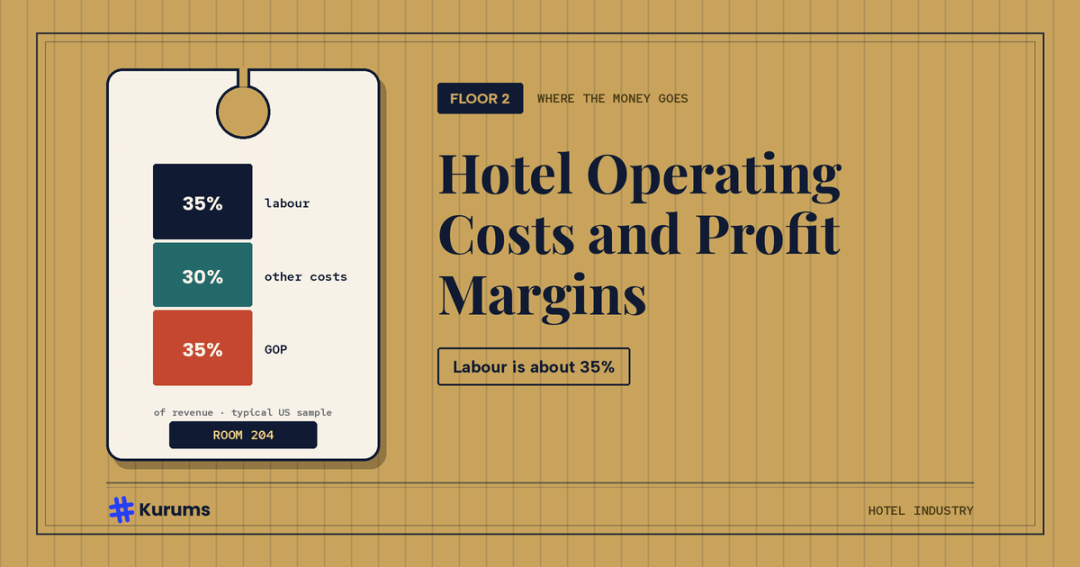
A hotel's profit-and-loss statement runs from departmental revenue through departmental costs and overheads to gross operating profit (GOP), then through management fees, property taxes, insurance and reserves to the income that reaches the owner. Labour is the largest cost at roughly 35 percent of revenue in the United States. In 2025, CBRE's sample of US hotels showed a GOP margin of 34.8 percent and an EBITDA margin of 22.8 percent, both slightly down. Profit has lagged revenue since 2019 because wages, insurance, brand fees and technology costs rose faster than room rates. Owners protect margin through pricing, mix, productivity and scrutiny of every fee charged on revenue.
In January 2026 the data showed something the US hotel industry had not seen outside a recession: revenue per available room fell for a full year. Even before that, owners had been pointing at a quieter problem. Their hotels were taking in more money than in 2019 and keeping less of it. To understand why, you have to read the hotel income statement, which follows its own conventions and vocabulary. This guide walks down the statement, puts numbers on the main lines and looks at what can be done. It continues from the guide to hotel KPIs.
What is a normal hotel profit margin?
It varies by type. CBRE's US sample showed a gross operating profit margin of 34.8 percent and an EBITDA margin of 22.8 percent in 2025.
What is the biggest hotel cost?
Labour. CoStar put it at about 35 percent of revenue in the US in 2025, up from 34 percent.
Why is profit below 2019 when revenue is higher?
Costs grew faster. HotStats reported US wages 15.3 percent above 2019 against operating revenue up 12.8 percent, with profit per room about 10 percent lower.
Which hotels have the best margins?
Hotels that earn most of their revenue from rooms, such as select-service and extended-stay, because rooms are far more profitable than food and beverage.
How is a hotel profit-and-loss statement organised?
Most hotels follow the Uniform System of Accounts for the Lodging Industry, known as USALI, so that statements can be compared across properties and companies. Its latest revision, the twelfth, was introduced for adoption from 2026. The layout has five layers.
| Layer | What it contains | Result |
|---|---|---|
| 1. Operated departments | Revenue and direct costs of rooms, food and beverage, and other departments | Departmental profit |
| 2. Undistributed operating expenses | Administration, IT, sales and marketing, maintenance, utilities | Gross operating profit (GOP) |
| 3. Management fees | Base and incentive fees to the operator | Income before non-operating items |
| 4. Non-operating items | Property taxes, insurance, rent | EBITDA |
| 5. Reserve for replacements | Money set aside for furniture, fixtures and equipment | Net operating income available for debt service and the owner |
Interest, depreciation and income tax come after this and belong to the owner's own accounts.
The dividing line that matters most is GOP. Everything above it is under the control of the hotel's management. Most of what lies below it is set by contracts, tax authorities and insurers. That is why GOP, and GOP per available room, are the standard measures of how well a hotel is run. See Decoded: GOPPAR.
What are the operated departments?
Rooms. Revenue is what guests pay for accommodation. Direct costs are front-office and housekeeping wages, linen and laundry, guest supplies, cleaning materials, reservation costs and commissions to travel agents and online travel agencies. The rooms department is highly profitable: in a typical hotel well over two thirds of room revenue remains after its direct costs.
Food and beverage. Restaurants, bars, banqueting and room service. Costs are the food and drink themselves and a great deal of labour. Departmental margins are a fraction of those in rooms, and some outlets lose money while being necessary to the hotel's positioning.
Other operated departments and miscellaneous income. Spa, parking, golf, retail, resort fees, cancellation fees and rentals.
This difference in margins explains the structure of the industry. A select-service hotel that earns nearly all its revenue from rooms keeps a higher share of each dollar than a full-service hotel with restaurants and banquet halls, which is why investors have favoured the former. The guide to hotel chain scales and service levels describes the types.
What are undistributed operating expenses?
These are overheads that serve the whole hotel and cannot be assigned to one department.
- Administrative and general: management, accounting, human resources, credit card commissions, security.
- Information and telecommunications systems: software subscriptions, hardware, connectivity.
- Sales and marketing: the sales team, advertising, loyalty programme costs and, in branded hotels, franchise and marketing fees.
- Property operation and maintenance: engineers, repairs, contracts.
- Utilities: electricity, gas, water, waste.
This layer is where much of the recent pressure sits. One 2026 analysis of STR and HotStats data argued that the gap between today's margins and those of 2019 lies largely in undistributed expenses, with franchise fees, administration and software subscriptions rising faster than revenue. CBRE's research on 2024 results likewise highlighted IT, maintenance and franchise fees among the costs that grew fastest.
How much does labour cost a hotel?
Labour runs through every department and is the largest single cost. CoStar reported that labour costs in US hotels rose on average from 34 percent of revenue in 2024 to 35 percent in 2025.
Several findings from 2025 show the pressure:
- A profit report on HotelData.com, drawing on about 5,000 US hotels, found labour cost per occupied room up 12.8 percent for the year and 21.1 percent in the fourth quarter, when demand softened and staffing did not fall with it.
- HotStats reported wages 15.3 percent above 2019 levels while operating revenue was up 12.8 percent.
- HotStats also found that the labour cost gap between unionised and non-union hotels had widened to 9.5 percentage points in 2025.
Labour behaves as a semi-fixed cost. A hotel needs a minimum team at the front desk, in maintenance and in management whatever the occupancy, and housekeeping hours rise with rooms sold. When occupancy drops, cost per occupied room climbs unless schedules are adjusted quickly.
What comes after gross operating profit?
Management fees. A base fee, typically 2 to 4 percent of total revenue according to HVS, and an incentive fee tied to profit. See hotel business models.
Property taxes. Set by local authorities on the assessed value of the real estate.
Insurance. Property and liability cover. CBRE reported that insurance premiums for its US sample grew 17.4 percent in 2024, continuing a run of double-digit increases, with coastal and storm-exposed hotels hit hardest.
Rent, if the land or building is leased.
Reserve for replacements. Carpets, mattresses, televisions and kitchen equipment wear out. Contracts and lenders normally require a few percent of revenue, commonly around 4 percent, to be set aside each year. It is a real cost even though it is not an expense in the accounting sense.
What remains is the income from which the owner pays the lender. A hotel with a 35 percent GOP margin might deliver something in the low twenties as EBITDA and less after the reserve.
What are typical hotel profit margins?
Published figures differ because each provider collects statements from a different set of hotels. Three sources for the United States in 2025:
| Source | Measure | 2025 | Change |
|---|---|---|---|
| CBRE Trends sample | GOP margin | 34.8% | Down from 35.1% in 2024 |
| CBRE Trends sample | EBITDA margin | 22.8% | Down from 23.3% |
| CoStar (first ten months) | GOP margin | 34.8% | Down from 36% |
| HotelData.com report (about 5,000 hotels) | GOP margin, full year | 38.3% | Up 1.1 points; Q4 fell to 36.0% |
Within these averages, results diverged. CBRE found that only resort and all-suite hotels grew profit in 2025 among its six property categories, and only luxury and upper upscale hotels among chain scales. Total GOP dollars in its sample rose 1.5 percent and EBITDA 0.3 percent, on rooms revenue growth of 1.1 percent.
Globally, HotStats data for the first eight months of 2025 showed gross operating profit per available room of about $104 in the Middle East, $93 in the Americas, $84 in Europe and $53 in Asia-Pacific.
Why is profit lagging revenue?
Four forces are at work.
- Wages. Pay rose sharply after 2021 to bring staff back, and has stayed high.
- Rate growth below inflation. US average daily rate rose 0.9 percent in 2025, and forecasters expect rate growth to remain below inflation.
- Costs charged on revenue. Brand fees, loyalty programme charges, management base fees and online travel agency commissions all take a percentage of sales regardless of profit.
- Fixed charges. Insurance and property taxes have risen independently of trading.
The result, in HotStats' words as summarised by commentators, is that a hotel can post a strong RevPAR and a bad year. US gross operating profit per available room in 2025 was still about 10 percent below 2019. HotStats also described the United States as the only major region where GOP margins contracted in 2024.
What is flow-through, and why do owners watch it?
Flow-through is the share of additional revenue that becomes additional profit. Because many hotel costs are fixed, revenue growth from higher rates should convert strongly, and revenue growth from extra occupancy less so, since each occupied room adds cleaning and supplies.
The measure works in reverse as well. When revenue falls, a well-run hotel limits how much of the decline reaches profit by cutting variable costs quickly, an ability sometimes called flex. HotStats reported a striking split in the United States in 2025: non-union hotels converted about 25 percent of revenue change into profit, while unionised hotels showed a slightly negative conversion.
How can a hotel protect its margin?
On the revenue side:
- Price for profit. Hold rate where demand allows and accept lower occupancy when the alternative is unprofitable business. See hotel revenue management.
- Improve the mix. Shift bookings to lower-cost channels and reduce commission. See hotel distribution.
- Grow profitable ancillaries such as parking, upgrades and late check-out, and review loss-making outlets.
On the cost side:
- Schedule labour to the forecast by day and by hour, and cross-train staff.
- Review housekeeping models, including optional daily cleaning where guests accept it.
- Audit energy use and invest where payback is short.
- Renegotiate contracts for laundry, waste, maintenance and technology, and remove unused software.
- Check every brand and management charge against the agreement.
- Appeal property tax assessments where values have fallen.
- Tender insurance and invest in risk reduction.
And in governance:
- Benchmark profit, not just revenue, against comparable hotels.
- Hold a monthly owner's review of the statement down to net operating income.
- Align incentives so that the general manager and the operator are rewarded on profit.
What does a simple example look like?
A 120-room select-service hotel with annual revenue of $5.3 million, almost all from rooms.
| Line | Amount | Share of revenue |
|---|---|---|
| Total revenue | $5,300,000 | 100% |
| Rooms and other departmental expenses | $1,590,000 | 30% |
| Undistributed operating expenses | $1,802,000 | 34% |
| Gross operating profit | $1,908,000 | 36% |
| Management fee (3%) | $159,000 | 3% |
| Property taxes and insurance | $371,000 | 7% |
| EBITDA | $1,378,000 | 26% |
| Reserve for replacements (4%) | $212,000 | 4% |
| Net operating income | $1,166,000 | 22% |
The example is illustrative and broadly in line with the averages above. It shows how a 36 percent operating margin becomes 22 percent before any interest is paid. The hotel RevPAR calculator reproduces the top of this statement and adds break-even occupancy, and the guide to hotel investment and valuation shows how the bottom line turns into a property value.
Frequently Asked Questions
What is a good GOP margin for a hotel?
It depends on the type of hotel. CBRE's 2025 US sample averaged 34.8 percent. Select-service hotels often run higher and full-service hotels with large food and beverage operations lower.
What is the largest expense in a hotel?
Labour, at around 35 percent of revenue in US hotels in 2025 according to CoStar.
What is USALI?
The Uniform System of Accounts for the Lodging Industry, the standard format for hotel financial statements that allows comparison between properties.
What is the difference between GOP and EBITDA in hotels?
GOP is profit after operating expenses that management controls. EBITDA is what remains after management fees, property taxes, insurance and rent are also deducted.
Why are hotel profits below 2019 levels?
Wages, insurance, fees and technology costs have risen faster than room rates. HotStats put US profit per available room in 2025 about 10 percent below 2019.
Discover more from Kurums | Business Intelligence
Subscribe to get the latest posts sent to your email.