
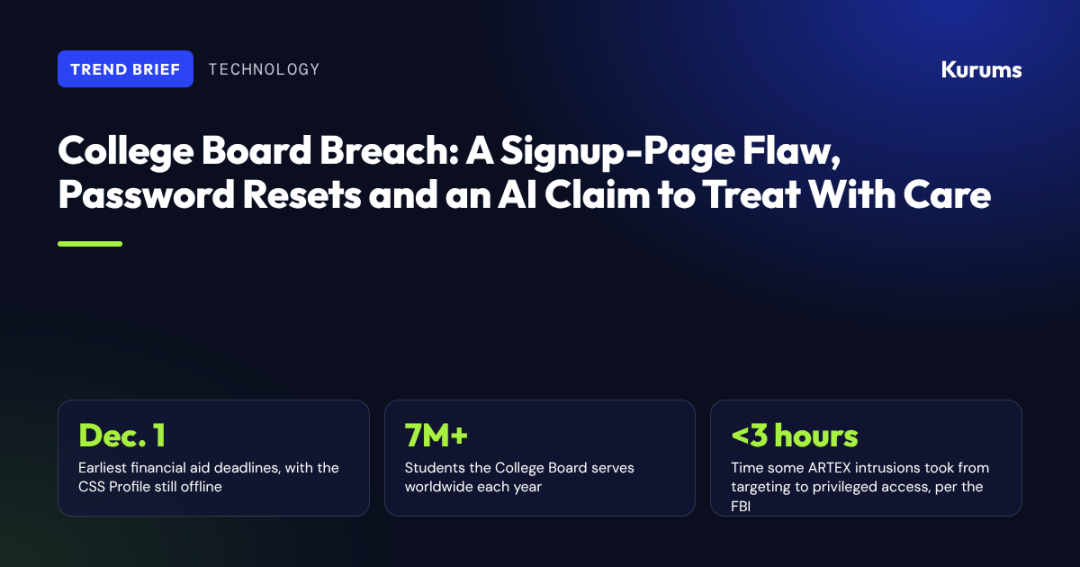
The SAT administrator blames AI tools for a breach that forced its financial aid form offline days before deadlines. The lessons apply to anyone running customer accounts.
The College Board says attackers reached the systems used to create accounts and submit CSS Profile financial aid forms, exposed names and emails for a small subset of users and triggered password resets. It has paused new registrations and the CSS Profile, with aid deadlines from December 1. The organisation's preliminary view is that AI tools, reportedly the ARTEX framework, found a flaw in a professional signup page. That is unverified. A linked vendor breach is under investigation. Leaders should audit every signup and reset path, monitor reset spikes and plan for peak-season shutdowns.
What is confirmed so far
The College Board, the New York non-profit that runs the SAT and Advanced Placement exams, said on Friday November 27 that it had identified “unauthorized activity affecting certain user accounts and College Board products”. Its College Board security update says the activity involved “the systems students and professionals use to create new College Board accounts and to submit CSS Profile applications for financial aid”.
The same notice says the access let the attackers “access basic account information for a subset of users and to initiate password resets in some cases”. New accounts cannot be created and the CSS Profile, the form many colleges use to award their own financial aid, is “temporarily unavailable”. Existing accounts work “with reduced functionality”. The organisation says it has “no evidence of improper access to our repository of test scores and content”.
The first public signal came from users, not the organisation. BleepingComputer reports that students began receiving password-change emails on Thanksgiving, Thursday November 26, showing a device in North Bergen, New Jersey. Some could not log in or complete a manual reset, and a parent told the outlet that customer support was closed for the holiday.
Spokesperson Massie Ritsch said early findings point to a “small subset” of the organisation’s millions of accounts, with names and email addresses exposed, according to a wire report carried by The Advocate. No number of affected accounts has been published. CBS News puts the organisation’s reach at more than 7 million students a year.
The detail that matters: how they got in, and what “AI” means here
The headline phrase “unauthorized password changes” suggests credential stuffing, where attackers replay passwords stolen elsewhere. That is not what the College Board describes. It told BleepingComputer that the attackers “used AI-powered tools to discover a vulnerability in the signup page for professional accounts”, then exploited it. The password resets were a consequence of that access, not the way in.
The AI claim comes from the College Board alone and is labelled preliminary. Its notice refers to “sophisticated AI tools that have recently been leveraged to gain access to the systems of other major institutions worldwide”. Ritsch went further in the wire report, saying preliminary findings suggest the tool was ARTEX. The Washington Examiner likewise attributes the belief to the organisation. No outside investigator has confirmed it, and no group has claimed the attack.
ARTEX is an open-source penetration testing framework that connects large language models to an attack workflow. The FBI issued a flash alert on it on November 13, saying it can “automate multiple phases of cyber intrusions at machine speed, from reconnaissance through data exfiltration”, according to The Record. BleepingComputer reports the FBI’s view that the tool is particularly effective against “overlooked systems, including partner portals, employee applications, legacy services, and third-party integrations”. A signup page for professional accounts fits that description.
| Question | Status on November 29 | Who says so |
|---|---|---|
| Entry point | Vulnerability in the professional-account signup page | College Board, to BleepingComputer |
| Data exposed | Names and email addresses for a “small subset”; no count given | College Board spokesperson |
| Financial aid data | Unknown; a linked breach at a vendor storing submitted aid data is under investigation | College Board, to BleepingComputer |
| AI involvement | Preliminary assessment; tool named as ARTEX; not independently verified | College Board only |
| Services | New registrations and CSS Profile offline; no restoration date | College Board notice |
The vendor line deserves the most attention. The College Board told BleepingComputer that a third-party supplier holding submitted financial aid information “suffered a separate security breach at the same time”, believed to be linked. Those submissions can include Social Security numbers, household income and tax documents. Whether any were taken has not been established.
Why it matters for technology leaders
Every organisation with customer logins runs the same three components that failed or were strained here: a registration flow, a password-reset flow and a support desk. Four points travel well beyond education.
The side door was the weak one. The consumer login was not the reported entry point. A lower-traffic signup route for professionals was. Partner, staff, reseller and legacy registration paths often sit outside the main identity platform’s testing and bot controls.
Reset is a privileged action. If a back-end weakness lets someone trigger or complete resets, the notification email becomes the only control left. Here it worked as an alarm, but customers raised it on a public holiday.
Timing multiplied the damage. Some aid deadlines fall as early as December 1 and an SAT sitting follows on December 5, BleepingComputer notes. Containing the breach meant switching off a service at its seasonal peak.
Speed has changed. The FBI says some ARTEX intrusions went “from initial targeting to privileged access in under three hours”. A weekly review of authentication logs does not match that tempo.
Search interest: muted so far
Google Trends data for the United States over the past 90 days shows the breach has not yet driven a surge in searches. “College board” peaked at 100 on November 6; the fastest-rising related queries over the period concern PSAT scores, not security. Its average for the last seven days was 14.0, against 37.7 for the earlier part of the period, reflecting the Thanksgiving lull. The latest reading, a partial day on November 29, is 21, up from 9 on November 27. “Css profile” peaked at 12 on October 31 and reads 6 now, double the previous day. Rising related queries include “college board idoc” (+350%) and “college board css profile” (+200%). The index measures relative attention on a 0 to 100 scale, not the number of searches.
Search interest: college board vs css profile
Google Trends, United States, Aug 29, 2026 to Nov 29, 2026. Daily index, 0–100, relative to the highest point among the terms compared; it shows relative attention, not search volume.
How to respond, by role
Chief information security officer
List every route by which an account can be created or recovered, including partner and staff portals, mobile APIs and legacy pages. Test each one as an attacker would, and apply the same rate limits and bot detection to all. Alert on bursts of resets, especially many from one location or network. Load the FBI’s indicators of compromise into monitoring.
Chief information officer
Map peak-season dependencies. Decide in advance which functions can be switched off in isolation, and what the manual fallback is for customers facing a deadline. Check that incident, support and communications teams are staffed on holidays, when attackers know cover is thin.
Head of identity or product engineering
Treat reset and email-change as high-risk transactions. Require step-up verification, invalidate sessions on reset, notify the old and new contact details, and hold sensitive actions for a cooling-off period after any credential change. Keep uploaded documents behind a second check.
Communications and legal
The College Board published a dated notice the day after the first user reports and said what it did not know. It also announced forced resets in advance, which helps users tell real emails from phishing. Prepare the same templates now, and tell customers what you will never ask for.
Risks and open questions
- Scale. The College Board has not said how many accounts were affected, and “small subset” of millions is not a number.
- Financial data. Whether CSS Profile or uploaded tax documents were accessed, at the College Board or its vendor, is unresolved.
- Attribution. The ARTEX link is a preliminary finding from the victim. It may change, and “AI did it” does not explain why the signup page was exploitable.
- Restoration. There is no date for bringing registration or the CSS Profile back, and no confirmed deadline extensions.
- Follow-on phishing. Exposed names and emails, plus announced password resets, give fraudsters a convincing pretext.
What to do next
- Inventory every account creation and recovery route, including partner, staff and legacy portals, and put each in scope for penetration testing this quarter.
- Apply the same rate limiting, bot detection and logging to secondary signup pages as to the main customer login.
- Create an alert for abnormal volumes of password resets or resets clustered on one location, and route it to an on-call responder.
- Require step-up verification and session invalidation for password and email changes, with a hold on sensitive actions afterwards.
- Ask vendors that store customer documents how they would detect and report a linked intrusion, and confirm contract notification terms.
- Rehearse taking one customer-facing service offline at peak, including holiday staffing, a manual fallback and pre-approved customer messages.
- Load the FBI's ARTEX indicators and published detection rules into your monitoring, and review internet-facing applications against its mitigation list.
Frequently asked questions
Was this a credential stuffing attack?
Not according to the College Board. It told BleepingComputer that attackers used AI-powered tools to find and exploit a vulnerability in the signup page for professional accounts. That access let them view basic account information and start password resets for some users. No reporting so far describes stolen passwords being replayed against the login page.
How strong is the evidence that AI was used?
It rests on the College Board's own preliminary assessment. A spokesperson said early findings suggest the open-source ARTEX framework, which the FBI warned about on November 13. No independent investigator has confirmed this, no group has claimed responsibility, and the organisation says its investigation is continuing. Treat it as a working hypothesis.
Was financial aid or tax data stolen?
That has not been established. The College Board says basic account information such as names and email addresses was exposed. It also told BleepingComputer that a vendor storing submitted financial aid information suffered a separate, apparently linked breach, and that an investigation is under way to determine what was accessed there.
What should organisations with customer accounts do first?
Start with an inventory of every signup, login and recovery path, including low-traffic partner or staff portals. Check each has rate limits, bot controls and logging. Then add monitoring for unusual bursts of password resets, and confirm someone is on call to act on those alerts during holidays and peak periods.
- College Board: Security Update (2026-11-27)
- BleepingComputer: College Board confirms data breach after unauthorized password changes (2026-11-28)
- CBS News: College Board financial aid profiles, student registration hit by cyberattack during college application season, company says (2026-11-28)
- The Advocate: Cyberattack on US College Board exposed user data (2026-11-29)
- KTVU FOX 2: College Board cyberattack exposes user data, disrupts financial aid service (2026-11-28)
- Washington Examiner: College Board investigates AI cyberattack gaining access to student information (2026-11-28)
- BleepingComputer: FBI warns ARTEX AI hacking tool is powering global cyberattacks (2026-11-15)
- The Record: FBI flash alert says Artex tool automating cyberattacks at ‘machine speed’ (2026-11-13)
Search-interest figures are from Google Trends (United States, 90 days to November 29, 2026). This article is analysis for operators, not legal, tax or investment advice. Last updated November 29, 2026.
Discover more from Kurums | Business Intelligence
Subscribe to get the latest posts sent to your email.