
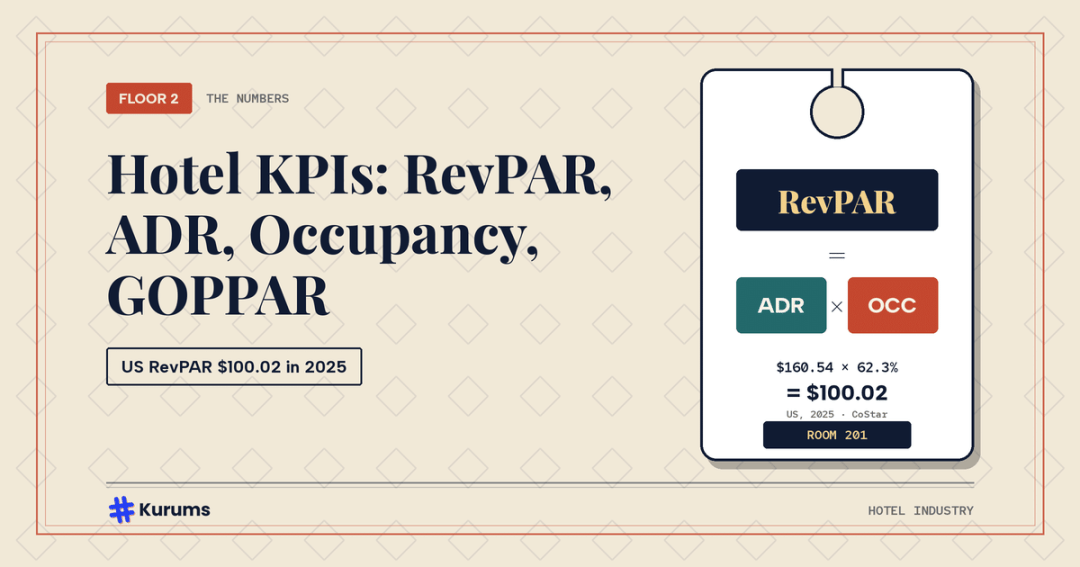
Occupancy tells you how full the hotel is, average daily rate (ADR) tells you what guests paid, and revenue per available room (RevPAR) combines the two. RevPAR equals occupancy multiplied by ADR. It measures room sales, not profit, so owners add total revenue per available room (TRevPAR) and gross operating profit per available room (GOPPAR). Numbers mean little alone: compare them with your own history, your budget and a competitive set. In the United States in 2025, occupancy was 62.3 percent, ADR $160.54 and RevPAR $100.02, according to CoStar.
Hotel people speak in abbreviations. A general manager will say the hotel "ran 78 at 142 for a RevPAR of 111" and expect to be understood. The shorthand exists because a hotel's sales really can be summarised in three figures, and because the whole industry reports them in the same way, which makes comparison possible. The trouble starts when the sales figures are mistaken for a measure of success. This guide defines the main indicators, shows how they fit together with one example, explains benchmarking and ends with the mistakes to avoid. The free hotel RevPAR calculator does the arithmetic for you.
What is RevPAR?
Room revenue divided by rooms available. It equals occupancy multiplied by average daily rate.
What is a good occupancy rate?
It depends on the market and season. The US average in 2025 was 62.3 percent, while New York City ran at 84.1 percent.
Why is RevPAR not enough?
It ignores other revenue and all costs. Two hotels with the same RevPAR can have very different profits.
What is GOPPAR?
Gross operating profit divided by rooms available. It shows how much operating profit each room generates.
What are the three core hotel KPIs?
Occupancy is the percentage of available rooms that were sold.
Occupancy = rooms sold ÷ rooms available
Average daily rate (ADR) is the average price paid per sold room, excluding taxes.
ADR = room revenue ÷ rooms sold
Revenue per available room (RevPAR) is room revenue spread over every room the hotel could have sold.
RevPAR = room revenue ÷ rooms available = occupancy × ADR
"Rooms available" means rooms multiplied by days in the period, less rooms taken out of service for a long time. A 100-room hotel has 3,000 room nights available in a 30-day month. Complimentary rooms and house-use rooms are normally counted as available and not as sold, though companies differ, which is one reason to check definitions before comparing.
The national figures for the United States in 2025, published by CoStar, show the relationship: occupancy of 62.3 percent multiplied by an ADR of $160.54 gives RevPAR of $100.02.
| KPI | Formula | What it tells you | What it hides |
|---|---|---|---|
| Occupancy | Rooms sold ÷ rooms available | How much of your capacity you used | At what price |
| ADR | Room revenue ÷ rooms sold | What the average guest paid | How many rooms stood empty |
| RevPAR | Room revenue ÷ rooms available | Room sales performance in one number | Other revenue and all costs |
| TRevPAR | Total revenue ÷ rooms available | Sales from every department | Costs |
| GOPPAR | Gross operating profit ÷ rooms available | Operating profit per room | Fixed charges, debt, capital spending |
How do the three numbers work together?
RevPAR can rise because the hotel is fuller, because it charges more, or both. The route matters.
Consider a 100-room hotel on one night:
- Option A: 90 rooms at $100. Occupancy 90 percent, ADR $100, RevPAR $90.
- Option B: 60 rooms at $150. Occupancy 60 percent, ADR $150, RevPAR $90.
Both produce $9,000 of room revenue. Option B is usually more profitable, because 30 fewer rooms have to be cleaned, supplied and serviced, and commissions on rate-led bookings may be lower. Option A fills the restaurant and bar and may build a base of guests who return. Neither is right in every case, which is why revenue managers look at profit per room and not at RevPAR alone. The guide to hotel revenue management explains how the trade-off is managed.
What is a worked example for a month?
A 120-room hotel in a 30-day month.
| Item | Figure | How it is calculated |
|---|---|---|
| Rooms available | 3,600 | 120 rooms × 30 days |
| Rooms sold | 2,520 | From the property management system |
| Room revenue | $352,800 | Net of taxes |
| Other revenue | $88,200 | Food, beverage, parking and other |
| Total revenue | $441,000 | Rooms plus other |
| Operating expenses | $282,240 | Departmental and undistributed costs |
| Gross operating profit | $158,760 | Total revenue minus operating expenses |
| Occupancy | 70% | 2,520 ÷ 3,600 |
| ADR | $140.00 | $352,800 ÷ 2,520 |
| RevPAR | $98.00 | $352,800 ÷ 3,600 |
| TRevPAR | $122.50 | $441,000 ÷ 3,600 |
| GOPPAR | $44.10 | $158,760 ÷ 3,600 |
| GOP margin | 36% | $158,760 ÷ $441,000 |
The figures are illustrative. The margin was chosen to sit close to published US averages, discussed in the benchmark section below.
Which revenue KPIs go beyond rooms?
TRevPAR, total revenue per available room, includes food and beverage, meetings, spa, parking and other income. It matters most in resorts and full-service hotels, where a large share of spending happens outside the room.
RevPOR, revenue per occupied room, shows how much each staying guest spends in total and is useful for judging upselling.
RevPAM, revenue per available square metre, and related measures are used for meeting space.
NRevPAR, net RevPAR, deducts distribution costs such as commissions and transaction fees from room revenue before dividing by rooms available. It answers the question a plain RevPAR cannot: what did we keep after paying to acquire the booking? With commissions from online travel agencies typically between 15 and 25 percent, the gap between RevPAR and net RevPAR is one of the largest controllable items in the business. See hotel distribution.
Which profit KPIs should owners watch?
Gross operating profit (GOP) is total revenue minus departmental expenses (the direct costs of rooms, food and beverage and other departments) and undistributed operating expenses (administration, sales and marketing, maintenance, utilities, technology). It is the profit the hotel's management controls. Management fees, property taxes, insurance, rent and the reserve for replacements come after it.
GOPPAR is GOP divided by rooms available. It is the profit counterpart of RevPAR.
GOP margin is GOP as a percentage of total revenue.
Flow-through, or profit conversion, is the share of each additional dollar of revenue that reaches GOP. If revenue rises by $100,000 and GOP by $55,000, flow-through is 55 percent. Strong flow-through means growth came from rate. Weak flow-through means costs rose with revenue.
CPOR, cost per occupied room, tracks what it costs to service one sold room, in total or for labour alone. A report on HotelData.com covering about 5,000 US hotels found that labour cost per occupied room rose 12.8 percent in 2025.
EBITDA and net operating income (NOI) are what remain after fixed charges, and are the basis for valuing the property. See hotel investment and valuation.
These definitions follow the Uniform System of Accounts for the Lodging Industry, the standard chart of accounts that makes hotel statements comparable. The guide to hotel operating costs and profit margins walks through the statement line by line.
How do hotels benchmark against competitors?
Raw numbers mislead. A RevPAR of $98 is excellent in a market that averages $80 and poor in one that averages $130. Hotels therefore compare themselves with a competitive set, usually five or more nearby hotels of similar type and price, using anonymised data pooled by a benchmarking service. STR, part of CoStar, is the best-known provider.
The comparison is expressed as three indexes, where 100 means the hotel earned exactly its fair share:
- Occupancy index (MPI) = hotel occupancy ÷ competitive set occupancy × 100
- ADR index (ARI) = hotel ADR ÷ competitive set ADR × 100
- RevPAR index (RGI) = hotel RevPAR ÷ competitive set RevPAR × 100
A hotel with an occupancy index of 108 and an ADR index of 92 is filling rooms by underpricing. One with 90 and 112 may be pricing itself out of business on quiet nights. A RevPAR index consistently above 100 is the usual test in management contracts for whether an operator is performing.
Profit benchmarking works the same way with pooled profit-and-loss data from providers such as HotStats and CBRE.
What do recent benchmarks look like?
United States, full year 2025, from CoStar:
| Market | Occupancy | ADR | RevPAR |
|---|---|---|---|
| United States | 62.3% | $160.54 | $100.02 |
| New York City (highest of the top 25 markets) | 84.1% | $333.71 | $280.71 |
| San Francisco | n/a | $225.82 | $155.84 (+11.8%) |
| Las Vegas | n/a | $199.79 | $149.13 (−10.9%) |
It was the first year since 2020 in which US occupancy and RevPAR both fell. Luxury hotels were the exception, with RevPAR up 5.7 percent. For 2026, STR and Tourism Economics forecast occupancy of 62.1 percent, ADR growth of 1.0 percent and RevPAR growth of 0.6 percent.
On profit, sources differ because their samples differ. CBRE's sample of US hotels showed a GOP margin of 34.8 percent in 2025, down from 35.1 percent, and an EBITDA margin of 22.8 percent. The HotelData.com report put the full-year GOP margin at 38.3 percent, falling to 36.0 percent in the fourth quarter. HotStats reported gross operating profit per available room for the first eight months of 2025 at about $104 in the Middle East, $93 in the Americas, $84 in Europe and $53 in Asia-Pacific, and found that US GOPPAR for 2025 was still roughly 10 percent below 2019.
Use such figures as orientation only. A resort, an airport hotel and a city boutique have little in common, and the only fair comparison is with similar hotels in the same market.
What mistakes do people make with hotel KPIs?
- Treating RevPAR as profit. It is a sales measure.
- Comparing different definitions. Gross or net of commission, with or without resort fees, with or without closed rooms.
- Ignoring the mix. A rise in ADR caused by losing low-rate group business is not a price increase.
- Looking at one period. Seasonality and events distort single months. Use rolling twelve-month and same-period comparisons.
- Forgetting the calendar. A month with five weekends is not comparable with one that has four.
- Benchmarking against the wrong set.
- Rewarding managers on RevPAR alone. It encourages buying revenue with commission and discounts.
Which KPIs belong on an owner's monthly dashboard?
One page is enough:
- Occupancy, ADR and RevPAR against budget and last year.
- RevPAR index against the competitive set.
- TRevPAR and revenue by department.
- Share of room nights by channel: direct, online travel agency, corporate, group.
- Net RevPAR after distribution costs.
- Labour cost as a percentage of revenue and per occupied room.
- GOP, GOP margin, GOPPAR and flow-through.
- Guest review score.
- Forecast for the next three months, with rooms already on the books.
For definitions in plain English, see the Decoded entries on RevPAR, ADR and GOPPAR. An earlier Kurums article looks at ways to optimise RevPAR.
Frequently Asked Questions
How do you calculate RevPAR?
Divide room revenue by the number of rooms available in the period, or multiply occupancy by average daily rate. Both give the same result.
What is the difference between ADR and RevPAR?
ADR is the average price of rooms that were sold. RevPAR spreads room revenue over all available rooms, so it also reflects empty rooms.
What is a good RevPAR?
One that beats your competitive set and your own previous year. The US average in 2025 was $100.02, but markets range from far below to almost three times that.
What is GOPPAR?
Gross operating profit per available room: total revenue minus operating expenses, divided by rooms available.
What is a RevPAR index?
The hotel's RevPAR divided by its competitive set's RevPAR, multiplied by 100. Above 100 means the hotel is winning more than its fair share.
Discover more from Kurums | Business Intelligence
Subscribe to get the latest posts sent to your email.