
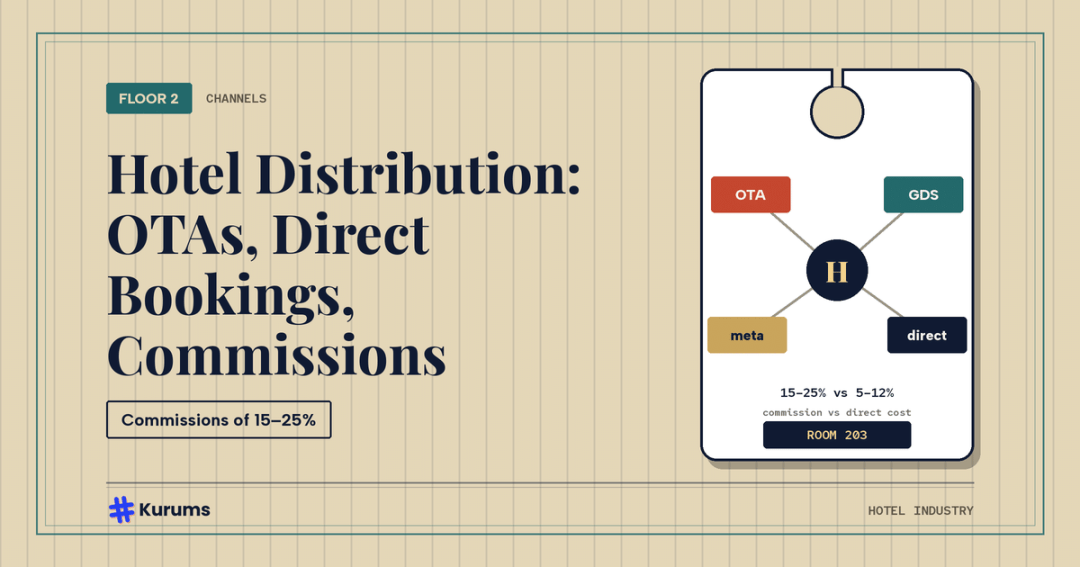
Distribution is how a hotel's rooms reach buyers: its own website and phone, online travel agencies (OTAs), global distribution systems, metasearch, wholesalers and brand channels. OTAs deliver about 30 percent of hotel bookings and typically charge commissions of 15 to 25 percent, against an estimated all-in cost of 5 to 12 percent for a direct booking. In Europe, Booking.com removed its price parity requirements in 2024 under the Digital Markets Act, and the EU's top court ruled that such clauses are not exempt from competition law. The aim is not to abandon OTAs but to control the mix, know the net revenue of each channel and win back guests who would have booked direct anyway.
Every hotelier has a view on online travel agencies, and it is rarely neutral. They fill rooms a small hotel could never fill alone, in languages and markets it could never reach. They also take a share of revenue that, for many properties, exceeds the profit margin. Both statements are true, which is why distribution is better treated as a portfolio to manage than as a battle to win. This guide explains the channels, their costs, the rules that changed in Europe and the steps that shift the balance. It follows from the guide to hotel revenue management.
What is an OTA?
An online travel agency such as Booking.com or Expedia that sells hotel rooms on its website and app and charges the hotel a commission or keeps a margin.
How much commission do OTAs charge?
Industry sources put it at 15 to 25 percent of the room rate, depending on the platform, market and visibility programmes.
How much do OTAs sell?
About 30 percent of hotel bookings, a share that held flat in 2025, with direct bookings just above 51 percent according to one industry analysis.
Can a hotel offer a lower price on its own website?
In the European Economic Area, yes: Booking.com removed its parity requirements in July 2024. Elsewhere, check your contract.
What is hotel distribution?
Distribution is the set of channels through which a room is offered and booked, and the technology that keeps prices and availability consistent across them. Each channel has a cost, a type of guest and a degree of control.
| Channel | How it works | Typical cost | Who owns the guest relationship |
|---|---|---|---|
| Hotel website and booking engine | Guest books on the hotel's own site | Booking engine fee, payment fees, marketing | Hotel |
| Phone, email, walk-in | Reservation staff take the booking | Staff time | Hotel |
| Brand website, app and loyalty programme | Chain channels deliver members | Brand, reservation and loyalty fees | Shared with brand |
| Online travel agencies | Guest books on the OTA | Commission, often 15–25% | Largely the OTA |
| Metasearch | Price comparison sites send clicks to hotel or OTA | Cost per click or commission | Hotel, if the click lands on its site |
| Global distribution systems | Travel agents and corporate booking tools | Transaction fee plus agent commission | Shared |
| Wholesalers and bed banks | Buy at net rates and resell to agents and sites | Deep discount on the rate | Intermediary |
| Groups and corporate sales | Negotiated by the sales team | Sales cost and discount | Hotel |
A channel manager connects the hotel's property management system to these channels so that a booking on one site reduces availability on all the others within seconds. Without it, staff update each extranet by hand and double bookings follow. See the hotel technology stack and the comparison of the best hotel channel managers.
How do online travel agencies work, and what do they charge?
Two commercial models exist.
- Agency model. The guest pays the hotel, and the hotel pays the OTA a commission after the stay.
- Merchant model. The OTA collects payment from the guest and passes the hotel the rate minus its margin. This gives the OTA control of the price shown and of the payment relationship.
The merchant model has spread. One 2026 industry analysis reported that Booking Holdings now collects guest payment on 73 percent of its sales, up from 25 percent in 2019.
Commission levels are not published as a single tariff. Industry sources in 2026 place the usual range at 15 to 25 percent of the room rate. Reports put Booking.com's standard commission for most independent hotels at roughly 15 to 18 percent and Expedia Group's at around 18 to 22 percent, with higher rates for visibility programmes: preferred partner status raises commission in exchange for a better position in search results. Sponsored listings, loyalty discounts funded by the hotel and payment fees add to the bill.
The market is concentrated. The European hotel association HOTREC found that Booking Holdings accounted for 68.8 percent of OTA bookings at European hotels in 2025 and Expedia Group for 16.6 percent, 85.4 percent between them. In the United States, SiteMinder's ranking of channels by booking volume put Expedia Group first, Booking.com second and the hotel's own website third.
What an OTA sells is reach. It spends heavily on advertising, operates in dozens of languages, handles payment and offers a trusted cancellation process. For a hotel without a brand, that reach is often the difference between a full and a half-empty house in low season.
What does a direct booking really cost?
Direct is cheaper, not free. A realistic account includes the booking engine, payment processing, website upkeep, search and metasearch advertising, a loyalty discount if you offer one and staff time. One 2026 industry review estimated the all-in acquisition cost of a direct booking at roughly 5 to 12 percent of the rate, against about 15 to 25 percent through an OTA.
The larger benefit is the relationship. A direct guest gives you a real email address, preferences and consent to be contacted. That makes pre-arrival upselling, repeat stays and reviews possible. Guests who book through an intermediary frequently arrive with a masked email address and belong, commercially, to the platform.
What is the right channel mix?
There is no universal target, but there are healthy patterns.
- No single intermediary should supply so much business that it can dictate terms.
- Repeat guests, local customers and corporate accounts should book direct. If they arrive through an OTA, you are paying commission for demand you already owned.
- OTAs are most valuable for new guests, foreign markets, low season and last-minute gaps.
- Wholesale fills a base of rooms far in advance at low net rates and needs careful control.
- Groups and corporate provide midweek and off-season volume.
The starting point differs by region. An industry analysis of Southeast Asia put OTA share there at about 69 percent of bookings, and far higher for independent hotels in some countries, compared with direct shares of 25 to 35 percent for independents in Western Europe. Overall, OTA share held at about 30 percent in 2025 while direct edged from 50.9 to 51.3 percent, so the balance is stable and moves slowly.
What is rate parity, and what changed in Europe?
Rate parity is the practice of showing the same price for the same room on every channel. For years OTAs wrote it into contracts. A wide parity clause stopped a hotel from offering a lower price anywhere, including on rival OTAs. A narrow clause stopped it from undercutting the OTA on the hotel's own website.
Europe has dismantled these clauses step by step:
- Several countries, among them Germany, France, Austria, Italy and Belgium, restricted or banned parity clauses through courts or legislation over the past decade.
- In May 2024 the European Commission designated Booking.com a gatekeeper under the Digital Markets Act, which prohibits gatekeepers from using wide or narrow parity clauses.
- Booking.com removed parity requirements from its terms for the European Economic Area in July 2024, including as a condition for its Genius and Preferred programmes.
- On 19 September 2024 the Court of Justice of the EU ruled in case C-264/23 that price parity clauses cannot, in principle, be treated as "ancillary restraints" that escape EU competition law.
- A Commission factsheet of September 2026 states that businesses using Booking.com in the EEA can freely set prices and conditions on and off the platform, including on their direct channel.
Separately, Spain's competition authority fined Booking.com €413.24 million in July 2024, a decision the company said it would appeal, and European hotels have organised a collective claim for damages over past parity clauses.
Outside the EEA, parity terms may still appear in contracts, and enforcement can be commercial as well as legal: a hotel that undercuts a platform may find itself lower in the search results. The Decoded entry on rate parity explains the term.
How do metasearch, GDS and wholesalers fit in?
Metasearch sites, such as Google's hotel search, Trivago, Tripadvisor and Kayak, compare prices from many sellers. A hotel can list its own website price there, through its booking engine or channel manager, and pay per click or by commission. It is the main paid route for bringing price-comparing travellers to the direct channel.
Global distribution systems, namely Amadeus, Sabre and Travelport, connect hotels to travel agents and corporate booking tools. They matter for business hotels and far less for small leisure properties.
Wholesalers and bed banks contract rooms at net rates, often 20 to 30 percent below public prices, and resell them to tour operators, travel agents and other websites. They fill rooms in distant markets. The problem is leakage: net rates intended for packages reappear on consumer sites below the hotel's own price, which undermines every other channel. Contracts should restrict where rates may be shown, and rate-shopping tools can detect breaches.
How can a hotel increase direct bookings?
- Fix the website first. Fast, mobile-friendly, with real photographs, clear room descriptions and a booking engine that takes three steps.
- Give a reason to book direct. A member rate, flexible cancellation, breakfast, parking, late check-out or the best room allocation.
- Appear in metasearch with your own price.
- Bid on your own name in search advertising, where OTAs otherwise capture the click.
- Convert OTA guests at the property. Collect email addresses at check-in with consent, deliver a good stay and invite the guest to book direct next time.
- Email past guests before their usual travel season.
- Train reservations staff to convert phone and email enquiries.
- Serve local and corporate accounts with a booking code.
- Keep content and reviews strong on OTAs too. Many guests discover a hotel there and then search for it by name, the so-called billboard effect.
Chains pursue the same goal with loyalty programmes and member-only rates, which is one of the benefits a franchise fee buys. See hotel business models.
How should a hotel work with OTAs?
Treat them as a paid marketing channel with measurable return.
- Optimise the listing: photographs, descriptions, policies and prompt replies to reviews.
- Join visibility programmes only on dates and in markets where you need demand, and measure the incremental bookings.
- Close or limit OTA availability on peak dates when you expect to sell out directly.
- Avoid stacking discounts. A mobile rate, a loyalty discount and a promotion applied together can cut the price by a third.
- Watch cancellations. OTA bookings often cancel more than direct ones.
- Reconcile commission invoices against actual stays.
- Monitor parity and leakage with a rate-shopping tool.
| Company | Type | Headquarters | Pricing | Known for |
|---|---|---|---|---|
| SiteMinder | Channel manager and hotel commerce platform | Sydney, Australia | Published starting price that scales with property size | ASX-listed; 56,000 properties and 2.6 million rooms at 30 June 2026 |
| Cloudbeds | PMS and hospitality platform | San Diego, USA | By quote; plans Flex, One, Experience, Enterprise | Founded 2012; PMS, channel manager, booking engine and payments in one platform for independents |
| HotelRunner | Channel manager and booking engine | Türkiye and UK | Published plans | Sales channel management, booking engine and payments for hotels and agencies |
| D-EDGE | CRS and distribution technology | Paris, France | By quote | Accor subsidiary; central reservation system, channel manager and digital marketing |
| RateGain | Distribution and rate intelligence | Noida, India | By quote | Listed in India; channel manager, rate shopping and distribution for travel |
| Lighthouse | Rate intelligence and benchmarking | London, UK | By quote | Formerly OTA Insight; rate shopping, parity monitoring and market data |
Pricing models and figures as published by each company, checked on 28 November 2026. Full list: Solutions Directory.
What is changing in distribution?
- Regulation. The Digital Markets Act has changed the terms of trade in Europe, and short-term rental platforms face registration and data-sharing rules there since May 2026. See hotel regulations.
- Price transparency. Rules requiring total prices to be shown upfront, including mandatory fees, apply in the United States to short-term lodging and affect how rates are displayed on every channel.
- Payments. Intermediaries increasingly collect the guest's money, which shifts control and cash flow.
- AI-assisted search. Travel planning through AI assistants is beginning to send bookings by new routes. SiteMinder told investors in 2026 that it is connecting hotel inventory to AI-powered booking experiences. Structured, accurate data about the hotel becomes more important.
- Consolidation of technology. Channel management, booking engines, pricing and payments are being bundled into single platforms.
To see the effect of commission on what you keep, enter your channel mix in the hotel RevPAR calculator, which reports net RevPAR after distribution cost.
Frequently Asked Questions
What percentage do OTAs take from hotels?
Typically 15 to 25 percent of the room rate, depending on the platform, the market and any visibility programmes the hotel joins.
Are direct bookings always more profitable?
Usually, because the acquisition cost is lower and the hotel keeps the guest relationship. A direct booking still costs an estimated 5 to 12 percent once technology and marketing are counted.
Is rate parity still required?
Not in the European Economic Area for Booking.com, which removed its parity requirements in 2024. In other regions it depends on the contract and local law.
What is the billboard effect?
The tendency of travellers to find a hotel on an OTA and then book it on the hotel's own website, so that an OTA listing also generates direct business.
Do small hotels need a channel manager?
If they sell on more than one or two online channels, yes. It keeps prices and availability in step and prevents double bookings.
Discover more from Kurums | Business Intelligence
Subscribe to get the latest posts sent to your email.