
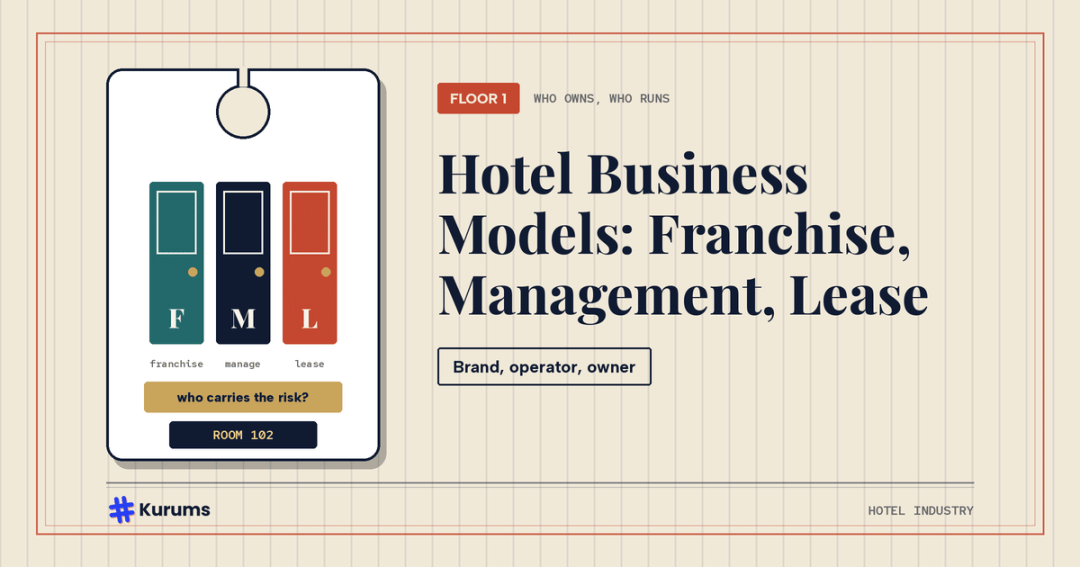
A hotel has an owner, a brand and an operator, and the business model decides who plays which role. Under a franchise the owner licenses a brand and runs the hotel or hires a manager. Under a management contract the brand company runs it for a fee. Under a lease the operator pays rent and keeps the profit or loss. An owner-operated independent keeps everything in one pair of hands. Fees for brands are charged mainly on room revenue and for managers on total revenue plus a share of profit, so the owner carries most of the downside. The right model depends on the owner's experience, the market, the lender and the type of hotel.
When a developer says "we are building a Hilton", it almost never means Hilton is building anything. It usually means an investor has signed a franchise agreement that allows the Hilton name on a building the investor pays for, and a second contract with a management company that will staff it. The structure behind a hotel matters more than the sign, because it determines who gets paid first, who decides on prices and renovations, and who loses money in a bad year. This guide explains the four basic models and their variants in plain terms. It follows from the overview of the hotel industry and its largest companies.
What is a hotel franchise?
A licence to use a brand's name, standards, reservation system and loyalty programme in return for fees. The owner remains responsible for running the hotel.
What is a management contract?
An agreement under which an operator runs the hotel on the owner's behalf for a base fee on revenue and an incentive fee on profit.
What is a hotel lease?
The operator rents the building, pays fixed or variable rent and takes the operating profit or loss.
Who carries the risk?
Under franchise and management, mostly the owner. Under a fixed lease, mostly the operator.
Why do hotels separate ownership, brand and operation?
Each party is good at something different, and each wants a different kind of return.
Real estate investors want an asset that produces income and gains value. They have capital and access to debt, and often no wish to manage housekeepers. Brand companies have something that scales without capital: a name guests recognise, a loyalty programme with millions of members and a reservation system. Operators have people and processes.
Splitting the roles lets each party do what it does best. It is also why the largest chains could grow to more than a million rooms each: Marriott, Hilton, IHG, Accor and Wyndham expand by signing contracts, not by buying land. The cost of the split is complexity. Three parties with three sets of incentives have to agree on budgets, pricing, staffing and renovation, and the contracts that govern them run for decades.
How does a hotel franchise work?
In a franchise, the owner (the franchisee) signs an agreement with a brand company (the franchisor). The franchisor provides the brand name and signage rights, design and service standards, the central reservation system, the loyalty programme, national marketing, training and quality inspections. The franchisee builds or converts the hotel to brand standards, pays the fees and operates the property, either with its own team or through a third-party management company.
HVS, a hospitality consultancy that analyses franchise disclosure documents, groups the costs as follows:
- Initial fee, paid with the application, usually a minimum amount that rises with room count.
- Royalty fee, the franchisor's main income, normally a percentage of rooms revenue.
- Marketing or advertising contribution, a percentage of rooms revenue for brand-wide promotion.
- Reservation fees, a percentage, a charge per booking or both, for use of the central system.
- Loyalty programme fees, charged on stays by members. HVS notes that these have grown as more guests join programmes.
- Miscellaneous fees for technology, training, revenue management services and conferences.
Taken together, the continuing fees of a mainstream US brand commonly add up to around a tenth of rooms revenue or more, with the exact figure depending on the brand and on how many bookings arrive through its channels. HVS also observes that collection or "soft" brands generally cost less than the core brands of the same parent company.
On top of fees come property improvement plans: renovations the brand requires at signing and at intervals afterwards. They are a capital cost, not a fee, and they are a common source of dispute.
How does a hotel management contract work?
Under a hotel management agreement, the owner hires an operator to run the hotel in the owner's name and at the owner's expense. Staff are usually employed by the owner's entity or by the operator on the owner's account, and all revenue and costs flow through the owner's books. The operator is an agent, not a tenant.
Fees have two parts. HVS's European guide describes a base fee typically between 2 and 4 percent of total revenue, and an incentive fee calculated on profit, so that the operator shares in good results. Brand operators add charges for marketing, reservations, loyalty and shared services, much as a franchisor would.
Two kinds of operator exist:
- Brand operators. The chain manages the hotel under its own brand. This is the standard for luxury and large full-service hotels, where service standards are the product.
- Third-party or "white label" operators. Independent management companies run hotels under a franchise the owner holds, or as independents. They are the usual partner for select-service hotels in North America and increasingly in Europe.
The clauses that matter most to an owner are these:
| Clause | What it decides | Why it matters |
|---|---|---|
| Term and renewal | How long the operator stays | Brand contracts often run 20 years or more |
| Performance test | When the owner can end the contract for poor results | Usually tied to RevPAR against competitors and to budgeted profit |
| Owner approvals | Budget, senior hires, major contracts | The owner's only regular control |
| Reserve for replacements | Share of revenue set aside for furniture and equipment | Commonly a few percent of revenue each year |
| Termination on sale | Whether a buyer can remove the operator | Affects the hotel's value |
| Area protection | Whether the brand may open nearby | Protects against competing with your own flag |
How does a hotel lease work?
In a lease, the operator is a tenant. It pays rent to the property owner, runs the hotel as its own business and keeps the profit or absorbs the loss. Three forms are common:
- Fixed lease. Rent is a set amount, usually indexed to inflation. The owner receives bond-like income, and the operator carries the trading risk.
- Variable lease. Rent is a percentage of revenue or profit, so the two share the cycle.
- Hybrid lease. A guaranteed minimum plus a variable part above it.
Leases are the traditional structure in Germany and are widespread elsewhere in continental Europe and in parts of Asia, where institutional investors such as pension funds prefer predictable rent. Chains with asset-light ambitions dislike fixed leases because the obligations sit on their balance sheets and become painful in downturns, as 2020 showed. Budget and lifestyle operators that want to grow quickly in European cities still use them, because landlords there ask for them.
What about independent and owner-operated hotels?
The simplest model has one party in all three roles: the hotelier owns the building, trades under its own name and runs the business. Most of the world's small hotels work this way.
The advantages are full control, no brand fees and complete ownership of the guest relationship. The disadvantages are the absence of a loyalty programme and central sales, a heavier reliance on online travel agencies, and sometimes more difficulty with lenders, who often prefer a recognised flag.
Between pure independence and a full franchise sit several options:
- Soft brands and collections, where the hotel keeps its own name and character and joins a chain's reservation and loyalty systems.
- Marketing consortia and referral groups, which offer shared sales and booking channels for a membership fee.
- Technology alone. A good property management system, channel manager and website can now replace part of what a brand's systems once provided. See the hotel technology stack.
Who carries the risk and who gets paid first?
Follow one dollar of room revenue through a franchised, third-party-managed hotel:
- The brand takes royalty, marketing and loyalty fees off the top, as a share of room revenue.
- Online travel agencies take commission on the bookings they deliver.
- Operating costs are paid: wages, utilities, supplies, maintenance.
- The manager takes its base fee from total revenue.
- What remains is gross operating profit, from which the manager's incentive fee, property taxes, insurance and the replacement reserve are deducted.
- The lender receives interest and principal.
- The owner keeps the rest.
| Model | Owner's income | Owner's control over operations | Owner's risk | Who suits it |
|---|---|---|---|---|
| Franchise, self-operated | Hotel profit after fees | High | High | Experienced hoteliers and groups |
| Franchise plus third-party manager | Profit after fees to both | Medium | High | Investors who want a brand and a specialist operator |
| Brand management contract | Profit after fees | Low | High | Institutional owners of luxury and full-service hotels |
| Fixed lease | Rent | Very low | Low, but tenant credit risk | Pension funds, insurers, property companies |
| Variable or hybrid lease | Rent linked to trading | Low | Medium | Owners sharing the cycle with the operator |
| Independent, owner-operated | All profit | Full | Full | Hoteliers with a distinctive product or location |
The pattern explains a recurring complaint from owners. HotStats and other analysts have noted that brand fees, management fees and software subscriptions are charged on revenue or by subscription, while the owner alone is paid on profit. When wages and insurance rise faster than room rates, the owner absorbs the difference. The guide to hotel operating costs and profit margins shows the numbers.
How should an owner choose a model?
Six questions lead to an answer.
- Do you have operating experience? If not, you need a manager or a tenant.
- Does the market need a brand? A roadside or airport hotel lives on recognition and loyalty members. A boutique hotel in a historic centre may not.
- What does your lender require? Many lenders want a known brand and an approved operator before they commit.
- How much control do you want? Franchise keeps control with the owner. A brand management contract gives most of it away.
- How long do you plan to hold the asset? A contract that cannot be ended on sale narrows the pool of buyers.
- What is the total cost? Add every fee and compare it with the extra revenue the brand or operator is likely to produce.
A practical test is to model three cases over ten years with the same hotel: branded with fees, soft-branded and independent, each with a realistic share of bookings by channel. The hotel RevPAR calculator covers the trading side, and the guide to how to open a hotel covers the capital side.
What should you check before signing with a brand or operator?
- The total fee load as a percentage of rooms revenue and of total revenue, including loyalty and technology charges.
- The brand's delivery: the share of room nights from its website, app, call centre and loyalty members at comparable hotels.
- The property improvement plan and its timetable and cost.
- The term, renewal rights and what it costs to leave early.
- The performance test and how easily it can be passed.
- Territorial protection against new hotels of the same brand family.
- Who owns the guest data during and after the contract.
- Budget approval and what happens when owner and operator disagree.
- Key money or other contributions the brand offers, and what they oblige you to do.
- The operator's track record with similar hotels in similar markets, from owners you call yourself.
Have a lawyer with hotel experience negotiate the agreement. These contracts are specialised, long and asymmetric: the brand signs hundreds a year, and most owners sign one or two in a lifetime.
Frequently Asked Questions
What is the difference between a hotel franchise and a management contract?
Under a franchise the owner licenses the brand and remains responsible for operations. Under a management contract the operator runs the hotel for the owner in exchange for base and incentive fees.
How much are hotel franchise fees?
They combine an initial fee with continuing royalty, marketing, reservation and loyalty fees, mostly charged on rooms revenue. For mainstream brands the continuing fees commonly total around a tenth of rooms revenue or more.
How much does a hotel management company charge?
Typically a base fee of about 2 to 4 percent of total revenue plus an incentive fee linked to profit, according to HVS.
What is an asset-light hotel company?
A chain that earns fees from franchising and managing hotels owned by others instead of owning the real estate itself.
Is a hotel lease safer for the owner?
A fixed lease gives predictable rent and moves trading risk to the operator, but the owner then depends on the tenant's ability to pay.
Discover more from Kurums | Business Intelligence
Subscribe to get the latest posts sent to your email.