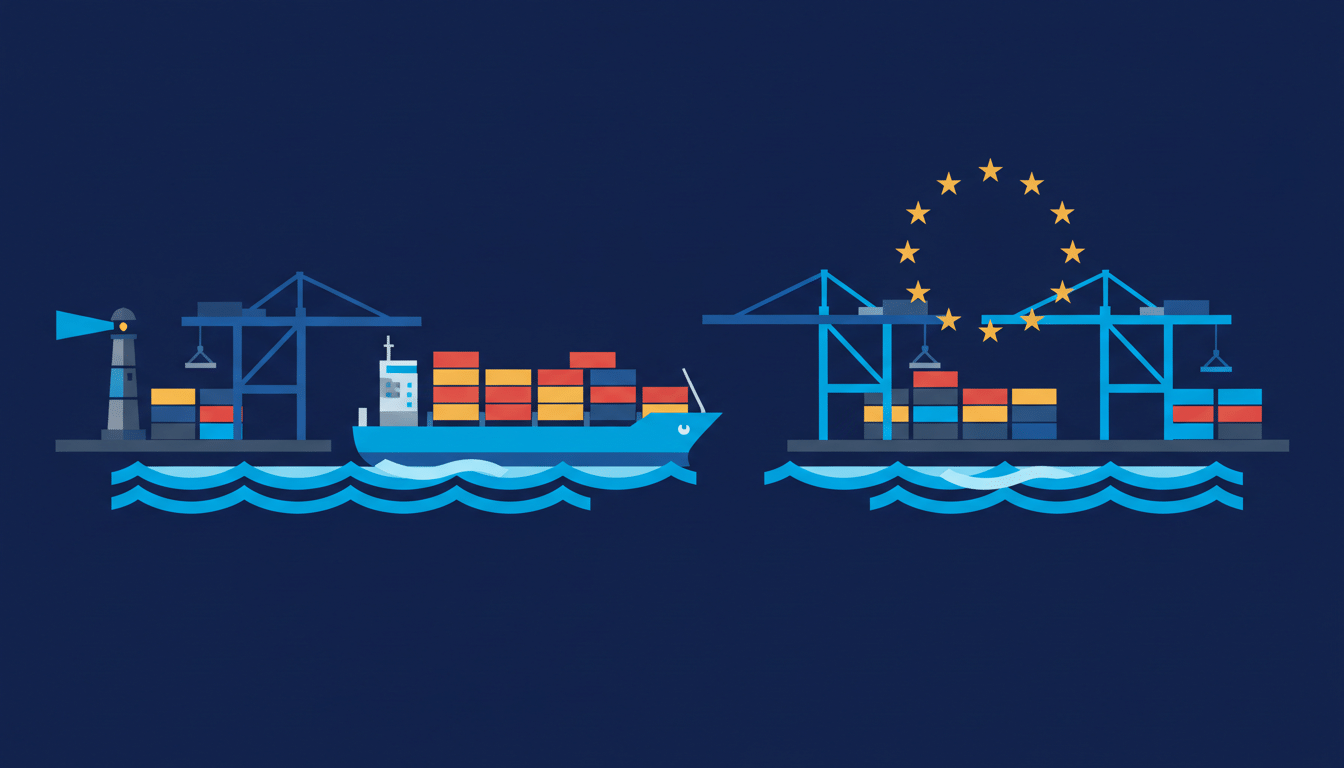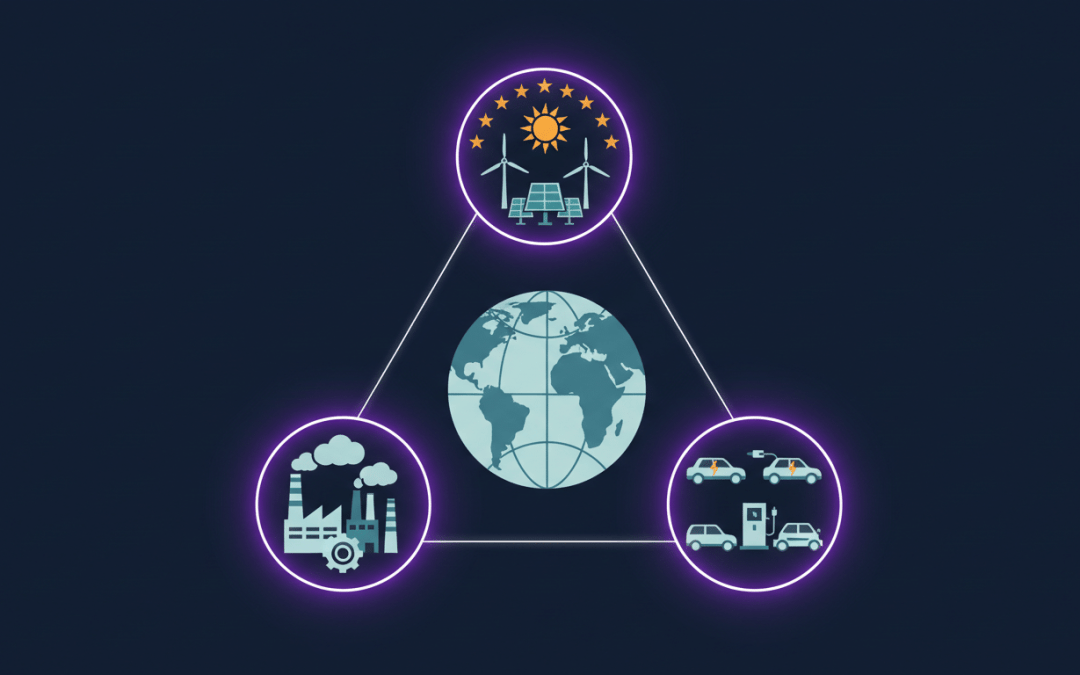
For a generation, the rich world told everyone else to keep public money neutral about where goods were made. In 2026 the three largest economies all do the opposite. Europe's "Made in Europe" rules are the newest entry in a global race to tie procurement, subsidies and investment approvals to local production. This guide compares the rulebooks and explains what they mean for companies that sell across all three.
Status checked 28 October 2026 · EU rules at proposal stage
TL;DR
- The EU's Industrial Accelerator Act (IAA) uses demand — public procurement and subsidies — rather than tariffs to favour EU-made, low-carbon products in steel, aluminium, cement, net-zero technologies and vehicles.
- The US already applies Buy America rules of up to 75% domestic content for federally funded infrastructure, and the 2025 OBBBA tax law sets rising domestic-content thresholds for clean-energy credits.
- China gives domestic products a 20% price preference in government procurement from 2026, on top of long-standing Buy Chinese practice.
- The result is a world of overlapping clubs: where you manufacture, and which trade agreements your country has, decide which public money you can reach.
- Procurement preferences are easier to defend at the WTO than subsidies tied to origin; the EU's consumer-incentive rules carry the most legal risk.
Key takeaways
- Local content is now standard industrial policy in the three largest economies, not an emerging-market exception.
- The EU combines origin with carbon: low-carbon steel and aluminium requirements sit alongside "Made in EU" rules and CBAM.
- Trade agreements are becoming entry tickets to procurement and subsidy clubs, not just tariff cuts.
- Global manufacturers need product-level origin and carbon data as a core capability.
Why is everyone writing local-content rules now?
Three pressures converged. The first is deindustrialisation. The share of manufacturing in EU GDP fell from 17.4% in 2000 to 14.3% in 2024, and the Commission says more than 200,000 jobs were lost in energy-intensive industries and car-making after 2024, with car-making alone projected to lose 600,000 this decade. The IAA's headline target is to lift manufacturing back to 20% of GDP by 2035.
The second is China's scale. The EU's goods deficit with China reached €359.8 billion in 2025, and Chinese manufacturers dominate global capacity in batteries, solar modules, electric vehicles and critical-mineral processing. The IAA's investment rules apply only to countries with more than 40% of global capacity in those sectors — a threshold written around China.
The third is the example set by the United States. The 2021 infrastructure law's Build America, Buy America provisions and the 2022 Inflation Reduction Act tied public money to US production and pulled clean-tech investment across the Atlantic. Although most of the IRA's consumer incentives were later unwound, the domestic-content logic survived in the 2025 One Big Beautiful Bill Act. Europe's industrial strategy, from the Draghi report onwards, concluded that it could not stay neutral while its two largest competitors were not.
How do the rulebooks compare?
| Instrument | Scope | Key thresholds | Partner treatment |
|---|---|---|---|
| EU Industrial Accelerator Act (proposed Mar 2026) | Public procurement and support schemes in steel, aluminium, cement, net-zero tech and vehicles; FDI conditions in batteries, EVs, solar, critical raw materials | Vehicles: EU assembly, 70% EU non-battery content, EU-made cells. Steel: 25% low-carbon. Aluminium: 25% low-carbon and EU origin. Concrete: 5%. FDI: 4 of 6 conditions above €100m | FTA, customs-union and (for procurement) GPA partners deemed EU origin — scope contested |
| EU Public Procurement Act (proposed Sep 2026) | Horizontal framework for all public procurement | Price advantage for EU content; tenders can be rejected below 50% EU or covered content | GPA and FTA partners covered unless excluded for strategic reasons |
| US Build America, Buy America (2021) | Federally funded infrastructure | Iron and steel US-made; manufactured products rising to 75% US components by 2029 | Limited waivers; GPA covers 37 of 50 states |
| US OBBBA domestic content (2025) | Clean-energy tax credits | Steel and iron 100%; manufactured products 45%, then 50% (2026), 55% (2027+) | No partner equivalence; foreign-entity restrictions |
| China domestic-product standard (Jan 2026) | Government procurement | 20% price preference; local manufacture, domestic-component threshold, key processes in China | Not a GPA party; Buy Chinese across sectors |
| China investment negative list (2024 edition) | Foreign investment access | 29 restricted sectors plus prohibited areas; national security review | National treatment outside the list |
What makes "Made in Europe" different?
Four design choices set the EU approach apart from Washington's and Beijing's.
It works through demand, not tariffs. The IAA does not raise customs duties. It conditions what governments buy and subsidise. Public procurement represents roughly 15% of EU GDP, and support schemes — EV bonuses, auctions, grants — shape demand in downstream sectors. The EU is betting that steering this spending will build "lead markets" for European products without closing the single market.
It combines origin with carbon. The steel rule is a low-carbon requirement; the aluminium rule demands low-carbon and EU origin together. That sits on top of the Carbon Border Adjustment Mechanism, whose definitive phase began in January 2026 for steel, aluminium and cement. A foreign supplier may pay CBAM at the border and still be ineligible for publicly funded projects. Digital traceability is arriving at the same time: the EU's Digital Product Passport registry went live in July 2026, with batteries first in line from February 2027.
It is sector by sector. Member states must apply origin rules to at least 45% of support budgets for steel, aluminium and concrete, but to 100% for vehicles. Net-zero technologies phase in with transitions of one to six years depending on supply-chain maturity. The EU is not trying to localise everything; it is choosing where dependency is most dangerous.
It has a partner clause. Unlike the US and China, the EU proposal deems some third-country content to be EU origin — FTA and customs-union partners, and GPA parties for procurement. That clause has become the main battleground, with France pushing for a narrow list and Germany, carmakers and partner governments pushing for a broader one.
Is this legal under WTO rules?
Partly, and the answer depends on the instrument. Government procurement is largely outside the WTO's core non-discrimination rules unless a country has joined the plurilateral Government Procurement Agreement. The GPA has 22 parties covering 49 WTO members and, according to the WTO, opens more than $1.7 trillion of procurement a year. Preferring EU products over those of non-GPA countries such as China in public tenders is therefore on relatively solid ground, provided the EU honours its GPA and FTA commitments to the countries that have them.
Subsidies are harder. WTO rules prohibit subsidies that are contingent on using domestic over imported goods, and national-treatment rules restrict measures that favour domestic products in the market. Experts quoted by the European Parliament's research service consider the IAA's procurement conditions broadly consistent with WTO and FTA obligations, but see a serious risk of legal challenge to linking consumer subsidies and other incentives to "Union origin or equivalent" conditions, especially from countries without an FTA. China has already argued that the IAA breaches most-favoured-nation and national-treatment principles.
The practical constraint is weaker than it used to be. The WTO's appellate body has not functioned since 2019, so a losing party can appeal a panel ruling into a void. The US domestic-content rules have operated for years in the same grey zone. Legal risk is real, but it is unlikely to stop any of the three economies on its own.
Who wins and who loses globally?
| Country or bloc | Position under the EU rules | Net effect |
|---|---|---|
| EU manufacturers | Inside by definition | Gain More protected public demand, but higher input costs if partners are excluded |
| China | Outside procurement and subsidy equivalence; FDI conditions on new investments | Loss Pushed towards EU joint ventures and licensing |
| United States | Procurement via GPA; outside subsidy equivalence | Mixed US-owned EU plants gain; US exporters into subsidised demand lose |
| UK, Switzerland, EFTA | Conditional trusted partners in cars | Mixed Inside if they align on investment and trade-defence policy |
| Japan, South Korea | FTA/GPA partners, outside the Franco-German auto compromise | Mixed EU-built models fine; exports exposed |
| Türkiye, Morocco | Customs union / FTA; contested | At risk Large EU-oriented car industries, outcome unresolved |
| India | FTA concluded without procurement chapter; not in GPA | Outside for procurement equivalence |
| Mercosur, Mexico, Indonesia | New agreements with procurement chapters | Potential gain if equivalence survives |
A broader pattern emerges. Trade agreements used to be mostly about tariffs; now they decide membership of procurement and subsidy clubs. The EU's research service suggests that if FTA partners with procurement commitments keep EU-origin status, the IAA could become an incentive for other countries to negotiate such chapters. In that sense, "Made in Europe" is also a trade-negotiating tool.
What does a world of local-content clubs mean for supply chains?
Region-for-region manufacturing. Global companies increasingly build in each major market for that market: in the US for US incentives, in the EU for EU incentives, in China for Chinese procurement. That raises costs and duplicates capacity, but it reduces political risk. Toyota and Jaguar Land Rover have both warned that rigid European rules would make European-built vehicles more expensive relative to Chinese competitors.
Partner-country hubs. Countries that end up inside a club become attractive production bases for companies from outside it. If Türkiye or Morocco stay inside "Made in Europe", they gain; if they are excluded, investment shifts into EU member states such as Spain, Hungary or Slovakia. BYD's decision to pause its Turkish plant and look for a southern European site is an early example of that logic.
Data as a compliance asset. Every one of these regimes asks the same questions: where was each component made, what share of value is local, how much carbon is embedded? Companies that can answer at part-number level will qualify faster and negotiate better. Origin and carbon data, once a customs back-office task, are becoming a sales capability.
Political bargaining over conditions. The UK's conditional path into the European automotive club depends on aligning with EU investment screening and trade defence. Expect similar conditions — on China policy, labour standards and procurement reciprocity — to become the price of entry into other clubs.
What should global manufacturers do now?
- Build an origin-and-carbon data layer. Collect supplier declarations, component origin under each region's rules and embedded emissions for steel, aluminium and batteries.
- Map revenue by public-money exposure. For each region, separate sales that depend on procurement or subsidies from purely private demand. Only the first group is affected by local-content rules.
- Choose footprint per club. Decide where you need to be inside the EU, US or Chinese club, and where a partner-country plant is enough — then stress-test that choice against a narrow EU partner list.
- Use transition periods. Net-zero technology rules in the EU phase in over one to six years. Plan localisation to land before the rules bite in your product category.
- Watch the horizontal law. The EU Public Procurement Act could apply European preference across all sectors, not only the IAA's strategic ones.
- Prepare for retaliation scenarios. China has threatened countermeasures, and the US has opened Section 301 investigations into excess capacity in 16 economies including the EU. Map exposure to retaliatory tariffs in your export portfolio.
Pro tip
Treat local-content rules as a pricing input, not just a compliance cost. A product that qualifies for EU incentives can carry a higher price than an ineligible rival and still be cheaper for the buyer after the subsidy. Model eligibility value alongside localisation cost.
Risk to watch
If every major economy reserves public money for its own producers, the global market for clean technology fragments. Prices rise, scale economies shrink and decarbonisation slows. China's argument against the IAA — that it will slow Europe's green transition — is self-interested, but the trade-off is real and will shape the final text.
Made in Europe Tracker
The EU side of the race
- Jan 2026CBAM definitive phase: steel, aluminium, cement
- 4 Mar 2026Industrial Accelerator Act proposed
- Jul 2026Digital Product Passport registry live
- 9 Sep 2026Public Procurement Act proposed
- Oct 2026Partner-list fight after Franco-German deal
- 1 Dec 2026Parliament committee vote on the IAA
- Feb 2027Battery passport deadline
Frequently asked questions
What is a local content requirement?
A rule that makes access to public money, contracts or market approval conditional on a minimum share of a product's value — or certain production steps — happening in a specific country or region. The EU, US and China all use them in 2026, in procurement, subsidies or investment approvals.
Is "Made in Europe" stricter than Buy American?
It depends on the sector. For vehicles, the EU's proposed 70% EU-origin requirement for non-battery components plus EU-made cells is very demanding. For infrastructure, US rules are stricter: iron and steel must be US-made and manufactured products are moving to 75% US content by 2029. The EU's partner clause is more generous than anything in US law.
Can the WTO stop these rules?
Procurement preferences against non-GPA countries are largely permitted. Subsidies contingent on local content are more vulnerable to challenge. But with the WTO's appellate body inactive since 2019, rulings can be appealed into a void, which limits the practical effect.
When do the EU rules apply?
The IAA is still a proposal. Parliament's committees vote on 1 December 2026, trilogues follow in 2027, and adoption is not expected before mid-to-late 2027, with sector-specific transition periods after that.
Made in Europe Tracker · the series
More from the Automotive desk

Who Counts as Europe? The UK, Japan, Korea, Morocco and the Fight Over ‘Made in Europe’
The real battle in the EU’s Industrial Accelerator Act is the partner list. How the Commission, Parliament and the Franco-German compromise would treat the UK, Switzerland, Japan, South Korea, Morocco and other trade partners, and what each outcome means for carmakers.
Made in Europe and the United States: When ‘Buy European’ Meets ‘Buy American’
The US is inside Europe’s procurement club through the WTO’s GPA but outside its subsidy club. What the Industrial Accelerator Act means for American exporters, US companies manufacturing in Europe, defence procurement and the risk of a transatlantic tit-for-tat.

How ‘Made in Europe’ Hits China: EVs, Batteries and the EU’s New Investment Conditions
The Industrial Accelerator Act never names China, but its 40% capacity test, €100m investment conditions and procurement rules are built around it. What the 49% rule means for BYD, CATL and their European partners, and how Beijing is responding.
Made in Europe and Türkiye’s Car Industry: What the EU Industrial Accelerator Act Means for Turkish Automotive Production
The EU’s ‘Made in Europe’ rules could cut Turkish-built EVs, buses and parts out of European subsidies and public tenders. Exposure by segment, four scenarios, and what Turkish automakers and suppliers should do before the December vote.
Trade incentives and global expansion

India Incentives for Foreign Companies: PLI Scheme, Startup India & Concessional Tax
Invest India, the Production Linked Incentive scheme, concessional corporate tax, Startup India’s tax holiday and SEZ/state incentives.

South Korea Incentives for Foreign Companies: KOTRA Cash Grants, K-CHIPS & Free Economic Zones
KOTRA/Invest Korea, negotiated cash grants, K-CHIPS semiconductor R&D credits and free economic zones.

Japan Incentives for Foreign Companies: JETRO, Strategic-Tech R&D Credit & Startup Visas
JETRO support, the enhanced 2026 strategic-technology R&D credit, capital-investment incentives, special zones and startup visas.

Brazil Incentives for Foreign Companies: SUDENE/SUDAM, Manaus Free Trade Zone & ApexBrasil
ApexBrasil, the SUDENE/SUDAM 75% IRPJ reduction, the Manaus Free Trade Zone and the 2026 dual-VAT tax reform.
Sources
- EPRS — International dimension of the proposed IAA (Sep 2026)
- Skadden — European Commission Proposes Industrial Accelerator Act (Apr 2026)
- Euronews via Yahoo — China slams Made in Europe push; job-loss figures (Apr 2026)
- Customs Support — What Made in EU means for customs; DPP timeline (2026)
- TelQuel — CBAM definitive phase and the 70% rule (Sep 2026)
- German Marshall Fund — The EU's IAA puts pedal to the metal (2026)
- White & Case — USTR Section 301 excess-capacity investigations (Mar 2026)
- Chatham House — European preference signals a wider change of EU doctrine (Mar 2026)
This article compares legislation and proposals as reported by the cited sources; thresholds apply to different scopes and are not directly comparable. It is not legal, trade-compliance or investment advice.
Reviewed by the Kurums Industry desk · Startup › Industry › Automotive · Last checked 28 October 2026
Discover more from Kurums | Business Intelligence
Subscribe to get the latest posts sent to your email.