
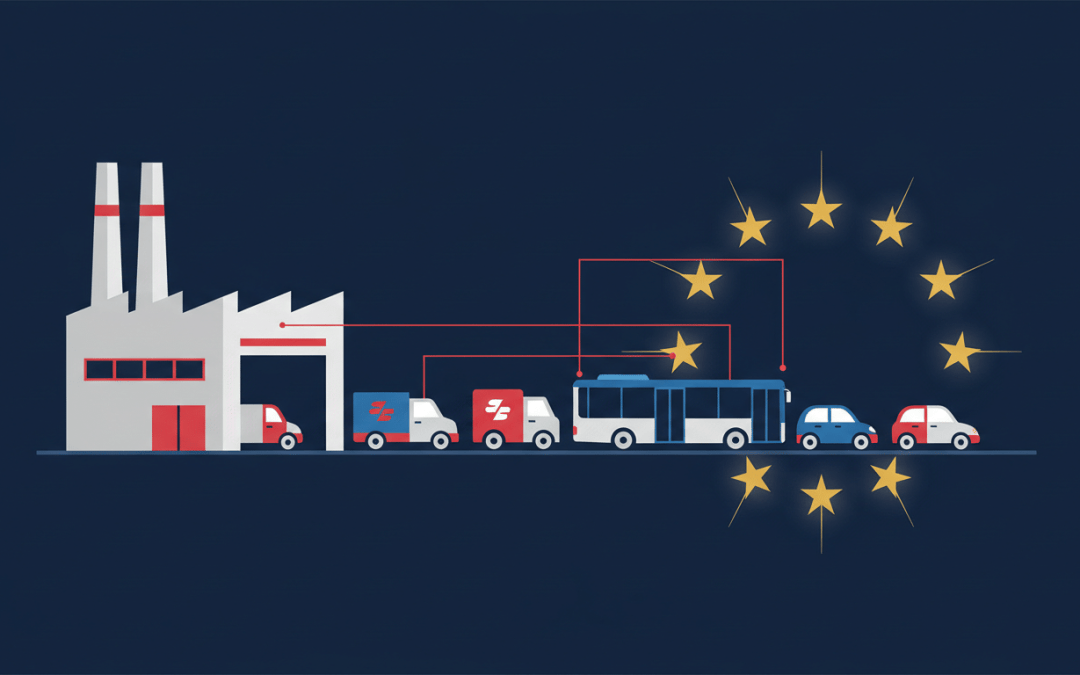
For thirty years the EU–Türkiye Customs Union made a car built in Bursa or Kocaeli commercially "European". The EU's Industrial Accelerator Act asks a new question: is it European enough to receive European public money? Here is what is at stake for Türkiye's automotive industry, segment by segment, and what manufacturers and suppliers can do before the rules are fixed.
Status checked 28 October 2026 · Proposal stage — not yet law
TL;DR
- The EU's proposed Industrial Accelerator Act (IAA) does not add tariffs. It decides which vehicles qualify for public money: purchase incentives, fleet support schemes and public procurement.
- To qualify, a car would have to be assembled in the EU, with at least 70% of component value (excluding the battery) of EU origin and EU-made battery cells.
- The Commission's March text counted customs-union content as EU origin. The Franco-German compromise of 16 October 2026 leaves Türkiye out while opening a conditional door to the UK.
- Most exposed: Turkish-built EVs and plug-in hybrids, electric vans, and buses sold into municipal tenders. Least exposed: combustion and hybrid cars sold to private buyers.
- The bigger long-term risk may be for suppliers: if Turkish parts stop counting as EU content, EU carmakers may quietly re-source them to stay above 70%.
Key takeaways
- Market access stays: the Customs Union, in force since 1996, keeps Turkish vehicles tariff-free in the EU.
- Eligibility is what is contested — and for the automotive sector the origin rules would apply to 100% of support-scheme budgets.
- Nothing is final: Parliament's committees vote on 1 December 2026, trilogues follow in 2027, and adoption is not expected before mid-to-late 2027.
- ACEA, Toyota, Ford and Hyundai have all argued publicly against excluding Türkiye; the outcome is still being negotiated.
What does "Made in Europe" actually require from a car?
The European Commission tabled the Industrial Accelerator Act on 4 March 2026. Its headline aim is to lift manufacturing from 14.3% of EU GDP in 2024 to 20% by 2035, and its main lever is demand: when governments spend taxpayers' money on steel, cement, aluminium, net-zero technology or vehicles, that money should flow to low-carbon, European-made products. The automotive rules are the strictest in the package.
Under the Commission's proposal, a vehicle bought or subsidised under a covered scheme must meet three conditions. It must be assembled within the EU. At least 70% of the value of its components, excluding the traction battery, must be of EU origin. And the battery must contain EU-made cells plus at least three main battery components of EU origin. Separately, at least 25% of the steel and aluminium used in motor vehicles bought under the framework would need to be low-carbon, with the aluminium also of EU origin.
Two details make the automotive chapter unusually powerful. First, while member states would only have to apply origin rules to 45% of their support budgets for steel, aluminium and concrete, the automotive requirements apply to 100% of the budget of relevant support schemes. Second, the rules bite exactly where Europe's electric-vehicle demand is still being stimulated: purchase bonuses, social leasing programmes, fleet grants and public procurement of buses, vans and service vehicles. Germany has already signalled it would align its EV incentive programme with the "Made in EU" criteria if they enter into force.
"Origin" in the proposal follows EU customs rules: a product is of EU origin where it was last substantially transformed. That is why the question of which non-EU countries are deemed to be EU origin matters so much for Türkiye — and why the fight has moved from the content threshold to the partner list.
Is Türkiye inside or outside "Made in Europe" right now?
The honest answer is: both, depending on which text you read. The Commission's proposal contains an equivalence clause. In public support schemes, content originating in countries with which the EU has concluded a free trade area or a customs union is deemed to be of Union origin. Türkiye is the EU's only large customs-union partner, and on 24 April 2026 Executive Vice-President Stéphane Séjourné confirmed in a written answer to the European Parliament that the original proposal treats customs-union content, including Turkish content, as equivalent to EU origin for the specified requirements.
The politics then moved. On 16 October 2026, France and Germany struck a broad automotive deal in Brussels that combined a softer 2035 CO₂ target with a tighter "Made in Europe" definition. Under that compromise the UK — and, according to several reports, Switzerland and other EFTA states — could qualify as trusted partners if they align with EU foreign-investment screening, trade-defence policy and reciprocity conditions. Türkiye, Japan and South Korea were not included.
The Franco-German position is the view of two member states, not EU law, and the automotive industry has not accepted it quietly. Türkiye's Trade Minister Ömer Bolat held talks in Brussels and met the heads of TİM, OİB, OSD and TAYSAD in Ankara on 19 October to coordinate the response. OSD chairman Cengiz Eroldu said the approach does not reflect Europe's real production and supply structure and lacks economic justification. Europe's own carmakers' association, ACEA, has asked for targeted exemptions protecting existing investments in neighbouring countries such as Türkiye and Morocco, especially in heavy commercial vehicles.
There is a third text in play as well. The European Parliament's rapporteurs — from the trade, industry and internal-market committees — want a narrower, opt-in model in which no partner qualifies automatically; the Commission would add countries one by one if they grant real national treatment, align with EU economic security and meet labour-standard conditions. Under that model, Türkiye would have to earn its place rather than inherit it from the Customs Union.
Made in Europe Tracker
Where the Industrial Accelerator Act stands
- 4 Mar 2026Commission proposal; customs-union content counts as EU origin
- 24 Apr 2026Commission confirms Turkish content can qualify (written answer)
- 17 Sep 2026EP rapporteurs push a narrower opt-in partner list
- 16 Oct 2026Franco-German deal: UK in on conditions; Türkiye, Japan, Korea out
- Oct–Nov 2026Lobbying window: ACEA, OSD, Toyota, Ford, Hyundai
- 1 Dec 2026Parliament committee vote
- 2027Trilogues; adoption expected mid-to-late 2027
How much of Türkiye's automotive industry is exposed?
Automotive is Türkiye's largest export sector. Turkish plants produced 1,419,464 vehicles in 2025, up 4%, and exported 1,057,920 of them. The mix shifted sharply: passenger-car exports fell about 8% to roughly 600,000 units while commercial-vehicle exports jumped 28% to about 458,000. Measured in dollars, the Turkish Exporters Assembly put automotive exports at $41.5 billion, 17.5% of the country's goods exports.
The European dependence is extreme. According to the Uludağ Automotive Industry Exporters' Association (OİB), Türkiye exported about €36.73 billion of vehicles and components in 2025, and EU countries bought €26.65 billion of it — 72.5% of the total. Germany alone took about €5.85 billion, France €4.50 billion and Spain €3.03 billion. Türkiye is also Europe's largest producer of commercial vehicles, the region's fifth-largest vehicle producer overall and around the world's thirteenth, with roughly three-quarters of output exported.
The trade runs both ways, which is the Turkish side's strongest argument. In 2025 the EU shipped about 812,000 cars worth €18.8 billion to Türkiye, while Türkiye sent about 798,000 vehicles worth €18.2 billion to the EU, for two-way automotive trade of roughly €37 billion. EU-built cars make up about 73% of Türkiye's imported-car market, and automotive products account for about a quarter of all EU–Türkiye trade. OİB estimates that Turkish automotive activity supports some 250,000 jobs inside the EU, and European carmakers have invested around €21 billion in the country over 55 years.
None of these exports would be banned. The IAA works through eligibility, not market access. The relevant question for each Turkish-built model is therefore narrower: how much of its European volume depends on a buyer who uses public money?
Which plants and vehicle segments are most at risk?
Exposure depends less on the brand than on the powertrain and the customer. A Turkish-built combustion or full-hybrid hatchback sold to a private buyer in Lyon or Munich is barely affected. An electric van leased with a fleet grant, or a battery-electric city bus bought by a municipality, sits directly in the IAA's path.
| Segment (examples built in Türkiye) | How it reaches EU buyers | IAA lever | Exposure |
|---|---|---|---|
| City buses and coaches — Mercedes-Benz Türk, MAN Türkiye, Otokar, Karsan, Temsa, Anadolu Isuzu | Municipal and transport-authority tenders, often with zero-emission funding | Public procurement + support schemes | High |
| Electric and plug-in vans — e.g. Ford Otosan's electric Transit Custom (Kocaeli) | Fleet leasing, business incentives, public fleets | Support schemes + procurement | High |
| Plug-in hybrid and electric cars — e.g. Toyota's C-HR plug-in hybrid (Sakarya) | Retail with purchase bonuses, social leasing, company-car schemes | Support schemes (100% of budget) | High |
| Heavy trucks — Mercedes-Benz Türk (Aksaray), Ford Trucks | Mostly private fleets; zero-emission truck grants in some markets | Support schemes | Medium |
| Combustion and full-hybrid cars — Oyak Renault (Bursa), Tofaş (Bursa), Toyota (Sakarya), Hyundai (İzmit) | Private retail and rental fleets | Indirect only (2035 rules, future schemes) | Low today |
| Components — seats, castings, wiring, powertrain and chassis parts | Supplied to EU assembly plants | The 70% value calculation | Medium–High |
Heavy commercial vehicles are where ACEA has been most explicit. Its members produced about 29,000 trucks and 8,500 buses in Türkiye in 2025, and the association's policy director, Maria Linkova-Nijs, singled out the segment when asking negotiators to protect existing investments. Ford Otosan matters too: its Turkish plants built about 452,000 vehicles in 2025 and the company accounted for roughly 38% of Türkiye's vehicle exports and 87% of its commercial-vehicle exports.
Carmakers' own exposure differs. French trade press reports that Stellantis describes its Turkish output as mainly destined for the region and only marginally for Europe, while Renault exports most of its Bursa production to Europe. Hyundai's İzmit plant exports the large majority of its output, and Hyundai Europe's chief executive Xavier Martinet has warned that if Türkiye is excluded the company may have to consider alternative scenarios — while adding that moving production would make some cars more expensive and create a lose-lose outcome.
Why could suppliers be hit harder than carmakers?
The 70% rule is a value calculation across every component in the car. If Turkish content no longer counts as EU origin, then every Turkish-made seat frame, wiring harness, casting or axle inside a German- or Spanish-assembled EV becomes "non-EU" in the arithmetic. A carmaker sitting at 72% EU content with a large Turkish supply base could drop below the line without changing a single factory.
That matters because Türkiye's supply industry is big and export-driven. OİB data show automotive suppliers exported about €13.96 billion in 2025, around 38% of the sector's exports, and more than 30 of the world's top 50 automotive suppliers have production in the country. Many of those parts end up in vehicles assembled inside the EU.
The risk is not a dramatic plant closure; it is a slow drift in sourcing decisions. Carmakers awarding contracts in 2027 and 2028 for models launching around 2030 will run the origin calculation at the nomination stage. If Turkish parts carry a "non-EU" flag, a supplier in Bursa may lose a tender to a competitor in Poland or Romania at the same price — and nobody will announce it. TAYSAD board member Kâzım Eryılmaz made the same point publicly: a law meant to make Europe more competitive should not weaken the production ecosystem Europe already relies on.
Ford Europe's president Jim Baumbick used a Turkish-built vehicle to make the opposite case. He said the electric Transit Custom from Kocaeli is engineered in the UK and Germany, uses a UK-built electric motor and an EU-built battery, and that more than half of its component value comes from EU countries. In his words, Made in Europe should be measured "by where value is created, not where the last bolt is tightened."
What happened to BYD's Manisa plant, and what does it signal for investment?
The clearest early signal came from China's BYD. In July 2024 it signed a roughly $1 billion deal to build a 150,000-vehicle plant in Manisa, near İzmir, partly because the Customs Union would let Turkish-built cars enter the EU tariff-free. In June 2026, BYD executive vice-president Stella Li told Reuters that work on the Turkish plant was on hold and that, after its Hungarian plant in Szeged, the company's second priority was finding a production site in southern Europe — inside the EU.
BYD did not give a detailed reason. Industry outlets linked the pause to the proposed "Made in EU" rules, because a car built in Türkiye that is ineligible for incentives is a weaker product in Germany or France than one built in Spain or Italy. Whether or not the IAA was the sole driver, the episode shows the mechanism investors will follow: new capacity aimed at the EU market will be located where it is unambiguously eligible. Türkiye also announced a separate $1 billion, 200,000-unit plant by China's Chery in 2025; projects of that kind will face the same calculation.
The opposite effect is also possible. If Türkiye ends up inside the framework while Chinese brands face the IAA's foreign-investment conditions in the EU, Türkiye could become a more attractive base for joint ventures that need EU-equivalent origin. That is why the final partner list matters more than any single plant.
What are the realistic outcomes for Türkiye?
Four scenarios cover the range being discussed in Brussels. Treat them as planning cases, not predictions.
Scenario A
The Commission text survives
Customs-union content keeps counting as EU origin in support schemes. Turkish plants and suppliers stay eligible; Türkiye may even gain investment relative to non-partner countries.
Signal to watch: Parliament or Council amendments restoring the customs-union clause.
Scenario B
Grandfathering for existing plants
ACEA's "targeted exemption" route: existing investments in neighbouring countries stay eligible, but new capacity is pushed into the EU. ACEA has said such an exemption should lapse if the operation changes owner.
Impact: today's volumes protected; tomorrow's models at risk.
Scenario C
Hard exclusion
The Franco-German line becomes law. Turkish-built EVs, plug-in hybrids and e-buses lose eligibility for incentives and covered tenders, and Turkish parts stop counting towards the 70% threshold.
Impact: highest for buses, electric vans and Tier-1/Tier-2 suppliers.
Scenario D
Conditional opt-in
Türkiye is admitted on conditions similar to those offered to the UK: alignment on foreign-investment screening and trade defence, plus reciprocal access to Turkish public procurement.
Trade-off: the Commission already lists Türkiye among countries whose procurement measures disadvantage EU firms.
Scenario D deserves attention because it links the IAA to the long-stalled modernisation of the Customs Union. Turkish commentators have argued for months that the 1995 arrangement covers trade in goods but gives Türkiye no automatic rights in public procurement, green-industry incentives or battery policy. The IAA makes that gap expensive. A deal that trades procurement reciprocity and alignment on China-related trade defence for "trusted partner" status would be politically difficult, but it is the route the UK is being offered. Türkiye's status as an official EU candidate country is another argument: the European Trade Union Confederation, otherwise one of the most restrictive voices, has suggested limiting inclusion to EFTA states, candidate countries and the UK.
What should Turkish automakers and suppliers do now?
The text will not be final for months, but sourcing decisions for 2029–2031 models are being made now. A practical preparation list:
- Map origin at part-number level. Calculate, for each product sold into EU vehicles, how much value is EU-origin, Turkish-origin and third-country under EU non-preferential origin rules. Keep the battery separate, because the IAA treats it separately.
- Run the 70% test twice. Once with Turkish content counted as EU origin (Commission text) and once without (Franco-German line). The gap between the two results is your negotiating exposure.
- Identify programme-dependent volume. Which customers and models rely on purchase incentives, fleet grants or public tenders? That share — not total EU exports — is the revenue at risk.
- Document existing investments. If a grandfathering clause is adopted, eligibility may depend on proving when and how much was invested. Keep dated records of capex, tooling and contracts tied to EU programmes.
- Prepare an EU-located option, but do not commit yet. Sketch what final assembly or a high-value sub-assembly inside the EU would cost. Committing capital before the trilogue outcome is premature; having the numbers ready is not.
- Engage through the right channels. OSD, TAYSAD and OİB are coordinating with the Trade Ministry; your EU carmaker customers have more weight in Brussels than any Turkish association. Give them the data on how much EU value your parts contain.
Pro tip
Suppliers should ask their EU customers one direct question this quarter: "How will you calculate the 70% for models nominated in 2027, and how will you treat Turkish content if Türkiye is excluded?" The answer tells you whether you are already on a re-sourcing list.
What is not changing?
It is easy to overstate the threat. The Customs Union itself is not on the table: Turkish vehicles and parts will continue to enter the EU without tariffs, under EU technical rules Türkiye already applies. Private buyers will still be free to buy a Turkish-built Clio, Corolla or i20. Most of Türkiye's passenger-car exports today are combustion or hybrid models whose sales do not depend on EV incentives. And the European carmakers that own most Turkish capacity have strong reasons to fight exclusion, because their own cost base would rise.
What changes is the direction of future investment. Europe's car market is moving to electric drivetrains, and electric vehicles are exactly where public support and public fleets matter most. If Türkiye is outside "Made in Europe", it risks being locked into the shrinking combustion part of the European market while the growing electric part is reserved for plants inside the EU.
Risk to watch
The automotive file is being negotiated alongside unrelated political tensions, including renewed maritime disputes in the eastern Mediterranean involving EU members Greece and Cyprus. Diplomatic friction could make it harder for Ankara to secure member-state support in the Council, regardless of the economic case.
Frequently asked questions
Will Turkish-made cars face new tariffs in the EU?
No. The Industrial Accelerator Act does not change tariffs or the EU–Türkiye Customs Union. It changes which products qualify for public procurement and public support schemes. A Turkish-built car can still be sold freely; it may simply be ineligible for some incentives or public tenders if Türkiye is excluded.
When would the Made in Europe rules start to apply?
Not before the law is adopted. Parliament's committees are scheduled to vote on 1 December 2026, trilogue negotiations are expected in 2027, and law firms advising on the file do not expect adoption before mid-to-late 2027. Some reports cite an application date of 1 January 2028 for the automotive content rules, but that is not final.
Does the 70% rule include the battery?
No. In the Commission's proposal the 70% EU-origin threshold applies to the value of components excluding the traction battery. The battery has its own rule: EU-made cells and at least three main battery components of EU origin. Transition arrangements for batteries are still under discussion.
Is Türkiye definitely excluded?
No. The exclusion comes from a Franco-German compromise of 16 October 2026, which is the position of two member states. The Commission's own proposal treats customs-union content as EU origin, Parliament has its own narrower opt-in model, and ACEA, Toyota, Ford, Hyundai and the Turkish government are all pressing for Türkiye's inclusion or for protection of existing investments.
Made in Europe Tracker · the series
More from the Automotive desk
The Global Local-Content Race: How ‘Made in Europe’ Compares with Buy American and Buy Chinese
Europe, the US and China now all tie public money to where things are made. A side-by-side guide to the rulebooks, the WTO questions they raise, and what a world of competing local-content clubs means for global manufacturers and suppliers.

Who Counts as Europe? The UK, Japan, Korea, Morocco and the Fight Over ‘Made in Europe’
The real battle in the EU’s Industrial Accelerator Act is the partner list. How the Commission, Parliament and the Franco-German compromise would treat the UK, Switzerland, Japan, South Korea, Morocco and other trade partners, and what each outcome means for carmakers.
Made in Europe and the United States: When ‘Buy European’ Meets ‘Buy American’
The US is inside Europe’s procurement club through the WTO’s GPA but outside its subsidy club. What the Industrial Accelerator Act means for American exporters, US companies manufacturing in Europe, defence procurement and the risk of a transatlantic tit-for-tat.

How ‘Made in Europe’ Hits China: EVs, Batteries and the EU’s New Investment Conditions
The Industrial Accelerator Act never names China, but its 40% capacity test, €100m investment conditions and procurement rules are built around it. What the 49% rule means for BYD, CATL and their European partners, and how Beijing is responding.
Automotive company stories
Europe Taxed Chinese Cars. Spain Invited the Factories.
Countries with national champions protect them. Countries that host other people’s factories compete to host more. Spain is firmly in the second group.

Spain Owns No Car Brands and Several Global Component Groups
Everyone discusses the assembly plants Spain hosts. The interesting half is the component multinationals Spain owns.
Two Gigafactories, Two Bets: Spain’s Battery Manufacturing Test
One manufacturer thinks cells are a core competence. The other thinks they are a specialist process. Both are testing the theory in Spain.
Spain Builds Europe’s Second-Most Cars and Owns None of the Brands
Second in Europe by output, with no domestic manufacturer and every strategic decision taken in Wolfsburg, Paris or Amsterdam.
Sources
- Skadden — European Commission Proposes Industrial Accelerator Act (Apr 2026)
- European Parliamentary Research Service — International dimension of the proposed IAA (Sep 2026)
- Nordic Monitor — OİB export data and the Commission's 24 April answer (Oct 2026)
- Türkiye Today — ACEA calls for targeted exemptions (Oct 2026)
- Hürriyet Daily News — Automakers warn against excluding Türkiye (Oct 2026)
- Daily Sabah — Türkiye to keep pressing for inclusion (Oct 2026)
- Ford Otosan — 2025 year-end earnings release (OSD production and export data)
- electrive — BYD puts Turkey plant plans on hold (Jun 2026)
- Invest in Türkiye — Automotive sector profile
This article explains a legislative proposal that is still being negotiated. Figures are as reported by the cited sources; derived figures are labelled. It is not legal, tax or investment advice.
Reviewed by the Kurums Industry desk · Startup › Industry › Automotive · Last checked 28 October 2026
Discover more from Kurums | Business Intelligence
Subscribe to get the latest posts sent to your email.