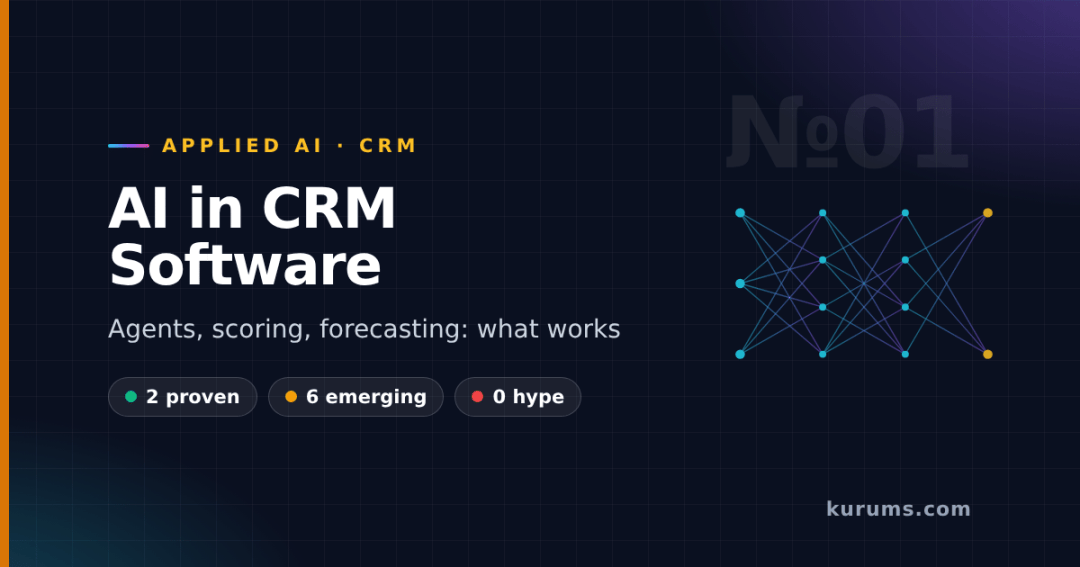
Every major CRM now sells AI agents alongside seats. Scoring, call analysis and forecasting are mature; autonomous selling is not, and the pricing models are shifting under buyers' feet.
- Proven: predictive lead scoring, conversation intelligence and AI-assisted forecasting have years of adoption and are now bundled into mainstream CRM plans.
- Emerging: inbound qualification agents, AI-drafted outreach and automatic CRM updates are shipping at scale, but most results are vendor-reported and lack baselines.
- Hype: the idea that autonomous agents can replace an outbound SDR team. Salesforce's own pilot produced a reply rate of roughly 1.5% across 156,000 emails.
- Watch the meter: pricing has moved from seats to credits, per-lead fees and per-action charges, so budget for usage, not only licences.
Customer relationship management software was one of the first business categories to add machine learning, with lead and opportunity scoring arriving in the late 2010s. In 2026 the pitch has changed. Vendors no longer sell a score next to a record; they sell agents that research prospects, write emails, book meetings and update the pipeline on their own.
The money is real. Salesforce reported Agentforce annual recurring revenue above $1.5 billion in its quarter to July 2026, and HubSpot told investors that nearly 17,000 customers had activated its Prospecting Agent. Yet Gartner predicted in July 2026 that by 2028 fewer than 40% of sellers will say AI agents improved their productivity.
This article looks at how eight CRM and sales software companies apply AI inside their products, which use cases have evidence behind them, what the published pricing looks like as of 11 October 2026, and what a CFO or sales leader should check before signing.
Where AI sits in the sales workflow
Each step of the CRM and sales workflow, what the software now does with AI, and how mature it is.
How is AI used in CRM software today?
AI in CRM software now works at three levels. The oldest is prediction: models trained on a company's won and lost deals score leads and opportunities. Zoho lists conversion, deal-closing and churn predictions in its Professional edition, and Pipedrive's AI Sales Assistant predicts a deal's win probability and suggests next steps.
The second level is generative assistance. Large language models summarise email threads, draft follow-ups and answer questions in plain language. Ask Attio, launched in February 2026, lets users update pipeline by describing what happened on a call; Microsoft's Sales Research Agent answers questions about sales data without a pre-built dashboard.
The third level is agents that act. Salesforce's Piper qualifies inbound leads and books meetings, HubSpot's Prospecting Agent can send outreach autonomously once a team switches off review, and Microsoft's Sales Qualification Agent researches each lead and starts personalised outreach. This is where most of the 2026 marketing spend, and most of the uncertainty, sits.
Can AI agents really qualify leads and book meetings?
They can, at a modest rate. Salesforce published results from using its own lead-nurturing agent between July and October 2025: 68,000 dormant leads re-engaged, 156,000 emails sent, 2,400 replies and 800 meetings booked autonomously. That is useful pipeline from leads no human was working, but it also implies a reply rate of about 1.5%.
Microsoft reports that a Sandvik Coromant pilot of its Sales Qualification Agent saved more than 120 hours and $19,000 in three weeks. The agent runs on GPT-4.1 mini, chosen for lower cost per lead, and offers a research-only mode that hands sellers just the leads that match the ideal customer profile.
At Dreamforce in September 2026 Salesforce split the role in two. Piper, for inbound qualification, is generally available; Hunter, an outbound agent built on a new long-horizon runtime that keeps context across weeks-long deal cycles, is in pilot with general availability planned for November 2026.
- Inbound agents work on warm leads that have already shown interest, so results are easier to measure.
- Outbound agents rely on cold contact and generic personalisation, where reply rates are low across the industry.
- Most vendors offer a human-review mode; start there and switch to autonomous sending only with evidence.
Which software vendors are applying AI in CRM & Sales, and how well?
The cards below describe each product as shipped on 11 October 2026: what the AI does, how it is built, what it costs where a price is published, and the best evidence we found that it works. No vendor paid to appear and the order is not a ranking.
Agentforce Sales (formerly Einstein)
- What
- Agents that qualify inbound leads (Piper), research and work outbound accounts (Hunter, in pilot), coach reps and update opportunities inside Sales Cloud.
- How
- Agents are configured in Agentforce Builder, grounded in CRM and Data 360 records plus company content, with guardrails on when and how they contact leads.
- Price
- Agentforce add-on for Sales $125/user/month; Flex Credits $500 per 100,000 credits; Agentforce 1 Editions from $550/user/month (as listed on 11 Oct 2026).
- Proof
- Salesforce's own nurturing pilot booked 800 meetings from 68,000 leads (vendor-reported); Agentforce ARR above $1.5bn, per Q2 FY27 results.
Breeze agents and Breeze Assistant
- What
- Prospecting, Data and Customer agents plus an assistant that researches accounts, scores them against the ideal customer profile and drafts outreach in each rep's voice.
- How
- Agents run on HubSpot's unified CRM data and buy enrichment from providers such as ZoomInfo and Apollo; usage is metered through HubSpot Credits.
- Price
- Prospecting Agent $1 per lead it recommends outreach for, paid in HubSpot Credits; some plans include monthly credits (as listed on 11 Oct 2026).
- Proof
- Nearly 17,000 customers activated the Prospecting Agent and 16,000+ the Data Agent, according to HubSpot's Q2 2026 earnings call.
Dynamics 365 Sales agents and Copilot
- What
- Sales Qualification, Opportunity, Research and Close agents that research leads, flag deal risk, answer data questions and send follow-ups.
- How
- The Qualification Agent uses GPT-4.1 mini with agentic retrieval over CRM records and SharePoint content; Copilot works across Dynamics, Outlook and Teams.
- Price
- Sales Professional $65, Enterprise $105, Premium $150/user/month billed yearly; Premium includes 1,000 Copilot Credits/user/month (as listed on 11 Oct 2026).
- Proof
- Sandvik Coromant pilot saved 120+ hours and $19,000 in three weeks, according to Microsoft.
Zia (Zoho CRM)
- What
- Predicts lead conversion, deal closing and churn, and runs agents for lead follow-up, quote generation and agent-to-human handoff.
- How
- Zoho trains its own Zia LLM in 1.3B, 2.6B and 7B parameter sizes and offers a no-code Agent Studio with access to 700+ actions across Zoho apps.
- Price
- Zia Agents carry no extra licence; Zoho-hosted LLM use up to 30 million tokens/month included, beyond that consumption-based (as listed on 11 Oct 2026).
- Proof
- No independent results published yet.
Pipedrive AI and Nova
- What
- Win-probability predictions, AI email drafting and summaries, an AI Sales Assistant, and Nova meeting briefs, transcripts and suggested CRM updates.
- How
- Nova records calls via desktop app or a visible notetaker on Zoom, Teams and Meet, then proposes field changes that reps must approve.
- Price
- Lite $14, Growth $39, Premium $59, Ultimate $79/seat/month billed annually; Nova in all plans, AI multi-email tools from Premium (as listed on 11 Oct 2026).
- Proof
- Pilot customer Snug reports Nova saves 30 to 60 minutes per sales meeting (customer-reported).
Ask Attio
- What
- A conversational layer that preps calls, updates pipeline from a description, drafts follow-ups and runs account research.
- How
- Built on what Attio calls Universal Context, a semantic index over records, emails, calls, product usage and warehouse data; suggested record changes need user approval.
- Price
- Plus $35 and Pro $79/seat/month billed annually, with 500 and 1,000 AI seat credits respectively; Enterprise custom (as listed on 11 Oct 2026).
- Proof
- Customer Lightdash says it prepares for meetings ten times faster (customer-reported).
Gong Revenue AI (Activate, Agent Builder)
- What
- Records and analyses customer calls, scores deals, predicts revenue, coaches reps and runs custom agents that monitor accounts for risk.
- How
- Agents work on Gong's conversation and CRM data under a governance layer called Revenue Harness, with MCP support to share data with other AI systems.
- Price
- Quote-based (checked 11 Oct 2026).
- Proof
- Cisco deployed 18,000 licences; early-adopting teams saw about 26% higher win rates, according to Gong.
Clari Forecast and Salesloft agents
- What
- AI forecasting, deal inspection and risk alerts combined with Salesloft cadences and research agents for accounts and people.
- How
- A shared data engine prioritises buyer signals, triggers agents and exposes forecasting signals to other AI tools through an MCP server.
- Price
- Quote-based (checked 11 Oct 2026).
- Proof
- Combined company cites 4,000+ sales teams; performance claims on its site carry no published methodology.
What does conversation intelligence add to a CRM?
Conversation intelligence records sales calls, transcribes them, links them to the right account and deal, and turns what was said into coaching, risk signals and CRM updates. Gong built the category and says it serves more than 5,000 companies; in September 2026 it reported that Cisco had deployed 18,000 Gong licences across the business.
The capability is now moving into the CRM itself. Pipedrive made Nova, its meeting assistant, generally available on 16 September 2026 in all plans at no extra cost. It prepares pre-call briefs, transcribes calls on Zoom, Teams or Google Meet, and suggests updates to deal stage, value and close date that a rep must approve.
Clari and Salesloft, which merged in December 2025, launched their own conversation intelligence in July 2026 and feed call signals into forecasting. The pattern is clear: call data is becoming an input to every other AI feature, not a separate tool.
Does AI fix CRM data entry and data quality?
Poor data is the oldest complaint about CRM, and vendors now pitch AI as the fix. Outreach's Deal Agent recommends updates to opportunity fields and, since February 2026, can apply them without rep intervention. Gong's Activity Mapper links emails and calls to the correct accounts and opportunities, and Gong Enrich, announced in September 2026, fills missing contact details through partners including ZoomInfo, Apollo and Lusha.
HubSpot's Data Agent answers questions about any contact or company from CRM records, calls, emails and documents, and HubSpot says more than 16,000 customers had activated it by mid-2026. Its Prospecting Agent enriches buying committees through providers such as ZoomInfo, Apollo, Surfe and Seamless.
The catch is circular. Agents need clean data to perform, yet they are sold as the way to get clean data. Gartner's July 2026 analysis warned that without a solid data foundation, adding agents scales the fragmentation instead of fixing it. Suggest-and-approve designs, such as Pipedrive's, are safer than silent writes.
How accurate is AI sales forecasting?
AI forecasting combines CRM fields, activity data and call signals to predict which deals will close and what the quarter will land at. Clari has sold this for years and now sits inside the merged Clari and Salesloft company, which cites more than 4,000 sales teams. Gong offers AI Deal Predictor and Revenue Predictor, and Salesforce and Microsoft include forecasting in higher editions.
Independent accuracy data is scarce. Vendor pages quote conversion and efficiency gains without methodology, and no major vendor publishes forecast error rates across its customer base. Forecasting is proven as a workflow that managers use every week, but buyers should test accuracy on their own historical quarters before trusting the number.
A practical test is simple: freeze the AI forecast at the start of a past quarter, compare it with the managers' call and the actual result, and repeat for several quarters. If the model does not beat your managers' judgement consistently, use it as a second opinion rather than the number you report to the board.
Which AI use cases in CRM & Sales software are proven, and which are hype?
Where the claims outrun the evidence
Most impressive numbers on CRM vendor sites are vendor-reported and lack baselines. HubSpot's agent page claims double-digit gains in qualified leads and win rates without saying compared with what, and the Clari and Salesloft site lists conversion and efficiency improvements with no methodology. Gartner's July 2026 forecast that fewer than 40% of sellers will feel more productive by 2028 is a useful counterweight, as is its earlier prediction that over 40% of agentic AI projects will be cancelled by the end of 2027 on cost and unclear value.
Cost is the other blind spot. Pricing now mixes seats, credits, per-lead fees and per-action charges: Salesforce sells Flex Credits at $500 per 100,000, HubSpot charges $1 per lead its Prospecting Agent works, and Microsoft meters agents through Copilot Credits. An autonomous agent working tens of thousands of dormant leads can produce a bill that is hard to forecast, while the yield, as Salesforce's own 1.2% meeting rate shows, may be small. Data quality caps everything: agents built on duplicate or stale records simply act on bad data faster.
How should a company adopt AI in CRM & Sales?
- Fix the data firstRun a deduplication and field-completeness audit before switching on any agent. Agents read and write the same records your reps do, so gaps and duplicates become wrong emails and wrong forecasts.
- Start with bundled featuresTurn on what your current plan already includes, such as scoring, call summaries and meeting notes. These carry little extra cost and give you a baseline to judge paid agents against.
- Pilot one agent on one segmentPick a contained use case, such as dormant inbound leads, and run the agent in review mode for 60 to 90 days. Keep a control group worked the old way so you can compare meetings and pipeline, not activity.
- Model the metered costTranslate credits, per-lead fees and per-action prices into a monthly figure at realistic volumes. Set spending caps where the vendor offers them and review consumption every month.
- Measure outcomes, then scaleJudge agents on qualified pipeline, win rate and forecast accuracy rather than emails sent or hours saved. Expand to autonomous mode only where the pilot beats the control group.
💡 Pro tip: Before buying an AI SDR agent, export last year's dormant leads and ask the vendor to quote the credit cost of working them. Then compare that figure with a 1 to 2% meeting rate to see whether the maths holds.
What can software companies learn from how CRM & Sales vendors build AI?
The series looks at AI from both sides of the contract. If you build software, these are the product lessons the CRM and sales vendors have paid for.
Pipedrive's Nova and Attio's suggested record changes ask the user to approve each update. That design builds trust and protects data quality, and it lets you collect approval data to improve the model before offering full autonomy.
Buyers struggle with credit systems they cannot forecast. HubSpot's move toward outcome-based pricing and spending controls, and Zoho's included token allowance, show that clear caps and outcome-linked fees reduce purchase friction.
The strongest products, from Gong to Attio, win on proprietary context: calls, emails and product usage linked to accounts. A model is replaceable; a clean, connected record of customer interactions is not.
Microsoft's published qualification benchmark and Salesforce's raw pilot numbers are more credible than unqualified percentage gains. Share methodology, sample sizes and control groups if you want enterprise buyers to believe your claims.
What are the risks of AI in CRM & Sales software?
⚠️ Before you switch it on
Privacy and regulation. Autonomous outreach to EU contacts raises GDPR questions on lawful basis and profiling, and the EU AI Act adds transparency duties for AI that interacts with people. Microsoft notes some agent data may be processed outside a customer's primary region.
Accuracy and brand damage. An agent that misstates pricing or contacts the wrong person acts at scale. Review samples of agent emails weekly and restrict what agents can promise.
Unpredictable cost. Credit and per-action pricing can grow faster than results. Without caps, a broad agent rollout can exceed the cost of the seats it was meant to save.
Platform lock-in. Agents, prompts and credits are tied to one vendor's data model. Prefer vendors with MCP or open APIs so your data and workflows can move.
Frequently asked questions
What is the most proven use of AI in CRM software?
Predictive lead and opportunity scoring and conversation intelligence have the longest track record. Both have been sold for years by Salesforce, Zoho, Gong and others, and are now included in many standard plans. Agentic features are newer and less tested.
Can an AI agent replace a sales development representative?
Not on current evidence. Agents can work leads that no human would touch, and Salesforce's pilot booked 800 meetings that way, but reply rates were around 1.5%. Most companies use agents to extend SDR capacity on low-priority leads rather than to replace the team.
How much does AI in a CRM cost?
It varies widely. Some features are bundled, such as Pipedrive Nova in all plans, while others are metered: Salesforce's Agentforce add-on for Sales lists at $125 per user per month and HubSpot charges $1 per lead its Prospecting Agent works, as listed on 11 October 2026. Always model usage-based charges at your real volumes.
Does the EU AI Act apply to CRM AI?
Most CRM uses, such as lead scoring and email drafting, are not listed as high-risk, but transparency rules apply when AI interacts with people, and GDPR still governs profiling and outreach. EU lawmakers provisionally agreed in 2026 to delay several high-risk obligations to December 2027, so check the final text with counsel.
Sources
- Salesforce — Agentforce Pricing
- Salesforce — Salesforce Delivers Record Second Quarter Fiscal 2027 Results
- Salesforce — AI for Lead Qualification: How Salesforce Uses Agentforce
- Salesforce — Dreamforce 2026 Announcements
- HubSpot — AI Prospecting Agent
- MarketBeat — HubSpot Q2 Earnings Call Highlights
- Microsoft — Dynamics 365 Sales Pricing
- Microsoft — Dynamics 365 sets the bar for agentic sales qualification on new benchmark
- Zoho — Zia Agents in Zoho CRM
- Pipedrive — Pipedrive launches Nova to turn sales meetings into CRM intelligence
- Attio — Introducing Ask Attio
- Gong — From Data to Action: Gong Debuts New Revenue AI Innovation at Celebrate '26
- destinationCRM — Clari + Salesloft Merger Creates a Revenue Intelligence Leader
- Gartner — Gartner Predicts AI Agents Will Outnumber Sellers 10 to 1 by 2028
- Sidley Austin (Data Matters) — EU Lawmakers Reach Provisional Agreement to Delay Key EU AI Act Obligations
How we judge AI in software
Proven means the feature is generally available, used by a broad customer base and backed by measurable results we could trace. Emerging means it ships but adoption or evidence is thin, mixed or only vendor-reported. Hype means the announcement, demo or marketing claim runs ahead of what customers can verify today.
Every product, price and figure was checked against vendor pages, filings or reputable reporting on 11 October 2026; vendor-reported numbers are labelled as such. No company paid for inclusion or position, and nothing here is a purchase recommendation. Product names and prices in AI software change quickly, so confirm current terms with the vendor before you buy.
Discover more from Kurums | Business Intelligence
Subscribe to get the latest posts sent to your email.