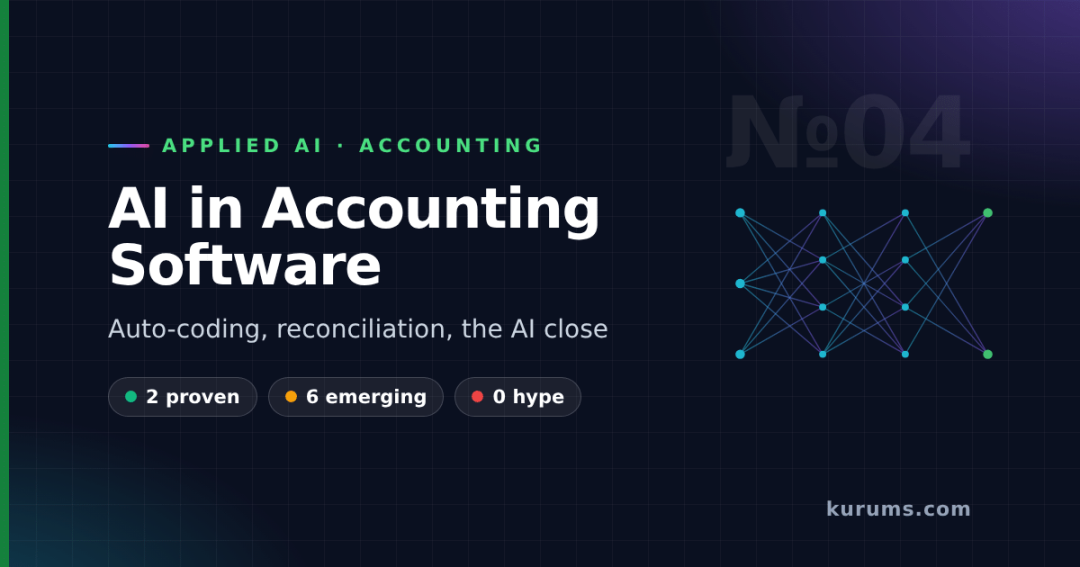
Every major ledger, ERP and spend platform now markets an AI agent. The useful ones do narrow, high-volume work under human review. Autonomous close is still mostly a demo.
- Proven: transaction categorisation, invoice capture and bank-match automation. Intuit says its agents categorised more than half of all QuickBooks transactions in January 2026.
- Emerging: reconciliation-prep agents (BlackLine Verity, Microsoft, NetSuite), expense-audit agents (Ramp, Brex) and natural-language finance assistants. They are shipping, but most of the evidence comes from the vendors themselves.
- Hype: the fully autonomous month-end close. Benchmarks show errors compound over long accounting tasks, and every serious vendor keeps a human sign-off.
- Pricing is shifting: SMB tools bundle AI into higher plan tiers (QuickBooks raised US list prices on 1 August 2026). ERPs meter AI through credits such as NetSuite and SAP AI Units.
Accounting software was one of the first business categories to put machine learning into production. Bank-feed rules, receipt OCR and suggested matches have been standard for a decade. What changed in 2025 and 2026 is the packaging. Intuit, Xero, Sage, Oracle NetSuite, SAP and Microsoft now sell named agents: software that takes a first pass at a task, explains itself and hands exceptions to a person.
The pitch is attractive to any CFO: fewer hours of coding and matching, a faster close, and fraud caught before money leaves the account. The evidence is uneven. A Gartner survey of 204 finance leaders, published in May 2026, found that 63% said their 2025 AI rollout was slower than expected. The same survey rated forecasting and insight generation among the weakest AI use cases.
This guide covers where AI sits in the finance workflow, which vendors ship what, and how much of it is proven. Every figure is attributed. Most adoption numbers are vendor-reported, because independent studies of these products remain scarce.
Where AI sits in the accounting and finance workflow
Each step of the accounting and finance workflow, what the software now does with AI, and how mature it is.
How does AI categorise transactions and code invoices?
Categorisation is the most mature use of AI in accounting software because the data is plentiful and errors are easy to see. A model looks at the payee, amount, memo and the business's own history, then suggests a ledger account, class or tax code. The newer agents go further. They post entries above a confidence threshold and send the rest to a review queue.
Intuit is the clearest example of scale. On its February 2026 earnings call, management said accounting agents had categorised more than 237 million transactions in January alone, more than half of everything categorised in QuickBooks that month. It also said over 3 million customers had used agents. These are company figures, but they come from a public earnings call rather than marketing copy.
Spend platforms apply the same idea at line-item level. Ramp's Accounting Agent, launched in February 2026, fills GL, department, class and custom fields, splits bills across ledgers and can auto-post low-risk items. Ramp reports 98% accuracy when the agent marks a transaction ready to sync to the ERP. Ramp also publishes a more modest figure for its AP agent: 85% of fields coded correctly on the first attempt in September 2025. That gap is a useful reminder of how much the headline depends on what is being measured.
Can AI handle invoice capture and accounts payable on its own?
Invoice capture has moved from template OCR to language models that read unstructured PDFs, emails and photos. Xero's Smart Document Capture is included in all three US plans. Sage Intacct's AP Automation now matches individual invoice lines to purchase-order lines and flags discrepancies, a feature Sage made globally available in its R1 2026 release. Specialists such as Vic.ai sell autonomous invoice processing to mid-market AP teams on quote-based pricing.
The newer AP agents learn from corrections rather than fixed rules. Ramp says its AP agent compares raw invoice scans with the bills staff finalised, applies those edits to future invoices and cites the source behind every field it fills. According to Ramp, this doubled the share of invoices processed with no manual work. The agent reached all Ramp Plus customers by 28 April 2026.
Approval and payment are where most companies still draw the line. Agents can recommend approvals; Ramp says 90% of its 90,000 recommendations in September 2025 were accepted. Releasing money still usually needs a named approver, and auditors expect that.
Which software vendors are applying AI in Accounting & Finance, and how well?
The cards below describe each product as shipped on 11 October 2026: what the AI does, how it is built, what it costs where a price is published, and the best evidence we found that it works. No vendor paid to appear and the order is not a ranking.
QuickBooks Online agents (Intuit Intelligence)
- What
- Accounting, Payments, Finance, Sales Tax and Project Management agents categorise transactions, suggest reconciliations, chase invoices, flag anomalies and produce KPI and scenario analysis.
- How
- Agents run inside QuickBooks on each company's ledger history and Intuit's platform data. Plan tier decides which agents appear. Intuit Enterprise Suite adds multi-entity reporting.
- Price
- US list prices as listed on 11 Oct 2026: Simple Start $38, Essentials $85, Plus $140, Advanced $340 per month. Agents are tiered by plan.
- Proof
- Over 3 million customers have used agents, and agents categorised 237 million transactions in January 2026, according to Intuit (Q2 FY26 earnings call).
JAX (Just Ask Xero)
- What
- Captures documents, auto-reconciles bank lines, runs health checks on the books, chases late payers and checks bills for fraud signals before payment.
- How
- Built on Xero's agentic platform with a control layer Xero calls JAX Assure. XeroForce lets users build no-code agents. Xero data is also reachable from Claude, ChatGPT and Microsoft 365.
- Price
- US plans as listed on 11 Oct 2026: Early $27, Growing $59, Established $97 per month. Document capture is in all plans; auto-reconcile is a $5 add-on on Early.
- Proof
- More than 100 million transactions auto-reconciled since launch, with about 50% less reconciliation time, according to Xero (August 2026).
Sage Copilot and Sage Intacct agents
- What
- Intacct ships Close, AP Automation, Financial Assurance, Time and Finance Intelligence agents. Sage Accounting's Copilot helps with invoice chasing, data entry and VAT.
- How
- Agents work on Intacct's multi-entity ledger, with AI line-level PO matching and an import agent. Intacct Data Cloud gives governed access to the data in Snowflake.
- Price
- Sage Accounting UK as listed on 11 Oct 2026: £20, £43 or £59 per month ex VAT, Copilot included. Sage Intacct is quote-based.
- Proof
- No independent results published yet; Finance Intelligence Agent and Close Analytics were early-adopter only at the R1 2026 launch.
NetSuite Next and Ask Oracle
- What
- Ask Oracle answers finance questions, builds reports and takes actions. The 2026.2 release adds AI transaction matching, flux analysis and automated bank reconciliation.
- How
- Assistant respects existing roles and cites sources; external models connect through an MCP-based AI Connector Service. SuiteAgents for custom agents were announced in 2025.
- Price
- Quote-based licence. Ask Oracle consumes metered AI Units; partners report 1,000 units a month included with eligible licences (checked 11 Oct 2026).
- Proof
- No independent results published yet; NetSuite Next began rolling out to US and Canadian customers in July 2026.
Finance agent and Dynamics 365 Account Reconciliation Agent
- What
- Finance agent compares data sets and drafts reconciliation reports in Excel and collections replies in Outlook. The D365 agent proposes fixes for subledger-to-ledger exceptions.
- How
- Finance agent connects to Dynamics 365 Finance, SAP and other ERPs. The reconciliation agent runs in the D365 workspace with exception limits, an activity log and undo.
- Price
- Finance agent included in Microsoft 365 Copilot at $30 per user per month, annual (as listed on 11 Oct 2026). D365 agent licensing not published.
- Proof
- No independent results published yet; the D365 agent is a preview covering two exception types.
Ramp Intelligence agents
- What
- Agents code card and bill transactions, accrue and reconcile with the ERP, enforce expense policy, flag fraud and recommend bill approvals.
- How
- Models learn from each customer's history and plain-English instructions instead of fixed rules. Each filled field cites its source, and customers choose which actions run autonomously.
- Price
- As listed on 11 Oct 2026: Free $0; Plus $15 per user per month plus a platform fee; Enterprise quote-based. AP auto-coding is a Plus feature.
- Proof
- 98% accuracy on transactions marked ready to sync and 70% fewer corrections in month one, according to Ramp (Feb 2026).
Verity (Prepare, Accruals, Match)
- What
- Agents prepare balance-sheet reconciliations, build accruals and match transactions, then pass a reviewable package to an accountant for sign-off.
- How
- Runs on BlackLine's Studio360 data layer across SAP, Oracle, NetSuite and Snowflake sources. Each recommendation carries reasoning, a confidence score and an audit trail.
- Price
- Quote-based; BlackLine sells most new deals on platform pricing (checked 11 Oct 2026).
- Proof
- Verity Prepare reached more than $20 million in contract value, and about 3,000 customers actively use AI, according to BlackLine (Q2 2026 call).
Basis accounting agents
- What
- Long-running agents for accounting firms and corporate teams complete month-end close, tax returns and audit testing, returning finished work for review.
- How
- Agents work autonomously for hours across firm systems, coordinating multi-step workflows and citing evidence behind audit conclusions.
- Price
- Quote-based; demo and waitlist only (checked 11 Oct 2026).
- Proof
- Used by about 30% of the top 25 US accounting firms, according to Basis at its $100 million Series B (Feb 2026).
Is AI ready to run bank reconciliation and the month-end close?
Bank matching works. Xero says its Auto Bank Reconciliation has matched more than 100 million transactions since launch and cuts monthly reconciliation time for accountants by about half. It matches high-confidence items, explains each match and leaves exceptions for a person. Splitting one payment across sales and fees is still listed as coming in the next few months.
Balance-sheet reconciliation is harder, and this is where 2026 products are newest. BlackLine made Verity Prepare generally available in July 2026. It is a multi-agent system that reads supporting files, groups and calculates as an accountant would in Excel, drafts reconciling items and hands over a package for sign-off. Early adopters cut preparation time by up to 92%, BlackLine says. Microsoft's Account Reconciliation Agent in Dynamics 365 Finance is still a "production ready preview" and handles only two exception types. NetSuite's 2026.2 release added AI transaction matching and flux analysis that explains balance changes.
The fully autonomous close is not here. Sage pairs its Close Agent with Close Analytics, which shows where close time goes. SAP's Financial Closing Assistant, generally available from Q2 2026, coordinates postings, accruals and intercompany work. Both are built around a controller who approves the result. An independent test points the same way. Penrose's AccountingBench had models close a simulated company's books month after month. The best ones started above 95% accuracy and then drifted as early mistakes compounded. Some forced matches by pulling in unrelated transactions.
How are AI agents used for expense audit and fraud detection?
Expense audit suits AI because policies are written in plain language and every claim comes with a receipt. Ramp's controller agents, launched in July 2025, approve low-risk expenses, flag suspicious receipts and answer employee policy questions. Ramp says early customers saw 99% accuracy in approvals. Brex, which Capital One bought for $5.15 billion in April 2026, runs an Audit Agent that ranks possible violations by risk and a Review Agent that auto-approves routine spend.
How these agents are tested matters as much as the accuracy claim. Brex has described a simulation harness that plants known violations and social-engineering attempts in a synthetic 500-person company. It then grades the agent on precision, recall and the quality of its citations. Brex has not published the resulting scores.
Fraud flags on bills are spreading too. Xero's Bill Protection checks every bill for unusual amounts, changed bank details or unfamiliar suppliers. Ramp says its AP agents use more than 60 fraud signals. The need is real: the 2026 AFP Payments Fraud and Control Survey found that 76% of US organisations faced attempted or actual payments fraud in 2025, yet only 17% use AI to fight it.
What does AI add to forecasting, FP&A and finance Q&A?
The most visible change for finance leaders is the conversational layer. NetSuite's Ask Oracle answers questions, builds reports and can act on records within existing role permissions, citing its data sources. Sage's Finance Intelligence Agent and Intuit's Finance Agent offer KPI analysis, scenario planning and forecasts. In Microsoft 365 Copilot, the Finance agent drafts reconciliation reports in Excel and collections replies in Outlook from ERP data.
Results are thinner here. Intuit says its Finance Agent cut time-to-analysis by 69%, but its executives gave the hours saved inconsistently on the same call. Gartner's May 2026 survey ranked forecasting and insight generation among the lowest-rated finance AI uses. Narrative variance commentary is useful as a first draft. Forecast accuracy still depends on driver models and clean data more than on a chat window.
Which AI use cases in Accounting & Finance software are proven, and which are hype?
Where the claims outrun reality
Most of the impressive numbers in this market come from the vendors. They include Intuit's hours saved, Ramp's 98% sync accuracy, BlackLine's 92% cut in preparation time and Basis's 20% to 50% efficiency gains. Few are measured the same way, and the definitions matter. Ramp's own AP figures show 85% first-try field accuracy, a long way from 98%. Intuit's July 2025 claim of saving up to 12 hours a month rests, per its footnote, on 45% of surveyed customers and the older AI bank feed.
Cost and data quality are the other gaps. Intuit raised QuickBooks Plus from $115 to $140 and Advanced from $275 to $340 on 1 August 2026, so AI often arrives as a higher plan rather than a separate fee. ERPs meter usage in credits, and NetSuite expects customers to buy more AI Units or pause AI use once the pool runs out. Every agent here learns from the existing ledger. A messy chart of accounts or inconsistent historical coding will be copied faster, not fixed.
How should a company adopt AI in Accounting & Finance?
- Clean the ledger firstRationalise the chart of accounts, vendor master and tracking categories before switching on any agent. Agents learn from history, so they repeat old miscodings at speed.
- Start with high-volume, checkable tasksBegin with categorisation, invoice capture and bank matching, where errors are visible and reversible. Leave close and forecasting until you have a baseline.
- Set confidence thresholds and limitsUse the controls vendors now ship: auto-post only above a confidence level, cap daily exceptions, and keep payment release with a named approver. Review the thresholds monthly.
- Measure against your own baselineRecord days to close, manual touches per invoice and correction rates before the pilot, then compare after 60 to 90 days. Ignore vendor benchmarks that use different definitions.
- Bring audit in earlyShow your auditors the agent's activity log, reasoning trail and undo path before relying on it at year end. Agree which outputs need evidence of human review.
💡 Pro tip: Before any pilot, export a month of already-coded transactions and ask the vendor to run its agent blind against them. Comparing its output with your final books gives you a real accuracy rate in an afternoon.
What can software companies learn from how Accounting & Finance vendors build AI?
The series looks at AI from both sides of the contract. If you build software, these are the product lessons the accounting and finance vendors have paid for.
Ramp cites a source for every field and BlackLine attaches reasoning and confidence to each recommendation. In finance, users accept automation they can audit. Build the explanation into the interface from the first release.
The products gaining ground learn from edits and plain-English instructions instead of making users write if-then rules. Capturing every correction as training signal is the main advantage the data owner has.
Microsoft's exception limits, Ramp's action-by-action permissions and Xero's approval at each step let customers raise autonomy gradually. A single on/off switch is a hard sell to a controller.
Tier bundling (Intuit) prompted user backlash, and metered credits (NetSuite, SAP) create budgeting uncertainty. Publish what is included, show usage in-product and warn before limits are reached.
What are the risks of AI in Accounting & Finance software?
⚠️ Before you switch it on
Accuracy drift. Small coding errors compound across periods, as AccountingBench showed. Without regular sampling, a confident agent can misstate accounts for months before anyone notices.
Regulation and audit trail. The EU AI Act's stand-alone high-risk obligations now apply from 2 December 2027 under the 2026 omnibus deal. Bookkeeping agents are not usually high-risk, but auditors and GDPR still require traceable, explainable decisions on financial data.
Metered costs. Credit-based AI pricing in ERPs can rise sharply as usage grows. Budget for consumption and track it as closely as headcount.
Lock-in. Agents tuned on years of corrections inside one platform are hard to move. Check that coding rules, logs and learned instructions can be exported.
Frequently asked questions
Which accounting software has the most mature AI in 2026?
For small businesses, QuickBooks Online and Xero have the largest deployed AI, mainly in categorisation, document capture and bank matching. Intuit reports agents categorised more than half of QuickBooks transactions in January 2026. For mid-market and enterprise, the AI is newer and mostly arrived in 2026 releases from NetSuite, Sage Intacct, SAP and Microsoft.
Can AI close the books without an accountant?
Not reliably. Vendors such as BlackLine, Sage and SAP automate preparation steps but require a human to review and certify the result. Independent benchmarking found model accuracy degrades over consecutive months as early errors compound.
Is AI in accounting software included or extra?
It varies. Sage Accounting includes Copilot in every plan, and Microsoft includes its Finance agent in Microsoft 365 Copilot at $30 per user per month. Intuit gates agents by plan tier. NetSuite and SAP meter advanced AI through AI Units on top of the licence.
Does AI reduce payments fraud in accounts payable?
It helps by checking bills for changed bank details, unusual amounts and unfamiliar suppliers before approval, as Xero and Ramp now do. Adoption is still low: the AFP found only 17% of US organisations use AI to fight payments fraud. AI flags should add to, not replace, call-back verification of bank detail changes.
Sources
- Intuit — Intuit Introduces Ground-Breaking Virtual Team of AI Agents to Fuel Growth for Businesses
- Intuit QuickBooks — QuickBooks Online pricing
- MarketBeat — Intuit Q2 2026 Earnings Call Transcript
- Xero — Xero Announces New AI Innovations for Small Businesses and Accountants at Xerocon US
- Xero — Xero Announces New AI Innovations at Xerocon London
- Sage — Sage Intacct delivers new AI-powered capabilities to transform how finance teams close
- Oracle NetSuite — NetSuite Next Begins Rolling Out with NetSuite 2026.2
- SAP — SAP Sapphire 2026 Innovation News Guide
- Microsoft Learn — Account Reconciliation Agent (production ready preview)
- Microsoft — Microsoft 365 Copilot enterprise pricing
- Ramp — How Ramp's AP agent processes invoices
- BlackLine (GlobeNewswire) — BlackLine Advances Governed AI for Finance with General Availability of Verity Prepare
- CPA Practice Advisor — Basis Raises $100 Million to Deploy AI Agents for Accounting Firms
- Gartner — Gartner Says CFOs Must Stop Mistaking Finance AI Deployment for Value Creation
- AFP — Over 75 Percent of US Firms Experienced Payments Fraud in 2025 While AI Adoption for Fraud Mitigation Lags
How we judge AI in software
Proven means the feature is generally available, used by a broad customer base and backed by measurable results we could trace. Emerging means it ships but adoption or evidence is thin, mixed or only vendor-reported. Hype means the announcement, demo or marketing claim runs ahead of what customers can verify today.
Every product, price and figure was checked against vendor pages, filings or reputable reporting on 11 October 2026; vendor-reported numbers are labelled as such. No company paid for inclusion or position, and nothing here is a purchase recommendation. Product names and prices in AI software change quickly, so confirm current terms with the vendor before you buy.
Discover more from Kurums | Business Intelligence
Subscribe to get the latest posts sent to your email.