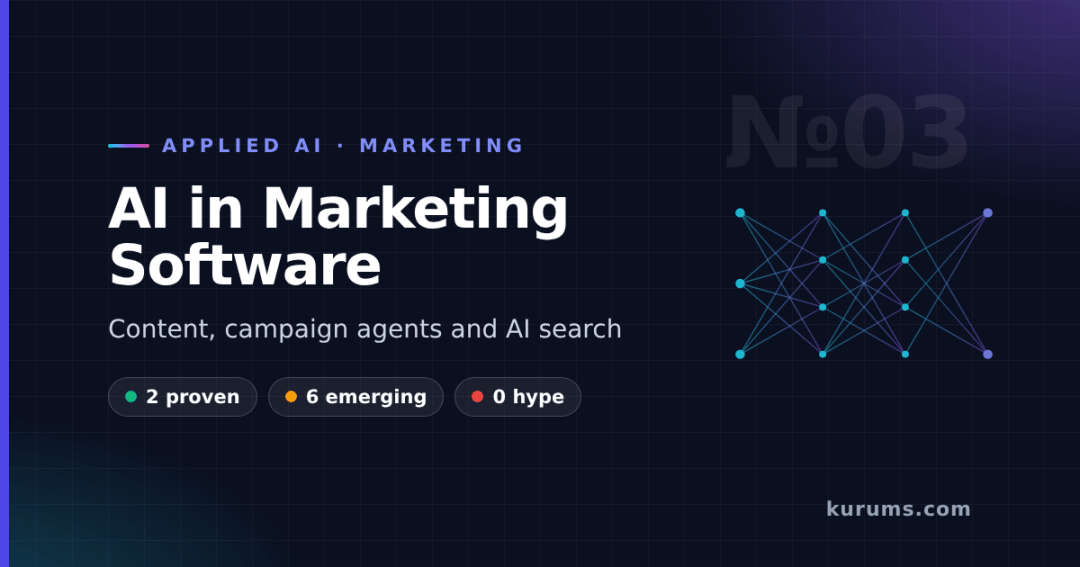
AI in marketing software has moved from copy assistants to agents that plan campaigns and to tools that track brands inside ChatGPT. Some of it is proven at scale; much of it shipped this year and has yet to show results.
- Proven: ad-platform automation (Meta Advantage+, Google Performance Max and AI Max), predictive segmentation and high-volume copy and image variants. These have years of data behind them.
- Emerging: campaign agents from Salesforce, HubSpot, Klaviyo and Adobe. Most reached general availability or public beta in 2025–26, and their published results are mostly vendor-reported.
- AI search visibility (AEO/GEO) is the new category of 2026. HubSpot, Semrush (now owned by Adobe), Ahrefs and Jasper all sell it. Answers vary so much from run to run that a single visibility score needs careful reading.
- Costs are moving to credits and per-outcome pricing. Budget for consumption, not just seats, and check which generative models carry IP indemnity.
Marketing was the first business function where generative AI produced work people could use. Draft emails, ad variants and product descriptions are cheap to produce and easy for a human to check. By October 2026, almost every marketing platform has gone further. Vendors now sell agents that turn a goal into a full campaign, models that predict which customers will churn, and dashboards that show how often ChatGPT or Gemini mentions your brand.
Ambition still outruns evidence. In a Gartner survey of 402 CMOs (fielded August to October 2025), leaders expected AI to automate 16% of marketing work in 2026 and 36% by 2028. Eighty per cent said staff fear and anxiety hold back experimentation. The tools are arriving faster than organisations can absorb them.
This article looks at how eight vendors build AI into their products: Adobe, Salesforce, HubSpot, Klaviyo, Canva, Jasper, Semrush and Meta, with Google and Ahrefs covered alongside. It explains how the features work and what they cost where prices are published. Each one gets a proven, emerging or hype verdict.
Where AI sits in the marketing workflow
Each step of the marketing workflow, what the software now does with AI, and how mature it is.
How are marketing platforms using generative AI to produce on-brand content?
Generating content is now a basic feature. Competition has moved to governance: making thousands of variants that respect brand rules, legal claims and channel formats. Adobe GenStudio for Performance Marketing stores brand voice, tone and channel rules taken from brand guidelines. It checks ads and emails for brand voice, accessibility and regulatory standards before launch. It then pushes approved assets to Meta, LinkedIn, Google Campaign Manager 360 and Marketo Engage. Adobe names Firefly, Azure OpenAI and Google's Veo as the models behind it. In May 2026 it added a connection for building ads that run in ChatGPT.
Adobe's own marketing team is its showcase customer. Adobe reports cutting the time to create emails by 96%. It says an onboarding campaign went from 27 days of creation time to one, and the campaign's click-through rate rose 84% quarter on quarter. These are vendor-reported internal results, not independent ones, but they show where the savings come from: fewer handoffs, not better prose.
Canva targets the same problem for smaller teams. Canva AI 2.0 launched as a research preview in April 2026. It turns prompts into editable designs, and a Brand Intelligence feature applies a company's fonts, colours and style. Canva's Business plan includes 100 brand kits with approval workflows. Jasper puts brand voices, style guides and audience profiles into a shared context layer called Brand IQ that applies to every output, and it routes work across several third-party language models.
- Adobe GenStudio: brand rules, pre-flight compliance checks, direct activation to ad platforms
- Canva AI: prompt-to-design with Brand Intelligence and approval workflows
- Jasper: Brand IQ context layer, 100+ prebuilt marketing agents, no-code Studio for custom agents
What can AI campaign agents in Salesforce, HubSpot and Klaviyo actually do?
The headline feature for 2026 is the campaign agent. You describe a goal and the software drafts a brief, audiences, a journey and the content. Salesforce rebranded Marketing Cloud as Agentforce Marketing. Its Marketing Cloud Next editions include Agentforce Campaign Creation, which generates briefs, recommended audiences, journeys and on-brand content from a natural-language goal. A segment builder turns a plain-language audience description into segment rules without SQL. The agents depend on Data 360, Salesforce's unified data layer. Without clean, unified data they have little to work with.
HubSpot renamed Breeze Studio to Agent Hub in July 2026, and custom agents now consume HubSpot credits. Content Agent and Nurture Agent appeared in Marketing Hub Professional in beta in September 2026, with a Campaign Agent alongside them. On its Q2 2026 call, HubSpot said more than 55% of Professional and Enterprise customers use its agents or Breeze Assistant. It also said monthly agentic actions had more than tripled during the year. Both figures are vendor-reported.
Klaviyo's Composer went into public beta on 30 June 2026. It audits a brand's live campaigns, flows and segments, ranks revenue opportunities and builds email and SMS campaigns. Nothing goes live without approval. Klaviyo's main published example is qualitative: one beta brand found automations in its 113-flow library competing for the same customers. That kind of audit is a sensible early use for agents, because it finds problems for a human to fix rather than acting on its own.
Which software vendors are applying AI in Marketing, and how well?
The cards below describe each product as shipped on 11 October 2026: what the AI does, how it is built, what it costs where a price is published, and the best evidence we found that it works. No vendor paid to appear and the order is not a ranking.
GenStudio for Performance Marketing + Experience Platform agents
- What
- Generates brand-compliant copy, image and video variants for paid social, display and email, then activates them on ad platforms. Experience Platform agents build audiences, journeys and experiments.
- How
- Brand rules and assets are stored centrally. Content uses Firefly, Azure OpenAI and Veo models and is checked before launch. The agents run on Adobe Experience Platform customer profiles and are coordinated by Agent Orchestrator.
- Price
- Quote-based (checked 11 Oct 2026). Licensed per base, which includes 10 power users and 60,000 generative actions a year.
- Proof
- Adobe reports a 96% cut in email creation time from its own internal use. Adobe AI-first ARR grew more than 150% year on year in Q3 FY2026 (company-reported).
Agentforce Marketing (Marketing Cloud Next)
- What
- Agents create campaigns from a stated goal, build segments from plain-language descriptions, personalise offers and pause underperforming paid media against set thresholds.
- How
- Built natively on the Salesforce platform and grounded in Data 360's unified profiles. Agent Builder lets teams create custom agents.
- Price
- Growth US$1,500 and Advanced US$3,250 per org per month, billed annually. Personalization add-on US$8,000 per org per month (as listed on 11 Oct 2026).
- Proof
- Agentforce ARR passed US$1.5bn company-wide in the quarter to 31 July 2026. No marketing-specific independent results published yet.
Marketing Hub with Breeze agents and AEO
- What
- Breeze Assistant and agents for content, nurture and campaigns draft assets and personalise email sequences. HubSpot AEO tracks brand visibility in ChatGPT, Gemini and Perplexity.
- How
- Agents read CRM data in HubSpot's Smart CRM and consume HubSpot credits per action. Agent Hub (formerly Breeze Studio) builds custom agents with per-agent credit limits.
- Price
- Marketing Hub Professional from US$890/month with 3 seats, Enterprise from US$3,600/month. AEO standalone US$50/month (as listed on 11 Oct 2026).
- Proof
- 32% of Marketing Hub Pro+ customers activated AEO and more than 55% of Pro+ customers use agents or Breeze Assistant (HubSpot Q2 2026 call).
Predictive analytics, Composer and Customer Agent
- What
- Predicts lifetime value, churn risk and next order date for each customer. Composer audits flows and builds email and SMS campaigns, and Customer Agent handles service conversations.
- How
- Models run on Klaviyo's real-time customer profile, fed by store order history. Composer and Customer Agent share the same data, and Composer needs approval before anything is sent.
- Price
- Plans start free. Klaviyo's own ROI calculator uses US$0.70 per AI resolution for Customer Agent. Composer pricing not published (checked 11 Oct 2026).
- Proof
- Predictive features are long-standing. Composer has qualitative beta results only (AS Beauty, SPANX, Dermalogica), per Klaviyo.
Canva AI (Magic Studio, Canva AI 2.0)
- What
- Turns prompts into editable designs across social posts, presentations and documents, applies brand kits and resizes content for each channel.
- How
- An orchestration layer coordinates Canva's own image and style models with third-party ones. Brand Intelligence applies fonts, colours and style, and connectors bring in data from tools such as Slack and Google Drive.
- Price
- Pro US$144/year, Business US$250 per person per year, Enterprise quote-based (as listed on 11 Oct 2026).
- Proof
- More than 250 million monthly users, according to Canva. The agentic 2.0 release has been a research preview since April 2026.
Jasper (agents, Brand IQ, GEO)
- What
- AI-native content platform with prebuilt agents for SEO and GEO content, campaigns, email and personalisation, all governed by shared brand context.
- How
- Brand IQ stores voices, style guides and audiences. Studio and Grid build custom agents and run content at scale across several third-party LLMs.
- Price
- Pro US$69 per seat per month, or US$59 billed yearly. Business is quote-based (as listed on 11 Oct 2026).
- Proof
- A Jasper-commissioned Forrester TEI study (Aug 2025) modelled 342% three-year ROI for a composite enterprise.
AI Visibility Toolkit
- What
- Shows how a brand appears in AI-generated answers, benchmarks competitors, finds prompts and checks whether sites block AI crawlers.
- How
- Runs tracked prompts daily through Google AI Mode and ChatGPT and analyses the brands and sources cited. Adobe is folding it into its brand-visibility stack.
- Price
- US$99/month for the toolkit. SEO plus AI Search bundles from US$199/month billed monthly (as listed on 11 Oct 2026).
- Proof
- Adobe completed its acquisition of Semrush, which has more than 28 million users, on 28 April 2026. No independent outcome results published yet.
Advantage+
- What
- Automates audience targeting, placements, budget allocation and creative selection, and generates image and video variations from advertiser assets.
- How
- Meta's ranking and recommendation models, including the LLM-based Generative Recommender, match ads to users using first-party signals and conversion data.
- Price
- No software fee. Advertisers pay for media through Meta Ads auctions.
- Proof
- Advantage+ end-to-end products passed a US$75bn annual revenue run rate in Q2 2026, per Meta.
Is predictive analytics in marketing software reliable?
Predictive scoring is the oldest and least glamorous AI in marketing, and the most proven. Klaviyo calculates predicted customer lifetime value, expected next order date and churn risk for each profile. It builds segments from those scores that update automatically, and it times each send to when that person is most likely to engage. The predictions only fill in once a profile has enough purchase history, so a new store gets little from them at first.
Enterprise suites offer the same idea at larger scale. Adobe made its Audience Agent, Journey Agent, Experimentation Agent and Data Insights Agent generally available in September 2025. At Summit 2026 it updated Audience Agent with monitoring and automatically built predictive models. Salesforce's Personalization add-on, listed at US$8,000 per org per month, includes Agentforce Personalization Decisioning for next-best-offer logic.
Reliability depends on data volume and on whether outcomes feed back into the model. Churn and CLV models trained on thousands of orders are dependable inputs for segmentation. They are weaker for low-frequency B2B purchases, where a handful of deals cannot train a stable model.
How do Meta Advantage+ and Google AI Max optimise advertising?
Ad platforms are where AI in marketing has the most commercial evidence. Meta said its Advantage+ end-to-end advertising products reached an annual revenue run rate of more than US$75 billion in Q2 2026. It also said 9 million small businesses use at least one of its AI creative tools, per its earnings call. Advantage+ automates audience, placement, budget and creative selection. Meta credits ad-ranking improvements with a 15.7% rise in conversions on Facebook in the quarter.
Google's equivalent is Performance Max, plus AI Max for Search, which adds broader query matching, automatic text customisation and landing-page selection to standard Search campaigns. Google states that advertisers typically see 14% more conversions or conversion value at similar CPA or ROAS. That figure comes from Google's internal 2025 data for non-retail advertisers. AI Max is replacing Dynamic Search Ads; agency reports put the automatic migration deadline at February 2027. At Google Marketing Live 2026, Google added AI Max for Shopping and a plain-language AI Brief.
The trade-off is control. Performance Max only added channel-level reporting in 2025 after years of advertiser complaints. When the platform that sells the media also optimises the bids, reports the results and generates the creative, buyers should run independent incrementality tests.
What are AEO and GEO tools, and should marketers pay for them?
Answer engine optimisation (AEO), also called generative engine optimisation (GEO), tracks how a brand appears in AI-generated answers. The demand is real. HubSpot says organic traffic to its customers' sites fell 27% year on year (HubSpot proprietary data). Adobe reported AI traffic to US retail sites up 269% year on year in March 2026.
Vendors moved quickly. HubSpot AEO tracks ChatGPT, Gemini and Perplexity for US$50 a month standalone, or is included in Marketing Hub Professional and Enterprise. By Q2 2026, 32% of eligible Marketing Hub customers had switched it on. Semrush's AI Visibility Toolkit costs US$99 a month, and Adobe completed its acquisition of Semrush on 28 April 2026 to feed its brand-visibility products. Ahrefs Brand Radar covers six AI surfaces from US$199 a month. Jasper added GEO agents to its Business tier.
The measurement problem is serious. A SparkToro and Gumshoe study ran 12 identical prompts nearly 3,000 times through ChatGPT, Claude and Google's AI. It found under a 1 in 100 chance of getting the same brand list twice. Treat visibility scores as trends across many prompts, not rankings, and judge any recommendation by whether it improves pages that convert.
Which AI use cases in Marketing software are proven, and which are hype?
Where the claims outrun the evidence
Most results in this field come from vendors, platforms or commissioned studies: Adobe's internal case, Meta's and Google's own lift figures, and Jasper's commissioned Forrester model. That does not make them false. It does mean nobody can see the control group. Gartner's late-2025 research, reported by Marketing Dive, found that only 5% of marketers using generative AI without agents reported significant business-outcome gains. It also placed agentic AI at the peak of inflated expectations.
Costs are also harder to predict. HubSpot moved custom agents to credit billing in July 2026. Adobe licenses generative actions by volume, Klaviyo prices service resolutions, and Salesforce's AI add-ons start at US$8,000 per org per month. Agents also inherit bad data. If customer profiles are duplicated or consent records are messy, a campaign agent will build campaigns on those errors faster than a human would.
How should a company adopt AI in Marketing?
- Start with the ad platforms you already pay forAdvantage+ and Performance Max or AI Max have the strongest evidence and no extra licence fee. Run them against a holdout or geo-split test so you measure incremental results, not the platform's own attribution.
- Fix data before buying agentsPredictive scores and campaign agents only work on clean, unified customer profiles with consent recorded. Audit duplicates, event tracking and order history before signing for Data 360, AEP or similar layers.
- Govern content generation centrallyLoad brand voice, banned claims and accessibility rules into one system, whether that is GenStudio, Canva brand kits or Jasper Brand IQ. Keep a human approval step for regulated claims and anything published under your name.
- Pilot one agent on an audit taskGive a campaign agent a task with a clear benchmark first, such as finding overlapping flows or underperforming segments. Track hours saved and revenue impact for a quarter before letting it build or launch campaigns.
- Treat AEO as research, not rankingTrack a broad set of prompts monthly with a low-cost tool, starting from about US$50–99 a month. Act on recurring source gaps and citation patterns rather than daily score swings.
💡 Pro tip: Before renewing any AI add-on, ask the vendor for a usage export showing credits consumed, actions taken and outputs approved or rejected. If they cannot supply one, you cannot judge its ROI.
What can software companies learn from how Marketing vendors build AI?
The series looks at AI from both sides of the contract. If you build software, these are the product lessons the marketing vendors have paid for.
Adobe, Canva and Jasper all compete on brand rules, approvals and compliance checks rather than raw output quality. Software companies adding generative features should build the review layer first, because that is what enterprise buyers pay for.
Klaviyo's Composer draws on purchase histories from nearly 200,000 brands, and Salesforce grounds its agents in Data 360. Adobe and Jasper use several third-party models. The lasting advantage is proprietary context, not the language model.
HubSpot's per-agent credit limits, test-run cost estimates and activity logs answer a buyer's first question about consumption pricing. Outcome pricing, such as Klaviyo's per-resolution model, is easier to sell when the outcome is easy to count.
Composer finds problems and waits for sign-off, and Salesforce's paid-media agent acts only within thresholds the marketer sets. Starting with read-only analysis builds trust before an agent is allowed to act on its own.
What are the risks of AI in Marketing software?
⚠️ Before you switch it on
EU AI Act transparency. Article 50 obligations to disclose chatbots and deepfakes apply from 2 August 2026. Machine-readable marking of AI-generated content has a grace period to 2 December 2026 for generative systems already on the market.
IP and model provenance. Adobe indemnifies outputs from its own Firefly models. Under terms effective 8 May 2026, only certain Google and OpenAI partner models get supplemental coverage, so check which model produced each asset.
Measurement controlled by the platform. When the same platform runs the auction, generates the creative and reports conversions, its attribution will tend to favour itself. Independent incrementality testing is the only reliable check.
Lock-in through data layers. Agents grounded in Data 360, Adobe Experience Platform or HubSpot's Smart CRM work best inside one vendor's stack. Switching later means rebuilding profiles, prompts and agent logic.
Frequently asked questions
What is the most proven use of AI in marketing software today?
Ad-platform automation and predictive segmentation. Meta Advantage+ and Google Performance Max carry very large ad budgets, and churn and lifetime-value scoring have been standard in email platforms such as Klaviyo for years. Generating copy and image variants is also proven, provided a human reviews the output.
Are AI marketing agents ready to run campaigns on their own?
Not yet. Salesforce, HubSpot, Klaviyo and Adobe agents draft campaigns, segments and content, but all of them keep a human approval step, and several are still in beta. Published results are mostly vendor-reported, so pilot them on narrow tasks first.
What is the difference between AEO, GEO and SEO?
SEO targets rankings in traditional search results. AEO (answer engine optimisation) and GEO (generative engine optimisation) aim to get a brand mentioned or cited in AI answers from ChatGPT, Gemini, Perplexity or Google AI Mode. The tools track prompts and citations rather than keyword positions.
How much does AI in marketing software cost?
It ranges widely. As listed on 11 October 2026, HubSpot AEO costs US$50 a month and Semrush's AI Visibility Toolkit US$99 a month. Jasper Pro is US$69 per seat a month, and Salesforce Marketing Cloud Next starts at US$1,500 per org a month. Adobe GenStudio is quote-based, and more products now add consumption credits on top of seat fees.
Sources
- Salesforce — Agentforce Marketing Pricing
- HubSpot — HubSpot puts Growth Context to work with new HubSpot AEO, Smart Deal Progression, AI agents, and 100+ updates
- The Motley Fool — HubSpot (HUBS) Q2 2026 Earnings Call Transcript
- Klaviyo — Klaviyo launches AI agents that work together to drive revenue for consumer brands
- Adobe — Customer Zero: Adobe GenStudio for Performance Marketing
- Adobe — Adobe Completes Semrush Acquisition
- Adobe (SEC filing) — Adobe Q3 FY2026 results, Exhibit 99.1
- Canva — Canva pricing
- Nasdaq — Meta Platforms Q2 earnings call highlights
- Google Ads Help — Optimize Google Ads with AI Max for Search campaigns
- Search Engine Land — AI recommendation lists rarely repeat: study
- Gartner — Gartner Survey Reveals Marketing Leaders Expect AI Automation of Marketing Work to Double to 36% by 2028
- Adobe — Partner Model product description and supplemental coverage
- Jasper — Jasper pricing
- Semrush — AI Visibility Toolkit
How we judge AI in software
Proven means the feature is generally available, used by a broad customer base and backed by measurable results we could trace. Emerging means it ships but adoption or evidence is thin, mixed or only vendor-reported. Hype means the announcement, demo or marketing claim runs ahead of what customers can verify today.
Every product, price and figure was checked against vendor pages, filings or reputable reporting on 11 October 2026; vendor-reported numbers are labelled as such. No company paid for inclusion or position, and nothing here is a purchase recommendation. Product names and prices in AI software change quickly, so confirm current terms with the vendor before you buy.
Discover more from Kurums | Business Intelligence
Subscribe to get the latest posts sent to your email.