
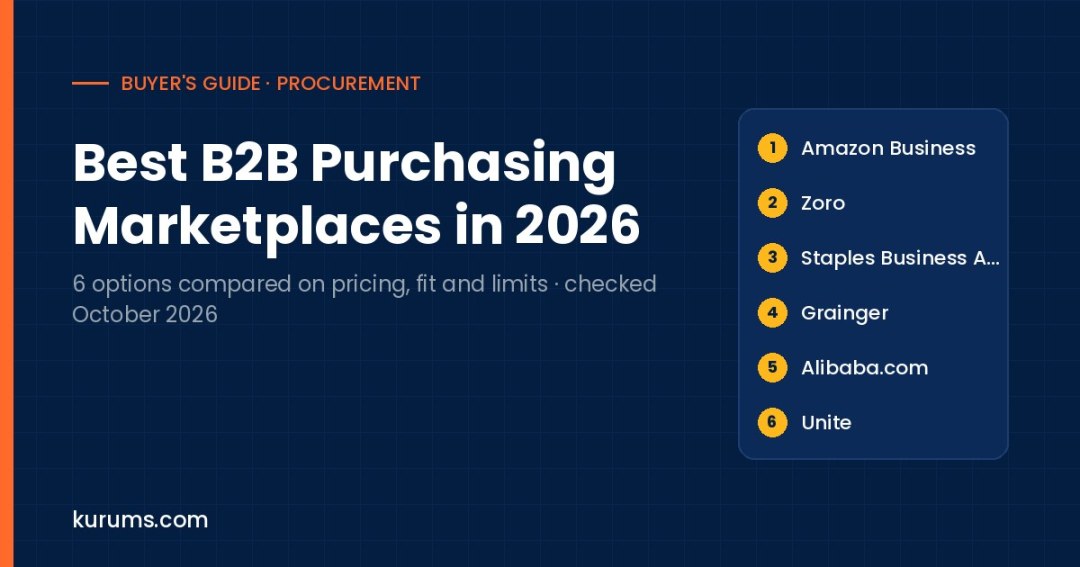
Buyer's guide · Procurement
We compared six B2B purchasing marketplaces and business buying platforms on published fees, free account options, catalog breadth, payment terms, eProcurement and punchout integration, and the main tradeoff for tail spend buyers.
- Small business or multi-site team buying everything: Amazon Business — Accounts are free, and Prime Business runs from a free Duo tier to Essentials at $179 per year for up to five users.
- Maintenance team buying MRO online at low cost: Zoro — It lists more than 13 million industrial products, free shipping on $50+ orders when signed in and Net 30 terms for qualifying buyers.
- Office, facilities and breakroom buyer: Staples Business Advantage — A free account offers everyday business pricing, spend controls and integration with over 170 purchasing platforms.
- Plant or facility needing managed MRO inventory: Grainger — It lists 1.5 million products and offers KeepStock vending, storeroom and on-site inventory services through a Grainger rep.
- European organization buying indirect goods: Unite — Formerly Mercateo, it serves business and public buyers across 11 European country sites and can connect with ERPs and Coupa.
B2B purchasing marketplaces let businesses buy indirect goods, such as office supplies, MRO parts, IT accessories, safety equipment and breakroom items, from a large online catalog with business features: tax-exempt purchasing, invoicing or payment terms, user accounts, approval rules and spend reports. Procurement teams use them to control tail spend, the long list of small, infrequent purchases that would cost more to source formally than they are worth. Some marketplaces are open multi-seller platforms; others are distributors with large catalogs. Buyers range from sole proprietors and small office managers to enterprise procurement teams that connect marketplaces to their eProcurement system through punchout, so employees shop inside approved channels.
We assessed each option on published fees, free account or trial, catalog focus, business payment terms, eProcurement and punchout integration and the main limitation we found. The list follows practical buyer order, from self-serve accounts with published pricing to sales-led and regional options; the order is not a quality ranking. Fees, terms and features were checked on official company websites on 12 October 2026. Where a company publishes no fee or terms, we say so rather than estimate. Product prices change daily, so we compare buying models rather than item prices.
B2B Purchasing Marketplaces compared at a glance
| Platform | Pricing | Best for | Link |
|---|---|---|---|
| 1. Amazon Business | Free account; Prime Business Essentials $179/yr, Small $499/yr, Medium $1,299/yr | Broad catalog with tiered membership | Site → |
| 2. Zoro | Free account; free shipping on $50+ orders when signed in | Self-serve MRO and industrial supplies | Site → |
| 3. Staples Business Advantage | Free account; negotiated pricing for larger customers | Office, breakroom and facilities supplies | Site → |
| 4. Grainger | Free account; KeepStock services quote-based via rep | MRO with managed inventory services | Site → |
| 5. Alibaba.com | Free to browse and buy; optional paid membership listed at US$199/yr | Sourcing direct from manufacturers | Site → |
| 6. Unite | Fees not published; contact sales for procurement services | European indirect procurement | Site → |
Pricing checked 12 October 2026 on each vendor's official pricing or product pages. Prices are list prices in USD unless stated; "Quote-based" means the vendor does not publish a price. Order follows buyer fit and pricing transparency, not a quality score. Confirm billing basis, minimums and taxes with the vendor before you buy. Methodology is described below.
The 6 options in detail
Amazon Business
Best for broad catalog with tiered membershipBest for: Small and mid-sized organizations, and larger teams with many buyers, that want one broad catalog with tiered business membership and controls.
| Attribute | Amazon Business |
|---|---|
| Published pricing | Prime Business: Duo free with personal Prime; Essentials $179/yr (5 users); Small $499/yr (20); Medium $1,299/yr (200); Enterprise $10,099/yr |
| Free plan or trial | Free business account; Essentials offers a 30-day free trial for eligible buyers; extended trials or fee waivers on higher tiers |
| Catalog focus | Broad multi-seller catalog across office, IT, MRO, breakroom and more |
| Payment terms and controls | 45-day terms via Business Credit Account on Small (upon approval), 60-day on Enterprise; approval workflows and Guided Buying |
| eProcurement integration | More than 200 e-procurement systems integrate with Amazon Business, per Amazon |
| Main limitation | Multi-seller catalog means product quality and seller reliability vary; Guided Buying needs setup to steer users |
- Published annual membership prices with clear user limits per tier
- Enterprise tier adds Spend Anomaly Monitoring alerts and Guided Buying restrictions on certain purchases
- Because many third-party sellers list products, buyers need Guided Buying rules and preferred-seller settings to keep purchases consistent and compliant.
Our take: Amazon Business is the default starting point for many organizations because accounts are free and the catalog covers almost every tail spend category. Prime Business adds free business delivery on eligible orders, rewards and controls, with tiers sized by users: Essentials at $179 per year for up to five users, Small at $499 for up to 20, Medium at $1,299 for up to 200 and Enterprise at $10,099 with unlimited users. Higher tiers add payment terms through a Business Credit Account and longer approval windows. For enterprise procurement, the key feature is integration: Amazon says more than 200 e-procurement systems connect to it. In a trial, test Guided Buying rules, approval routing and tax exemption setup. Compared with Zoro or Grainger, Amazon Business is broader but less specialized for MRO; compared with Unite, it is more US-centric in its published plan details.
Zoro
Best for self-serve MRO and industrial suppliesBest for: Small and mid-sized businesses and maintenance teams buying tools, safety and industrial supplies online without a sales relationship.
| Attribute | Zoro |
|---|---|
| Published pricing | No membership fee listed; product prices shown online |
| Free plan or trial | Free account; account needed for free shipping on orders of $50 or more |
| Catalog focus | 13 million+ industrial supply products from 37,000+ brands; 550,000+ stocked items |
| Payment terms and controls | Net 30 terms for qualifying customers; tax-exempt purchasing for qualifying buyers; Quick Order for bulk |
| eProcurement integration | No eProcurement or punchout details found on the pages we checked |
| Main limitation | Self-serve model with limited account management compared with full-service distributors |
- Ships stocked items from 11 distribution centers, per Zoro
- US-based customer service and a reseller program for qualifying businesses
- Zoro is built for self-serve buying, so teams that need on-site inventory services or deep eProcurement integration may need a full-service distributor.
Our take: Zoro is an online industrial supply store aimed at business buyers who know what they need and want to order quickly. The catalog lists more than 13 million products from over 37,000 brands, with more than 550,000 items stocked for shipping from 11 distribution centers. Business features are simple and useful: free shipping on orders of $50 or more when signed in, Net 30 terms for qualifying customers, tax-exempt purchasing and bulk ordering. For a small manufacturer, contractor or facilities team, that covers most MRO tail spend without a sales cycle. In a trial, check whether your common parts are stocked or drop-shipped, how Net 30 approval works and how returns are handled. Compared with Grainger, Zoro trades services such as KeepStock and account reps for a self-serve experience; compared with Amazon Business, it focuses on industrial categories with a curated brand mix.
Staples Business Advantage
Best for office, breakroom and facilities suppliesBest for: Mid-sized and large organizations, including schools, healthcare and government, standardizing office, janitorial, breakroom and furniture purchasing.
| Attribute | Staples Business Advantage |
|---|---|
| Published pricing | No membership fee; free account with everyday low pricing; promotional savings such as 3% off orders of $150+ |
| Free plan or trial | Free account with digital spend tools; no trial needed |
| Catalog focus | Office, breakroom, janitorial, technology, furniture and print |
| Payment terms and controls | Standardized products and pricing across an organization, approval workflows and free reporting and spend controls |
| eProcurement integration | Integrates with over 170 purchasing platforms, per Staples Business |
| Main limitation | Category range is narrower than multi-seller marketplaces; delivery terms are not stated on the main page |
- Next-day delivery to over 98% of the US, per Staples Business
- Focus sectors include K-12, higher education, healthcare, government and banking
- Free shipping and delivery minimums are not stated on the main business page, so confirm delivery terms and contract pricing during setup.
Our take: Staples Business Advantage, now presented as Staples Business, is the contract-buying side of Staples for organizations that buy office, breakroom, janitorial and facilities supplies at scale. A free account gives everyday business pricing, spend controls and reporting, and larger customers can standardize products and pricing across locations with approval workflows. The ability to integrate with over 170 purchasing platforms matters for enterprises that want employees to punch out from Coupa, SAP Ariba or another eProcurement tool. In a trial or setup call, ask how contract pricing is set, what delivery minimums apply to your sites, and whether your eProcurement platform is on the supported list. Compared with Amazon Business, Staples offers a narrower, more curated catalog with account management; compared with Grainger and Zoro, it covers office and facilities rather than industrial MRO.
Grainger
Best for MRO with managed inventory servicesBest for: Plants, hospitals, universities and facilities that buy MRO supplies and want inventory services, account support and eProcurement ordering.
| Attribute | Grainger |
|---|---|
| Published pricing | No membership fee listed; product prices online; KeepStock services priced through a Grainger rep |
| Free plan or trial | Free online account; no trial needed |
| Catalog focus | 1.5 million MRO products including safety, electrical, plumbing, HVAC and tools |
| Payment terms and controls | KeepStock order management includes role-based access, spend limits and approval routing |
| eProcurement integration | eProcurement and punchout details were not reachable on the pages we checked; ask your rep |
| Main limitation | Catalog is narrower than multi-seller marketplaces and some pricing depends on account agreements |
- KeepStock offers vending, point-of-use storage, on-site specialists and inventory analysis
- Grainger reports serving over 4.6 million customers worldwide
- Grainger's strongest value comes with an account relationship and services, which adds onboarding effort compared with pure self-serve stores.
Our take: Grainger is a broad-line MRO distributor with an online catalog of about 1.5 million products and a services layer that self-serve marketplaces do not offer. KeepStock is the main example: vending machines and point-of-use storage that track usage and reorder automatically, open-stock storeroom setups, on-site specialists who restock, and reporting on consumption and spend. For a plant or hospital that runs out of critical parts or loses items from open storerooms, that can reduce downtime and leakage more than shaving item prices. In a setup call, ask how account pricing compares with list prices, how KeepStock is priced and which eProcurement systems you can connect. Compared with Zoro, Grainger costs more effort to set up but offers inventory management; compared with Amazon Business, it is narrower but specialized in industrial and facilities supplies.
Alibaba.com
Best for sourcing direct from manufacturersBest for: Small businesses, resellers and product companies sourcing customized or bulk goods directly from manufacturers, mostly in Asia.
| Attribute | Alibaba.com |
|---|---|
| Published pricing | Free to browse and order; the homepage lists an optional paid membership at US$199 per year |
| Free plan or trial | Free buyer account; membership offers member prices |
| Catalog focus | Millions of offerings across 5,000+ industries; 34,000+ verified manufacturers |
| Payment terms and controls | Trade Assurance covers eligible orders with secure payment, delivery guarantee, refund and after-sales protections |
| eProcurement integration | No punchout or eProcurement integration described on the homepage |
| Main limitation | Lead times, minimum order quantities, import duties and quality checks need managing for each order |
- RFQ tool lets buyers post sourcing requirements and receive quotes from several suppliers
- Supports samples and customization from verified manufacturers
- Alibaba.com suits planned sourcing rather than urgent tail spend, because cross-border shipping, customs and supplier vetting add time and risk.
Our take: Alibaba.com is different from the other options on this page: it is a global sourcing marketplace where businesses buy directly from manufacturers and trading companies, often with customization and volume pricing. The site cites 34,000+ verified manufacturers and 50 million+ buyers, and its RFQ tool lets you post requirements and compare quotes. Trade Assurance covers eligible orders with secure payment, delivery guarantees, refunds and after-sales protection. A paid membership listed at US$199 per year offers member pricing, but basic buying is free. This fits small brands sourcing packaging, promotional items or private-label products. In a first order, ask for samples, confirm Incoterms, factor in duties and shipping time, and keep payment inside Trade Assurance. Compared with Amazon Business or Zoro, Alibaba.com can lower unit costs on large orders but is not a replacement for fast domestic delivery.
Unite
Best for European indirect procurementBest for: European companies and public bodies that want a multi-supplier marketplace for indirect, catalog-based purchasing connected to ERP or eProcurement systems.
| Attribute | Unite |
|---|---|
| Published pricing | Fees not published on the site; contact sales; prices shown net of VAT |
| Free plan or trial | Business-only purchasing; no trial terms stated |
| Catalog focus | Indirect, catalog-based goods; cites 117 million+ items from vetted European suppliers |
| Payment terms and controls | Procurement services for private and public sector buyers; details on approvals via sales |
| eProcurement integration | Customers describe ERP integration; partners embed Unite in e-procurement tools; marketplace can be brought into Coupa |
| Main limitation | Europe-focused; buyers outside the listed countries have limited options |
- Country sites include Germany, Austria, France, Italy, Spain, the Netherlands, Poland, Switzerland and the UK
- Formerly Mercateo, with the legacy Mercateo storefront still linked from Unite
- Unite does not publish buyer fees or service terms, so procurement teams need a sales conversation to understand costs and setup.
Our take: Unite, the platform formerly known as Mercateo, is a European procurement marketplace for indirect, catalog-based purchasing used by private companies and the public sector. Instead of buying from one distributor, organizations can buy from many vetted European suppliers through one platform, and Unite cites more than 117 million items. Customers describe connecting Unite to their ERP, partners offer it inside eProcurement and e-commerce tools, and the site mentions bringing the marketplace into Coupa. That fits European groups that want marketplace breadth with local suppliers, VAT handling and public-sector compliance. In a sales call, ask how supplier contracts and pricing are managed, what approval workflows exist, which country sites your entities can use and what fees apply. Compared with Amazon Business, Unite is built around European procurement processes; compared with Staples or Grainger, it is a multi-supplier platform rather than one distributor.
How to choose a B2B purchasing marketplace
Profile your tail spend first
Export twelve months of purchase card, expense and low-value PO data and group it by category, supplier and site. You will usually find that a few categories, such as office supplies, MRO, IT accessories and breakroom, make up most of the transactions. Match each category to the marketplace type that fits: broad multi-seller platforms for mixed needs, MRO distributors for industrial parts, office specialists for facilities and global sourcing marketplaces for planned bulk orders. This prevents you from forcing every purchase into one channel that fits only some of them.
Compare buying models, not item prices
Item prices change daily and vary by account, so comparing a basket at one moment can mislead. Instead, compare the model: membership fees, shipping thresholds, payment terms, rebates and the cost of managing returns. Amazon Business publishes Prime Business tiers from free to $10,099 per year, while Zoro offers free shipping on $50+ orders for signed-in accounts. Distributors such as Grainger and Staples may offer contract pricing. Run a sample basket of your top 50 items through each option after account setup, using your real account prices.
Set controls before rollout
Marketplaces make buying easy, which can increase off-policy spend if controls are missing. Before inviting users, set approval rules by amount and category, restricted categories, preferred sellers or brands, shipping addresses and tax exemption. Amazon Business offers Guided Buying and approval workflows, Staples offers standardized products and spend controls, and Grainger's KeepStock includes spend limits and approval routing. Decide who owns these settings, how often they are reviewed and how exceptions are approved, and communicate rules to users at launch.
Connect to eProcurement where it matters
If you run Coupa, SAP Ariba, Oracle or another eProcurement system, punchout lets employees shop on the marketplace and return the cart to your system for approval and PO creation. Amazon says more than 200 e-procurement systems integrate with it, and Staples Business cites over 170 purchasing platforms. Ask each provider to confirm your system and version, whether invoices arrive electronically and how returns and credits are matched. Without integration, plan how marketplace invoices or card statements will be coded in accounting.
Plan payment, tax and reconciliation
Decide how you will pay: corporate card, invoice terms or a business credit account. Payment terms such as Zoro's Net 30 for qualifying customers or Amazon's 45- and 60-day terms on higher Prime Business tiers can help working capital. Set up tax-exempt status where it applies and check how sales tax or VAT is shown on invoices. Ask whether the platform can export reconciled order and invoice data to your accounting system. This is general information, not tax or financial advice; confirm treatment with your tax adviser.
How B2B purchasing marketplace pricing works
Most B2B marketplaces are free to join, and you pay for the products you buy. Costs differ in the extras. Amazon Business sells Prime Business memberships by number of users: Duo is free with a personal Prime membership, Essentials is $179 per year for up to five users, Small is $499 for up to 20, Medium is $1,299 for up to 200 and Enterprise is $10,099 per year with unlimited users. Alibaba.com lists an optional paid membership at US$199 per year for member pricing. Distributors such as Grainger, Staples and Zoro do not charge membership fees on the pages we checked.
The bigger cost differences come from shipping rules, payment terms and contract pricing. Zoro offers free shipping on orders of $50 or more for signed-in accounts. Staples offers everyday pricing and promotions such as 3 percent off orders of $150 or more, with contract pricing for larger customers. Grainger services such as KeepStock are quoted by a rep. For cross-border sourcing on Alibaba.com, add freight, duties and inspection costs to the unit price. Unite does not publish buyer fees, so ask how service fees and supplier pricing work for your entities and countries.
To compare fairly, total each option's annual membership, shipping and return costs against your expected volume and payment terms. This is general information, not financial or tax advice.
Kurums Match: which one fits you?
Pick the situation closest to yours. Each answer jumps to the matching card above.
I manage purchasing for a 15-person company and want one account for everythingSmall team, mixed categories
Amazon Business → Amazon Business has a free account and a Small Prime Business tier at $499 per year for up to 20 users, with payment terms on approval.
Our maintenance crew needs tools and safety supplies fast without a sales repSelf-serve MRO
Zoro → Zoro lists more than 13 million industrial products, free shipping on $50+ orders when signed in and Net 30 for qualifying buyers.
We run a plant and keep running out of critical consumablesManaged MRO inventory
Grainger → Grainger's KeepStock adds vending, storeroom setups and on-site specialists who monitor and restock inventory.
Our school district wants standard office and janitorial supplies across sitesMulti-site facilities buying
Staples Business Advantage → Staples Business focuses on education, healthcare and government, with standardized products, approval workflows and spend controls.
We are a German company wanting a marketplace connected to our ERPEuropean indirect buying
Unite → Unite, formerly Mercateo, serves European business and public buyers and can be integrated into ERP and eProcurement systems.
Buying tip
Pick your 50 most frequently bought items and price them on two or three platforms using real business account pricing after signup. Include shipping, returns and payment terms, and repeat the check every six months because marketplace pricing moves often.
B2B Purchasing Marketplaces: frequently asked questions
What is a B2B purchasing marketplace?
A B2B purchasing marketplace is an online platform where businesses buy products using business features such as multi-user accounts, approval rules, tax exemption, invoicing or payment terms and spend reporting. Some are multi-seller marketplaces like Amazon Business or Unite, while others are distributors with large online catalogs such as Grainger, Zoro and Staples Business. Global sourcing marketplaces such as Alibaba.com connect buyers directly with manufacturers.
How much does Amazon Business Prime cost in 2026?
Amazon now calls the membership Prime Business. On its plans page, Duo is free with a personal Prime membership, Essentials costs $179 per year for up to five users, Small $499 per year for up to 20 users, Medium $1,299 per year for up to 200 users and Enterprise $10,099 per year with unlimited users. Essentials offers a 30-day free trial for eligible buyers. A basic Amazon Business account is free.
What is tail spend and why do marketplaces help?
Tail spend is the large number of small, infrequent purchases outside main supplier contracts, such as office items, spare parts or one-off tools. Each purchase is too small to source formally, but together they add up and are hard to control. Marketplaces help by consolidating many suppliers into one account with approval rules, standard pricing and reports, so procurement gains visibility without slowing employees down.
Can I connect a marketplace to Coupa or SAP Ariba?
Yes, most large business marketplaces support punchout, where users shop on the marketplace and return the cart to the eProcurement system for approval and a PO. Amazon says more than 200 e-procurement systems integrate with Amazon Business, Staples Business cites integration with over 170 purchasing platforms and Unite mentions bringing its marketplace into Coupa. Confirm your exact system and version with each provider.
Do B2B marketplaces offer payment terms like Net 30?
Many do, subject to credit approval. Zoro offers Net 30 to qualifying customers. Amazon Business offers 45-day terms through a Business Credit Account on the Small Prime Business tier and 60-day terms on Enterprise, upon approval. Distributors with account relationships often invoice on agreed terms. Terms affect working capital, so involve finance. This is general information, not financial advice.
Is Alibaba.com safe for business purchasing?
Alibaba.com offers protections through Trade Assurance, which covers eligible orders with secure payment, delivery guarantees, refunds and after-sales protection, and it highlights verified manufacturers. Risks remain around quality, lead times, customs and intellectual property, so order samples, use verified suppliers, keep payments inside Trade Assurance and consider third-party inspection for large orders. Check import duties and regulations with a customs adviser.
Related comparisons
Last updated 13 October 2026 · Pricing checked 12 October 2026.
Disclosure: Kurums is reader-supported through advertising. We currently have no affiliate, sponsorship or partnership relationship with any product compared on this page; if that changes, this page will say so and affected links will carry sponsored attributes.
Discover more from Kurums | Business Intelligence
Subscribe to get the latest posts sent to your email.