Buyer's guide · Procurement
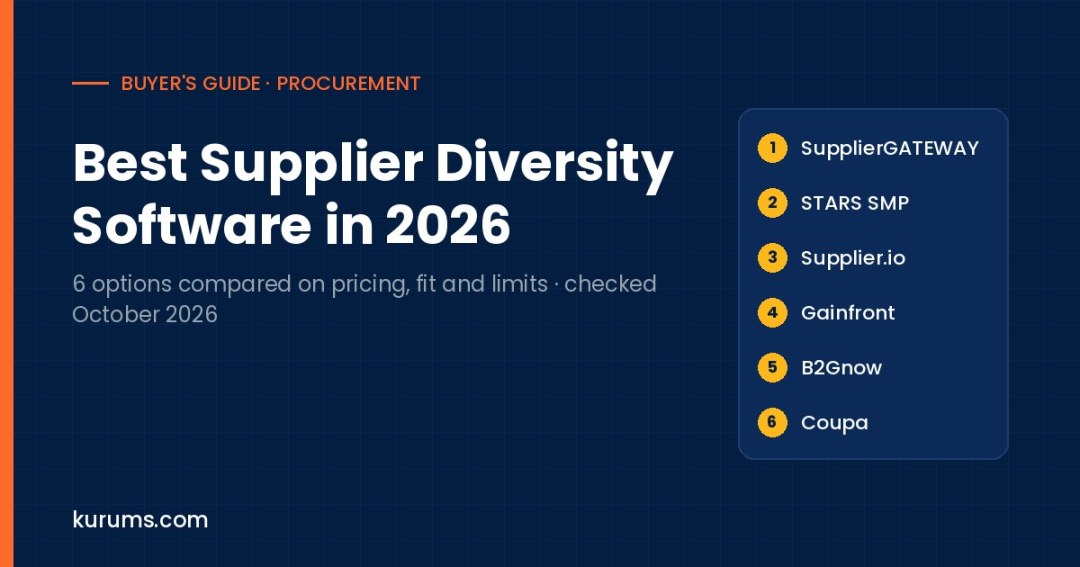
We compared six supplier diversity and supplier inclusion platforms on published pricing, supplier data and certification checks, Tier 1 and Tier 2 reporting, public-sector fit and the main tradeoff to test before buying.
- Small team starting to track supplier spend: SupplierGATEWAY — Buyers can search its database and monitor their supplier base for free, and its paid buyer plans include unlimited suppliers and seats.
- Large company wanting a branded supplier portal: STARS SMP — It offers a branded private portal with fixed pricing and unlimited users, plus Tier 2 reporting and data enrichment modules.
- Enterprise needing data enrichment plus vendor master: Supplier.io — All three quote-based packages include unlimited users, and its April 2026 TealBook acquisition added Atlas vendor master data management.
- Public agency or contractor running DBE programs: B2Gnow — It covers DBE, MBE, WBE and SBE compliance, certification management and contract goal tracking for government and contractors.
- Coupa customer wanting diversity inside its suite: Coupa — Coupa states access to a database of over 2 million certified minority-, women-, veteran- and LGBT-owned vendors within its supplier management.
Supplier diversity software helps organizations find, verify and report spending with small, minority-owned, women-owned, veteran-owned, disability-owned, LGBT-owned, local and other designated businesses. Its core jobs are enriching the vendor master with certification and ownership data, checking that certifications are current, measuring direct (Tier 1) spend, collecting indirect (Tier 2) spend from prime suppliers and producing reports for customers, government contracts or boards. Buyers include procurement teams at large companies, government agencies and contractors with small business or disadvantaged business participation requirements. In 2025 and 2026 the US policy environment around these programs changed, and many organizations reframed programs around small business, local and supplier inclusion goals, which affects how you evaluate tools.
We assessed each product on published pricing, free plan or trial, supplier data and certification checks, Tier 1 and Tier 2 reporting, public-sector and contract compliance fit, and the main limitation we found. Products are listed in practical buyer order, from free or lower-entry options toward enterprise suites; the order is not a quality ranking. Prices, plans and capabilities were checked on official vendor websites and pricing pages on 12 October 2026. Where a vendor publishes no price, we write Quote-based. We describe policy changes factually and do not take a position on them.
Supplier Diversity Software compared at a glance
| Platform | Pricing | Best for | Link |
|---|---|---|---|
| 1. SupplierGATEWAY | Free buyer search and monitoring; paid buyer plans quote-based | Teams starting with free tools | Site → |
| 2. STARS SMP | Quote-based; fixed pricing with unlimited users | Branded portals with fixed pricing | Site → |
| 3. Supplier.io | Quote-based; three packages, all with unlimited users | Enterprise data enrichment and reporting | Site → |
| 4. Gainfront | Quote-based; demo required | Diversity inside a modular suite | Site → |
| 5. B2Gnow | Quote-based; demo required | Public agencies and DBE compliance | Site → |
| 6. Coupa | Quote-based; part of Coupa suite licensing | Coupa source-to-pay customers | Site → |
Pricing checked 12 October 2026 on each vendor's official pricing or product pages. Prices are list prices in USD unless stated; "Quote-based" means the vendor does not publish a price. Order follows buyer fit and pricing transparency, not a quality score. Confirm billing basis, minimums and taxes with the vendor before you buy. Methodology is described below.
The 6 options in detail
SupplierGATEWAY
Best for teams starting with free toolsBest for: Procurement teams that want to search for verified suppliers and monitor their supplier base before committing to a paid platform.
| Attribute | SupplierGATEWAY |
|---|---|
| Published pricing | Buyer plans priced per year but amounts not shown; supplier subscriptions start at $9.99 per month |
| Free plan or trial | Buyers can search the supplier database and monitor their supplier base for free; suppliers register free |
| Supplier data and certification checks | Verified supplier profiles, data enrichment and Experian business reports on supplier plans |
| Tier 1 and Tier 2 reporting | Basic plan includes Tier 1 tracking and reporting; Premium adds Tier 2 and project diversity reporting |
| Public-sector and compliance fit | Basic plan includes Amazon Business diversity reporting and economic impact reporting |
| Main limitation | Paid buyer plan prices are not published, so the cost of moving beyond free tools needs a quote |
- Basic and Premium buyer plans include unlimited suppliers and seat licenses
- Also sells supplier onboarding and offboarding plans tiered by supplier count, from up to 2,500 suppliers
- The pricing page lists plan names and contents but no dollar amounts for buyers, so budgeting requires a sales conversation.
Our take: SupplierGATEWAY runs a two-sided platform: suppliers build one verified profile they can share with buyers, and buyers search, verify and monitor those suppliers. The free buyer entry point is useful for a team that wants to understand its current supplier mix before buying analytics. Paid buyer plans add data enrichment, Tier 1 reporting, economic impact reporting and Amazon Business diversity reporting, while Premium adds Tier 2 and project-level reporting. Named clients include Amazon, The Home Depot, DHL and Duke University. In a demo, ask how certification data is verified, how often records refresh, and what the free monitoring tier actually includes. Compared with Supplier.io or STARS, SupplierGATEWAY has the lowest-commitment way to start, and it also bundles sustainability assessments through SupplyShift on higher plans. Compared with Coupa, it is a standalone layer rather than part of a source-to-pay suite.
STARS SMP
Best for branded portals with fixed pricingBest for: Large companies and agencies that want a branded supplier portal with Tier 2 reporting, sourcing and certification workflows.
| Attribute | STARS SMP |
|---|---|
| Published pricing | Quote-based; the vendor states fixed pricing with no hidden costs and unlimited users |
| Free plan or trial | No free plan or trial listed; demo on request |
| Supplier data and certification checks | Data scrubbing and enrichment, supplier locator, supplier registration and certification application workflows |
| Tier 1 and Tier 2 reporting | Tier 1 analytics dashboards and automated Tier 2 spend reporting covering direct and indirect spend |
| Public-sector and compliance fit | Serves corporations, government and certifying agencies; contract spend compliance monitoring |
| Main limitation | Integration detail is limited on the website beyond ERP data flow for Tier 1 analytics |
- Operated by VIVA USA, which the site describes as certified woman- and minority-owned
- Customer logos and testimonials include Walmart, Kaiser Permanente, Dell and Gilead
- The website gives few specifics on ERP and source-to-pay connectors, so integration scope must be confirmed in a demo.
Our take: STARS, the Supplier Success Platform from VIVA USA, sells a branded, private portal configured for each customer, priced like a standard SaaS subscription with unlimited users. Modules cover the full program: data cleansing and enrichment, Tier 1 analytics, Tier 2 reporting, supplier sourcing, supplier registration, certification applications for certifying agencies, economic impact analysis and ESG reporting. That breadth suits organizations that run outreach events and supplier development as well as reporting. In a demo, ask which modules are included in the base price, how Tier 2 suppliers submit data and how the portal links to SAP Ariba, Coupa or Oracle if you use them. Compared with SupplierGATEWAY, STARS is more configurable as a branded program portal; compared with Supplier.io, it has less public detail on data sources but a clearer statement on fixed pricing and unlimited users.
Supplier.io
Best for enterprise data enrichment and reportingBest for: Large companies that need enriched supplier data, Tier 2 reporting, benchmarking and now vendor master data management from one vendor.
| Attribute | Supplier.io |
|---|---|
| Published pricing | Quote-based Basics, Base Platform and Advanced Platform packages; all include unlimited users |
| Free plan or trial | No free plan or trial listed; demo and free assessment offered |
| Supplier data and certification checks | Enrichment against 20M+ suppliers from 450+ sources; flags expired or unmatched certifications |
| Tier 1 and Tier 2 reporting | Tier 2 Standard, Advanced and Regions options; primes report once to multiple buyers |
| Public-sector and compliance fit | Testimonial cites support for FAR 52.219-9 small business subcontracting documentation |
| Main limitation | Packages and Tier 2 options are quote-based, so costs rise with modules and number of primes |
- Acquired TealBook on 2 April 2026 and launched Atlas for vendor master data management
- Base Platform adds supplier registration, advanced analytics and benchmarking to enrichment
- No published prices, and the TealBook integration is recent, so ask what is generally available today versus on the roadmap.
Our take: Supplier.io is one of the longest-running specialist vendors in this category and now describes itself as a supplier intelligence platform for small, diverse and sustainable suppliers. Its core service enriches your vendor file against a large supplier database, validates certifications and turns the results into dashboards and benchmarking. The Tier 2 product lets prime suppliers fill out one form and report to several customers, which reduces supplier fatigue. In April 2026 it acquired TealBook and launched Atlas, which adds legal entity resolution, deduplication and corporate hierarchies to the same data. In a demo, ask which package your reporting needs require, how often enrichment reruns and how Atlas connects to SAP Ariba or Oracle. Compared with SupplierGATEWAY, Supplier.io is aimed at larger programs; compared with Coupa, it is suite-neutral and can feed data into whichever procurement system you run.
Gainfront
Best for diversity inside a modular suiteBest for: Enterprises in utilities, construction and manufacturing that want diversity and ESG reporting alongside sourcing, contracts and procure-to-pay.
| Attribute | Gainfront |
|---|---|
| Published pricing | Quote-based; no prices listed on the website |
| Free plan or trial | No free plan or trial listed; 30-minute demo and a free procurement stack scorecard |
| Supplier data and certification checks | Certification tracking with expiry, diverse-supplier classification and supplier onboarding profiles |
| Tier 1 and Tier 2 reporting | Tier 1 and Tier 2 reporting with a prime-contractor cycle: collect, validate evidence, approve and publish |
| Public-sector and compliance fit | Industry pages for utilities and construction; economic impact and Scope 3 supplier data |
| Main limitation | Suite-oriented product; buying only the diversity module may not be the most efficient route |
- Nine modules across sourcing, contracts, procure-to-pay, inventory, diversity and ESG, and third-party risk
- Vendor says a typical single-module onboarding takes about eight weeks
- Gainfront's value is strongest when you use several modules, so a diversity-only buyer may find specialist tools simpler.
Our take: Gainfront is a source-to-pay suite with diversity and ESG built in, rather than a standalone diversity tool. Its Tier 2 process is described in practical steps: open a reporting cycle, collect prime submissions, validate evidence, resolve exceptions, approve and publish, with subcontractor spend rolled up for reporting. That fits utilities and construction firms, where prime contractors and subcontracting reports are routine and regulators or customers may ask for documentation. Gainfront also offers an orchestration layer for companies that keep existing ERPs and P2P tools. In a demo, ask whether you can start with the diversity module alone, how certification data is sourced and what the eight-week single-module estimate assumes. Compared with Supplier.io, Gainfront relies more on your process and less on a large external supplier database; compared with Coupa, it is a smaller suite with industry-specific packaging.
B2Gnow
Best for public agencies and DBE complianceBest for: State and local agencies, transit authorities, airports and contractors that manage DBE, MBE, WBE and SBE participation and certification.
| Attribute | B2Gnow |
|---|---|
| Published pricing | Quote-based; no prices listed on the website |
| Free plan or trial | No free plan or trial listed; demo on request |
| Supplier data and certification checks | Certification management and certification directories for UCPs and agencies, plus vendor sourcing |
| Tier 1 and Tier 2 reporting | Contract compliance and spend tracking by prime and subcontractor, with Power Analytics reporting |
| Public-sector and compliance fit | Built for DBE, ACDBE, MBE, WBE and SBE programs; separate labor compliance and grant modules |
| Main limitation | Public-sector focus; corporate buyers may find specialist enrichment tools a closer fit |
- Serves states, state DOTs, transit and housing authorities, airports, cities and counties, plus contractors
- Also offers eComply for certified payroll and BlackCat for grant management
- B2Gnow is designed around government program compliance, so corporate teams wanting broad supplier discovery data may need a different tool.
Our take: B2Gnow, based in Phoenix, builds compliance software for agencies and contractors that run disadvantaged and small business programs on public contracts. Its vendor management product handles certification applications and directories, contract goal tracking, subcontractor payment verification, outreach and analytics. This matters in 2026 because US Department of Transportation rules changed: an interim final rule effective 3 October 2025 removed race- and sex-based presumptions from the DBE and ACDBE programs and required certifying bodies to reevaluate certified firms. Agencies using B2Gnow will need workflows that reflect the new individualized showing of disadvantage. In a demo, ask how the system supports reevaluation, decertification notices and goal setting under current rules. Compared with Supplier.io or STARS, B2Gnow is less about corporate supplier discovery and more about documenting program compliance on public contracts. This is general information, not legal advice.
Coupa
Best for Coupa source-to-pay customersBest for: Enterprises already running Coupa that want diverse and small supplier discovery and spend tracking inside their existing suite.
| Attribute | Coupa |
|---|---|
| Published pricing | Quote-based as part of Coupa's source-to-pay licensing |
| Free plan or trial | No free plan or trial listed; demo on request |
| Supplier data and certification checks | Access to a database of over 2 million certified minority-, women-, veteran- and LGBT-owned vendors |
| Tier 1 and Tier 2 reporting | Track spending with diverse suppliers in one place and embed diversity in sourcing criteria |
| Public-sector and compliance fit | Part of supplier management with self-service supplier portal, onboarding forms and duplicate checks |
| Main limitation | Best value only if you already run or plan to run Coupa; Tier 2 collection is less prominent than in specialists |
- Diversity data sits next to onboarding, sourcing and spend in the same system of record
- Supplier portal lets suppliers update data when they receive a PO or send an invoice
- Coupa makes most sense for existing Coupa customers; it is not a lightweight standalone diversity tool.
Our take: Coupa includes diversity capabilities in its supplier management product, so companies on the Coupa suite can find certified diverse suppliers, add diversity criteria to sourcing events and track spend without exporting data to another tool. Coupa states access to a database of over 2 million certified minority-, women-, veteran- and LGBT-owned vendors. Because supplier onboarding, sourcing and invoicing already run in Coupa, reporting can draw on transaction data directly. The tradeoff is depth: specialist vendors such as Supplier.io, SupplierGATEWAY and STARS put more emphasis on Tier 2 collection, economic impact analysis and supplier development. In a demo, ask which diversity features are in your current licence, how certification data is refreshed and whether you can feed in Tier 2 data from a specialist. Many large companies combine Coupa with a specialist data provider rather than choosing one.
How to choose supplier diversity software in 2026
Start from the reports you must produce
List every report you owe: customer requirements, government subcontracting plans, board or sustainability disclosures and internal goals. Note which require Tier 1 spend, which require Tier 2 spend from primes, and which categories they track, such as small business, veteran-owned or local. This list decides whether you need enrichment only, a Tier 2 collection workflow, or a full compliance system such as B2Gnow for public contracts. In 2026 some reports changed scope or wording, so confirm the current requirements with each customer or agency before you buy.
Understand the 2025-2026 US policy changes
Executive Order 14173, signed on 21 January 2025, revoked Executive Order 11246 and requires federal contractors and grantees to certify they do not run programs that violate federal anti-discrimination law. On 3 October 2025, USDOT issued an interim final rule removing race- and sex-based presumptions from the DBE and ACDBE programs and requiring certified firms to be reevaluated. Many companies responded by reframing programs around small business, local or supplier inclusion goals. Ask vendors how their categories and reports can be configured to match your current policy. This is general information, not legal advice.
Check certification data sources and freshness
Reports are only as reliable as the certification data behind them. Ask each vendor which certifying bodies and government databases they use, how often records refresh, how expired certifications are flagged and whether self-reported status is separated from third-party certified status. Supplier.io states it validates against 450+ sources and flags expired or unmatched certifications. Ask for a sample enrichment of a few hundred of your suppliers so you can see match rates and error types before you sign.
Make Tier 2 easy for prime suppliers
Tier 2 reporting depends on prime suppliers sending data on time. Look for a single form primes can use for several customers, clear instructions, reminders and validation of uploaded certificates. Supplier.io says most primes finish their report in about ten minutes once onboarded, and Gainfront describes a structured cycle with evidence validation and approvals. Ask how many primes you can invite per package, whether managed services can chase missing reports and how the tool handles primes that only report a total figure.
Decide between a suite module and a specialist
If you run Coupa, Ivalua or another suite, check what diversity features you already license before buying more. Suites keep data in one place, but specialists often offer deeper enrichment, benchmarking and Tier 2 services. A common pattern is to use a specialist for data and Tier 2 and feed results into the suite. Ask each specialist which source-to-pay systems they integrate with and whether enriched attributes can be written back into your vendor master automatically rather than through periodic file uploads.
How supplier diversity software pricing works
Supplier diversity platforms are mostly sold as annual subscriptions on custom quotes. Price typically depends on the size of your supplier file, the modules you choose, the number of Tier 2 primes, regions and business units, and whether managed services are included. Supplier.io sells three quote-based packages that all include unlimited users. STARS states fixed pricing with unlimited users. SupplierGATEWAY lets buyers search and monitor suppliers free, with paid annual plans for enrichment and reporting; on the supplier side, its subscriptions start at $9.99 per month and basic registration is free.
Watch for the cost drivers that vary between vendors. Tier 2 programs may be priced by number of primes or regions. Enrichment may be priced by supplier count or refresh frequency. Managed services, such as chasing primes or building custom reports, are often separate. Suite vendors such as Coupa usually include diversity features in broader licences, so the incremental cost may be low if you already own the module. Ask for a quote that separates platform fees, data fees, services and implementation, and confirm what happens to your enriched data if you leave.
When comparing options, weigh the cost against the reporting obligations you actually have in 2026, which may have changed. This is general information, not financial or legal advice; confirm obligations with your legal team.
Kurums Match: which one fits you?
Pick the situation closest to yours. Each answer jumps to the matching card above.
I want to understand our supplier mix before buying a full platformLow commitment start
SupplierGATEWAY → SupplierGATEWAY lets buyers search its database and monitor their supplier base for free, with paid plans when you need reporting.
We need Tier 2 reports and benchmarking for a large enterprise programEnterprise data and Tier 2
Supplier.io → Supplier.io combines enrichment, Tier 2 reporting and benchmarking, and all packages include unlimited users.
Our agency must reevaluate DBE firms under the new USDOT rulePublic-sector compliance
B2Gnow → B2Gnow is built for DBE certification, directories and contract compliance used by state DOTs, transit authorities and airports.
We are a utility and want diversity reporting inside our procurement suiteSuite with industry focus
Gainfront → Gainfront offers Tier 1 and Tier 2 reporting within a modular source-to-pay suite with utilities and construction focus.
We already run Coupa and want diverse suppliers in sourcing eventsExisting Coupa customer
Coupa → Coupa includes access to over 2 million certified diverse vendors and spend tracking inside its supplier management.
Buying tip
Before buying, run your full vendor file through a sample enrichment from two vendors and compare match rates, expired certifications found and how each labels self-reported versus certified status. Also confirm your 2026 reporting obligations with legal first.
Supplier Diversity Software: frequently asked questions
What is supplier diversity software?
Supplier diversity software helps organizations identify and measure spending with small and designated businesses, such as minority-, women-, veteran- or disability-owned firms. It enriches the vendor master with certification data, checks that certifications are current, tracks direct spend, collects indirect Tier 2 spend from prime suppliers and produces reports. Many tools also help find new suppliers by category, location or certification.
What is Tier 2 supplier diversity reporting?
Tier 1 spend is money you pay directly to a qualifying supplier. Tier 2 spend is money your prime suppliers spend with qualifying subcontractors on work related to your contracts. Tier 2 reporting collects that data from primes, validates certifications and adds it to your totals. Platforms such as Supplier.io, STARS, Gainfront and SupplierGATEWAY Premium include Tier 2 workflows.
How did US supplier diversity rules change in 2025 and 2026?
Executive Order 14173, signed 21 January 2025, revoked Executive Order 11246 and added contractor certifications about anti-discrimination compliance. USDOT issued an interim final rule effective 3 October 2025 that removed race- and sex-based presumptions from the DBE and ACDBE programs and required reevaluation of certified firms. Requirements vary by contract and jurisdiction, so check with counsel. This is general information, not legal advice.
How much does supplier diversity software cost?
Most vendors quote annual subscriptions based on supplier count, modules, Tier 2 primes and services. Supplier.io and STARS do not publish prices but state unlimited users. SupplierGATEWAY offers free buyer search and monitoring, with paid annual buyer plans, and supplier subscriptions from $9.99 per month. Suite vendors such as Coupa bundle diversity features into broader licences. This is general information, not financial advice.
Is supplier diversity software only for US companies?
Most vendors on this page focus on US certifications and reporting, but several support other regions. Supplier.io offers a Tier 2 Regions option, and STARS mentions global capabilities. Outside the US, programs often focus on small and medium-sized enterprises, social enterprises or local suppliers. Ask vendors which countries' certification bodies and registries they cover before you assume global coverage.
Can I use supplier diversity software for small business and local spend goals?
Yes. Most platforms let you track categories such as small business, local, veteran-owned or HUBZone alongside other attributes, and you can choose which categories appear in reports. Supplier.io describes its focus as small, diverse and sustainable suppliers, and one of its testimonials references FAR 52.219-9 small business subcontracting documentation. Configure categories to match your current policy and contract requirements.
Related comparisons
Last updated 13 October 2026 · Pricing checked 12 October 2026.
Disclosure: Kurums is reader-supported through advertising. We currently have no affiliate, sponsorship or partnership relationship with any product compared on this page; if that changes, this page will say so and affected links will carry sponsored attributes.
Discover more from Kurums | Business Intelligence
Subscribe to get the latest posts sent to your email.