Buyer's guide · Procurement
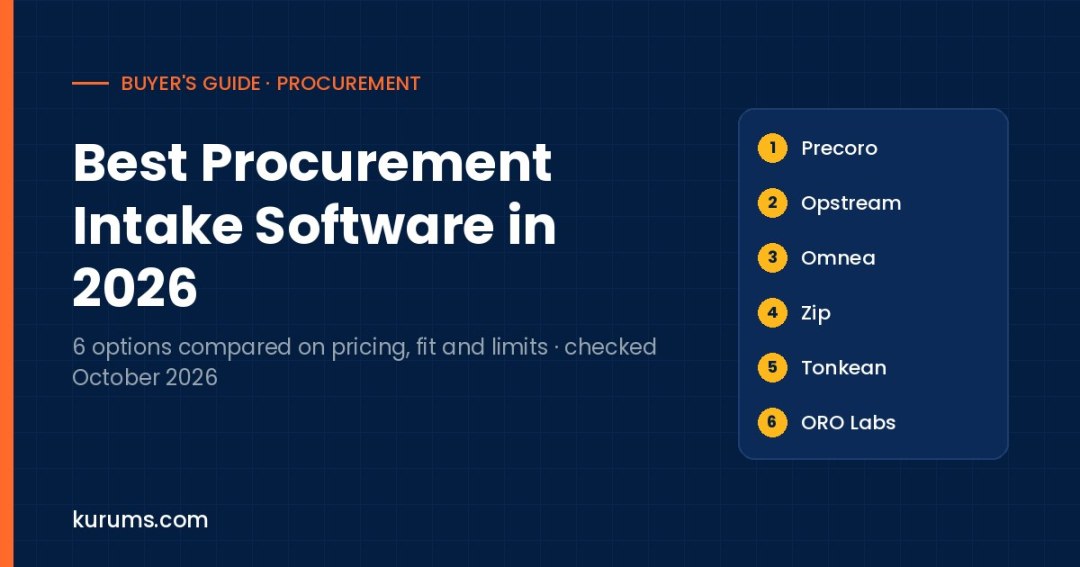
We compared six procurement intake and orchestration platforms on published pricing, request routing, AI agents, ERP and suite fit, supplier onboarding coverage and the main tradeoff a buyer should test before signing.
- Mid-sized company that wants a published price: Precoro — Core starts at $499 per month billed annually, and intake management is part of the Automation plan from $999 per month.
- Mid-to-large company with a sprawling tool stack: Opstream — Its integrations page names ERPs, CLMs, GRC, HRIS and Slack or Teams connectors, so intake can pull data from systems you already run.
- Fast-growing European or global team: Omnea — It covers intake through supplier management, raised a $50M Series B in September 2025 and lists Spotify, Wise and Adecco as customers.
- Enterprise standardizing intake-to-pay: Zip — Zip positions itself as an intake-to-pay platform, reports more than 50 AI agents and integrates with SAP S/4HANA, Oracle, Workday and SAP Ariba.
- SAP Ariba shop wanting an orchestration layer: ORO Labs — SAP announced in October 2026 that it will sell SAP Ariba Procurement Orchestration by ORO Labs, with general availability planned for November 2026.
Procurement intake software gives employees one front door for buying requests: new software, a contractor, a marketing agency, a renewal or a one-off purchase. Instead of emailing procurement or raising a ticket that nobody owns, the requester answers a guided form or types a plain-language request, and the platform routes it through budget, legal, security, privacy and finance review before a purchase order or contract is created. The category grew because classic source-to-pay suites were built for procurement staff, not for the occasional requester. Buyers are usually procurement, finance or IT leaders at companies with several hundred employees or more, multiple approvers per request and too much spend arriving without a contract or PO.
We assessed each product on published pricing, free plan or trial, how requests are captured and routed, AI agent coverage, ERP and source-to-pay suite fit, and the main limitation we found. Products are listed in practical buyer order, starting with a self-serve published price and moving toward quote-led enterprise platforms; the order is not a quality ranking. Every price, plan and capability below was checked on the vendor's official website, pricing page or press release on 12 October 2026. Where a vendor publishes no price, we say Quote-based rather than repeat third-party estimates.
Procurement Intake Software compared at a glance
| Platform | Pricing | Best for | Link |
|---|---|---|---|
| 1. Precoro | Core from $499/mo; Automation from $999/mo; billed annually | Mid-sized companies wanting published prices | Site → |
| 2. Opstream | Quote-based; pricing form asks for employee count | Teams with many connected systems | Site → |
| 3. Omnea | Quote-based; demo required | Global teams consolidating indirect spend | Site → |
| 4. Zip | Quote-based; priced on company size and needs | Enterprises standardizing intake-to-pay | Site → |
| 5. Tonkean | Quote-based; billed on average monthly tracked users | Coupa customers adding agentic intake | Site → |
| 6. ORO Labs | Quote-based; demo and value calculator | Large SAP Ariba enterprises | Site → |
Pricing checked 12 October 2026 on each vendor's official pricing or product pages. Prices are list prices in USD unless stated; "Quote-based" means the vendor does not publish a price. Order follows buyer fit and pricing transparency, not a quality score. Confirm billing basis, minimums and taxes with the vendor before you buy. Methodology is described below.
The 6 options in detail
Precoro
Best for mid-sized companies wanting published pricesBest for: Finance-led mid-sized companies, including multi-entity groups, that want intake, purchase orders and invoice matching in one tool at a published starting price.
| Attribute | Precoro |
|---|---|
| Published pricing | Core from $499 per month, Automation from $999 per month, Enterprise custom; all billed annually; AP module from $499 per month |
| Free plan or trial | No free plan or free trial listed; personalized demo on request |
| Request capture and routing | Guided smart forms, an AI agent that turns supplier quotes into requests, PunchOut catalogs and mobile submission |
| AI agents | AI agents, AI document processing and an AI assistant listed on the Automation plan |
| ERP and suite fit | QuickBooks Online, Xero, NetSuite, Sage Intacct and Dynamics 365 Business Central; ERP integrations on Enterprise |
| Main limitation | Intake management sits on the Automation plan, not Core, so the entry price does not include it |
- Published starting prices for every non-enterprise plan, which makes budgeting easier than with quote-only rivals
- Covers the full flow from purchase request to PO, receipt, invoice and 2- or 3-way matching
- Intake management, vendor onboarding and RFPs are on the Automation plan, so buyers who need guided intake should budget from $999 per month rather than $499.
Our take: Precoro is a procure-to-pay tool first, with intake added on top, which suits companies whose main pain is uncontrolled purchase requests and manual invoice matching rather than complex cross-functional review. Requesters fill out guided forms that show only relevant fields, and an AI agent can turn a supplier quote into an approval-ready request. Approved POs, receipts and invoices sync to accounting systems such as NetSuite, Xero or QuickBooks Online. In a demo, ask which features are on Core versus Automation, how many users each tier includes, since the pricing page describes tiers without exact counts, and how legal or security review steps are configured for software purchases. Compared with Zip, Omnea or ORO Labs, Precoro is narrower on orchestration across legal, security and risk tools, but it is the only product on this page with a published entry price, and it handles purchase orders and payables itself rather than relying on a separate suite.
Opstream
Best for teams with many connected systemsBest for: Procurement, legal and IT teams at mid-to-large companies that want intake workflows to pull and push data across many existing systems.
| Attribute | Opstream |
|---|---|
| Published pricing | Quote-based; the pricing page collects employee count and returns personalized pricing |
| Free plan or trial | No free plan or trial listed; demo on request |
| Request capture and routing | Intake and orchestration for new software, freelancers, vendor onboarding, renewals and periodic supplier checks |
| AI agents | Autonomous AI workflows built from your data and triggers; steps assigned to people or to the system |
| ERP and suite fit | Named connectors include NetSuite, Workday, SAP, Oracle, Coupa, SAP Ariba, DocuSign, Ironclad, Slack and Teams |
| Main limitation | No published price, and the homepage does not state a target company size |
- Unusually long published integration list across ERP, CLM, GRC, HRIS, ITSM and data validation tools
- Renewal workflows can start automatically 90 days before a renewal date
- Opstream does not publish prices or plan tiers, so you only learn cost after submitting company size details.
Our take: Opstream frames intake as a data problem: its Data Synthesizer pulls vendor data from ERPs, contract tools, HR systems and compliance platforms into one view, and workflows then use that data to decide what happens next. A typical software request in its example runs from business need and budget update through a vendor questionnaire, response analysis, legal review with redlines in the CLM, eSignature, and vendor creation in the ERP. That breadth suits companies running many SaaS tools and several review teams. In a demo, ask to see the exact connectors you use working end to end, especially your ERP and your security review tool, and how the system handles a request that changes mid-flow. Compared with Precoro, Opstream does not process POs or invoices itself; it orchestrates around them. Compared with Zip, it is lighter on native payables but its integration list is spelled out in more detail on the vendor site.
Omnea
Best for global teams consolidating indirect spendBest for: Procurement and finance teams at scaling or enterprise companies that want plain-language intake, workflows and supplier records in one AI-first platform.
| Attribute | Omnea |
|---|---|
| Published pricing | Quote-based; no prices listed on the website |
| Free plan or trial | No free plan or trial listed; demo on request |
| Request capture and routing | Unified intake in plain language, no-code approval workflows, renewal management; requests via Teams, Slack or MCP |
| AI agents | Named intake, review, approval, document review and mitigation agents with configurable human review points |
| ERP and suite fit | Claims 200+ integrations across ERP, contract and GRC tools via connectors or API |
| Main limitation | Younger vendor than suite players; check depth of PO and AP features against your needs |
- Raised a $50M Series B led by Insight Partners and Khosla Ventures in September 2025, with over $75M raised in total
- Customer list on the site includes Spotify, PayPal, Just Eat, The Adecco Group and DeepL
- PO automation, accounts payable and e-invoicing are listed as product areas, but buyers should verify maturity in a demo because Omnea started as an intake and supplier record platform.
Our take: Omnea started with one problem: giving employees one place to ask for something and giving procurement one record of every supplier. It now describes itself as an agentic operating system for procurement, with agents that draft, review and approve steps while customers set how much each agent can do without a person. A Context Engine uses past approvals and rejections to inform later decisions. That appeals to teams that want automation but need an audit trail, and the site cites SOC 2 Type II, SSO and role-based access. In a demo, test a messy request, such as a renewal with a price increase and a new data processing need, and see how the agents route legal and security review. Compared with Zip, Omnea is earlier in building payables and payments; compared with ORO Labs, it is a more self-contained product rather than a layer sold alongside a suite.
Zip
Best for enterprises standardizing intake-to-payBest for: Large and fast-growing enterprises that want one intake-to-pay platform covering requests, supplier onboarding, sourcing, contracts and payables.
| Attribute | Zip |
|---|---|
| Published pricing | Quote-based; Zip says pricing depends on company size, growth and needs |
| Free plan or trial | No free plan or trial listed; demo and ROI calculators |
| Request capture and routing | Single intake point for purchase and vendor requests with cross-team approvals and PO generation |
| AI agents | More than 50 purpose-built AI agents announced; AI agents for accounting launched in May 2026 |
| ERP and suite fit | SAP S/4HANA, Oracle, Workday, SAP Ariba, Icertis, Ironclad, DocuSign, OneTrust, Slack and Teams |
| Main limitation | Broad platform; scope and module mix drive price, so expect a structured enterprise sales process |
- Named a Visionary in the January 2026 Gartner Magic Quadrant for Source-to-Pay Suites
- Homepage reports $1T in total spend processed and $10.5B in platform savings
- Zip publishes no prices, and its add-ons such as Global Payments, Vendor Cards and Budgets add scope that you need to price separately.
Our take: Zip, which now operates from zip.com, is the most complete intake-to-pay product on this page. Requests arrive through one front door, approvals run across procurement, finance, legal, IT and security, and the platform can carry a request through supplier onboarding, sourcing, contracts and payables, with add-ons for global payments and vendor cards. Its customer list includes OpenAI, Anthropic, Snowflake, T-Mobile and Dollar Tree. Zip announced more than 50 AI agents and, in May 2026, agents for accounting tasks such as invoice coding. In a demo, ask which agents are included in your contract, how the ERP sync works for vendor master and POs, and what a phased rollout looks like if you already run SAP Ariba or Coupa. Compared with Tonkean or ORO Labs, Zip is more of a replacement platform than a layer on top of your suite, which can simplify the stack but makes migration a bigger project.
Tonkean
Best for Coupa customers adding agentic intakeBest for: Enterprises, especially Coupa customers, that want no-code intake and orchestration on top of existing systems without replacing them.
| Attribute | Tonkean |
|---|---|
| Published pricing | Quote-based; priced on average Monthly Tracked Users across the year, not named seats |
| Free plan or trial | No free plan or trial listed; demo on request |
| Request capture and routing | AI Front Door accepts plain-language requests and routes them; drag-and-drop flows for sourcing, POs and renewals |
| AI agents | AI sourcing, invoice processing, contract manager, renewal and procurement Q&A agents |
| ERP and suite fit | 250+ app connectors including Coupa, SAP and CLM tools; Coupa announced its acquisition of Tonkean in May 2026 |
| Main limitation | Roadmap is now tied to Coupa; confirm standalone availability and terms if you do not run Coupa |
- Usage-based MTU pricing means occasional requesters are not charged as full seats
- Unlimited workflows, connectors and automation are included in platform access
- Coupa announced in May 2026 that it is acquiring Tonkean to embed it natively in Coupa, and the announcement does not say how standalone customers on other suites will be served.
Our take: Tonkean built its business as a no-code orchestration layer that sits in front of existing systems: requesters use an AI Front Door, and process owners build flows and agents without waiting for IT. Its pricing model is distinctive, billing on Monthly Tracked Users, meaning people who actually interact with Tonkean in a month, averaged over the year. Named customers include Workday, Lenovo, Hyatt and Instacart. The big 2026 change is ownership: Coupa announced on 21 May 2026 that Tonkean will be natively embedded in Coupa. If you run Coupa, that is a reason to evaluate it closely. If you run SAP, Oracle or another suite, ask directly about standalone contracts, renewals and connector support. Compared with ORO Labs, which is partnering with SAP, Tonkean is now aligned with Coupa; compared with Zip, it is designed to orchestrate around your suite rather than replace it.
ORO Labs
Best for large SAP Ariba enterprisesBest for: Large enterprises, often on SAP Ariba, that want an orchestration layer for intake, supplier onboarding and risk across existing ERPs and point tools.
| Attribute | ORO Labs |
|---|---|
| Published pricing | Quote-based; no prices listed on the website |
| Free plan or trial | No free plan or trial listed; demo and an online value calculator |
| Request capture and routing | Central intake routes each request into the right compliant process under an Idea-to-Pay model |
| AI agents | ORO AI with ORO Studio agent builder; bring your own LLM or existing agents |
| ERP and suite fit | Connects ERPs, suites and point tools; SAP Ariba Procurement Orchestration by ORO Labs planned for November 2026 |
| Main limitation | Enterprise focus and orchestration scope make it heavier to deploy than a single-team tool |
- SAP and ORO Labs announced on 5 October 2026 that SAP will sell ORO as an SAP Ariba solution extension
- Site lists SOC 1, SOC 2 and ISO 42001 certification and customers such as Pfizer, Roche, BASF and Novartis
- ORO does not publish prices, and the SAP-sold version is only planned for general availability in November 2026, so contract route and timing need checking.
Our take: ORO Labs positions itself as an orchestration platform that coordinates people, systems and AI agents across procurement, from the first request through supplier onboarding and risk checks to payment. It is built to sit across existing ERPs and suites, which suits global companies that cannot rip out SAP Ariba or several regional ERPs. The site cites an 80 percent cut in supplier onboarding time and bank fraud checks as customer results, and the ORO Studio builder lets teams create agents or bring their own model. The October 2026 announcement that SAP will resell ORO as SAP Ariba Procurement Orchestration by ORO Labs matters for buying: you may be able to contract through SAP. In a demo, ask whether to buy direct or through SAP, what the November 2026 release covers, and how supplier onboarding data flows into your vendor master. Compared with Tonkean, ORO is aligned with SAP; compared with Zip, it orchestrates rather than replaces.
How to choose procurement intake software
Map your top five request types first
Before demos, list the five request types that cause the most friction, such as new SaaS, contractors, marketing agencies, renewals and hardware. For each one, write down who must approve it, which systems hold the data and what document ends the process, such as a PO or signed contract. Ask every vendor to configure those exact flows in the demo. Generic demos hide the hard parts, such as a security review that only applies above a data threshold or a legal step that loops back to the requester. The product that handles your real exceptions cleanly is usually the right fit.
Decide whether you need a layer or a replacement
Some products orchestrate around your existing source-to-pay suite, while others aim to replace parts of it. Tonkean and ORO Labs are designed as layers, and both now have close ties to a suite vendor: Coupa and SAP respectively. Zip and Precoro can run purchase orders and payables themselves. If you recently implemented Coupa or SAP Ariba, a layer protects that investment. If your current tools are fragmented or mostly spreadsheets, a broader platform may reduce total cost. Write the decision down before demos so sales teams cannot reframe the requirement.
Test AI agents with clear human checkpoints
Every vendor on this page now markets AI agents. Ask what each agent does on its own, what it drafts for a person to approve and how you limit it by spend level, category or risk. Ask for the audit log of an agent decision and whether customer data is used to train models. Omnea, for example, states it has zero data retention agreements with model providers. Agents that read contracts or questionnaires save the most time, but they also need the clearest controls, especially for supplier bank details and data protection terms.
Check ERP and vendor master sync in detail
Intake only saves time if approved requests create clean records in your ERP. Ask how a new vendor is created, which fields sync both ways, how duplicates are detected and what happens when the ERP rejects a record. Check named connectors for your exact ERP version, such as NetSuite, SAP S/4HANA, Oracle Fusion or Dynamics 365. Ask for a reference customer on the same ERP. Poor sync is the most common reason intake projects stall after launch, because finance teams start re-keying data and lose trust in the system.
Plan adoption, not just configuration
Intake tools fail when employees keep emailing procurement. Look for request channels people already use, such as Slack, Microsoft Teams or a browser extension, and for forms that hide irrelevant questions. Ask vendors for adoption metrics from comparable customers and how they measure them. Set a policy that requests outside the tool will not be paid without a PO, and agree it with finance before launch. Budget time for change management, training sessions and a short list of champions in high-spend departments such as IT, marketing and operations.
How procurement intake software pricing works
Most intake and orchestration vendors sell annual subscriptions on custom quotes. Price usually depends on company size, the number of people who submit or approve requests, the modules you add and the integrations you need. Precoro is the exception on this page, publishing Core from $499 per month and Automation from $999 per month, billed annually, with Enterprise on a custom quote. Tonkean bills on average Monthly Tracked Users, meaning people who actually interact with the platform in a month, rather than on named seats. Opstream asks for employee count before sharing a personalized price, and Zip says its pricing reflects company size, growth and needs.
Expect implementation and services to be priced separately on larger deals. Typical extras include deployment services, premium support, single-tenant hosting, additional legal entities, custom integrations and payment add-ons such as global payments or virtual cards. Ask each vendor to separate one-time setup costs from recurring fees, and ask whether AI agents are included or metered. Some products include unlimited workflows and connectors, while others charge for each additional integration. Confirm price protection on renewal, because intake platforms become hard to replace once every request and approval history lives inside them.
To compare quotes fairly, build a simple three-year total cost that includes subscription, implementation, internal admin time and any connector fees. Then compare it with the savings you expect from fewer off-contract purchases, faster cycle times and avoided auto-renewals. This is general information, not financial advice; your finance team should validate assumptions.
Kurums Match: which one fits you?
Pick the situation closest to yours. Each answer jumps to the matching card above.
I run finance at a 300-person company and need a price I can budget todayPublished pricing needed
Precoro → Precoro publishes starting prices and includes purchase orders and invoice matching, so you can budget without a long sales cycle.
We run dozens of SaaS tools and every request touches legal and securityMany systems, many reviewers
Opstream → Opstream lists detailed connectors for CLM, GRC, HRIS and ERP tools, which suits workflows that must move data across many systems.
I need one platform from request to payment for a global enterpriseEnterprise, replacement scope
Zip → Zip covers intake, onboarding, sourcing, contracts and payables, with integrations to SAP S/4HANA, Oracle and Workday.
We are a Coupa customer and want better intake without a new suiteExisting Coupa investment
Tonkean → Coupa announced it is acquiring Tonkean to embed its intake and orchestration natively, so Coupa customers can evaluate it as an extension.
Our company runs SAP Ariba and several regional ERPsSAP-centric enterprise
ORO Labs → ORO Labs orchestrates across existing systems, and SAP plans to sell it as an SAP Ariba solution extension from November 2026.
Buying tip
Ask each vendor to run one of your real past requests, including its emails and approvals, through a configured demo. Time how long it takes and count manual steps; that comparison is more useful than any feature checklist.
Procurement Intake Software: frequently asked questions
What is procurement intake software?
Procurement intake software is a front door for employee buying requests. It captures what someone needs, asks only the relevant questions, and routes the request through budget, legal, security, privacy and finance approvals before a purchase order or contract is created. Many tools also connect to ERPs, contract tools and risk platforms so data moves automatically. The goal is to bring more spend under policy while making it easier for employees to ask for what they need.
How is intake-to-procure different from a source-to-pay suite?
A source-to-pay suite covers sourcing events, contracts, catalogs, purchase orders, invoicing and payment, and is mainly used by procurement and finance staff. Intake-to-procure tools focus on the requester experience and on orchestrating reviews across departments. Some, such as Tonkean and ORO Labs, sit in front of a suite. Others, such as Zip, now cover much of the suite scope themselves. Many large companies run both: an intake layer plus an existing suite.
How much does procurement intake software cost?
Most vendors do not publish prices and sell annual contracts on quotes. On this page, Precoro is the only vendor with published entry prices, from $499 per month for Core and $999 per month for Automation, billed annually. Tonkean prices on average monthly tracked users, and Opstream and Zip base quotes on company size and needs. Ask for separate figures for subscription, implementation and add-ons. This is general information, not financial advice.
Did Coupa buy Tonkean?
Coupa announced on 21 May 2026 that it is acquiring Tonkean to accelerate agentic intake and orchestration, and said Tonkean will be natively embedded in Coupa. The announcement does not explain how customers on other suites will be served long term. If you are evaluating Tonkean without Coupa, ask the vendor in writing about standalone contracts, renewal terms and continued connector support for your systems.
Can intake software create vendors and purchase orders in my ERP?
Yes, most platforms on this page can push approved vendors and requests into ERPs such as NetSuite, SAP, Oracle or Workday, either through native connectors or APIs. The depth varies, so ask which fields sync in both directions, how duplicates are blocked and what happens when the ERP rejects a record. Ask for a reference customer on your exact ERP and version before you sign.
How long does it take to roll out procurement intake software?
Timelines depend on how many request types, approvers and integrations you include. A focused first phase covering two or three request types and one ERP connection is common, followed by more workflows. Vendors rarely publish standard timelines, so ask for a project plan with milestones, named roles and the customer effort required. Adoption work, such as training and a no-PO, no-pay policy, often takes longer than configuration.
Related comparisons
Last updated 13 October 2026 · Pricing checked 12 October 2026.
Disclosure: Kurums is reader-supported through advertising. We currently have no affiliate, sponsorship or partnership relationship with any product compared on this page; if that changes, this page will say so and affected links will carry sponsored attributes.
Discover more from Kurums | Business Intelligence
Subscribe to get the latest posts sent to your email.