
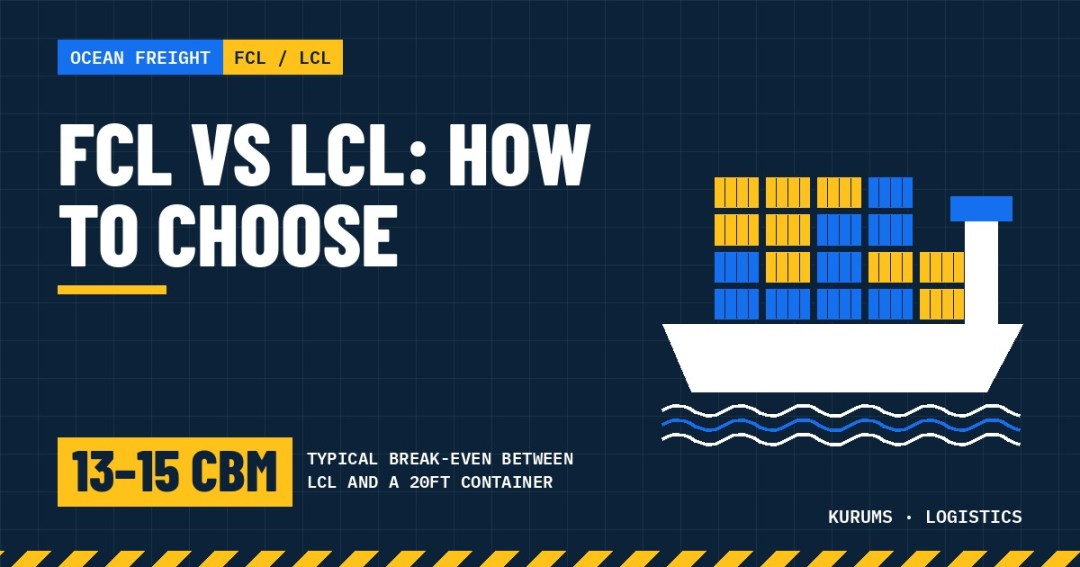
FCL is priced per box, LCL per cubic metre.
An FCL price does not change whether the container is half full or full. LCL is charged on volume or weight, whichever gives the higher figure.
The break-even is lower than the container's capacity suggests.
LCL carries per-cubic-metre charges at both ends, so a 20-foot container often wins from about 13 to 15 cubic metres.
LCL adds about a week.
Consolidation at origin and deconsolidation at destination each take several days on top of the sailing time.
Risk rises with handling.
LCL cargo is loaded and unloaded with other shippers' goods at a container freight station. FCL cargo is touched only by you and your consignee.
What do FCL and LCL mean?
They describe how much of a shipping container you are buying.
FCL, full container load, means one shipper has exclusive use of a container. You do not have to fill it. The term refers to who controls the box, not how much is inside. The container is loaded and sealed at the supplier's premises or a nearby depot, and the seal is broken at the destination.
LCL, less than container load, means your cargo shares a container with other shippers' cargo. A consolidator, usually a freight forwarder, collects many small consignments at a warehouse called a container freight station (CFS), loads them into one container and ships it as a single box. At the destination the container goes to another CFS, where it is unpacked and each consignment is released separately. The Kurums glossary covers the facility itself in container freight stations and LCL consolidation.
Ocean freight has an equivalent in every mode. On the road the same choice is LTL or groupage against a full truckload.
How much fits in a container?
Less than the internal volume, because cartons and pallets never pack perfectly. The figures below are standard dry containers; exact dimensions and payloads vary slightly by manufacturer and shipping line.
| Container | Internal volume | Practical loading volume | Euro pallets on the floor | Standard pallets on the floor |
|---|---|---|---|---|
| 20ft standard | About 33 CBM | 25 to 28 CBM | 11 | 9 to 10 |
| 40ft standard | About 67 CBM | 54 to 58 CBM | 23 to 24 | 20 to 21 |
| 40ft high cube | About 76 CBM | 65 to 68 CBM | 23 to 24 | 20 to 21 |
Two limits apply at the same time: volume and weight. A 20-foot container can usually carry more than 21 tonnes of cargo, and a 40-foot container is not rated for twice that, so dense cargo such as tiles, metal or liquids often "weighs out" in a 20-foot box long before it fills one. Road weight limits in the origin and destination countries can be lower than the container's rating. Light, bulky cargo does the opposite and "cubes out". For other equipment types, see the Kurums guide to container types and load securing.
How is each option priced?
FCL is a flat ocean freight rate per container between two ports, plus surcharges, plus local charges at each end. The same price applies whether you load 12 cubic metres or 28.
LCL is charged per freight tonne, also written W/M for weight or measure. One freight tonne is one cubic metre or 1,000 kilograms, whichever produces the larger number. Most general cargo is lighter than one tonne per cubic metre, so volume normally decides the charge. LCL also has minimums, commonly one cubic metre.
| Charge | FCL | LCL |
|---|---|---|
| Ocean freight | Per container | Per freight tonne (CBM or 1,000 kg) |
| Origin handling | Terminal handling per container | CFS charge per CBM plus documentation |
| Destination handling | Terminal handling per container | CFS and deconsolidation charges per CBM |
| Inland transport | Container haulage, a flat trip | Small-load delivery, by weight or pallet |
| Risk of storage costs | Demurrage and detention on the box | Warehouse storage at the CFS |
The line that surprises first-time importers is destination charges on LCL. They are billed to whoever collects the goods, they are per cubic metre, and they are often not shown in the supplier's or origin forwarder's quotation. Kurums explains the surcharge family in freight rates and surcharges.
Where is the break-even between LCL and FCL?
As a working rule, compare prices as soon as a shipment passes about 10 cubic metres, and expect a 20-foot container to be cheaper from roughly 13 to 15 cubic metres. The exact point moves with the market, because container rates swing far more than LCL rates do.
The method is simple. Add up the all-in LCL cost for your volume, including charges at both ends and delivery. Add up the all-in cost of a 20-foot container, including haulage. Divide the FCL total by the LCL cost per cubic metre. The answer is your break-even volume on that lane, that month.
In the illustration the lines cross just under 14 cubic metres. When container spot rates are high the crossover moves up; when they are low it moves down. Rates have been volatile: Drewry's World Container Index, a composite of spot rates on eight major routes, stood at about US$4,500 per 40-foot container in mid-September 2026, compared with about US$1,860 a year earlier. The Kurums guide to ocean freight rates explains what drives those swings.
Which is faster?
FCL, by several days and sometimes by more than a week. The sailing time is identical, since both travel on the same ships. The difference is on land.
LCL cargo has to reach the origin CFS several days before the vessel's cut-off so that the container can be packed. At the destination the box is moved to a CFS and unpacked before anything can be collected. If one consignment in the container is held for customs inspection, the others can be delayed with it. Some LCL services also route through a transhipment hub where containers are repacked, which adds more time.
Which is safer for the cargo?
FCL. A container that is sealed at origin and opened by the consignee has been handled by two parties. LCL cargo is unloaded from a truck, stored, loaded into a container alongside unknown goods, unloaded again and stored again. Each step is a chance for crushing, moisture, contamination or loss.
That does not make LCL unsafe. It makes packing matter more. LCL cargo should be palletised or crated, shrink-wrapped, clearly marked on several sides, and packed on the assumption that something heavy may be stacked on it. Declare non-stackable cargo, and expect to pay for the space above it. Insure it either way: carriers' liability under the conventions that govern sea carriage is limited and seldom covers the full value. See the Kurums guide to cargo insurance and claims.
What other options sit between LCL and FCL?
- Buyer's consolidation. If you buy from several suppliers in one region, a forwarder can collect their goods at one warehouse and load them into a single container that is yours alone. You get FCL security and pricing from several small orders.
- Air freight. For small, urgent or high-value consignments, a few hundred kilograms by air can compete with LCL once the time value of stock is counted. See air freight chargeable weight and cost.
- Rail and road. On some lanes, such as between China and Europe or within a continent, rail or road is a middle option on both price and speed.
- Express and courier. Below roughly a cubic metre, a courier service can be simpler than LCL, with customs clearance included.
Which documents and terms should you check?
The core documents are the same for both options: commercial invoice, packing list and bill of lading. With LCL, the forwarder issues a house bill of lading to you and holds the carrier's master bill of lading for the whole container. The Kurums guides to shipping documents and the ocean bill of lading explain how they work.
Check the Incoterm on your purchase contract as well, because it decides who books the freight and who pays which local charges. Under FOB the buyer arranges the ocean leg and can choose FCL or LCL. Under CIF or CFR the seller chooses, and a seller paying for freight will pick the cheapest freight rate, which is not always the cheapest landed cost for you. Buyers who ship regularly usually prefer terms that let them control the booking.
How do you decide quickly?
- Under about 10 CBM: LCL, unless the goods are fragile or urgent.
- 10 to 15 CBM: price both, all-in, including destination charges.
- Over about 15 CBM: a 20-foot container is normally cheaper.
- Over about 28 CBM: price a 40-foot container, which usually costs well under twice a 20-foot one.
- Dense cargo: check weight limits before choosing the box size.
- Several suppliers in one region: ask about buyer's consolidation.
What mistakes do first-time importers make?
Three recur. They compare the ocean freight line only and ignore local charges, which are where LCL costs accumulate. They accept the supplier's choice of forwarder without asking for the destination charges. And they forget free time: a full container that sits at the terminal or at their own premises beyond the agreed days starts to incur demurrage and detention. Ask for the free-time allowance in writing and plan unloading before the vessel arrives.
Frequently asked questions
Do I have to fill a container to book FCL?
No. FCL means you have exclusive use of the container. Many shippers book a 20-foot container for 15 to 20 cubic metres because it is cheaper, faster and safer than LCL at that volume.
What is a freight tonne in LCL pricing?
One cubic metre or 1,000 kilograms, whichever is greater. It is also written W/M, for weight or measure. Most general cargo is charged on volume.
How much longer does LCL take than FCL?
Typically several days to more than a week longer door to door, because cargo must be consolidated at origin and deconsolidated at destination. The sailing time itself is the same.
At what volume is FCL cheaper than LCL?
Often from about 13 to 15 cubic metres for a 20-foot container, but the crossover depends on the lane and on current container rates. Always compare all-in costs including destination charges.
What is a CFS?
A container freight station: a warehouse where LCL cargo from several shippers is consolidated into containers at origin and unpacked at destination.
Keep reading in the Logistics hub
- Drewry World Container Index
- Hellenic Shipping News: Drewry WCI assessment, 17 September 2026
- gCaptain: container rates edge lower as Suez traffic returns
Rates, rankings and market figures were checked in November 2026 and move quickly; confirm with the carrier, forwarder or publisher before you commit. Kurums has no paid relationship with the companies named here.
Discover more from Kurums | Business Intelligence
Subscribe to get the latest posts sent to your email.