
The all-in rate is what matters.
Base freight is only one line. Bunker, peak-season, canal and equipment surcharges plus terminal handling often add a large share on top.
Spot and contract solve different problems.
Spot buys this week's market price with no commitment. Contracts trade some upside for a known price and allocated space.
Capacity, not cost, sets the price.
Rates jump when ships are tied up on longer routes or in congested ports and fall when new vessels arrive or routes shorten.
Reliability varies widely between networks.
Sea-Intelligence measured Gemini Cooperation at 93.4% schedule reliability in May and June 2026 and Premier Alliance at 53.6%.
What is an ocean freight rate made of?
A quotation for moving a container between two ports usually has three layers, and comparing quotations means comparing all three.
| Layer | What it covers | How it is charged |
|---|---|---|
| Base ocean freight | Carriage from port of loading to port of discharge | Per container, by size and type |
| Carrier surcharges | Fuel, peak demand, canal tolls, equipment imbalance, risk | Per container or per TEU, set by the carrier |
| Local charges | Terminal handling, documentation, seals, release fees | Per container or per bill of lading, at each end |
Rates are quoted per TEU (twenty-foot equivalent unit) or FEU (forty-foot equivalent unit). A 40-foot container counts as two TEU but does not cost twice as much as a 20-foot one. Add inland haulage, customs clearance and insurance and you have the landed cost of the freight leg. If you are still deciding whether to book a whole container at all, start with FCL vs LCL.
What is the difference between spot and contract rates?
A spot rate is the price for a shipment sailing in the next few weeks. It moves weekly and sometimes daily. Carriers publish spot levels as FAK (freight all kinds) rates, meaning one price per container regardless of the commodity inside, and adjust them through announced general rate increases.
A contract rate is agreed in advance for a period, typically three to twelve months, against a volume commitment. Large shippers contract directly with carriers; they are known as beneficial cargo owners, explained in the Kurums entry on the BCO. Smaller shippers get contract-style pricing through a freight forwarder or NVOCC, which buys space in bulk and resells it.
| Spot | Contract | |
|---|---|---|
| Price | Market level at booking | Fixed or index-linked for the term |
| Commitment | None | Minimum quantity over the period |
| Space | Subject to availability | Allocation, with varying firmness |
| Best when | Markets are falling or volumes are irregular | Volumes are steady and budget certainty matters |
| Main risk | Price spikes and rolled bookings | Paying above market if spot falls |
Neither is safe on its own. In a tight market, carriers prioritise higher-paying spot cargo and contract allocations get squeezed. In a falling market, shippers abandon contracts for cheaper spot rates. A growing share of contracts are therefore index-linked: the price floats with a published benchmark, within agreed limits, so that neither side has a reason to walk away.
Which indices show where the market is?
Three are quoted most often.
- Drewry World Container Index (WCI). A weekly composite of spot rates per 40-foot container on eight major east-west routes, published on Thursdays.
- Shanghai Containerized Freight Index (SCFI). Weekly spot rates for exports from Shanghai, published by the Shanghai Shipping Exchange.
- Freightos Baltic Index and Xeneta data. Platform-based indices; Xeneta's draws on contracted and spot rates submitted by shippers.
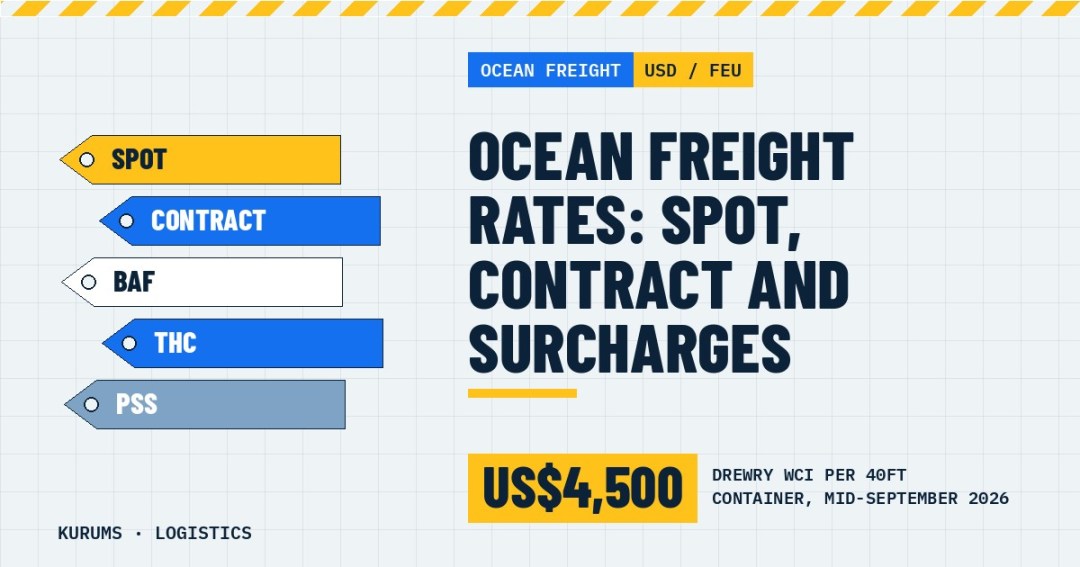
The numbers illustrate how far rates can travel. Drewry's composite was about US$1,860 per 40-foot container in mid-November 2025. By 17 September 2026 it was US$4,500, with Shanghai to Los Angeles at US$7,712 and Shanghai to New York at US$10,394, while Shanghai to Rotterdam had eased to US$3,626. A week later the composite slipped to US$4,468 and Shanghai to Rotterdam to US$3,485.
What moves ocean freight rates?
The balance between effective ship capacity and cargo demand. Fuel and other costs set a floor over the long run, but week to week the price is about how many container slots are available on a route.
Route length. When ships avoid the Suez Canal and sail around the Cape of Good Hope, each round trip takes longer and the same fleet delivers fewer slots per week. That absorbed a great deal of capacity. In its commentary through September 2026 Drewry linked falling Asia to Europe rates to containerships returning to the Suez route, which releases that capacity again; it counted 48 containership transits in one week of September, up from 41 the week before.
Congestion and chokepoints. Port congestion, restrictions at the Panama Canal and disruption around the Strait of Hormuz were all cited by Drewry in the same period as supports for rates.
Fleet growth. Carriers have ordered ships at record pace. Alphaliner's ranking of 10 November 2026 shows the top ten carriers controlling about 85% of capacity, with MSC alone holding 182 ships on order. New tonnage arriving faster than demand grows pushes rates down.
Blank sailings. Carriers cancel departures to hold rates up when demand is weak, most visibly around Chinese holidays.
Tariffs and front-loading. Importers ship early ahead of expected duty changes, which creates demand spikes followed by lulls.
Which surcharges should you expect on a quotation?
The list is long and the names vary by carrier. These are the ones that appear most often.
| Surcharge | Abbreviation | What it is for |
|---|---|---|
| Bunker adjustment factor | BAF | Changes in fuel cost. See the Kurums entry on BAF |
| Low-sulphur or emissions surcharge | LSS, ETS | Cleaner fuel and carbon-pricing costs |
| Currency adjustment factor | CAF | Exchange-rate movements |
| Peak season surcharge | PSS | High-demand periods |
| General rate increase | GRI | An announced across-the-board increase in base rates |
| Terminal handling charge | THC | Moving the container through the port terminal |
| Canal or transit surcharge | PCS, SCS | Panama or Suez tolls and restrictions |
| Equipment imbalance surcharge | EIS, CIC | Repositioning empty containers |
| War risk or emergency surcharge | WRS, ERS | Operating in or around high-risk areas |
| Demurrage and detention | D&D | Keeping the container beyond the free time |
Two habits protect a buyer. Ask whether a rate is all-in and get the list of what is excluded. And agree free time for demurrage and detention before the cargo sails, because storage charges on a delayed container can exceed the freight. The wider family of charges is covered in freight rates and surcharges.
How do alliances affect price and service?
Container lines share ships through alliances, so the vessel carrying your box may belong to a different carrier from the one you booked with. Since February 2025 the east-west trades have been organised into four blocks.
| Network | Members | Character |
|---|---|---|
| Gemini Cooperation | Maersk, Hapag-Lloyd | Hub-and-spoke network built around a reliability target above 90% |
| Ocean Alliance | CMA CGM, COSCO, Evergreen, OOCL | Largest alliance by capacity; agreement extended to 2032 |
| Premier Alliance | ONE, HMM, Yang Ming | Asian carriers, formed from the former THE Alliance |
| MSC | Operating alone | The largest carrier, with selected slot agreements |
Service quality differs sharply. Sea-Intelligence's Global Liner Performance report put global schedule reliability at 62.6% in June 2026. For May and June 2026 it measured Gemini at 93.4%, MSC at 80.7%, Ocean Alliance at 67.6% and Premier Alliance at 53.6%. A cheaper rate on a network that arrives a week late is not always cheaper once safety stock and missed sales are counted. The carriers themselves are ranked in The Largest Container Shipping Lines in 2026.
How can a smaller shipper buy ocean freight well?
- Get three all-in quotations for the same routing and the same week, and compare totals, not base rates.
- Ask which carrier and service the forwarder intends to use, and check its reliability record.
- Book early. Two to three weeks ahead of the cargo-ready date is normal; longer before holidays.
- Be flexible on ports and dates where you can. A nearby port or a sailing a few days later can be markedly cheaper.
- Fix the free time for demurrage and detention in writing.
- Track the index for your lane so you know whether a quotation is in line with the market.
- Build a relationship. Forwarders prioritise customers who ship regularly and pay on time when space is short.
Software can help with tendering and comparison; Kurums reviews the options in Best Freight Procurement Software.
How do you read a rate quotation line by line?
Take a quotation and mark each line as one of three things: fixed for the validity period, variable with an index or tariff, or payable by the other party. Base freight is normally fixed until the validity date. Bunker and currency surcharges are variable. Destination local charges are payable by whoever collects the cargo under the agreed Incoterm, which is often not the party that requested the quotation.
Then check four details that change the real cost: the validity date, since spot quotations commonly expire within two weeks; the transit time and routing, direct or via transhipment; the free time at origin and destination; and whether the price is per container or per bill of lading for documentation fees. Two quotations that differ by a hundred dollars on base freight can differ by several hundred once those details are compared.
Frequently asked questions
What is the difference between a spot rate and a contract rate?
A spot rate is the market price for a shipment sailing in the next few weeks, with no commitment. A contract rate is agreed in advance for a period, usually against a minimum volume, and gives price certainty and a space allocation.
What does FAK mean in ocean freight?
Freight all kinds. It is a single rate per container that applies regardless of the commodity inside, and it is how carriers publish most spot rates.
What is BAF?
The bunker adjustment factor, a surcharge that passes changes in fuel cost on to shippers. It is usually reviewed monthly or quarterly against a published fuel price.
Why did container rates rise so much between late 2025 and 2026?
Mainly because effective capacity was reduced by longer routes, port congestion and disruption at key chokepoints, while demand held up. Drewry's composite index rose from about US$1,860 per 40-foot container in November 2025 to about US$4,500 in mid-September 2026.
What are demurrage and detention?
Charges for keeping a container beyond the agreed free time. Demurrage applies while it sits in the port terminal; detention applies while it is outside the terminal before the empty is returned.
Keep reading in the Logistics hub
- Hellenic Shipping News: Drewry World Container Index, 17 September 2026
- gCaptain: container rates edge lower as Suez traffic returns
- Container News: Sea-Intelligence schedule reliability, June 2026
- Trans.info: Alphaliner ranking of 10 November 2026
- Sea-Intelligence: Global Liner Performance
Rates, rankings and market figures were checked in November 2026 and move quickly; confirm with the carrier, forwarder or publisher before you commit. Kurums has no paid relationship with the companies named here.
Discover more from Kurums | Business Intelligence
Subscribe to get the latest posts sent to your email.