
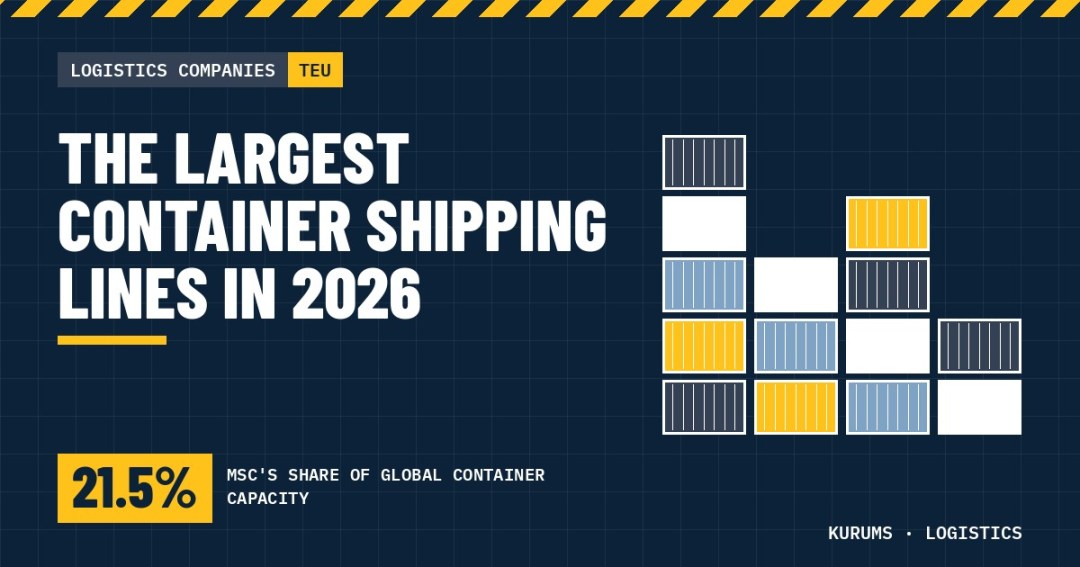
MSC is in a class of its own.
Its fleet of 1,023 ships and 7.48 million TEU is nearly 60% larger than Maersk's, and it has 182 more ships on order.
CMA CGM is closing on second place.
It was the fastest-growing top-ten carrier in the first half of 2026 and stood about 230,000 TEU behind Maersk in November.
Four networks carry the main east-west trades.
Gemini Cooperation, Ocean Alliance, Premier Alliance and MSC operating independently.
Reliability differs more than rates do.
Sea-Intelligence measured the networks between 53.6% and 93.4% on-time in May and June 2026.
How concentrated is container shipping?
Highly. A handful of companies carry most of the world's containerised trade, and the leaders have been pulling further ahead. According to the Alphaliner ranking published on 10 November 2026, as reported by Trans.info, the ten largest carriers control about 85% of global containership capacity. The five largest, MSC, Maersk, CMA CGM, COSCO and Hapag-Lloyd, account for 65.5% between them.
Capacity is measured in TEU, twenty-foot equivalent units, the number of standard 20-foot containers a fleet could carry. It is a measure of ship space, not of cargo actually moved, but it is the standard basis for market share. Europe dominates ownership at the top: four of the five largest lines are headquartered there, in Switzerland, Denmark, France and Germany.
For how this market sets prices, see the Kurums guide to ocean freight rates. For the companies that buy space from these lines on behalf of shippers, see The Largest Freight Forwarders in 2026.
Which are the largest container lines?
The table gives Alphaliner's figures for the five largest carriers as of 10 November 2026. Positions six to nine are taken from Alphaliner data reported earlier in 2026 by the trade press, so the figures are slightly older and are shown as approximate.
| Rank | Carrier | Headquarters | Fleet capacity | Ships | Share of world capacity |
|---|---|---|---|---|---|
| 1 | MSC (Mediterranean Shipping Company) | Switzerland | 7.48 million TEU | 1,023 | 21.5% |
| 2 | Maersk | Denmark | 4.71 million TEU | 745 | 13.5% |
| 3 | CMA CGM | France | 4.48 million TEU | 727 | 12.9% |
| 4 | COSCO | China | 3.70 million TEU | About 570 | 10.7% |
| 5 | Hapag-Lloyd | Germany | 2.41 million TEU | About 290 | 6.9% |
| 6 | Ocean Network Express (ONE) | Singapore | About 2.15 million TEU | - | About 6.3% |
| 7 | Evergreen | Taiwan | About 1.99 million TEU | - | About 5.9% |
| 8 | HMM | South Korea | About 1.04 million TEU | - | About 3.1% |
| 9 | Yang Ming | Taiwan | About 0.74 million TEU | - | About 2.2% |
How did MSC get so far ahead?
By adding ships faster than anyone else, for years. MSC is privately owned by the Aponte family and based in Geneva. It overtook Maersk as the largest carrier at the start of 2022 and has widened the gap since, buying second-hand vessels in large numbers and ordering new ones. Alphaliner recorded its capacity passing 7.2 million TEU in February 2026 and reported that in the previous year it had added 831,400 TEU, growth of 11.7%.
The expansion is not finished. The November 2026 ranking shows MSC with 182 ships on order, totalling 3.38 million TEU. That orderbook alone is larger than the entire existing fleet of the fifth-largest carrier.
MSC also changed how it operates. Its 2M vessel-sharing alliance with Maersk ended in early 2025, and it now runs its east-west network largely on its own, supplemented by slot agreements. With more than a fifth of world capacity, it is the only line large enough to do so.
Who is competing for second place?
Maersk and CMA CGM. Maersk held 4.71 million TEU in November 2026 and CMA CGM 4.48 million, a gap of about 230,000 TEU. Alphaliner named CMA CGM the fastest-growing carrier in the top ten in the first half of 2026: it added 235,500 TEU, or 5.7%, against an average of 2.7% for the top ten, and took delivery of twelve new ships, including its 24,212 TEU LNG-powered flagship CMA CGM Notre Dame.
The two companies have taken different paths. Maersk has presented itself as an integrated logistics company, investing in warehousing, air freight and customs services and holding fleet capacity fairly steady. CMA CGM has grown its fleet while also buying logistics businesses, building CEVA Logistics into one of the largest forwarders. The November ranking gives their orderbooks as about 1.80 million TEU for Maersk and 1.68 million for CMA CGM, with COSCO at about 1.87 million. Trade commentary earlier in the year expected CMA CGM to challenge for second place before the end of 2027.
Kurums has told the story of the industry's cycles through one of its oldest names in Hapag-Lloyd and the Container Cycle, and of the invention behind it all in The Box.
What are the alliances, and who is in them?
Alliances are agreements under which lines share ships on the main routes. Each member sells its own space and competes on price, but the vessels and port calls are pooled. Since February 2025 the east-west trades have had four blocks.
| Network | Members | Notes |
|---|---|---|
| Gemini Cooperation | Maersk, Hapag-Lloyd | Launched 1 February 2025. Hub-and-spoke design with a schedule-reliability target above 90% |
| Ocean Alliance | CMA CGM, COSCO (with OOCL), Evergreen | The largest alliance by capacity; agreement extended to 2032 |
| Premier Alliance | ONE, HMM, Yang Ming | Formed in February 2025 from the former THE Alliance after Hapag-Lloyd left |
| MSC | Operating independently | Standalone network with selected slot-sharing agreements |
The practical consequence is that the ship carrying your container may not belong to the line on your bill of lading. A booking with Evergreen may sail on a CMA CGM vessel. That affects which terminal the ship uses, how reliable the schedule is and what happens when a sailing is cancelled.
How reliable are the different networks?
They differ sharply. Sea-Intelligence's Global Liner Performance report measures the share of vessels arriving on schedule. It put global schedule reliability at 62.6% in June 2026. For the alliances, measured over May and June 2026, the figures were:
| Network | Schedule reliability, May/June 2026 |
|---|---|
| Gemini Cooperation | 93.4% |
| MSC | 80.7% |
| Ocean Alliance | 67.6% |
| Premier Alliance | 53.6% |
Gemini was built around reliability. Its ships call at fewer ports and feed the rest by shuttle, which makes the main schedule easier to keep. Through 2026 it stayed at or near the top of the reliability tables, although not above its 90% target in every month: Sea-Intelligence recorded 76.8% in March.
Does concentration hurt shippers?
It changes the balance of power, though not always in the carriers' favour. Three effects are worth understanding.
Capacity discipline. A few large operators can remove sailings quickly when demand weakens, which supports rates. Blank sailings around holidays are now routine.
Fewer choices on some routes. On smaller trades, a shipper may find that every option belongs to the same alliance and calls at the same terminal.
Overcapacity risk. The same companies have ordered record numbers of ships. If demand does not keep up, or if routes shorten as vessels return to the Suez Canal, there will be more space than cargo, and rates will fall. Drewry's commentary in September 2026 already linked softer Asia to Europe rates to returning Suez transits.
Regulators watch the sector closely. Vessel-sharing agreements operate under competition-law exemptions or filings that differ by jurisdiction, and shippers' associations regularly challenge surcharges and detention practices.
What should a shipper take from the ranking?
- Know who actually carries your cargo. The carrier, the alliance and the specific service, not just the forwarder.
- Buy reliability deliberately. Decide which shipments justify a premium service and which can take a slower, cheaper one.
- Watch the orderbook. A large wave of deliveries tends to push rates down a year or two later.
- Contract with care. In a concentrated market, allocation and free-time terms matter as much as the rate.
- Size the box first. If you are not filling a container, read FCL vs LCL before asking for prices.
How do the carriers differ in strategy?
The largest lines no longer look alike, and the differences affect what they sell.
| Carrier | Strategic emphasis | What a shipper notices |
|---|---|---|
| MSC | Scale and independence; the largest fleet and orderbook | Widest port coverage and frequent sailings; its own network outside the alliances |
| Maersk | Integrated logistics around a reliability-led ocean network | End-to-end contracts covering sea, warehousing, customs and inland transport |
| CMA CGM | Fleet growth plus logistics through CEVA, with air cargo and terminals | One group offering ocean, forwarding and contract logistics |
| COSCO | State-owned Chinese carrier with large terminal interests | Strength on trades to and from China; member of Ocean Alliance with OOCL |
| Hapag-Lloyd | Quality and reliability positioning; partner in Gemini | Reliability guarantees on selected services |
| ONE, Evergreen, HMM, Yang Ming | Asian carriers focused on liner shipping | Competitive on transpacific and Asia to Europe trades |
Two shifts stand out. The first is vertical integration: several lines now own forwarders, warehouses, aircraft or port terminals, so the company that carries a container may also offer to book it, store it and deliver it. That can simplify a supply chain, and it can also reduce a shipper's independence if one group controls every leg. The second is fuel transition. New ships are being delivered with engines that can burn liquefied natural gas or methanol, and European carbon pricing now applies to shipping, so emissions surcharges have joined fuel surcharges on quotations.
Fleet age is a quieter differentiator. Alphaliner data reported in early 2026 showed Evergreen operating the youngest fleet among the top twenty carriers. Newer ships burn less fuel per container and are less exposed to emissions rules, which matters for long-term contract pricing.
Frequently asked questions
Which is the largest container shipping line in the world?
MSC. Alphaliner's ranking of 10 November 2026 gives it 7.48 million TEU on 1,023 ships, 21.5% of global containership capacity.
How much of the market do the top ten container lines control?
About 85% of global containership capacity. The five largest alone hold 65.5%.
What are the container shipping alliances in 2026?
Gemini Cooperation (Maersk and Hapag-Lloyd), Ocean Alliance (CMA CGM, COSCO with OOCL, and Evergreen) and Premier Alliance (ONE, HMM and Yang Ming). MSC operates independently.
What does TEU mean?
Twenty-foot equivalent unit, the space of one standard 20-foot container. A 40-foot container counts as two TEU. Fleet capacity and port volumes are both measured in TEU.
Which shipping alliance is the most reliable?
Gemini Cooperation led Sea-Intelligence's measurements through 2026, with 93.4% schedule reliability in May and June, ahead of MSC at 80.7%, Ocean Alliance at 67.6% and Premier Alliance at 53.6%.
Keep reading in the Logistics hub
- Trans.info: Alphaliner ranking of 10 November 2026
- Safety4Sea: Alphaliner, the fastest-growing container shipping lines in 2026
- Hansa: MSC expands market share to new heights
- Container News: Sea-Intelligence schedule reliability, June 2026
- Alphaliner Top 100
Rates, rankings and market figures were checked in November 2026 and move quickly; confirm with the carrier, forwarder or publisher before you commit. Kurums has no paid relationship with the companies named here.
Discover more from Kurums | Business Intelligence
Subscribe to get the latest posts sent to your email.