
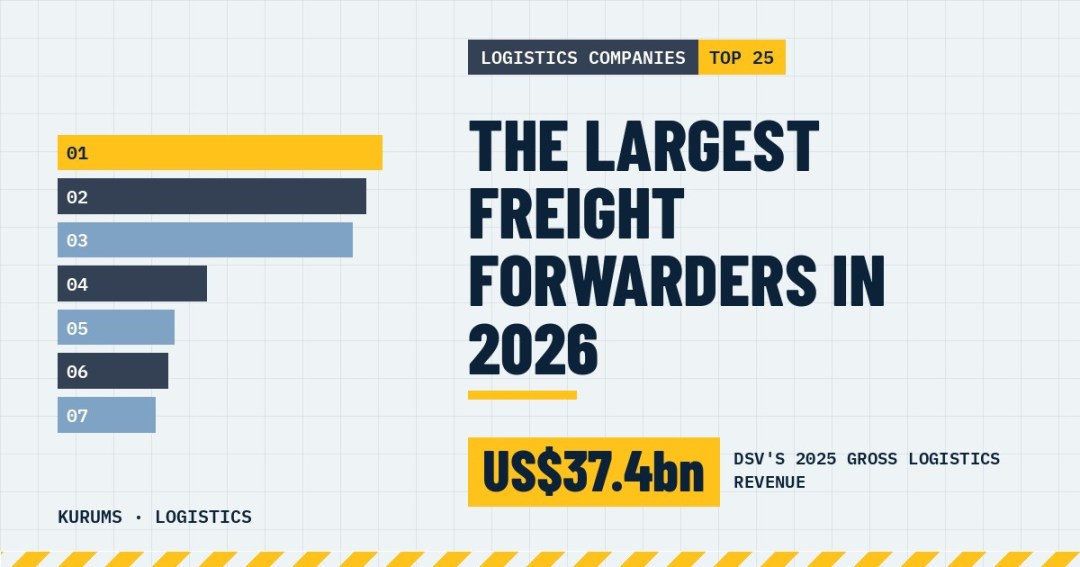
The top three are now within about 10% of each other on revenue.
DSV, DHL and Kuehne+Nagel reported US$37.4 billion, US$35.5 billion and US$33.8 billion of gross logistics revenue for 2025.
The ranking depends on the measure.
DSV is largest by revenue, Sinotrans by ocean volume and Kuehne+Nagel by air tonnage. The published rank averages all three.
Acquisitions built the leaders.
DSV ranked tenth in 2010 and reached the top after buying UTi, Panalpina, Agility's logistics arm and DB Schenker.
Biggest is not automatically best for a small shipper.
Mid-sized and specialist forwarders often give better service on the lanes they know. Use size as one criterion among several.
What does a freight forwarder do?
A freight forwarder arranges the movement of goods on behalf of a shipper. It books space with shipping lines, airlines and hauliers, consolidates small consignments into full loads, prepares the transport and customs documents, and manages the hand-offs between each leg. Most forwarders own few of the ships and aircraft that carry the cargo. Their product is organisation, buying power and information.
That makes a forwarder different from a carrier, which operates the vessel, aircraft or truck, and from a customs broker, which handles border formalities, although large forwarders usually offer brokerage too. The Kurums guide to freight contracts and parties sets out who is liable for what.
Forwarders matter because few importers and exporters have enough volume to negotiate directly with carriers. A forwarder pools thousands of customers' cargo, contracts for space in bulk and resells it. On ocean freight it often acts as a non-vessel-operating common carrier (NVOCC), issuing its own bill of lading.
Who are the largest freight forwarders?
The most widely cited ranking is published by the consultancy Armstrong & Associates (A&A). Its 2026 list ranks forwarders on a combined average of three measures for 2025: gross logistics revenue, ocean container volume and air freight tonnage.
| A&A rank | Forwarder | Headquarters | Gross logistics revenue | Ocean TEU | Air freight tonnes |
|---|---|---|---|---|---|
| 1 (tie) | Kuehne+Nagel | Switzerland | US$33.84bn | 4,325,000 | 2,030,280 |
| 1 (tie) | DSV | Denmark | US$37.38bn | 3,695,424 | 2,013,127 |
| 2 | DHL Supply Chain & Global Forwarding | Germany | US$35.54bn | 3,274,000 | 1,767,000 |
| 3 | Sinotrans | China | US$13.58bn | 4,925,154 | 912,000 |
| 4 | Nippon Express | Japan | US$17.20bn | 1,806,197 | 933,201 |
CEVA Logistics, part of the CMA CGM group, follows in the next position. C.H. Robinson and KLN (formerly Kerry Logistics Network) tie for seventh, and Dachser and LX Pantos tie for fifteenth; because of the ties, the list contains 25 companies although the numbered positions end at 22. In air freight alone, Expeditors (928,000 tonnes), KLN (840,508) and UPS Supply Chain Solutions (790,000) sit just behind Nippon Express.
A&A puts the combined gross logistics revenue of the top five at roughly US$137.5 billion and estimates that together they handle about 9 to 10% of global containerised ocean freight and 11 to 12% of global air cargo. That is the striking fact about this industry: even its giants hold modest shares. Forwarding is far less concentrated than container shipping, where the ten largest lines control about 85% of capacity. Kurums covers those in The Largest Container Shipping Lines in 2026.
Why do the rankings differ depending on the measure?
Because the companies have different business mixes.
| If you rank by | The leader is | Why |
|---|---|---|
| Gross revenue | DSV | Large road, air, sea and contract logistics businesses combined |
| Ocean containers | Sinotrans | Huge export volumes from China, at lower revenue per container |
| Air tonnage | Kuehne+Nagel | Narrowly ahead of DSV, 2.03 million against 2.01 million tonnes |
| Combined score | Kuehne+Nagel and DSV | Tied on the average of the three rankings |
Revenue rewards breadth. DHL's figure includes its large contract logistics arm, which runs warehouses for customers, alongside its forwarding division. Ocean TEU rewards presence in export markets with very high container volumes. Sinotrans moves more boxes than anyone, yet its revenue is well under half that of the European leaders, because it earns less per container and has a smaller high-value air and contract business. Air tonnage rewards strength in electronics, pharmaceuticals, fashion and other time-sensitive goods.
For a shipper, the lesson is to look at the measure that matches your cargo. An importer of containers from China cares about ocean buying power on that lane. A medical device exporter cares about air capacity and temperature-controlled handling.
How did DSV get to the top?
By buying competitors and integrating them. Supply Chain 24/7's analysis of the A&A data notes that DSV ranked tenth in 2010 and climbed after acquiring UTi Worldwide, Panalpina, Agility's Global Integrated Logistics business and, most recently, DB Schenker. The Schenker acquisition completed on 30 April 2025 and combined two of the top five forwarders into one group.
The same analysis observes that in 2010 DHL led with US$30.5 billion of gross revenue and no close challenger, whereas by 2025 DSV, DHL and Kuehne+Nagel were within roughly 10% of each other. Consolidation continues elsewhere. CMA CGM, a shipping line, has built CEVA Logistics into a top-ten forwarder and integrated Bolloré Logistics into it, and A&A counted 23 logistics acquisitions worth more than US$100 million in 2025, six of them above US$1 billion. Chinese forwarders have also gained ground: Sinotrans was the only mainland Chinese company on the 2010 list, while the latest includes Sinotrans, Cosco Shipping Logistics, CIMC Wetrans Logistics, AWOT Group and CTS International Logistics.
Kurums has told the longer story of several of these groups, including Deutsche Post DHL and New Zealand's Mainfreight.
What kinds of forwarder are there?
The top 25 are a small part of an industry of many thousands of firms. They sort into five groups.
| Type | Examples | Strength | Limitation |
|---|---|---|---|
| Global integrators | Kuehne+Nagel, DSV, DHL | Own offices almost everywhere, strong buying power, broad services | Small accounts can get limited attention |
| Carrier-owned forwarders | CEVA (CMA CGM), Maersk's logistics arm | Access to the parent's ships and assets | Less neutral when choosing a carrier |
| Regional leaders | Nippon Express, Sinotrans, KLN, Dachser, Mainfreight | Depth in home regions and specific trade lanes | Thinner coverage elsewhere |
| Specialists | Project cargo, perishables, pharma, fine art, automotive | Expertise and equipment for difficult cargo | Narrow scope |
| Digital forwarders | Platform-based newer entrants | Instant quotations and tracking | Often rely on partners for physical handling |
Many small and mid-sized forwarders extend their reach through agent networks, alliances of independent firms that handle each other's cargo in their home countries. A well-run network member can match a multinational on a specific lane.
How should you choose a freight forwarder?
Start with your cargo and lanes, then test candidates on six points.
- Lane strength. Ask how much volume they move on your specific origin and destination, and with which carriers. Buying power is lane-specific.
- Own offices or agents. Either can work. What matters is how long the relationship has existed and who is accountable when something goes wrong.
- Product expertise. Dangerous goods, temperature control, oversized cargo and regulated products need proven experience and the right licences.
- Customs capability. Check that they can act as broker at destination, and whether they hold trusted-trader status such as Authorised Economic Operator.
- Visibility. Ask for a demonstration of tracking, document access and exception alerts, not a brochure.
- Financial strength and liability. Forwarders pay carriers on your behalf. Check their terms, liability limits and insurance, and insure the cargo yourself; see the Kurums guide to cargo insurance and claims.
Then compare quotations on an identical specification: the same Incoterm, the same routing, the same week and the same list of included charges. Kurums explains the layers of a quotation in Ocean Freight Rates Explained and Air Freight Explained.
Is a bigger forwarder always the better choice?
No. Scale brings contract rates, space allocations in tight markets and a single system across many countries. Those advantages are real for shippers with volume across several lanes.
A smaller importer shipping a few containers a month on one lane may be better served by a mid-sized forwarder for whom that account matters. The mid-sized firm will often answer the telephone, know the shipment and fight for space, while a very large one routes a small customer through a service centre. The practical test is responsiveness during the quotation process: a forwarder that is slow to quote will be slow to solve problems.
What is the outlook for forwarding?
A&A estimates the global international transportation management market, its term for forwarding, at US$329.0 billion in 2025, up 8.0% on the year, and projects growth of 5.5% to US$347.1 billion in 2026 and 4.2% in 2027. It attributes the 2026 picture to an unusual mix of forces: rerouting of Asia to Europe and Asia to North America trades, importers shipping early ahead of tariff changes, volatile inventories and the reshaping of the top of the table by mergers.
Three trends follow for buyers. Consolidation will keep reducing the number of large independent forwarders. Shipping lines will keep pushing into forwarding and contract logistics, blurring the line between carrier and intermediary. And data, in the form of visibility, emissions reporting and automated documents, is becoming a basis of competition alongside price.
Frequently asked questions
Who is the largest freight forwarder in the world?
It depends on the measure. In Armstrong & Associates' 2026 ranking Kuehne+Nagel and DSV tie for first on a combined score. DSV has the highest revenue, Sinotrans the highest ocean volume and Kuehne+Nagel the highest air tonnage.
What is the difference between a freight forwarder and a carrier?
A carrier operates the ship, aircraft or truck. A forwarder organises the transport, buys space from carriers, consolidates cargo and handles documents, usually without owning the main transport assets.
When did DSV acquire DB Schenker?
The acquisition completed on 30 April 2025. It made DSV the largest forwarder by revenue, at about US$37.4 billion for 2025.
What is an NVOCC?
A non-vessel-operating common carrier. It buys space from shipping lines, sells it to shippers and issues its own house bill of lading, taking on a carrier's responsibilities without operating ships.
Should a small business use a large forwarder?
Not necessarily. Large forwarders offer coverage and buying power, but a mid-sized or specialist forwarder strong on your particular lane often provides better service to a smaller account.
Keep reading in the Logistics hub
- Armstrong & Associates: Top 25 Global Freight Forwarders List 2026
- Supply Chain 24/7: ranking the top 25 freight forwarders
- Supply Chain 24/7: the world's 25 largest air freight forwarders
- Armstrong & Associates: Global ITM market analysis 2026
Rates, rankings and market figures were checked in November 2026 and move quickly; confirm with the carrier, forwarder or publisher before you commit. Kurums has no paid relationship with the companies named here.
Discover more from Kurums | Business Intelligence
Subscribe to get the latest posts sent to your email.