
You pay for space as well as weight.
Light, bulky cargo is charged on its volume. One cubic metre is treated as 167 kg for general air cargo and 200 kg by most express carriers.
The rate per kilogram is only part of the bill.
Fuel and security surcharges, terminal handling, documentation, customs and trucking can add a large share on top.
About half of air cargo flies under passengers.
Belly capacity on passenger aircraft and dedicated freighters respond to different forces, which is why rates differ so much by lane.
Demand was rising through 2026.
IATA reported cargo tonne-kilometres up 7.7% year on year in September 2026, while jet fuel had more than doubled in price.
How does air freight work?
A shipment travels through more hands than the flight time suggests. A shipper hands goods to a freight forwarder, which books space with an airline, consolidates the cargo with other shipments, prepares the documents and delivers it to the airline's handling agent at the airport. The airline flies it, often through a hub. At the destination another handling agent breaks down the load, customs clears it, and the forwarder's partner delivers it.
Most shippers never contract with the airline directly. The forwarder is the buyer of capacity and issues its own transport document, the house air waybill, while the airline issues the master air waybill for the consolidated load. The Kurums guides to the air waybill and the house air waybill explain how the two fit together.
Express integrators such as DHL Express, FedEx and UPS run a different model: one company controls the collection, the aircraft, the customs clearance and the delivery, and sells a door-to-door service by the parcel. General air freight is airport-to-airport capacity sold by the kilogram and assembled into a door-to-door service by a forwarder.
What is chargeable weight?
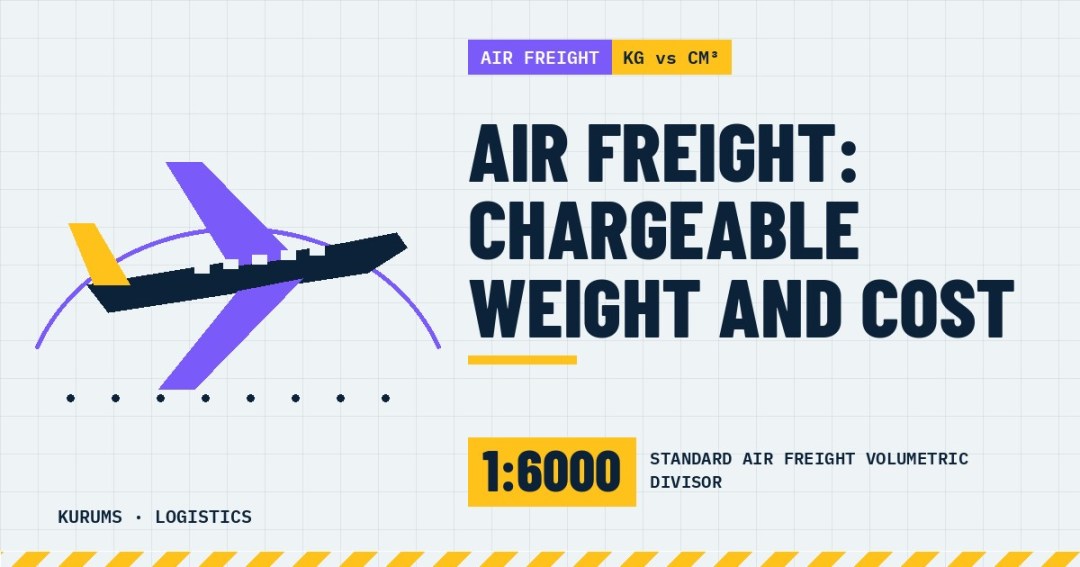
Aircraft run out of space before they run out of lift when cargo is light and bulky. To price both limits fairly, airlines charge on chargeable weight: the greater of the actual gross weight and the volumetric (dimensional) weight.
For general air cargo the volumetric formula is:
Length × width × height in centimetres ÷ 6,000 = volumetric weight in kilograms
That is the same as saying one cubic metre equals 166.67 kilograms, usually rounded to 167. Most express and courier services divide by 5,000 instead, which makes one cubic metre equal to 200 kilograms and charges bulky parcels more.
Worked example 1: bulky cargo. Ten cartons, each 60 × 50 × 40 cm and weighing 12 kg.
- Volume per carton: 60 × 50 × 40 = 120,000 cm³, or 0.12 m³. Total 1.2 m³.
- Volumetric weight: 120,000 ÷ 6,000 = 20 kg per carton. Total 200 kg.
- Actual weight: 10 × 12 = 120 kg.
- Chargeable weight: 200 kg. You pay for 80 kg of air.
Worked example 2: dense cargo. One pallet, 120 × 80 × 100 cm, weighing 400 kg.
- Volumetric weight: 960,000 ÷ 6,000 = 160 kg.
- Actual weight: 400 kg.
- Chargeable weight: 400 kg. Weight decides.
Dimensions are measured at the extreme points of each piece, and irregular shapes are treated as the box that would contain them. Pallets are included. If cargo is declared non-stackable, some airlines charge for the full height of the position it occupies. The same idea in other modes is covered in the Kurums guide to freight measurement and pricing and, for road freight, in LTL freight class and density pricing.
How is an air freight rate structured?
Rates are quoted per kilogram of chargeable weight and fall as the shipment gets heavier, in weight breaks. The usual breaks are a minimum charge, then under 45 kg, 45 kg, 100 kg, 300 kg, 500 kg and 1,000 kg. Because the rate drops at each break, it is sometimes cheaper to be charged at the next break up than at your actual chargeable weight. A good forwarder checks this automatically.
| Line on the quotation | Basis | Notes |
|---|---|---|
| Air freight rate | Per kg chargeable | Falls at each weight break |
| Fuel surcharge | Per kg, actual or chargeable | Tracks jet fuel prices |
| Security surcharge | Per kg | Screening and regulatory compliance |
| Origin terminal handling | Per kg or per shipment | Airline's ground handler |
| Documentation, air waybill fee | Per shipment | Forwarder's charge |
| Export and import customs | Per entry | Plus duties and taxes |
| Destination handling | Per kg or per shipment | Often billed to the consignee |
| Pick-up and delivery | By weight and distance | Road legs at each end |
Some airlines and forwarders quote all-in rates that fold the fuel and security surcharges into the price per kilogram. Either format is fine as long as you compare like with like.
What is the difference between belly cargo and freighters?
Air cargo flies in two kinds of space, and the split explains much of the market's behaviour.
| Belly capacity | Freighter capacity | |
|---|---|---|
| Where | Lower deck of passenger aircraft | Dedicated cargo aircraft |
| Driven by | Passenger route networks | Cargo demand |
| Strengths | Many destinations and frequencies | Large and heavy pieces, dangerous goods, main-deck loading |
| Limits | Size and height of pieces; passenger bags come first | Fewer routes, higher cost per flight |
Roughly half of world air cargo is carried in the bellies of passenger aircraft, though the share varies by region and year. When passenger flights are plentiful, belly capacity is abundant and rates soften. When routes are cut or aircraft are diverted around closed airspace, cargo capacity shrinks even though cargo demand has not changed.
Freighters matter most on the big manufacturing-to-consumer lanes and for express networks. That is why airports such as Anchorage, Louisville and Memphis rank among the world's busiest for cargo while barely featuring in passenger rankings. Kurums profiles the main hubs and airlines in The World's Air Cargo Hubs and Airlines.
What was the air cargo market doing in 2026?
Growing, with costs rising faster than prices. IATA's September 2026 analysis reported industry cargo tonne-kilometres up 7.7% year on year, and 8.6% on international routes, with capacity up only 2.7%. The cargo load factor rose 2.2 percentage points to 47.9%. Asia to North America was the strongest major trade lane, up 17.0%. For the first nine months of the year demand was up 5.0%.
The pressure point was fuel. IATA said jet fuel had risen 103.4% year on year against a 25.9% rise in cargo yields. Fuel surcharges therefore deserve as much attention as the base rate in any 2026 quotation.
When does air freight make sense?
When the value of time exceeds the difference in freight cost. Air typically costs several times as much per kilogram as ocean, and often far more, but it turns five weeks of transit into about one. Four situations justify it.
- High value relative to weight. Electronics, pharmaceuticals, fashion and components, where freight is a small share of product value and capital tied up at sea is expensive.
- Perishable or time-limited goods. Fresh food, flowers, medical supplies and seasonal products.
- Emergencies. A stopped production line or an out-of-stock bestseller costs more per day than the freight premium.
- Small shipments. Below a few hundred kilograms, ocean LCL minimums and local charges narrow the gap.
A simple test is to compare total landed cost including the cost of holding stock. Take the freight difference per unit, then add what five extra weeks of inventory costs you in financing, safety stock and lost or discounted sales. For low-value, heavy goods air almost never wins. For high-value, light goods it wins more often than buyers assume.
| Air freight | Ocean freight (FCL or LCL) | |
|---|---|---|
| Door-to-door time, intercontinental | About 3 to 8 days | About 4 to 8 weeks |
| Cost per kilogram | High | Low |
| Volume conversion | 167 kg per CBM | 1,000 kg per CBM (LCL) |
| Reliability of schedule | High | Variable |
| Carbon emissions per tonne-kilometre | Much higher | Much lower |
| Best for | Valuable, urgent, light goods | Bulky, heavy, planned goods |
Between the two sit sea-air services, which combine an ocean leg with a flight from a hub, and rail on some intercontinental corridors. Both trade some speed for a lower price. The ocean side of the comparison is set out in FCL vs LCL.
How can you lower an air freight bill?
- Reduce volume. Tighter cartons and denser pallets cut chargeable weight directly.
- Ask about the next weight break. Being charged at 100 kg can be cheaper than paying the under-100 rate on 92 kg.
- Consolidate. One shipment of 300 kg costs less than three of 100 kg.
- Choose the service level deliberately. Deferred or economy services that take a few extra days cost materially less than priority.
- Be flexible on routing. Indirect flights through a hub are usually cheaper than direct ones.
- Get the paperwork right. Accurate descriptions, weights and customs data avoid storage charges while errors are fixed.
- Compare forwarders. The largest air forwarders buy capacity in bulk; see The Largest Freight Forwarders in 2026.
Frequently asked questions
How do you calculate chargeable weight for air freight?
Multiply length, width and height in centimetres and divide by 6,000 to get volumetric weight in kilograms. Compare it with the actual gross weight. The higher of the two is the chargeable weight.
Why is the air freight divisor 6,000?
It reflects a standard density of 167 kg per cubic metre, a level at which an aircraft's volume and weight limits are reached together. Express carriers commonly use 5,000, equal to 200 kg per cubic metre.
Is air freight always more expensive than sea freight?
Per kilogram, yes, usually by a large multiple. On total landed cost the gap narrows for small, valuable or urgent shipments once inventory holding costs and ocean minimum charges are included.
What is the difference between a master and a house air waybill?
The airline issues the master air waybill to the forwarder for a consolidated load. The forwarder issues a house air waybill to each shipper for their part of it.
How long does air freight take?
The flight takes hours, but door-to-door transit is typically about three to eight days once collection, export handling, customs clearance and delivery are included.
Keep reading in the Logistics hub
- IATA: Air Cargo Market Analysis, September 2026
- IATA press release: air cargo demand accelerates in September
- Air Cargo Week: demand rises 7.7 percent in September as fuel costs bite
Rates, rankings and market figures were checked in November 2026 and move quickly; confirm with the carrier, forwarder or publisher before you commit. Kurums has no paid relationship with the companies named here.
Discover more from Kurums | Business Intelligence
Subscribe to get the latest posts sent to your email.