
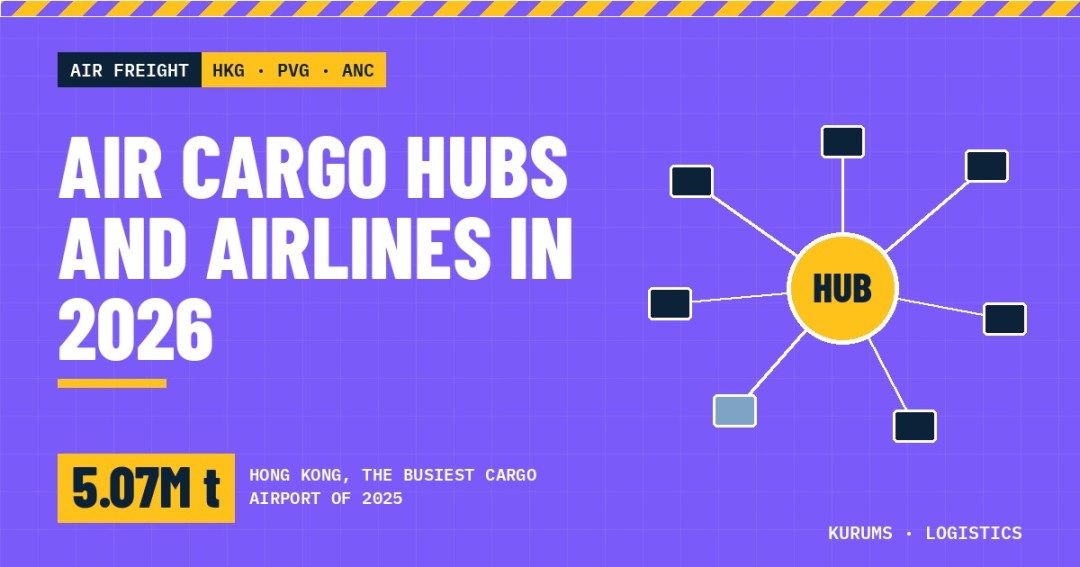
Ten airports handle about a quarter of world air cargo.
ACI World's 2025 data show global volume of 128.9 million tonnes, up 2.9%, with the top ten at close to 26%.
Hong Kong is still number one.
It handled 5.07 million tonnes in 2025, followed by Shanghai Pudong at 4.10 million and Anchorage at 3.85 million.
Memphis fell sharply.
The FedEx hub's volume dropped 20.9% in 2025, taking it from the top three to sixth as Louisville and Miami moved up.
The biggest cargo airlines are a mix of models.
Express integrators, Gulf and Asian combination carriers and all-cargo operators share the top of IATA's tonne-kilometre ranking.
How concentrated is air cargo?
Very. Airports Council International (ACI) World reported that air cargo volumes through the world's airports reached about 128.9 million tonnes in 2025, up 2.9% on the year before. The ten busiest airports handled close to 26% of that total. Passenger traffic is far more evenly spread: the ten busiest passenger airports account for only about 9% of passengers.
The reason is network economics. Cargo is consolidated at a hub, flown in large aircraft and broken down at another hub. A small number of airports with the right location, round-the-clock operations, customs capability and handling capacity therefore attract a disproportionate share. If you are new to how air freight is bought and priced, read the Kurums guide to chargeable weight and air freight cost first.
Which are the busiest cargo airports?
ACI World's ranking for 2025 is below. Volumes are cargo loaded and unloaded, in metric tonnes.
| Rank | Airport | 2025 cargo | Change on 2024 | Type of hub |
|---|---|---|---|---|
| 1 | Hong Kong (HKG) | 5.07 million t | +2.7% | Manufacturing gateway and transhipment |
| 2 | Shanghai Pudong (PVG) | 4.10 million t | +8.6% | Manufacturing gateway |
| 3 | Anchorage (ANC) | 3.85 million t | +4.2% | Transpacific transfer and refuelling |
| 4 | Louisville (SDF) | 3.40 million t | +13.5% | Integrator hub (UPS) |
| 5 | Miami (MIA) | 3.13 million t | +13.6% | Gateway to Latin America |
| 6 | Memphis (MEM) | 2.97 million t | -20.9% | Integrator hub (FedEx) |
| 7 | Incheon (ICN) | 2.95 million t | +0.3% | North-east Asian gateway and transfer |
| 8 | Doha (DOH) | 2.61 million t | -0.1% | Long-haul transfer hub |
| 9 | Taipei (TPE) | 2.50 million t | +10.1% | Electronics gateway |
Three movements stand out. Anchorage took third place. It is a small city, but it sits within reach of both Asia and North America, so freighters stop there to refuel and transfer loads, which lets them carry more cargo and less fuel on each leg. Louisville and Miami each grew by more than 13%. Memphis lost more than a fifth of its volume in one year, which trade coverage attributes to changes in integrator networks. Guangzhou completed the top ten, which puts four of the ten airports in Greater China.
What are the three types of cargo hub?
Read as an operating map, the ranking sorts into three groups, and each behaves differently for a shipper.
| Hub type | Examples | What happens there | What it means for you |
|---|---|---|---|
| Manufacturing gateway | Hong Kong, Shanghai Pudong, Guangzhou, Taipei | Export cargo originates and is consolidated | Capacity is tight before holidays and product launches; rates are set here |
| Integrator hub | Memphis, Louisville, Leipzig, Cologne | One express carrier sorts its whole network overnight | Reliable for parcels and express; not open-market capacity |
| Transfer hub | Anchorage, Doha, Dubai, Istanbul, Incheon | Cargo changes aircraft between long-haul flights | Wide destination choice; a missed connection adds a day or more |
Manufacturing gateways are where air freight is priced. When factories ship ahead of a holiday or a tariff deadline, space out of these airports is the first thing to run short. Integrator hubs are private networks: enormous volumes pass through, but the capacity belongs to the express company. Transfer hubs exist because of geography. Gulf carriers connect Asia, Europe and Africa through Doha and Dubai; Istanbul does the same with a very large network of destinations. Kurums has profiled several of these in its company stories, including Qatar Airways Cargo.
Which are the largest cargo airlines?
Airlines are ranked by cargo tonne-kilometres (CTK): tonnes carried multiplied by distance flown. It rewards long-haul operators, which is why it looks different from a ranking by tonnes. IATA's World Air Transport Statistics gave the following for 2024, the most recent full table Kurums could verify.
| Rank | Airline | 2024 CTK (billion) | Model |
|---|---|---|---|
| 1 | FedEx | 18.1 | Express integrator |
| 2 | Qatar Airways | 15.2 | Combination carrier with large freighter fleet |
| 3 | UPS | 15.1 | Express integrator |
| 4 | Emirates | 12.4 | Combination carrier |
| 5 | Atlas Air | 11.9 | All-cargo, flies for other carriers |
| 6 | Turkish Airlines | 10.2 | Combination carrier |
| 7 | Korean Air | 8.7 | Combination carrier |
| 8 | China Southern | 8.7 | Combination carrier |
| 9 | Cathay Pacific | 8.5 | Combination carrier |
| 10 | Cargolux | 8.3 | All-cargo |
For 2025, trade reporting on the latest ranking says the top 25 carriers together grew 5.5%, faster than the 3.4% recorded for the industry, and that Qatar Airways slipped to third place after its cargo tonne-kilometres fell 5% to 14.4 billion. The airline's own results put its chargeable freight at more than 1.43 million tonnes in the 2025/26 financial year.
The three models work differently.
- Express integrators (FedEx, UPS, DHL) own aircraft, trucks and delivery networks and sell a door-to-door service. Their capacity mainly serves their own parcels.
- Combination carriers (Qatar Airways, Emirates, Turkish Airlines, Korean Air, Cathay Pacific) carry cargo in the bellies of passenger aircraft and on freighters, and sell space to forwarders.
- All-cargo carriers (Cargolux, Atlas Air) fly only freighters. Some sell space on scheduled services; others operate aircraft on behalf of airlines, integrators and e-commerce companies.
How do hub and airline choice affect a shipment?
In four practical ways.
Capacity type. Outsize, heavy or dangerous cargo often needs a freighter with main-deck loading. Belly space on a narrow-body aircraft cannot take a tall pallet. Tell your forwarder the dimensions and nature of the largest piece before asking for a price.
Frequency. A daily flight means a missed cut-off costs one day. A twice-weekly freighter means it costs three or four.
Ground handling. The time cargo spends in a warehouse before and after the flight often exceeds the flight. Airports differ widely in how quickly they release freight, and it is worth asking a forwarder about recent performance at the specific airport.
Customs and trucking. A large hub in a neighbouring country with a bonded truck service can be faster and cheaper than a direct flight to a small local airport. European forwarders routinely fly cargo into one hub and truck it across borders under an air waybill.
What is shaping air cargo in 2026?
- Demand is growing. IATA reported cargo tonne-kilometres up 7.7% in September 2026, with every region growing and North American carriers up 11.8%.
- Fuel is the pressure point. Jet fuel was up 103.4% year on year against a 25.9% rise in yields, according to IATA.
- E-commerce keeps filling aircraft. ACI attributes much of 2025's growth to e-commerce demand and supply-chain adjustments, which also explains the rise of Miami and of airports serving Chinese export platforms.
- Border rules for parcels have tightened. The end of duty-free treatment for low-value parcels in the United States and the European Union changes how cross-border e-commerce is routed. See E-Commerce Logistics Explained.
- Airspace and geopolitics move routes. Closures lengthen flights, reduce payload and shift traffic between transfer hubs.
How should a shipper use this?
Ask three questions of any air freight quotation: which airline and aircraft type, through which hub, and with what connection time. Then weigh the price against the answers. For regular lanes, use two routings through different hubs so that a disruption at one does not stop your supply. The forwarders that buy the most air capacity are ranked in The Largest Freight Forwarders in 2026.
Which regional hubs matter beyond the top ten?
The global ranking hides airports that dominate their own regions, and these are often the ones a shipper actually uses.
| Region | Main cargo airports | Role |
|---|---|---|
| Europe | Frankfurt, Paris Charles de Gaulle, Leipzig, Liège, Amsterdam, Luxembourg, Istanbul | Frankfurt and Paris are combination-carrier hubs; Leipzig is DHL's European hub; Liège and Luxembourg are freighter specialists |
| Middle East | Doha, Dubai (both airports), Abu Dhabi | Long-haul transfer between Asia, Europe and Africa |
| North America | Anchorage, Louisville, Memphis, Miami, Los Angeles, Chicago, Cincinnati | Integrator hubs plus coastal and Latin American gateways |
| Asia | Hong Kong, Shanghai, Guangzhou, Shenzhen, Incheon, Taipei, Tokyo Narita, Singapore | Manufacturing gateways and transfer points |
| Latin America and Africa | Bogotá, São Paulo, Nairobi, Addis Ababa | Perishables exports such as flowers and fresh produce |
Türkiye's airports handled more than 2.2 million tonnes of cargo in 2025, almost all of it in Istanbul, which is covered in Türkiye's Logistics Sector. Freighter-focused airports such as Liège and Luxembourg rarely appear in general rankings, yet they are where a large share of main-deck cargo into Europe lands, because they offer night operations and fast truck connections that congested passenger hubs cannot.
For a shipper, the practical point is that the nearest airport is not always the best gateway. Cargo is routinely trucked several hundred kilometres to reach a hub with more frequent flights, more freighter capacity or faster handling, and the total door-to-door time is still shorter.
Frequently asked questions
What is the busiest cargo airport in the world?
Hong Kong International Airport. It handled about 5.07 million tonnes in 2025 according to ACI World, ahead of Shanghai Pudong with 4.10 million and Anchorage with 3.85 million.
Why is Anchorage such a large cargo airport?
Its location lets freighters flying between Asia and North America stop to refuel and transfer loads. Carrying less fuel on each leg allows more cargo, which makes the stop economical.
What is a cargo tonne-kilometre?
One tonne of cargo carried one kilometre. Airlines are ranked by cargo tonne-kilometres because the measure captures both how much they carry and how far.
Which airline carries the most cargo?
FedEx led IATA's ranking by cargo tonne-kilometres for 2024 with about 18.1 billion, followed by Qatar Airways and UPS. Reporting on the 2025 ranking places Qatar Airways third.
What is the difference between belly cargo and freighter cargo?
Belly cargo travels in the lower deck of passenger aircraft. Freighter cargo travels on dedicated cargo aircraft, which can take larger, heavier and more restricted loads.
Keep reading in the Logistics hub
- Cargo Newswire: global air cargo hits 128.9 million tonnes in 2025
- International Airport Review: busiest airports by cargo, ACI data
- Air Cargo News: top 25 cargo carriers, IATA WATS
- IATA press release: air cargo demand accelerates in September 2026
Rates, rankings and market figures were checked in November 2026 and move quickly; confirm with the carrier, forwarder or publisher before you commit. Kurums has no paid relationship with the companies named here.
Discover more from Kurums | Business Intelligence
Subscribe to get the latest posts sent to your email.