
Sea carries the value, road carries the European link.
UTİKAD's sector report puts sea at 58.92% of foreign trade by value and road at 26.4%, with air accounting for most of the rest.
Ports set records in 2025.
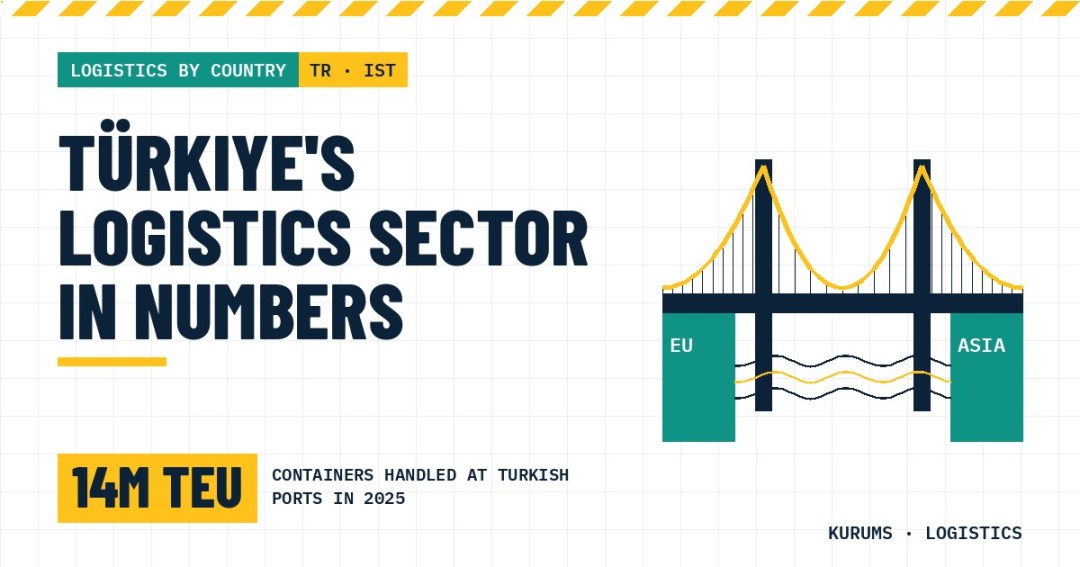
About 14 million TEU and 553.3 million tonnes were handled, with 84% of containers passing through five port regions.
Istanbul is a top-tier air cargo hub.
Turkish airports handled more than 2.21 million tonnes of cargo in 2025, 2.14 million of it at Istanbul's airports.
Logistics is a major export in its own right.
Trade ministry figures put logistics at about a third of Türkiye's service exports, second only to tourism.
Why does Türkiye matter in logistics?
Position and scale. Türkiye sits where Europe meets Asia, with coastlines on the Black Sea, the Aegean and the Mediterranean and land borders with the European Union to the west and the Caucasus, Iran, Iraq and Syria to the east and south. It is a large manufacturing exporter in its own right, in vehicles, textiles, white goods, steel and food, and it is a transit country for others.
That combination has produced a logistics sector with unusual breadth: one of Europe's largest international road-haulage fleets, a container port system spread across four seas, an air cargo hub of global rank and a growing rail link towards Central Asia. According to Türkiye's trade ministry, logistics and transport services generated US$42.4 billion of service exports in the latest full year, about 34.5% of the total, making the sector the second-largest service export after tourism and placing the country tenth in the world for logistics service exports.
On the World Bank's Logistics Performance Index, Türkiye scores 3.4 out of 5, level with Portugal, Lithuania and Saudi Arabia. Kurums explains how to read that score in Logistics by Country.
How does Türkiye's trade move?
Mostly by sea when measured by value, and overwhelmingly by sea when measured by weight. The International Transport and Logistics Service Providers Association, UTİKAD, publishes an annual sector report. Its 2025 edition, released in September 2026, gives the split of foreign trade by value.
| Mode | Share of foreign trade by value, 2025 | Typical cargo |
|---|---|---|
| Sea | 58.92% | Containers, bulk commodities, vehicles, energy |
| Road | 26.4% | Manufactured goods to and from Europe and neighbours |
| Air | About 13.8% | High-value, light and urgent goods |
| Rail | Under 1% | Bulk and block trains, growing from a low base |
The road share is high by international standards, and it reflects geography. Western Europe is two to four days away by truck, which is fast enough to compete with air for many goods and far quicker than a sea voyage around the continent. Air's share by value is also striking for a mode that carries very little weight; it shows how much high-value cargo Türkiye now ships and tranships by air.
How large are Türkiye's ports?
Large and growing. In 2025 Turkish ports handled about 14 million TEU of containers, up 3.5%, and 553.3 million tonnes of cargo in total, up 4%. Both were records. In the first nine months of 2026 the transport ministry reported 412.1 million tonnes and 10.77 million TEU, a 2.7% rise in containers, and official projections point to around 14.1 million TEU and 565 million tonnes for the full year.
Container traffic is concentrated. Five port regions, Ambarlı, Kocaeli, Tekirdağ, Mersin and Aliağa, handled 84% of containers in 2025, and all five appear among the world's hundred busiest container ports in Lloyd's List's ranking.
| Port region | Sea | Role |
|---|---|---|
| Ambarlı (Istanbul) | Marmara | Main gateway for Istanbul and the north-west |
| Kocaeli (Gulf of İzmit) | Marmara | Industrial heartland, vehicles and manufacturing |
| Tekirdağ | Marmara | Deep-water terminals with transhipment traffic |
| Mersin | Eastern Mediterranean | Gateway for southern and central Anatolia and transit cargo |
| Aliağa (İzmir) | Aegean | Aegean exports, energy and industry |
Two points deserve a buyer's attention. First, capacity. The port operators' association, TÜRKLİM, has warned that container terminals could approach yard-capacity limits between 2027 and 2030 on current growth, and its long-range scenario sees container volume exceeding 41 million TEU by 2050. Space for expansion around Istanbul is limited. Second, container imbalance: trade reporting on the port data notes that around 22% of export containers loaded on to ships in the first eleven months of 2025 left empty, a sign of the gap between import and export flows that affects equipment availability and pricing.
How important is road haulage?
Central. Road carries more than a quarter of foreign trade by value, and Turkish hauliers run a very large international fleet serving Europe, the Middle East, the Caucasus and Central Asia. For European buyers this is the mode behind most quotations for palletised goods, sold either as a full truck or as groupage, which in Turkish is parsiyel taşımacılık. The Kurums guide to LTL, FTL and groupage explains how shared loads are priced.
Three routes link Türkiye and Western Europe by road.
| Route | How it works | Trade-off |
|---|---|---|
| Overland via Bulgaria | Trucks cross at Kapıkule and drive through the Balkans | Fastest when borders flow; exposed to queues |
| Roll-on, roll-off ferry | Trailers sail from Turkish ports to Italy or France and continue by road | Avoids several borders; fixed sailing schedules |
| Intermodal | Trailers or swap bodies travel part of the way by rail | Lower emissions and driver hours; less flexible |
The recurring constraints are administrative. Waiting times at the Bulgarian border, transit permit quotas set under bilateral agreements, and visa requirements for drivers entering the Schengen area are long-standing issues raised by the sector's associations. They are the reason transit times on this lane are quoted as a range.
How big is air cargo?
Big enough to place Istanbul among the world's major cargo airports. UTİKAD's report puts total cargo traffic at Turkish airports above 2.21 million tonnes in 2025. International cargo reached 2.1 million tonnes, the highest level in the 2015 to 2025 period, and Istanbul's airports handled 2.14 million tonnes of the national total.
The driver is the national carrier's network. Turkish Airlines ranked sixth among the world's airlines by cargo tonne-kilometres in IATA's 2024 statistics, with about 10.2 billion, and its cargo operation sells connections between Asia, Europe, Africa and the Americas through Istanbul. For shippers this means two things: Turkish exporters have direct air access to an unusually wide list of destinations, and cargo from third countries often transfers through Istanbul. Kurums ranks the hubs and airlines in The World's Air Cargo Hubs and Airlines.
What about rail and the corridors?
Rail is small today and central to the plans. Its share of foreign trade by value is under 1%, but UTİKAD's report notes that rail accounts for 54% of the transport and logistics investment allocated for 2026, and long-term official targets foresee a large increase in freight tonnage by 2035.
Türkiye is a link in the Middle Corridor, the route between China and Europe that crosses Central Asia, the Caspian Sea and the Caucasus, entering Türkiye by the Baku-Tbilisi-Kars railway and continuing under the Bosphorus through the Marmaray tunnel. Interest in the corridor has grown as shippers look for alternatives to routes through Russia and to long sea voyages. Its capacity is still limited by Caspian ferry crossings, differing rail gauges and the number of borders involved. A second project, the Development Road, aims to connect the Gulf to Türkiye through Iraq by road and rail.
What should a foreign buyer check when sourcing from Türkiye?
- The mode behind the price. Road, sea and air quotations for the same goods can differ several-fold in cost and by weeks in time.
- The Incoterm. Many Turkish exporters quote FOB a Turkish port or FCA their factory. Decide whether you or the supplier will control the freight.
- Customs status. Türkiye has a customs union with the EU for industrial goods. Goods in free circulation move with an A.TR movement certificate, explained in the Kurums guide to customs documents. Agricultural products and goods needing proof of origin follow different rules.
- Lead-time range. Ask for the best, typical and worst transit time over the last three months, not a single figure.
- The forwarder's own network. A forwarder with its own offices or long-standing partners at both ends handles border problems better than one subcontracting the whole move.
For shipments by sea, compare a full container with a shared one using FCL vs LCL.
What is the outlook?
The direction is clear: more capacity, more rail and a stronger hub role. The open questions are practical. Port expansion has to keep pace with volume around a crowded Marmara. Road access to the EU depends on permits, visas and border processing that Türkiye does not control alone. And the corridor projects need consistent service before shippers will commit regular volume. Sector commentary through 2026 has also stressed green logistics, as EU carbon rules reach transport and exporters are asked for emissions data.
Where does e-commerce fit in?
Domestic parcel delivery has grown with online retail, and Türkiye's cargo companies have been investing in automated sorting capacity in Istanbul, Ankara and İzmir. For cross-border sellers, the country's position makes it a practical base for serving Europe, the Middle East and the Caucasus from one stock location, provided customs procedures for small consignments are planned in advance. The Kurums guide to e-commerce logistics covers the fulfilment models involved.
Frequently asked questions
How is most of Türkiye's trade transported?
By sea. UTİKAD's 2025 sector report puts sea at 58.92% of foreign trade by value, road at 26.4% and air at about 13.8%, with rail making up the small remainder.
Which are Türkiye's main container ports?
Ambarlı, Kocaeli, Tekirdağ, Mersin and Aliağa. Together these port regions handled 84% of the country's container traffic in 2025.
How many containers do Turkish ports handle?
About 14 million TEU in 2025, a record, along with 553.3 million tonnes of total cargo. In the first nine months of 2026 the figure was 10.77 million TEU.
What does parsiyel taşımacılık mean?
It is the Turkish term for groupage or less-than-truckload freight: several shippers' consignments sharing one vehicle, each paying for the space and weight it uses.
What is Türkiye's LPI score?
3.4 out of 5 in the World Bank's 2023 Logistics Performance Index, level with Portugal, Lithuania and Saudi Arabia.
Keep reading in the Logistics hub
- Dünya: UTİKAD Logistics Sector Report 2025 coverage
- Foreks: UTİKAD Lojistik Sektörü Raporu 2025
- Bloomberg HT: Turkish ports, first nine months of 2026
- Ekonomist: Turkish ports and 2027 targets
- Republic of Türkiye Ministry of Trade: foreign trade logistics
- World Bank: Logistics Performance Index
Rates, rankings and market figures were checked in November 2026 and move quickly; confirm with the carrier, forwarder or publisher before you commit. Kurums has no paid relationship with the companies named here.