
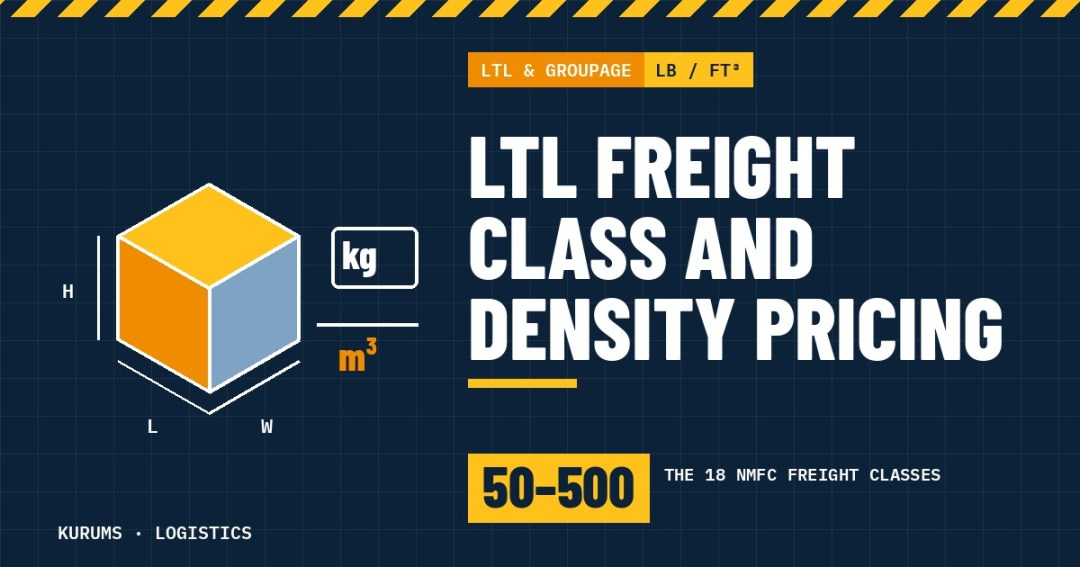
Freight class is a pricing shortcut.
It groups goods by how costly they are to carry, so a carrier can publish one tariff instead of pricing every product separately.
Density is now the main input.
For commodities on the density scale, pounds per cubic foot decides the class. Handling, stowability and liability still apply to goods with special characteristics.
The pallet counts as part of the shipment.
Dimensions are taken at the widest points including the pallet and any overhang. Wasted height and air inside cartons lower density and raise the class.
Reclass fees are avoidable.
Most come from estimated dimensions, a missing or wrong NMFC code, or a description that does not match what is on the pallet.
What is freight class?
Freight class is a number that tells a less-than-truckload (LTL) carrier how expensive your goods are to carry. It comes from the National Motor Freight Classification (NMFC), a standard published by the National Motor Freight Traffic Association (NMFTA) and used by most LTL carriers in the United States.
There are 18 classes: 50, 55, 60, 65, 70, 77.5, 85, 92.5, 100, 110, 125, 150, 175, 200, 250, 300, 400 and 500. The lower the number, the cheaper the rate per hundred pounds. A pallet of steel fasteners sits near the bottom of the scale. A pallet of lampshades sits near the top. The class is one input into the rate, alongside the weight of the shipment, the distance and any extra services. If you are new to shared road freight, start with the Kurums comparison of LTL, FTL and groupage.
What decides which class a shipment gets?
Four characteristics, which the NMFC calls the transportation characteristics.
| Characteristic | What it measures | Effect on class |
|---|---|---|
| Density | Weight relative to the space occupied | The main driver. Lower density means a higher class |
| Handling | Whether special care or equipment is needed | Awkward, fragile or hazardous freight is classed higher |
| Stowability | How well it loads with other freight | Odd shapes, excessive length and items that cannot be stacked are classed higher |
| Liability | Value, risk of theft or damage, risk to other freight | High-value or perishable goods are classed higher |
For a long time many commodities had a fixed class based on what they were. That produced thousands of individual listings and endless arguments about which description applied. The NMFTA's overhaul of the system, which took effect in 2025, moved a large share of commodities on to a standard density scale and consolidated a great many separate listings into broader groups. Where freight has no unusual handling, stowability or liability issues, its measured density now sets the class. Where it does, the listing carries specific rules.
The result is a simpler rule for most shippers and a stricter one: what you measure is what you pay for. Logistics Management reported in its 2026 market update that the industry absorbed the changes more smoothly than many expected, although other trade reports describe continuing disputes over reclassification charges. Both can be true. Shippers who measure properly have had little trouble.
How do you calculate density?
Density is weight divided by volume, expressed in pounds per cubic foot. Measure the shipment as it will travel: on its pallet, wrapped, at its widest, longest and tallest points.
- Measure length, width and height in inches, including the pallet and any overhang.
- Multiply them together to get cubic inches.
- Divide by 1,728 to convert to cubic feet.
- Divide the total weight in pounds, including the pallet, by the cubic feet.
Worked example. A pallet measures 48 by 40 by 50 inches and weighs 600 pounds including the pallet.
- 48 × 40 × 50 = 96,000 cubic inches
- 96,000 ÷ 1,728 = 55.56 cubic feet
- 600 ÷ 55.56 = 10.8 pounds per cubic foot
Now pack the same goods more tightly so the pallet stands 40 inches high instead of 50. Volume falls to 44.44 cubic feet and density rises to 13.5 pounds per cubic foot. Nothing about the product changed; the shipment simply contains less air. On a density scale that is the difference between two classes.
For several pallets, add up the cubic feet and the weights of all of them and divide the totals. For metric users, one pound per cubic foot is about 16 kilograms per cubic metre.
How does density translate into a class?
Through the density scale in the NMFC. The principle is consistent across versions of the scale: freight above about 50 pounds per cubic foot sits in class 50, and freight under one pound per cubic foot sits in class 500, with the other classes spaced between them. The 2025 revision extended the standard scale so that it reaches the lowest classes, 50 and 55, for very dense freight.
Because the break points and the commodity listings are updated through NMFTA dockets several times a year, do not rely on a table copied from a blog, including this one. Use the NMFTA's ClassIT tool, or ask your carrier or broker to confirm the NMFC item number and class for each product you ship regularly, and record them in your product data. The Kurums glossary entries on classification rating and freight measurement cover the governance side.
What is a reclass, and why do the fees appear?
A reclass happens when the carrier decides your shipment belongs in a different class from the one on the bill of lading and corrects the invoice. A reweigh is the same thing for weight. Both usually come with an inspection fee on top of the rate difference.
Carriers find the discrepancies because terminals now use dimensioning machines that scan every pallet as it crosses the dock. Estimating dimensions was a tolerated habit when checking was manual. It is not any more. The common causes are predictable.
| Cause | What happens | Fix |
|---|---|---|
| Estimated or rounded dimensions | Scanned size is larger, density lower | Measure every pallet after wrapping |
| Pallet weight left out | Actual weight is higher than declared | Weigh the finished pallet |
| Overhang or bulging wrap | Widest point sets the footprint | Keep cartons inside the pallet edge |
| Wrong or missing NMFC code | Carrier assigns its own, usually higher | Store the item number in product data |
| Vague description | "Parts" or "equipment" gets the default class | Describe the goods specifically |
| Mixed goods on one pallet | Highest class may apply to all | Separate by class or declare each line |
How can you bring your freight class down legitimately?
By increasing density and removing the features that make freight awkward. None of this is gaming the system; it is what the system rewards.
- Cut the air. Redesign cartons to fit the product and choose a carton footprint that tiles the pallet without gaps.
- Build square, level pallets. Fill the footprint, keep layers flat and stop at a sensible height.
- Make freight stackable. A flat, strong top surface lets the carrier load on it. Cone-topped or irregular pallets are treated as occupying the full height of the trailer.
- Disassemble or nest. Furniture shipped flat, or bins nested inside each other, can change density dramatically.
- Protect properly. Crating and edge protection reduce damage and the liability element.
- Declare accurately and in detail. A precise description and the correct item number prevent the default class being applied.
Is freight class the only way LTL is priced?
No. Several alternatives exist, and large shippers often negotiate them.
- FAK (freight all kinds). A contract term under which a range of classes is rated at one agreed class. It simplifies pricing for shippers with mixed freight.
- Density-based or dimensional pricing. Some carriers quote directly on measured space and weight without reference to NMFC classes.
- Pallet or spot-volume rates. For larger shipments, a price per pallet position or a one-off quotation for a block of trailer space.
- Linear-foot rules. Above a set length of trailer floor, carriers apply a minimum charge per linear foot regardless of class.
The last point matters. A shipment that takes a lot of floor and weighs little can trigger a cubic capacity or linear-foot rule in the carrier's tariff, which replaces the class rate with a much higher charge. Read those rules in the tariff before sending bulky freight, and consider a partial truckload instead. Published rate increases are only the starting point too: carriers announced general rate increases of around 5 to 6% in the most recent round, but what a shipper pays depends on its own freight profile and contract. The extra services that sit on top of the rate are covered in the Kurums guide to accessorial charges.
What does a good shipping process look like?
It takes ten minutes per shipment and saves most disputes.
- Weigh and measure each finished pallet, and photograph it with a tape measure visible.
- Calculate density and confirm the class against the current NMFC listing.
- Put the NMFC item number, class, piece count, dimensions and weight on the bill of lading.
- List extra services you need, such as a tail-lift or appointment, before collection.
- Keep the photographs and the weight ticket. They are your evidence if a reclass is disputed.
Carriers do correct invoices when a shipper produces clear measurements, and they rarely do when a shipper cannot.
Frequently asked questions
What is the cheapest freight class?
Class 50. It applies to very dense, durable freight that is easy to handle, typically above about 50 pounds per cubic foot.
How do I find the NMFC code for my product?
Use the NMFTA's ClassIT tool, or ask your carrier, broker or 3PL to confirm it. Record the item number and class in your product data so that it appears on every bill of lading.
Does the pallet count towards weight and dimensions?
Yes. Carriers weigh and measure the shipment as tendered, including the pallet, packaging and any overhang.
What changed in freight classification in 2025?
The NMFTA moved many more commodities on to a standard density scale and consolidated a large number of individual listings, so measured density decides the class for a greater share of freight.
Can I dispute a reclass fee?
Yes. Send the carrier your measurements, weight ticket and photographs of the pallet as tendered, and ask for the inspection report. Disputes succeed when the shipper has evidence and usually fail when it does not.
Keep reading in the Logistics hub
- National Motor Freight Traffic Association: NMFC and classification
- Logistics Management: 2026 market update, LTL holds the line
- Supply Chain Management Review: 2026 LTL market update
Rates, rankings and market figures were checked in November 2026 and move quickly; confirm with the carrier, forwarder or publisher before you commit. Kurums has no paid relationship with the companies named here.
Discover more from Kurums | Business Intelligence
Subscribe to get the latest posts sent to your email.