
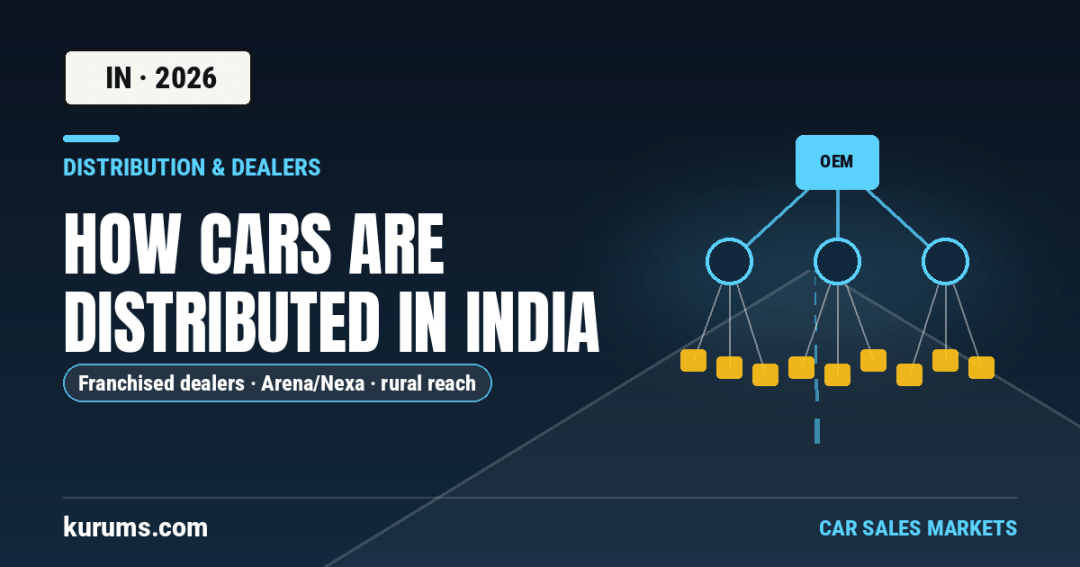
Indian cars are distributed almost entirely through franchised dealers that buy vehicles from manufacturers and resell them, organised in single-brand networks reaching from metro showrooms to small-town and rural outlets. Maruti Suzuki runs the largest network, split into Arena and premium Nexa channels; Mahindra, Tata, Hyundai, Toyota and Kia follow. Dealers are represented by the Federation of Automobile Dealers Associations (FADA), which tracks retail registrations and has long pushed for legal protection against abrupt terminations and forced inventory. Used cars are shifting from informal brokers to organised channels — manufacturer certified programmes and platforms such as Cars24, Spinny and CarDekho — that now handle about a third of the 5.9-million-unit market.
India’s car dealer network is the engine behind the world’s third-largest car market. In a country of 1.4 billion people, where most car buyers are first-time owners and many live far from big cities, distribution reach is the decisive competitive advantage. This guide explains how new and used cars reach Indian buyers in 2026: the franchised dealer model, the major networks, the challenges dealers face and the rise of organised used-car retail. It complements our India car market overview and our guide to India’s online car marketplaces, in the Car Sales Markets hub.
How are new cars sold in India?
Through franchised dealers who buy cars from manufacturers (wholesale) and sell to customers (retail), mostly in single-brand showrooms, plus smaller satellite and rural outlets.
Who has the biggest network?
Maruti Suzuki, with thousands of sales outlets across its Arena and Nexa channels, reaching most of India’s districts.
How organised is used-car retail?
About one-third of used-car volume is handled by organised players — OEM certified programmes and online platforms — and that share is growing fast.
How does car distribution work in India?
Indian car makers sell to franchised dealers, who sell to customers. Manufacturers report “wholesales” — dispatches to dealers — which is the number SIAM publishes; FADA reports “retail” — vehicle registrations at regional transport offices (via the government’s Vahan database) — which reflects actual sales to customers. The gap between the two is dealer inventory, a closely watched indicator: when wholesales run ahead of retail, dealers are carrying too much stock.
Dealers are independent businesses, typically family-owned companies or regional groups, that invest in showrooms, workshops and staff to the manufacturer’s standards. They earn a margin on new cars, often a few percent of the ex-showroom price, plus incentives for meeting targets, commissions on finance and insurance, accessory sales, extended warranties and, most importantly over the life of the customer, service and parts revenue.
Which car companies have the largest dealer networks in India?
Maruti Suzuki operates India’s largest sales and service network, covering the vast majority of the country’s districts through thousands of sales outlets and an even larger number of service workshops. It runs two separate retail channels: Arena, for mass-market models such as the Swift, Dzire, Wagon R and Brezza, and Nexa, a premium-styled channel for models such as the Baleno, Grand Vitara and Fronx. A third channel serves commercial vehicles. The two-channel strategy, launched in 2015, allowed Maruti to move upmarket without diluting its mass-market brand.
Hyundai, Tata Motors and Mahindra each have well over 1,000 sales outlets; Tata also runs separate EV-focused stores. Toyota Kirloskar and Kia have smaller but efficient networks, and Toyota sells some Maruti-built models through its own dealers under a cross-badging partnership with Suzuki. Premium brands — Mercedes-Benz, BMW, Audi, Jaguar Land Rover, Volvo — have far smaller networks concentrated in metros, and Mercedes-Benz India moved to a “retail of the future” agency-style model in 2021, with the manufacturer owning stock and setting prices.
How do dealers reach rural and small-town India?
Rural and semi-urban markets account for a large and growing share of car sales, especially for entry-level and compact models. Manufacturers reach them through layered networks: a main dealership in a district town, smaller satellite showrooms or “outlets” in surrounding towns, and rural sales executives who visit villages. Maruti’s rural strategy, built over two decades, relied on rural dealer outlets and local recruitment and is a key reason for its dominance.
Financing is essential in rural markets. Banks, NBFCs (non-bank finance companies) such as Mahindra Finance and Shriram Finance, and cooperative banks provide loans to customers with limited credit history, often using local knowledge rather than credit scores. Dealers act as the link between lender and customer.
What challenges do Indian car dealers face?
Dealer profitability in India is thinner than in mature markets. New-car margins are low, real-estate and staffing costs in cities are high, and dealers depend on manufacturers’ targets and incentives. Three issues dominate FADA’s agenda.
- Inventory pressure. When manufacturers push wholesales ahead of demand, dealers carry excess stock financed by inventory loans. FADA has repeatedly warned about inventory levels above 50–60 days and the interest burden it creates.
- Franchise protection. India has no specific dealer protection law. FADA has campaigned for years for legislation or a code governing terminations, compensation and territorial rights, pointing to the losses dealers suffered when Ford, General Motors and Harley-Davidson exited India. The industry has sought a “Dealer Protection Act” modelled on laws in other countries.
- Digital disruption. Online research, direct online booking and price transparency compress dealer margins on new cars, while used-car platforms compete for trade-ins.
The GST 2.0 tax cut of September 2025 helped dealers by lifting demand sharply, but it also required them to pass on price reductions on existing stock purchased at the old tax rate — a transition issue that FADA raised with the government.
How is used-car distribution organised in India?
India’s used-car market, about 5.9 million units in FY2024-25, has historically been dominated by unorganised players: local brokers, small independent dealers and direct private sales. Organised channels now handle about one-third of volume and are growing much faster than the market.
Manufacturers’ certified pre-owned programmes are a pillar of organised retail: Maruti Suzuki True Value is the largest, alongside Mahindra First Choice, Toyota U Trust, Hyundai Promise and Das WeltAuto. Online platforms — Cars24, Spinny, CarDekho’s Gaadi/CarDekho Used, CarTrade’s platforms and OLX’s successors — buy cars from owners, inspect and refurbish them, and sell them online and through hubs, offering warranties and financing. Cars24 bought the enthusiast community Team-BHP in 2025, illustrating how platforms are investing in content and trust.
Organised players’ advantages are inspection, refurbishment, warranties, financing and paperwork — particularly ownership transfer at the regional transport office (RTO), which can be slow and complex. Our India marketplaces guide covers each platform.
| Channel | Key players | Role in 2026 |
|---|---|---|
| Franchised dealers (mass) | Maruti Arena, Hyundai, Tata, Mahindra, Toyota, Kia | Almost all new-car sales |
| Premium channel | Maruti Nexa, luxury-brand dealers | Upmarket models |
| Agency-style | Mercedes-Benz India | Fixed prices, manufacturer-owned stock |
| Rural outlets | Satellite showrooms, rural executives | Tier-3 and village demand |
| OEM certified used | True Value, First Choice, U Trust | Organised used retail |
| Online used platforms | Cars24, Spinny, CarDekho | Buy, refurbish, sell online |
How are imported and new brands distributed in India?
High import duties mean most brands assemble locally and build their own dealer networks. New entrants typically appoint experienced dealer groups that already represent other brands, start in major cities and expand as volumes grow. Kia, which entered in 2019, built one of the fastest-growing networks by appointing established dealers and opening outlets ahead of launch. Tesla started selling in India in 2025 through company-run experience centres in Mumbai and Delhi, with imported cars and online ordering. VinFast entered with its own showrooms and dealer partners alongside its Tamil Nadu plant.
Chinese brands face restrictions on investment in India since 2020, which has slowed their entry; JSW MG Motor India, a joint venture in which India’s JSW Group took a 35% stake in 2024, is the main Chinese-origin brand, and BYD sells a limited range through dealers.
How is car retail in India changing?
Digital retail is spreading. Manufacturers offer online booking and configuration, dealers use WhatsApp and video calls for sales, and test drives at home are common in cities. EV stores and experience centres are being built alongside traditional showrooms. Service is becoming the profit centre, as in mature markets, with dealers investing in body shops and extended-warranty programmes.
The longer-term question is whether India will adopt agency models more widely or legislate dealer protection — or both. For now, the franchised dealer remains the backbone of Indian car distribution, and any company entering the market needs a credible plan to reach the districts where the next ten million buyers will come from. For comparison, see how distribution works in China and Japan.
What does this mean for companies selling into Indian dealerships?
For suppliers of technology and services, India’s dealers are a large, fragmented customer base. They buy dealer management systems, CRM and lead-management tools, digital marketing, financing integrations, inspection tools and service-workshop software, often through the manufacturer’s preferred vendor. Price sensitivity is high, so vendors with local language support, WhatsApp integration and low per-user costs do best. Our dealer management systems comparison and automotive CRM comparison cover the international vendors; Indian dealers also use domestic providers that integrate with manufacturer systems.
How do Indian car buyers experience the dealership?
For most Indian buyers, the dealership visit comes after weeks of online research. Shoppers compare variants on CarDekho, CarWale and YouTube, read owner reviews and check on-road prices, then visit two or three dealers — often of competing brands — with a short list. Negotiation centres on the “on-road” price, which includes road tax, registration, insurance and handling charges, and on extras: free accessories, extended warranty, a cash discount, an exchange (trade-in) bonus or a corporate discount for employees of listed companies.
Insurance and accessories are important dealer profit lines, and buyers increasingly push back on bundled add-ons, comparing dealer insurance quotes with online insurers. Delivery is a ceremony: many buyers time it to an auspicious date, and dealers organise delivery events, particularly during the festive season, when dealerships stay open late to manage queues of customers. The customer then returns to the dealer’s workshop for free services over the first few years, which is where the dealer builds the long-term relationship that underpins service revenue and the next trade-in.
Frequently Asked Questions
How do car dealerships work in India?
Dealers are independent franchisees that buy cars from manufacturers at wholesale, sell them at retail and earn margins, incentives, finance and insurance commissions and service revenue.
What is the difference between Maruti Arena and Nexa?
Arena is Maruti Suzuki’s mass-market channel (Swift, Wagon R, Brezza); Nexa is its premium channel with upmarket showrooms (Baleno, Grand Vitara, Fronx).
Is there a dealer protection law in India?
No. FADA has long campaigned for a Dealer Protection Act to govern terminations and compensation, especially after the exits of Ford, GM and Harley-Davidson.
What is FADA retail data?
FADA publishes monthly retail sales based on vehicle registrations from the government’s Vahan system, which reflects sales to customers rather than manufacturer dispatches.
Discover more from Kurums | Business Intelligence
Subscribe to get the latest posts sent to your email.