
Tuesday morning in Tampines. The HR director of an electronics supplier has budget for two process engineers and one machine-learning hire. The catch: the new fabs nearby are recruiting hundreds of engineers, her last Employment Pass applications barely cleared COMPASS, and her AI candidate holds a bank’s counter-offer.
In Novena, a 38-year-old logistics planner weighs a Career Conversion Programme into health-data work against a part-time nursing degree. Both want the same answer: which professions in Singapore are really rising in 2026, what they pay, and how to enter or hire for them.
Singapore enters late 2026 with one of Asia’s tightest labour markets and a two-speed hiring picture. According to the Ministry of Manpower (MOM) Labour Market Report for the second quarter of 2026, employment grew by 11,400, the 19th consecutive quarterly gain, and unemployment was 1.9 per cent in June. Yet vacancies eased to 68,600 from 73,300 in March, and retrenchments climbed from 3,830 in the first quarter to 4,800 in the third, mainly through restructuring in trade-exposed sectors.
Beneath the headlines, demand is concentrating in AI and data, semiconductors, cybersecurity, wealth management, carbon services and care. This guide ranks the fastest growing jobs in Singapore 2026 using LinkedIn’s Jobs on the Rise list, MOM data, the 2026 Shortage Occupation List and three salary guides. It is part of the Rising Professions 2026 hub on kurums.
Which job is rising fastest in Singapore in 2026?
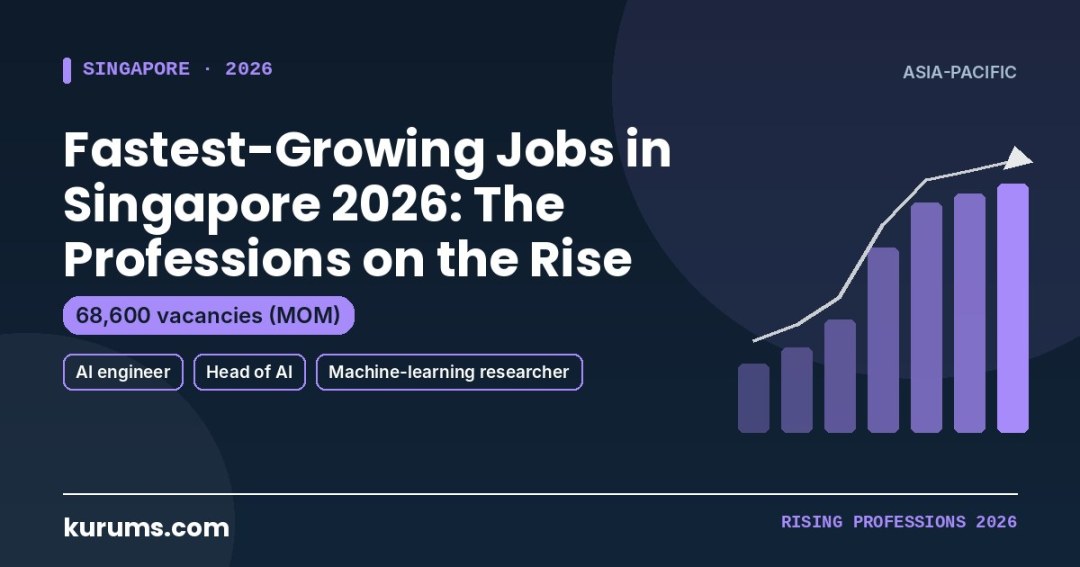
AI engineer. LinkedIn’s Jobs on the Rise 2026 list for Singapore ranks it first, ahead of head of AI and machine-learning researcher; all three sit on MOM’s 2026 Shortage Occupation List.
What do the rising roles pay?
Hays’ 2026 data put AI engineers at about S$72,000–200,000 (US$56,000–155,000) a year; Michael Page starts heads of generative AI at S$225,000.
What is the biggest employer risk?
Paying AI-hype premiums while ignoring structural shortages in nursing, allied health and semiconductor engineering.
Which jobs are rising fastest in Singapore in 2026?
AI engineer, head of AI and machine-learning researcher lead LinkedIn’s Jobs on the Rise 2026 list for Singapore, followed by payment operations specialist and fundraising manager. Add MOM’s Shortage Occupation List and vacancy counts, and semiconductor engineers, nurses, allied health professionals, private bankers and carbon specialists join the top tier.
Singapore publishes no ten-year occupational projections, so the best demand signals are LinkedIn’s ranking (growth in members holding a title), MOM’s vacancy table and the Shortage Occupation List (SOL) in force from 1 January 2026.
| Rank | Profession | Why it is rising | Demand signal (source) | Typical advertised pay |
|---|---|---|---|---|
| 1 | AI engineer | Generative AI moving into production | LinkedIn 2026 #1; SOL 2026 | S$72,000–200,000 / US$56,000–155,000 (Hays 2026) |
| 2 | Head of AI | Accountable leaders for governed AI at scale | LinkedIn 2026 #2 | From S$225,000 / US$174,000 (Michael Page 2026) |
| 3 | ML / AI researcher | Applied model research | LinkedIn 2026 #3; SOL 2026 | Not separately published |
| 4 | Payment operations specialist | Regional payments and fintech hub | LinkedIn 2026 #4 | Not published in guides checked |
| 5 | Data scientist | Data foundations for AI | SOL 2026; ~340 MOM vacancies | S$7,500–14,000 a month (PERSOL 2026/27) |
| 6 | Cybersecurity architect / specialist | Critical infrastructure and data centres | SOL 2026 | S$72,000–180,000 / US$56,000–140,000 (Hays 2026) |
| 7 | Semiconductor / process engineer | Micron and VSMC fab expansions | SOL 2026; ~250 MOM vacancies | Increments 10–15% (Michael Page 2026) |
| 8 | Registered nurse and allied health | Ageing; MOH target ~82,000 care workers by 2030 | SOL 2026; ~330 nurse vacancies (MOM) | Increments 10–15%, up to 25% (Michael Page 2026) |
| 9 | Private banking RM / wealth planner | 2,000-plus single family offices; S$6.7tn AUM (MAS) | SOL 2026 | S$180,000–250,000 a year senior (Michael Page 2026) |
| 10 | Carbon-market specialist | Carbon trading and verification hub | SOL 2026 | Increments 7–10%, up to 15% (Michael Page 2026) |
Two patterns stand out. First, the list is policy-shaped: eight of the ten roles sit on MOM’s Shortage Occupation List, meaning the government has formally judged that Singapore cannot grow these skills fast enough at home. Second, LinkedIn’s list is broader than the AI headlines: guidance counsellor (#6), teacher (#7), medical officer (#9) and psychologist (#10) also make the 2026 ranking. By volume, MOM counted software developers (about 630 openings) among the largest vacancy pools in September 2025.
What is driving demand for these professions?
Four forces explain most of the list: an AI and data-centre build-out, a semiconductor investment wave, a family-office-driven wealth boom, and an ageing population that Healthier SG is trying to serve closer to home.
AI deployment and renewed data-centre growth
Singapore lifted its data-centre moratorium in 2022 under a Green Data Centre Roadmap promising at least 300 MW of additional capacity. In August 2026 the Economic Development Board provisionally allocated 200 MW to four operators on a Jurong Island park with potential for 700 MW; the island already runs more than 70 data centres totalling roughly 1.4 GW.
OpenAI also committed more than S$300 million (about US$233 million) in 2026 to its first Applied AI Lab outside the United States, in Singapore, and Hays ranked Singapore eighth of 34 countries for technology pay.
Semiconductor expansion
Micron broke ground in January 2026 on a roughly US$24 billion (about S$31 billion) NAND wafer fab in Singapore, with output due in late 2028. With the 1,400 roles announced for its memory-packaging plant, Micron expects about 3,000 new Singapore jobs, mostly in fab engineering.
VSMC, the Vanguard–NXP joint venture, opened its first 12-inch fab in Tampines in September 2026 and expects around 1,600 jobs by 2029, three-quarters of them PMET roles, which is why semiconductor and process engineers joined the 2026 Shortage Occupation List.
Wealth management, family offices and carbon services
In an August 2026 parliamentary reply, MAS confirmed that more than 2,000 single family offices held tax incentives at end-2025 and that the asset-management industry grew 10.1 per cent in 2025 to a record S$6.7 trillion (about US$5.2 trillion). Each family office pulls through demand for private banking, legal, tax and fund administration, which is why UHNW relationship managers and wealth planners are the only front-office finance roles on the 2026 shortage list.
The same list names carbon traders, project managers and verification specialists. The carbon market is real but smaller than the hype: Michael Page puts sustainability increments at 7–10 per cent, up to 15 per cent at the top, and Eco-Business reported in 2026 that young Singaporeans face a green-jobs reality check.
Ageing, Healthier SG and the care economy
The Ministry of Health has set annual hiring targets to grow the care workforce to a projected 82,000 by 2030, roughly 24,000 more than when the target was set. Healthier SG shifts care into polyclinics and the community, multiplying demand for nurses, therapists, radiographers and clinical psychologists, all on the 2026 shortage list.
Pay is catching up: Michael Page reports healthcare increments of 10–15 per cent for 2026, up to 25 per cent for contested roles, the highest in its guide, and MOM’s second-quarter report shows Health & Social Services adding resident jobs while trade-exposed industries slowed.
What do the rising jobs pay in Singapore?
Rising roles typically advertise S$72,000–200,000 a year for AI, data and security specialists, S$180,000–250,000 for senior private bankers and above S$200,000 for data and compliance leaders, according to the Hays, Michael Page and PERSOL 2026 guides. Increments run 3–6 per cent for most staff and 10–15 per cent for job switchers; US dollar figures are rounded at S$1.29 per US$1.
| Role | Typical advertised range (2026) | Source / year |
|---|---|---|
| AI engineer | S$72,000–200,000 a year (US$56,000–155,000) | Hays 2026 |
| Head of generative AI | From S$225,000 (US$174,000) | Michael Page 2026 |
| Data scientist | S$7,500–14,000 a month (US$5,800–10,900) | PERSOL 2026/27 |
| Data engineer | S$90,000–120,000 (US$70,000–93,000) | Hays 2026 |
| Cybersecurity specialist | S$72,000–180,000 a year (US$56,000–140,000) | Hays 2026 |
| Data leader / IT director | S$200,000 or more (US$155,000+) | Michael Page 2026 |
| Private banking relationship manager | S$8,000–20,000 a month, senior to S$30,000 (US$6,200–23,000) | PERSOL 2026/27 |
| Compliance and risk leader | Often above S$200,000 (US$155,000) | Michael Page 2026 |
Pay beats inflation only in scarce roles. Robert Walters expects 3–6 per cent rises in 2026 for those who stay, broadly in line with inflation; Mercer forecasts about 4 per cent. Michael Page shows the spread underneath: 6–10 per cent in technology (up to 18 per cent for AI, cloud and cybersecurity), 10–15 per cent in healthcare and engineering, and 10–15 per cent for job switchers; it counts at least 243 roles starting at S$100,000 (about US$78,000).
Singapore has no statutory pay-transparency law, so advertised ranges are voluntary, although the Fair Consideration Framework requires most Employment Pass employers to advertise on MyCareersFuture first. As a city-state, Singapore has no regional pay gap; the premium follows employer type.
Which skills, degrees and certifications unlock these roles?
Most rising roles need a recognised degree plus a professional credential: cloud and ML certifications for AI and data, CISSP or OSCP for security, Singapore Nursing Board or AHPC registration for care roles, CMFAS and IBF accreditation for wealth management, and engineering degrees for fabs. SkillsFuture and Career Conversion Programmes subsidise most pathways.
SkillsFuture Singapore’s Skills Demand for the Future Economy reports group priority skills under the digital, green and care economies.
- AI engineer and ML researcher: relevant degree or three years in the role (the SOL test), plus AWS Certified Machine Learning or Google Professional ML Engineer; AI Singapore’s AI Apprenticeship Programme is the subsidised route.
- Data scientist and data engineer: statistics or computing degree; Databricks or AWS data-engineering certification.
- Cybersecurity architect and penetration tester: CompTIA Security+ at entry, then CISSP, CISM or OSCP.
- Semiconductor and process engineer: bachelor’s in electrical, chemical or materials engineering (the SOL requirement); Micron and VSMC graduate traineeships.
- Registered nurse and allied health: Singapore Nursing Board or Allied Health Professions Council registration; MOH Career Conversion Programmes.
- Private banking RM and wealth planner: CMFAS examinations, IBF accreditation, CFA, and three years in the role at a licensed institution (SOL).
- Carbon-market specialist: three years’ carbon-market experience plus a degree (SOL); GARP Sustainability and Climate Risk or CFA ESG Investing certificates.
The kurums Courses & Certifications directory lists providers, and the MBA & Business Education directory covers executive and finance master’s options.
Where are the jobs? Regional hotspots
Singapore is one labour market, so hotspots are districts: Jurong Island for data centres, Tampines and Woodlands for semiconductors, the CBD for wealth management, one-north and Punggol for AI and cyber, and the Novena and Outram health campuses for care roles.
| District / cluster | Why it matters in 2026 | Roles concentrated here |
|---|---|---|
| Jurong Island | Low-carbon data-centre park (up to 700 MW); 2026 capacity awards | Data-centre engineers, carbon project managers |
| Tampines and Woodlands | VSMC’s 12-inch fab (~1,600 jobs by 2029); Micron’s US$24bn fab (~3,000 roles) | Semiconductor and process engineers, technicians |
| CBD and Marina Bay | Private banks, asset managers and 2,000-plus family offices | Relationship managers, wealth planners, compliance |
| one-north and Punggol | Fusionopolis research cluster; Punggol digital campus | AI engineers, ML researchers, cybersecurity architects |
| Novena, Outram and regional health campuses | HealthCity Novena, SGH campus, polyclinics under Healthier SG | Nurses, allied health, medical officers, clinical psychologists |
Commuting is rarely the constraint; housing cost and Employment Pass quotas are.
Which professions are losing ground?
Routine administrative, clerical and back-office roles are losing ground, alongside mid-career professionals in trade-exposed sectors under restructuring. MOM data show retrenchments rising through 2026 with reorganisation the main cause, and MOM is reviewing how AI is captured in that data.
The numbers are moderate rather than alarming: retrenchments rose from 3,830 in the first quarter to 4,800 in the third, about 2.0 per 1,000 employees, and there were still 1.48 vacancies per unemployed person in June, though degree holders and PMETs were disproportionately affected. Globally, the World Economic Forum’s Future of Jobs Report 2025 lists data-entry clerks, administrative assistants, bank tellers and payroll clerks among the fastest-declining roles to 2030; decline is concentrated in automatable tasks, not whole sectors.
How should employers in Singapore hire for scarce rising roles?
Benchmark against two 2026 salary guides, hire on demonstrated skills, build internal conversion pathways, use the Shortage Occupation List and COMPASS bonus deliberately, and treat employer brand as retention; without a Singapore entity, use an employer of record.
Pay for scarcity, not titles
Combine two guides with MOM’s occupational wage data, then set bands by scarcity. The 2026 data justify double-digit premiums for AI, cybersecurity, fab engineering and specialist healthcare, not for generalist roles at 3–6 per cent.
Hire for skills and convert from within
Treat Career Conversion Programmes and polytechnic traineeships as a pipeline; VSMC’s seven campus MOUs are the template. For AI roles, take-home assessments beat degree filters.
Use the immigration routes correctly
Employment Pass applications are scored under COMPASS on salary, qualifications, firm diversity and local share, with bonus points for Shortage Occupation List roles (C5). Senior leaders may qualify for the Overseas Networks & Expertise Pass and technicians for the S Pass. Prepare now for the Workplace Fairness Act, expected to take effect from end-2027.
Fix the operating model
The kurums guide to recruiting in Singapore covers CPF, leave and contract rules. For specialist searches, the directory of recruitment agencies and HR consultancies in Singapore lists firms by niche, and the Expats in Singapore series covers housing, schooling and pass renewals.
What should job seekers and career changers do in 2026?
Pick a role on both LinkedIn’s list and MOM’s Shortage Occupation List, earn the one credential employers screen for, use SkillsFuture and Career Conversion funding, and target employers with announced expansion such as the fabs, data-centre operators and family-office service firms.
- Choose a double-signal role. AI engineer, data scientist, cybersecurity architect and registered nurse appear on LinkedIn’s list or MOM’s vacancy table and on the 2026 shortage list.
- Check the qualification bar first. The SOL states the minimum, such as a relevant degree or three years in the role for infocomm.
- Earn one recognised certification, not five badges. AWS or Google ML for AI; CISSP or OSCP for security; CMFAS and IBF for wealth.
- Use the money on the table. SkillsFuture Credit, the Level-Up Programme for over-40s and WSG Career Conversion Programmes subsidise fees and sometimes salary.
- Follow the capital. Micron and VSMC hire engineers through 2029, four data-centre operators have new capacity to staff, and 2,000-plus family offices need staff.
- Expect realistic progression. AI engineers start near S$6,000 a month and reach S$12,000 or more (PERSOL); switching employers paid 10–15 per cent in 2026.
- Protect the downside. Restructuring is hitting mid-career PMETs; refresh skills yearly and avoid roles built on pure data handling.
Frequently Asked Questions
Did LinkedIn publish a Jobs on the Rise 2026 list for Singapore?
Yes, in January 2026. The top five are AI engineer, head of AI, machine-learning researcher, payment operations specialist and fundraising manager; guidance counsellor, teacher, quantitative researcher, medical officer and psychologist complete the top ten. LinkedIn publishes ranks, not growth percentages.
Which jobs give a COMPASS bonus for Employment Pass applications in 2026?
Occupations on MOM’s Shortage Occupation List effective 1 January 2026 earn the C5 skills bonus: AI engineers, data scientists, cloud and cybersecurity specialists, software developers, semiconductor engineers, nurses, allied health professionals, clinical psychologists, private banking relationship managers, carbon-market specialists, marine superintendents and two agritech roles.
How much does an AI engineer earn in Singapore in 2026?
Typical advertised ranges, not guarantees: Hays’ 2026 data put AI engineers at about S$72,000–200,000 a year (US$56,000–155,000), and PERSOL’s 2026/27 guide shows S$6,000–12,000 a month. Michael Page starts heads of generative AI at S$225,000.
Is Singapore’s job market still growing despite rising retrenchments?
Yes, unevenly. MOM reports employment grew by 11,400 in the second quarter of 2026 and 27,700 in the third, with unemployment at 1.9–2.0 per cent. Retrenchments rose to 4,800 in the third quarter, concentrated in trade-exposed firms, while essential services and health added resident jobs.
Sources and method
- Labour Market Report Second Quarter 2026 — Ministry of Manpower, 2026
- Labour Market Advance Release Q3 2026 (MOM figures) — Human Resources Online, 2026
- COMPASS C5 Skills Bonus: Shortage Occupation List 2026 — Ministry of Manpower, 2025
- LinkedIn Jobs on the Rise 2026 Singapore; MOM Jobs in Demand — Vulcan Post, 2026
- Singapore’s fastest-growing jobs in 2026 (LinkedIn) — VnExpress International, 2026
- Singapore’s 2026 pay divide (Michael Page guide) — People Matters, 2026
- Singapore technology salaries ranked eighth globally — Hays plc, 2026
- PERSOL Singapore Salary Guide 2026/27 — Human Resources Online, 2026
- Singapore pay rises of 3–6% expected in 2026 — VnExpress International, 2025
- Written reply on single family offices — Monetary Authority of Singapore, 2026
- Singapore allocates 200 MW of data-centre capacity — eWeek, 2026
- Micron wafer fab to create 1,600 Singapore jobs — Human Resources Online, 2026
- VSMC Singapore fab to create 1,600 jobs by 2029 — Human Resources Online, 2026
- Healthcare workforce hiring targets to 2030 — Ministry of Health, 2022
- The Future of Jobs Report 2025 — World Economic Forum, 2025
<
p style=”font-size:.9em;color:#6B7280″>Method: LinkedIn’s 2026 Singapore ranking, MOM vacancy data (September 2025) and the 2026 Shortage Occupation List were combined as demand signals, with pay from the Hays, Michael Page and PERSOL 2026 guides; USD rounded at S$1.29. Figures checked November 2026.
Discover more from Kurums | Business Intelligence
Subscribe to get the latest posts sent to your email.