
The CFO of a Brisbane engineering contractor signs off her 2026 workforce plan with two facts on the desk: unemployment has drifted up to 4.7%, yet she still cannot fill power system engineer and electrician vacancies at last year’s rates before a renewable energy zone contract starts in March.
In Western Sydney, an executive assistant whose reporting work now runs through AI tools is weighing an electrical apprenticeship against a cyber security graduate certificate. Both lead to shortage-list occupations; pay and training time differ sharply. This guide is for both.
Australia enters 2026 with a cooler labour market than the post-pandemic boom, but not a weak one. According to the Australian Bureau of Statistics (ABS) release of 15 October 2026, unemployment was 4.7% in September 2026 and annual employment growth slowed to 1.2%. Jobs and Skills Australia (JSA) still projects employment to grow by 1.95 million (13.3%) to 2035, over 90% of it in jobs needing a post-secondary qualification.
Four themes decide where those jobs land: the 1.2 million homes target, the energy transition, an ageing population, and the industrial build-out behind AUKUS and AI data centres. This guide, part of the Rising Professions 2026 hub, ranks the professions gaining ground, explains the drivers, sets out pay and credentials, and closes with a hiring playbook.
Which jobs are rising fastest in Australia in 2026?
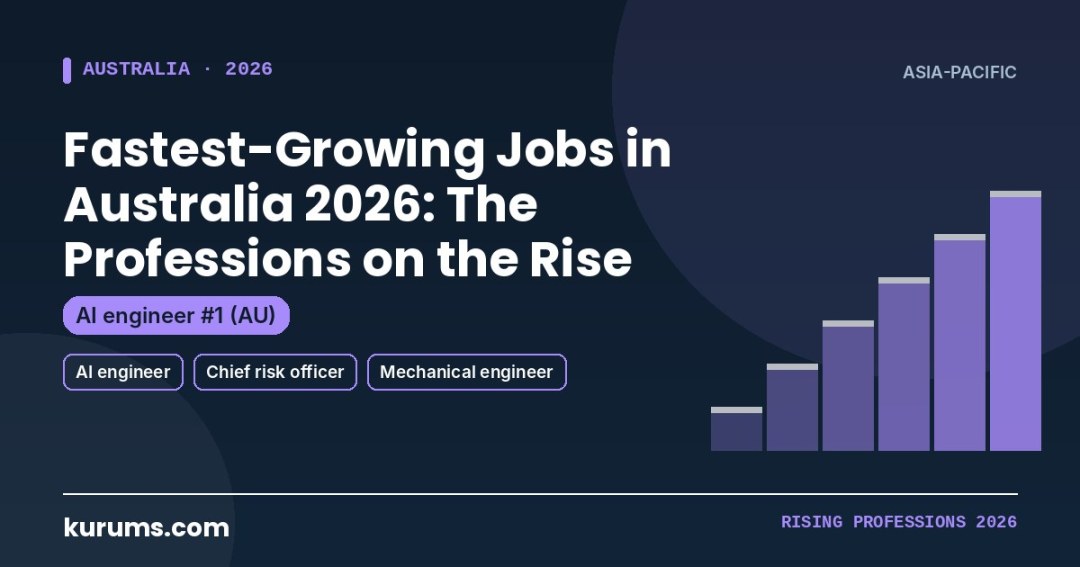
AI engineer, chief risk officer and mechanical engineer top LinkedIn’s Jobs on the Rise 2026 Australia list; JSA projects physiotherapists (+35.1%) to grow fastest to 2035, and nurses, electricians and engineers stay on the 2025 shortage list.
Is the wider Australian job market still growing?
Modestly. Unemployment was 4.7% in September 2026 (ABS), but JSA still projects 13.3% employment growth to 2035, led by health care, professional services and education.
What do the rising jobs pay?
Typical advertised ranges: AI engineers about A$190,000 (Hays FY25/26), cyber specialists A$135,000–180,000 (Robert Half 2026), electricians A$100,000–120,000 (Seek 2026) and registered nurses A$86,500–100,500 (Healthcare Australia 2026).
Which jobs are rising fastest in Australia in 2026?
AI engineer, chief risk officer and mechanical engineer lead LinkedIn’s Jobs on the Rise 2026 Australia list, while Jobs and Skills Australia’s projections and the 2025 Occupation Shortage List point to physiotherapists, nurses, electricians, power system engineers and care workers as the structurally rising professions.
The ranking triangulates three sources: LinkedIn’s January 2026 list of 15 titles ranked by growth across its membership base, JSA’s November 2025 ten-year projections, and the 2025 Occupation Shortage List (OSL), which found 293 of 1,022 assessed occupations (29%) in national shortage, down from 33% in 2024. Pay figures are typical advertised ranges, converted at about US$0.69 per Australian dollar.
| Rank | Profession | Why it is rising | Demand signal (source) | Typical advertised pay |
|---|---|---|---|---|
| 1 | AI engineer | Generative AI moving to production; A$25bn Microsoft AI build-out | LinkedIn Jobs on the Rise 2026 #1 | About A$190,000 (US$131,000) (Hays FY25/26) |
| 2 | Chief risk officer | Tighter prudential, privacy and cyber rules | LinkedIn Jobs on the Rise 2026 #2 | Risk manager A$150,000–170,000 (US$104,000–117,000) (Seek 2026) |
| 3 | Mechanical engineer | Shipbuilding, mining, clean energy manufacturing | LinkedIn 2026 #3; engineers in shortage (OSL 2025) | A$85,000–105,000 (US$59,000–72,000) (Seek 2026) |
| 4 | Power system / electrical engineer | Grid rebuild and renewable energy zones | LinkedIn 2026 #10; JSA clean energy critical occupation | A$105,000–125,000 (US$72,000–86,000) (Seek 2026) |
| 5 | Registered nurse | Ageing, aged care staffing mandates, NDIS | OSL 2025 shortage; 70,707 FTE nurse gap by 2035 | Acute RN 5+ A$100,500 (US$69,000); aged care RN A$86,500 (Healthcare Australia 2026) |
| 6 | Physiotherapist | Ageing, NDIS, preventive health | JSA +35.1% to 2035, fastest-growing occupation | A$90,000–105,000 (US$62,000–72,000) (Seek 2026) |
| 7 | Electrician | Housing, electrification, solar and batteries | OSL persistent shortage; 32,000 more needed by 2030 (JSA) | A$100,000–120,000 (US$69,000–83,000) (Seek 2026) |
| 8 | Personal care worker | Aged care and disability demand | JSA +24.7% to 2035; carers +98% 2014–24 (KPMG) | A$70,000–75,000 (US$48,000–52,000) (Seek 2026) |
| 9 | Cyber security specialist | Rising attacks, critical-infrastructure rules | Five cyber roles added to the CSOL, Dec 2024 | A$135,000–180,000 (US$93,000–124,000) (Robert Half 2026) |
| 10 | Data engineer / data scientist | AI needs governed data pipelines | Data Scientist added to CSOL, Dec 2024 | A$125,000–160,000 (US$86,000–110,000) (Robert Half 2026) |
Three families dominate. The first is AI and its data stack: AI engineer, director of artificial intelligence (LinkedIn #4), data engineers and cyber specialists. The second is governance: chief risk officer, legal director (#6), regulatory affairs consultant (#9) and tax specialist (#14). The third is the physical and care economy the OSL has flagged for years: engineers, electricians, nurses, physiotherapists and care workers.
The sources differ for a reason: LinkedIn measures title growth among profile-holders, so its list is white-collar, while the OSL and JSA measure unfilled vacancies and projected headcount. LinkedIn’s 2025 list was led by English teacher and server, so single-year rankings swing with the cycle.
What is driving demand for these professions?
Five forces pull Australian hiring in 2026: the AI and data-centre build-out, the 1.2 million homes target, the energy transition, an ageing population served by aged care and the NDIS, and industrial policy spanning AUKUS, critical minerals and compliance. Each creates its own rising roles.
AI, data and the data-centre build-out
On 23 April 2026 Microsoft announced an A$25 billion (US$18 billion) investment in Australia through 2029, expanding its local AI and cloud footprint by more than 140% and committing to train three million Australians in AI skills by 2028. LinkedIn reports AI literacy is now the most in-demand skill across all Australian jobs.
The Core Skills Occupation List that took effect on 7 December 2024 added Data Analyst, Data Scientist and five cyber security occupations, opening employer-sponsored visas to them.
Housing: 1.2 million homes and a trades gap
The National Housing Accord targets 1.2 million new homes by 2029. BuildSkills Australia estimates the industry needs 116,700 additional construction workers, about 25% above business as usual.
The OSL confirms the squeeze: almost one in two trades occupations were in shortage in 2025, and 71 of the 139 occupations in shortage every year since 2021 are trades.
Energy transition and renewable energy zones
JSA’s Clean Energy Generation study found Australia needs about 32,000 additional electricians by 2030, well above projected supply, and that clean energy generation and transmission could need 450,000 construction jobs by 2030.
Under JSA’s central scenario, regional New South Wales, Eastern Victoria and the Northern Territory should see annual employment growth close to 2% to 2030 thanks to renewable energy zones.
Ageing, aged care and the NDIS
Health Care and Social Assistance added 886,700 workers in the decade to May 2025 and employs over 2.3 million people, according to JSA, whose fastest-growing occupations to 2035 are nearly all health roles: physiotherapists (+35.1%), health and welfare services managers (+27.1%) and personal care workers (+24.7%).
Supply lags. The federal Nursing Supply and Demand Study projects an undersupply of 70,707 full-time-equivalent nurses by 2035, including 17,551 in aged care. KPMG’s analysis shows aged and disabled carers almost doubling to 429,400 between 2014 and 2024.
Industrial policy: AUKUS, critical minerals and compliance
The Australian Submarine Agency expects AUKUS to create around 20,000 direct jobs over 30 years, peaking at 8,500 industrial roles: up to 4,000 to build the Osborne yard in South Australia, 4,000 to 5,500 to build submarines, and about 3,000 at HMAS Stirling in Western Australia. Critical minerals projects compete for the same engineers.
Governance is the other effect. Five of LinkedIn’s 15 rising titles are risk, legal, regulatory, safety or tax roles, and Robert Half’s 2026 guide shows the price of scarcity: a head of financial crime or AML starts at A$185,000 to A$270,000 (US$128,000–186,000).
What do the rising jobs pay in Australia?
Advertised pay for the rising roles runs from about A$70,000 for aged care workers to A$190,000 and above for AI engineers. Technology and risk roles cluster between A$135,000 and A$220,000, engineers and electricians between A$85,000 and A$125,000, and clinical roles between A$86,500 and A$105,000, according to 2026 guides.
The table combines Hays’ FY25/26 guide, Robert Half’s 2026 guide (25th to 75th percentile starting salaries, excluding super), Seek’s employer-disclosed ad ranges and Healthcare Australia’s 2026 nursing guide.
| Role | Typical advertised range (2026) | Source / year |
|---|---|---|
| AI / machine learning engineer | About A$190,000 (US$131,000), major cities | Hays Salary Guide FY25/26 |
| Cyber security specialist | A$135,000 / 150,000 / 180,000 at 25th / 50th / 75th percentile (US$93,000–124,000) | Robert Half Salary Guide 2026 |
| Data engineer | A$125,000 / 145,000 / 160,000 (US$86,000–110,000) | Robert Half Salary Guide 2026 |
| Electrical engineer | A$105,000–125,000 (US$72,000–86,000) | Seek advertised ranges, November 2026 |
| Electrician | A$100,000–120,000 (US$69,000–83,000) | Seek advertised ranges, November 2026 |
| Registered nurse | Acute RN 5+ years A$100,500 (US$69,000); aged care RN A$86,500 (US$60,000); nurse unit manager A$140,000 (US$97,000) | Healthcare Australia Salary Guide 2026 |
| Physiotherapist | A$90,000–105,000 (US$62,000–72,000) | Seek advertised ranges, November 2026 |
| Aged care worker | A$70,000–75,000 (US$48,000–52,000) | Seek advertised ranges, November 2026 |
Pay momentum is uneven. Hays reports technology salaries rose almost 10% year on year, while Robert Half’s 2026 guide says data-engineering and cyber salaries have flattened; 52% of employers it surveyed will stretch further for specialised skills.
Transparency shapes negotiations: pay-secrecy clauses are prohibited under the Fair Work Act and the Workplace Gender Equality Agency publishes employer-level gender pay gaps. Location still moves the number: Hays puts cyber architects at about A$220,000 in NSW and Victoria, and aged care RN averages run from A$82,000 in South Australia to A$92,000 in Queensland.
Which skills, degrees and certifications unlock these roles?
Most rising Australian roles are gated by a registration body or licence rather than a degree alone: AHPRA for nurses and physiotherapists, state licences for electricians, Engineers Australia chartership for engineers, and vendor certifications for AI and cyber.
- AI engineer. A computer science or engineering degree plus AWS Certified Machine Learning – Specialty or Microsoft Azure AI Engineer Associate (AI-102).
- Cyber security specialist. CompTIA Security+ for entry, then CISSP, CISM or OSCP; the Australian Signals Directorate’s Essential Eight is expected in government work.
- Electrician. Certificate III in Electrotechnology through a four-year apprenticeship, then a state electrical licence.
- Power system or electrical engineer. A Washington Accord-recognised degree and Engineers Australia Chartered (CPEng) status.
- Registered nurse. A Bachelor of Nursing and registration with the Nursing and Midwifery Board of Australia via AHPRA.
- Chief risk officer. CPA or CA, GARP’s Financial Risk Manager (FRM) and fluency in APRA’s CPS 230 standard; an MBA remains the usual route.
The kurums Courses & Certifications directory lists providers for these credentials, and the MBA & Business Education directory covers business schools.
Where are the jobs? Regional hotspots
Sydney and Melbourne hold most AI, data, risk and legal roles; Adelaide and Perth are the AUKUS shipbuilding hubs; regional NSW, Eastern Victoria and the Northern Territory lead clean energy construction; and care shortages are deepest in regional and remote areas.
| Region | Rising roles | Why (source) |
|---|---|---|
| Sydney and NSW | AI engineers, cyber architects, CROs, compliance leaders | Financial-services headquarters; highest tech pay (Hays) |
| Adelaide and Osborne, SA | Shipbuilding trades, mechanical and electrical engineers | AUKUS: up to 4,000 yard jobs plus 4,000–5,500 build jobs (ASA) |
| Perth and HMAS Stirling, WA | Submarine sustainment, mining engineers, geologists | About 3,000 direct AUKUS jobs; critical minerals |
| Regional NSW, Eastern Victoria, NT | Electricians, power system engineers, linesworkers | Renewable energy zones; JSA projects close to 2% annual growth to 2030 |
| Regional and remote Australia | Nurses, GPs, aged care workers | Regional-only shortages rose to 21 occupations in 2025 from 12 (OSL) |
White-collar rising roles stay concentrated in Sydney and Melbourne. Trade and clinical shortages are deepest where the big projects are: submarine yards, renewable energy zones and regional hospitals, so employers who build training capacity there face less competition.
Which professions are losing ground?
Administrative support, travel agency, print and telecommunications installation roles shrank over the past decade, according to KPMG’s 2014–2024 analysis, while business, finance and ICT occupations moved out of shortage in 2025 as hiring cooled. The declines are gradual.
KPMG found executive assistants fell from 105,000 to 82,300 between 2014 and 2024 (−21.6%), travel agents from 27,000 to 17,600 (−34.8%), print manufacturing workers by 23.0% and telecommunications installers by 12.4%, reflecting automation of scheduling and booking and the shift to online travel and digital media.
The 2025 OSL adds a recent signal: 69 occupations moved out of shortage, 31 of them professional roles in a business, finance, engineering and ICT cluster, consistent with cooler software hiring after the 2021–22 boom. Deloitte, cited by Forbes Australia, also notes early US evidence that junior employment has fallen at firms adopting AI heavily.
How should employers in Australia hire for scarce rising roles?
Benchmark against 2026 percentile data rather than last year’s band, hire on demonstrated skills rather than titles, use apprenticeships for trades, build internal mobility into AI and risk roles, and have the Skills in Demand visa ready for Core Skills Occupation List roles.
Benchmark properly. Robert Half’s 2026 guide reports 99% of employers will go above their initial offer and 97% would add benefits where salary cannot move. Treat the percentile ranges above as a corridor.
Hire for skills, not titles. Use work samples over keyword screening for data, cyber and AI roles and licence checks for trades. The kurums guide to recruiting in Australia covers compliant ads and probation.
Grow your own. With 43% of Skill Level 3 occupations in shortage, apprenticeships are the long-term fix; Fee-Free TAFE and New Energy Apprenticeships (up to A$10,000 per apprentice) cut the cost. For professional roles, internal mobility into risk and AI engineering beats the external market.
Use the visa system deliberately. The Skills in Demand (subclass 482) Core Skills stream covers the 456 occupations on the Core Skills Occupation List, with a Core Skills Income Threshold of A$79,499 (US$55,000) from 1 July 2026; the Specialist Skills stream, for roles paying at least A$146,717 (US$101,000), suits AI engineers and risk leaders. Without an Australian entity, an employer-of-record lets you hire while you incorporate; the expat HR in Australia category covers relocation and superannuation.
Choose partners. Specialist agencies beat generalists on scarce roles; the guide to recruitment agencies and HR consultancies in Australia explains fee models.
What should job seekers and career changers do in 2026?
Pick a target occupation that appears on at least two of the three lists used here, choose the shortest credible credential path, and spend 2026 building proof of skill. For most career changers that means a trade apprenticeship, a health registration pathway or an AI, data or cyber upskilling route.
- Cross-check the demand signal. Roles on all three lists, such as nursing and electrical trades, carry the lowest risk.
- Price the credential honestly. An apprenticeship takes four years but pays while you train; a cyber graduate certificate takes a year.
- Build AI fluency whatever the role. LinkedIn ranks AI literacy as the most in-demand skill across all Australian jobs.
- Consider the regions. Regional-only shortages rose to 21 occupations in 2025; the energy and AUKUS hotspots sit outside the CBDs.
- If you are overseas, align with the CSOL. Confirm your occupation is among the 456 listed and target approved sponsors.
Frequently Asked Questions
What is the fastest-growing job in Australia in 2026?
AI engineer ranks first on LinkedIn’s Jobs on the Rise 2026 Australia list, followed by chief risk officer and mechanical engineer. On a ten-year basis, Jobs and Skills Australia expects physiotherapists to grow fastest, at 35.1% to 2035.
Is there still a skills shortage in Australia?
Yes, but it is easing. The 2025 Occupation Shortage List rated 293 of 1,022 occupations (29%) in national shortage, down from 33% in 2024. Trades remain the most affected, with almost one in two in shortage.
Which Australian visa covers these rising occupations?
The Skills in Demand (subclass 482) visa. Its Core Skills stream uses the 456-occupation Core Skills Occupation List, with an income threshold of A$79,499 from 1 July 2026; roles paying at least A$146,717 can use the Specialist Skills stream.
How much do electricians and nurses earn in Australia in 2026?
Seek’s employer-disclosed ranges put electricians at A$100,000–120,000 (about US$69,000–83,000) in November 2026. Healthcare Australia’s 2026 guide puts experienced acute-care registered nurses at A$100,500 and aged care RNs at A$86,500, before superannuation.
Sources and method
- LinkedIn Jobs on the Rise 2026 Australia — Forbes Australia, 2026
- Top 10 growing and declining occupations in Australia 2014–2024 (KPMG) — SmartCompany, 2025
- The Future of the Labour Market factsheet — Jobs and Skills Australia, 2025
- 2025 Occupation Shortage List: Key Findings Report — Jobs and Skills Australia, 2025
- Labour Force, Australia, September 2026 — Australian Bureau of Statistics, 2026
- Tech salaries grew 10% last year (Hays FY25/26 guide) — ACS Information Age, 2025
- 2026 Salary Guide press release — Robert Half Australia, 2026
- Electrician salary in Australia (and related role pages) — Seek, 2026
- Registered nurse salaries in Australia: 2026 Salary Guide — Healthcare Australia, 2026
- Nursing Supply and Demand Study coverage — The Weekly Source, 2024
- BuildSkills Australia housing workforce report — The Urban Developer, 2025
- Submarine industry and workforce — Australian Submarine Agency, 2025
- The Clean Energy Generation workforce study — EcoGeneration, 2023
- Microsoft A$25 billion investment in Australia — Microsoft, 2026
- New skilled visa income thresholds from 1 July 2026 — Vialto Partners, 2026
<
p style=”font-size:.9em;color:#6B7280″>Method: LinkedIn’s Jobs on the Rise 2026 Australia list, JSA’s November 2025 projections and the 2025 Occupation Shortage List were combined, with pay from Hays, Robert Half, Seek and Healthcare Australia 2026 guides; US dollar figures use an AUD/USD rate of about 0.69. Figures checked November 2026.
Discover more from Kurums | Business Intelligence
Subscribe to get the latest posts sent to your email.