
With fewer inspectors and narrower enforcement at the PCAOB, more of the work of judging audit quality shifts to audit committees and the finance teams that support them.
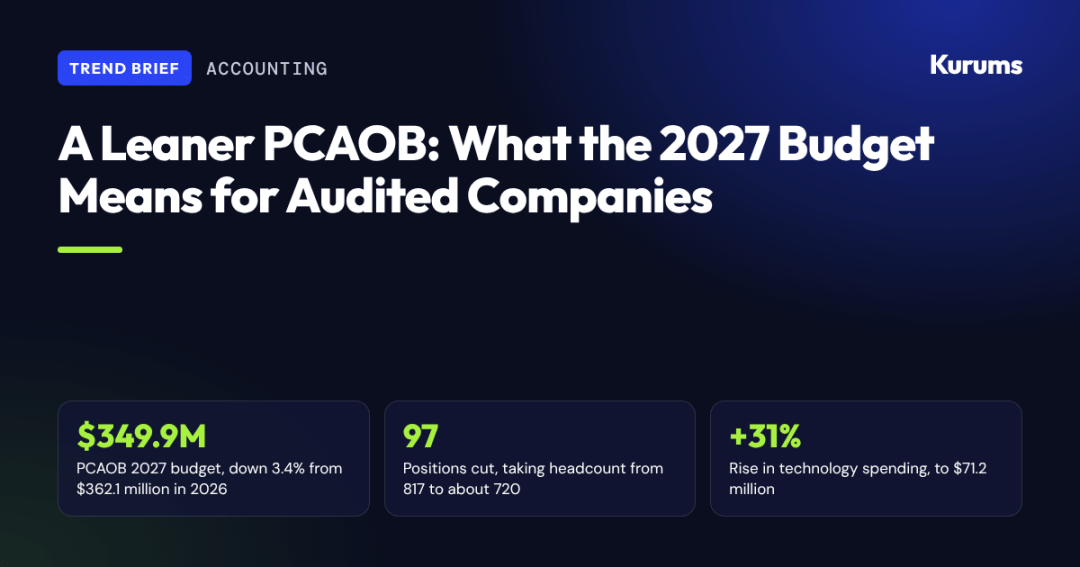
On November 19 the PCAOB approved a 2026-2030 strategic plan and a $349.9 million budget for 2027, down 3.4%, with headcount falling by 97 to about 720. Technology spending rises 31%. Inspections are moving toward firms' quality control systems, and enforcement is being narrowed to significant violations. The SEC still has to approve the budget. For companies, the fee that funds the regulator goes up 9%, and audit committees get less outside signal about their auditor, so they need to ask for more themselves.
What the board approved on November 19
The Public Company Accounting Oversight Board made two decisions at its November 19 open meeting. It unanimously adopted a strategic plan for 2026 to 2030, and it voted 4-1 for a 2027 budget of $349.9 million, according to Thomson Reuters. That is 3.4% below the $362.1 million budget for 2026, which was itself a 9.4% cut.
The headline disagreement over the plan’s length is easy to settle. The plan document is titled “Strategic Plan 2026-2030” and says it covers “the current and next four years”. It is a five-year plan with four years still ahead of it, which explains why some coverage calls it a four-year plan. The Journal of Accountancy notes it is the board’s first strategic plan in four years.
Neither the dollar figure nor the job cuts are final. The SEC must approve the budget before it takes effect.
Where the money and the people go
The budget moves money from staff to systems. Thomson Reuters reports a headcount reduction of 97, to an expected 720 by the end of 2027. CFO Brew puts the starting point at 817, a cut of nearly 12%.
| Item | 2026 | 2027 | Change |
|---|---|---|---|
| Total budget | $362.1M | $349.9M | -3.4% |
| Headcount | 817 | 720 (expected) | -97 |
| Personnel costs | about $270M | $237M | -12% |
| Technology | about $54M | $71.2M | +31% |
| Accounting support fee | $306M | $333M | +9% |
Source: Thomson Reuters and CFO Brew reporting. The 2026 personnel and technology figures are derived from the reported changes.
Chairman Demetrios Logothetis described the budget as a set of trade-offs that redirects resources without raising total spending. The dissenting vote came from board member George Botic, a former head of the inspections division. He argued that part of the technology money should have gone to inspections. Logothetis said division heads, including the inspections director, told the board they had the resources they needed.
One line matters directly to companies. The accounting support fee, which issuers and broker-dealers pay to fund the board, rises 9% to $333 million even though the budget falls. PCAOB staff attributed this mainly to a smaller carryover of unspent funds. Issuers’ share is $311.6 million.
Inspections shift from files to systems
Goal 2 of the plan commits the board to inspections that put more weight on a firm’s system of quality control: governance, ethics and independence, client acceptance, resources, monitoring and remediation. Reviews of individual audits “will remain an integral component”, the plan says, but Thomson Reuters notes that some observers expect fewer of them, depending on what inspectors find at the system level.
The timing lines up with QC 1000, the quality control standard that takes effect on December 15, 2026, according to Debevoise & Plimpton. CFO Brew reported that the SEC approved amendments on November 2 that make the standard less costly, including removal of an external review requirement for firms auditing 100 or more issuers.
The baseline is better than it was. The estimated share of inspected audits with Part I.A deficiencies fell to 23% in 2025 from 38% in 2024 and 46% in 2023, Thomson Reuters reported, and to 8% at the Big Four. If file reviews decline, that series becomes harder to compare year to year.
The board also proposed a permanent broker-dealer inspection program limited to auditors of firms that hold customer assets. Comments are due January 19, 2027.
Enforcement: narrower, and quieter about companies
Goal 3 says enforcement resources will concentrate on significant violations that pose meaningful risk to investors, with closer SEC coordination. Several staff-level changes during 2026 point the same way.
- Naming companies. A July 10 staff statement narrowed when an audit client is identified in a settled order against its auditor, Thomson Reuters reported. Naming is now generally recommended only when the company has disclosed related problems, another regulator is acting, or the company or its officers were found to have engaged in related misconduct.
- No-deny clauses. A July 31 statement dropped the routine requirement that settling firms agree not to deny the findings publicly, Thomson Reuters reported.
- Specialized units. On November 10 the enforcement division was reorganized into five units covering strategic risk, artificial intelligence, global network firms, non-affiliated firms and international matters, per the Journal of Accountancy.
Volume was already down. A Brattle Group report covered by Thomson Reuters counted 39 SEC and PCAOB actions against auditors in 2025, down from 58, with monetary sanctions falling 66% to $17.9 million.
Debevoise reads the reorganization as a change in how staff are deployed, not in the board’s authority, and expects more specialist investigators and broader requests for workpapers and metadata. Fewer cases does not mean lighter scrutiny for the ones that are opened.
What Google Trends shows about attention
Google Trends data for the United States from August 26 to November 26, 2026 shows no public reaction to these decisions. The figures are relative indices from 0 to 100 against the peak among the four terms compared. They are not search volumes.
- “PCAOB” averaged 1.6 over 90 days, 1.4 over the prior 30 days and 1.3 over the last seven. Its peak of 4 came on August 26.
- “FASB” averaged 2.4, and “audit firm” 1.1.
- “auditor” averaged 55.1 and peaked at 100 on November 3, before easing to 41.1 over the last week. That date was election day, so the spike probably reflects state and local auditor races and not interest in the profession.
A budget vote that removes about one in eight positions at the national audit regulator did not move the index. This remains a specialist story. Directors outside finance are unlikely to have noticed it.
Search interest: auditor vs PCAOB
Google Trends, United States, Aug 26, 2026 to Nov 25, 2026. Daily index, 0–100, relative to the highest point among the terms compared; it shows relative attention, not search volume.
What it means for companies, audit committees and firms
Audited companies
Under the revised naming approach, a company is less likely to be identified when its auditor settles a case. That lowers reputational spillover, and it also means you may not learn from a public order that your own engagement was involved. Ask directly.
Audit committees
Inspection reports and enforcement orders have been the main external evidence of audit quality. With fewer file reviews possible, fewer orders, and firms no longer routinely barred from disputing findings after settling, committees need to gather more evidence themselves. Former Institute of Internal Auditors chief Richard Chambers told Thomson Reuters that directors should ask what a firm disputes, why it settled and what it remediated.
Audit firms
The firm’s own quality control system becomes the main object of inspection, and its annual QC 1000 evaluation becomes a document clients will reasonably ask about.
What accounting teams should do now
None of this changes a company’s own obligations. Auditing standards, internal control requirements and SEC reporting rules are the same this year-end as before the vote. What changes is how much independent assurance about your auditor arrives from outside. This is analysis, not legal advice.
Three practical points follow. First, treat the auditor’s quality control reporting as an input to your annual auditor evaluation, and ask for it early. Second, keep documentation standards for estimates, controls and management review where they are. A year with fewer inspected files is a poor reason to let evidence thin out, because expectations in litigation or an SEC inquiry are unchanged. Third, tell the audit committee what happened. The search data suggests they have not heard about it elsewhere.
Watch for the SEC’s decision on the budget, the broker-dealer comment deadline on January 19, 2027, and any detail on how inspection reports will change, since the plan promises clearer and more timely reports.
What to do next
- Brief the audit committee chair on the PCAOB plan, the budget vote and the pending SEC approval before the next meeting.
- Ask the engagement partner how the firm will evaluate and report on its quality control system under QC 1000, and what the committee will see.
- Ask whether your engagement was inspected in the latest cycle and whether any firm-level findings or enforcement matters touch your audit team.
- Add questions on staffing, partner time and AI tool use to this year's auditor evaluation.
- Check the 2027 budget line for the PCAOB accounting support fee, given the 9% rise in the total.
- Hold documentation standards for estimates, controls and review evidence at current levels through year-end.
- If you own or audit a broker-dealer, review the inspection proposal and decide whether to comment by January 19, 2027.
Frequently asked questions
Is the PCAOB plan four years or five?
Five. The document is titled Strategic Plan 2026-2030 and was adopted on November 19, 2026. It describes its scope as the current year plus the next four, which is why some headlines call it a four-year plan.
Are the 2027 budget and job cuts final?
Not yet. The board voted 4-1 for a $349.9 million budget with 97 fewer positions, but the SEC must approve the PCAOB's budget before it takes effect. The same approval step applies to the strategic plan, according to Thomson Reuters.
Will our company pay less to fund the PCAOB?
Probably not in 2027. The total accounting support fee rises 9% to $333 million, with $311.6 million allocated to issuers, because less unspent money carried over from the prior year. Individual company amounts depend on the allocation, so check your own invoice.
Does a leaner regulator mean a lighter audit?
There is no basis for expecting that. Auditing standards and internal control requirements are unchanged, and firms face closer review of their quality control systems. Audit scope and evidence requests for this year-end should look much like last year's.
Is PCAOB enforcement ending?
No. The plan narrows enforcement to significant violations and coordinates more with the SEC, and the division has been reorganized into five specialized units. Case counts have fallen, but lawyers at Debevoise expect investigations that do open to involve more specialist staff and broader document requests.
- PCAOB: Strategic Plan 2026-2030 (2026-11-19)
- Thomson Reuters Tax & Accounting News: PCAOB cuts 2027 budget 3.4%, reduces workforce while boosting technology spending (2026-11-20)
- CFO Brew: PCAOB votes for deeper workforce cuts (2026-11-24)
- Journal of Accountancy: PCAOB proposal would end inspections of some broker-dealer audits (2026-11-20)
- Journal of Accountancy: PCAOB seeks feedback on comfort-letter proposal, restructures enforcement (2026-11-16)
- Debevoise & Plimpton: PCAOB Unveils New Specialized Enforcement Units
- CFO Brew: PCAOB approves modernized inspections (2026-11-05)
- Thomson Reuters Tax & Accounting News: Public company audit quality continues to improve, PCAOB's 2025 inspections show (2026-10-26)
- Thomson Reuters Tax & Accounting News: PCAOB staff narrows circumstances for naming issuers in settled enforcement orders (2026-07-24)
- Thomson Reuters Tax & Accounting News: PCAOB enforcement staff drops routine no-deny requirement in settlements, citing SEC alignment (2026-08-12)
- Thomson Reuters Tax & Accounting News: Audit Enforcement Actions Fall Sharply in 2025 Amid SEC and PCAOB Leadership Changes – Report (2026-02-26)
- Thomson Reuters Tax & Accounting News: Regulatory board proposes permanent broker-dealer audit inspection program after 15 years under interim framework (2026-11-20)
- The Accountant: PCAOB approves five-year strategy and $350m budget for 2027 (2026-11-23)
- Google Trends: US search interest: auditor, FASB, PCAOB, audit firm (Aug 26 – Nov 26, 2026) (2026-11-26)
Search-interest figures are from Google Trends (United States, 90 days to November 26, 2026). This article is analysis for operators, not legal, tax or investment advice. Last updated November 26, 2026.
Discover more from Kurums | Business Intelligence
Subscribe to get the latest posts sent to your email.