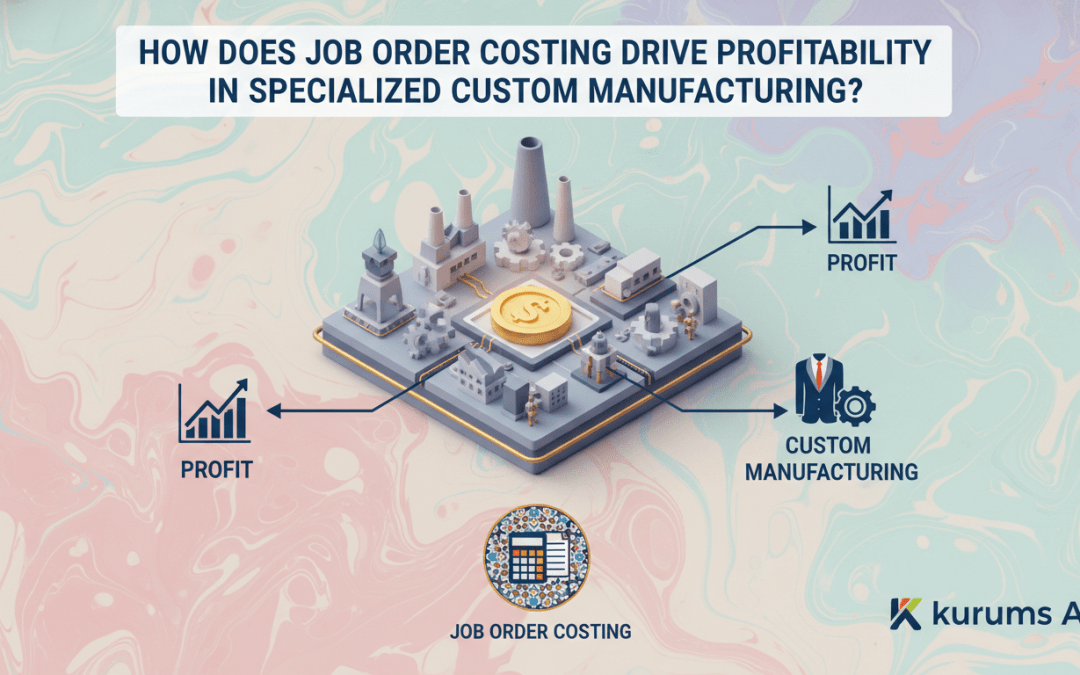
Managing financial health in a business that produces unique, high-value products requires more than just high-level oversight. The truth is: without a granular understanding of individual project costs, you are essentially gambling with your bottom line. Job order costing provides the precision needed to determine whether a specialized project is truly profitable or silently eroding your cash flow.
But here is the real catch: many firms fail to account for the ‘hidden’ costs of custom work, such as indirect labor or machine depreciation, leading to “profit leaks” that are invisible on a standard balance sheet. In the world of specialized manufacturing—where no İtwo products are identical—relying on averages is a recipe for disaster. This is where job order costing steps in as the ultimate financial compass.
The Anatomy of Job Order Costing: More Than Just Bookkeeping
Job order costing (JOC) is not merely an accounting exercise; it is a strategic management tool. Unlike process costing, which averages costs across thousands of identical units, JOC treats every “job” as a distinct profit center. Think of a custom yacht builder or an aerospace components manufacturer. They cannot simply say, “It costs $X to make a part.” They must say, “It cost exactly $14,205.50 to make this specific turbine blade for this specific client.”
This level of detail allows for a feedback loop that informs future bidding, resource allocation, and even client selection. If you find that custom orders for a specific industry consistently require 20% more labor than estimated, JOC provides the data to adjust your pricing or refine your production process. Without it, you are flying blind in a storm of overhead and fluctuating material prices.
Job Order Costing vs. Process Costing: Choosing the Right Framework
Understanding when to use job order costing is critical for organizational efficiency. While it offers unparalleled detail, it also requires more administrative effort than process costing. Let’s break down the fundamental differences between these two methodologies to see why JOC is the champion of the custom world.
| Feature | Job Order Costing | Process Costing |
|---|---|---|
| Product Type | Unique, custom, small batches. | Homogeneous, mass-produced. |
| Cost Accumulation | By specific job or project. | By department or time period. |
| Unit Cost Calculation | Total Job Cost / Units in Job. | Total Dept. Cost / Total Units produced. |
| Typical Industries | Construction, Law, Custom Furniture. | Oil Refining, Soda, Chemicals. |
As you can see, if your business thrives on variety and specialization, process costing will leave you with “cost blindness.” You might be making a fortune on one order and losing it all on another, yet your monthly reports would show a mediocre average that hides both the success and the failure.
The Three Pillars: Tracking Direct Materials, Labor, and Overhead
Every job order costing system is built upon three foundational pillars. Mastering these is the key to unlocking true profitability. Let’s peel back the layers of these costs.
1. Direct Materials: The Physical Foundation
In specialized manufacturing, direct materials aren’t just “raw stuff.” They are often high-grade alloys, custom-sourced fabrics, or specialized electronics. Tracking these involves more than just a purchase order. You must track the requisition—the moment the material leaves the warehouse and is dedicated to Job #502. Why is this important? Because material waste in custom projects can be significantly higher. If you don’t track it to the specific job, you can’t hold production teams accountable for efficiency.
2. Direct Labor: The Human Element
This is where things get tricky. In a custom environment, some tasks take longer because they’ve never been done before. Direct labor includes the wages of the craftsmen, engineers, or technicians directly touching the product. But wait, there’s more. You also need to consider the specialized skills involved. Using a senior engineer on a task that a junior technician could do increases the “job cost” even if the time remains the same.
3. Manufacturing Overhead: The Silent Profit Killer
This is the most complex component. Overhead includes indirect materials (glue, nails), indirect labor (supervisors, maintenance), and factory costs (utilities, rent, depreciation). Since these cannot be tied to a specific unit of production easily, we use a Predetermined Overhead Rate (POHR). If you calculate this incorrectly, you risk underpricing your work and going out of business despite being “busy.”
The Lifecycle of a Job Cost Sheet
The “Job Cost Sheet” is the primary document used in job order costing. In the digital age, this is usually a dynamic dashboard in an ERP (Enterprise Resource Planning) system, but the logic remains the same. It serves as the ledger for every penny spent on a specific project.
How does it work in practice? Let’s look at the flow of a typical custom order:
- Job Initiation: A unique Job Number is assigned as soon as a customer signs a contract.
- Material Requisition: As parts are pulled from inventory, they are scanned and immediately recorded against the Job Number.
- Time Tracking: Workers clock in and out of the specific Job Number, automatically calculating labor costs based on their hourly rates.
- Overhead Application: Overhead is applied based on a driver (like machine hours or labor hours) as work progresses.
- Completion and Analysis: Once the job is finished, the total cost is compared against the initial estimate to find “variances.”
Calculating the Predetermined Overhead Rate (POHR)
To drive profitability, you must master the POHR. This isn’t just a math problem; it’s a strategic decision. How you allocate overhead can change which products look profitable. Most companies use Direct Labor Hours or Machine Hours as the “allocation base.”
The formula is simple, but the execution is vital:
POHR = Estimated Total Manufacturing Overhead Cost / Estimated Total Amount of Allocation Base
For example, if your total annual overhead is estimated at $500,000 and you expect 10,000 machine hours of work, your POHR is $50 per machine hour. Every hour a machine runs for a specific job, $50 is added to that job’s cost sheet. But what happens if the machine breaks down? Or if you only run 8,000 hours? This leads to under-applied overhead, which means your profits at the end of the year will be lower than what your job sheets suggested. This is why constant monitoring is non-negotiable.
Case Study: High-Performance Custom Auto Parts
Let’s imagine a company, “Precision Pistons Inc.,” that creates custom engine parts for racing teams. They use Job Order Costing to manage their intense R&D and manufacturing costs. For a recent order of 10 custom titanium pistons (Job #XYZ), the costs were as follows:
| Cost Category | Budgeted Cost | Actual Cost | Variance |
|---|---|---|---|
| Direct Materials (Titanium) | $5,000 | $5,800 | +$800 (Waste) |
| Direct Labor (CNC Operator) | $2,000 | $2,400 | +$400 (Rework) |
| Overhead ($100/hr machine time) | $3,000 | $3,000 | $0 |
| Total Cost | $10,000 | $11,200 | +$1,200 |
Now, here is the kicker: If “Precision Pistons” had used a process costing average, they might have missed that the titanium supplier raised prices or that the new CNC operator needed more training. Because of Job Order Costing, they can see exactly why they lost $1,200 in margin on this specific job. They can then decide to raise prices for future titanium orders or invest in better training.
The Psychological Impact: Accountability and Performance
Beyond the spreadsheets, Job Order Costing changes the culture of a manufacturing floor. When teams know that their time and material usage are being tracked to a specific project, it creates a sense of ownership. “Job 402” isn’t just another part on the belt; it’s a project with a budget and a deadline.
This accountability allows for:
- Incentive Programs: Rewarding teams that complete jobs under the estimated labor budget without sacrificing quality.
- Waste Reduction: Identifying specific stages in a project where material scrap is highest.
- Better Project Management: Seeing “work-in-progress” (WIP) in real-time prevents bottlenecks before they cause late deliveries.
Driving Strategic Pricing Decisions
How do you price a product that has never been made before? This is the central challenge of custom manufacturing. Without historical job cost data, you are essentially “guesstimating.” Job order costing provides a library of data from previous similar projects.
By analyzing past jobs, you can identify “hidden” cost drivers. For example, you might realize that projects for a certain client always require 30% more administrative “hand-holding” or revision cycles. With this data, you can apply a “Client-Specific Overhead Multiplier.” This ensures that difficult clients pay for the extra resources they consume, rather than having those costs eat into the profits generated by easier projects.
The Technology Factor: ERPs and Job Costing Automation
The days of paper-based job cost sheets are over. In a modern high-tech manufacturing environment, Job Order Costing is handled by integrated ERP systems like SAP, Oracle, or specialized manufacturing software like Fishbowl or Katana. These systems automate the data entry that used to make JOC so burdensome.
Automation allows for:
- Automatic Inventory Updates: When a barcode is scanned, the inventory levels drop and the job cost rises simultaneously.
- Live Margin Tracking: Managers can see the profit margin of a job while it is still on the shop floor.
- Accurate WIP Valuation: At the end of the month, the system tells you exactly how much capital is tied up in unfinished work, which is vital for tax and cash flow purposes.
Avoiding the “Death Spiral”: Common JOC Pitfalls
Even with the best software, job order costing can fail if the inputs are wrong. One of the biggest dangers is the “Death Spiral” of under-applied overhead. This happens when a company loses a few jobs, leading to fewer hours to spread overhead across. This makes the remaining jobs look more expensive, leading the company to raise prices, which causes them to lose more jobs.
Addressing the “Scope Creep” Challenge
In custom manufacturing, customers often ask for “one small change” mid-project. If your job order costing system isn’t flexible, these changes won’t be captured. A robust system requires a Change Order process where additional labor and materials are assigned to the job number immediately, ensuring the final invoice reflects the actual work done.
Job Order Costing in the Service Sector
It’s a common misconception that job order costing is only for people who make physical things. In reality, some of the best users of JOC are service providers.
Think about a law firm. Each “case” is a job.
Think about a marketing agency. Each “campaign” is a job.
In these industries, the “Direct Material” might be negligible, but the “Direct Labor” and “Applied Overhead” (software licenses, office space) are everything. By tracking time to specific client codes, these firms can see which types of cases are “loss leaders” and which are their true profit engines.
Conclusion: Transform Your Margins with Data
Job order costing is the difference between a business that survives and a business that thrives. In specialized custom manufacturing, the “average” is a myth. Every job has its own story, its own challenges, and its own unique cost structure. By adopting a rigorous JOC methodology, you stop guessing and start knowing.
You will know exactly how much it costs to produce excellence. You will know which clients are worth your time. And most importantly, you will have the financial clarity needed to scale your operations with confidence. The precision of job order costing is not just an accounting choice—it is a competitive advantage that directly drives your bottom line.
Ready to take control of your production costs? Start by auditing your current overhead allocation. Are you using a rate from five years ago? If so, today is the day to recalculate, refine, and reclaim your profitability.
Discover more from Kurums | Business Intelligence
Subscribe to get the latest posts sent to your email.