
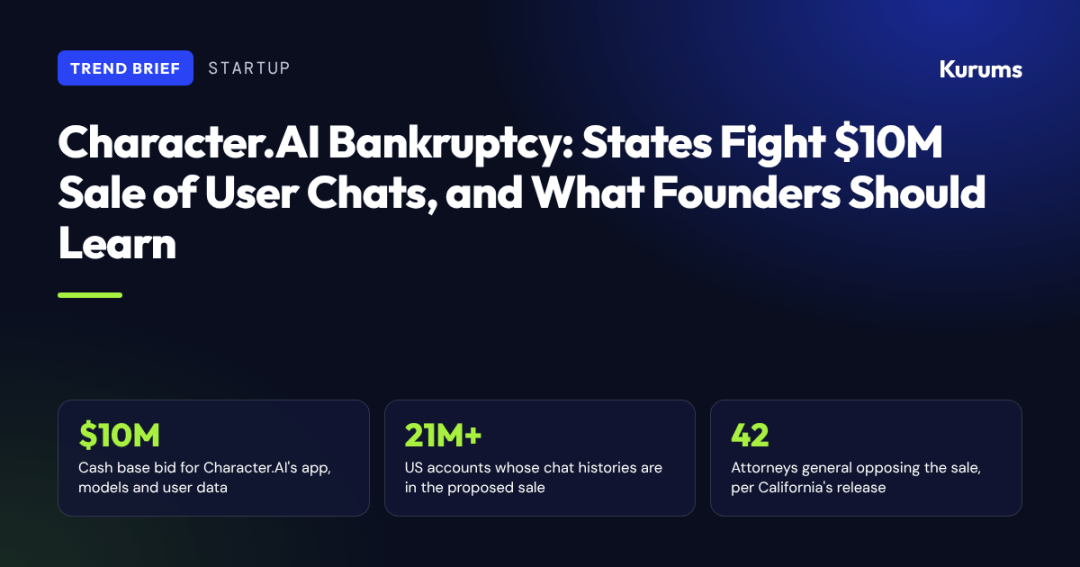
State attorneys general want a Delaware court to block a $10 million sale of Character.AI's app, models and private chats. The case shows how privacy promises limit what a startup can sell.
Character.AI is in Chapter 11 in Delaware and wants to auction its app, AI models and users' private chat histories on December 1, 2026. The only disclosed bidder is a two-week-old Delaware company offering $10 million. A coalition of state attorneys general has asked the court to deny the sale, pointing to the company's own promise not to sell personal information. For founders, the case shows that privacy commitments, consent records and deal structure decide what a startup's data is worth at exit.
What happened
Character.AI, the companion chatbot company legally named Character Technologies, Inc., is trying to sell its app, its AI models and its users’ chat histories out of Chapter 11, and a large group of state attorneys general is asking the court to stop it. According to a California Department of Justice release dated November 24, 2026, a bipartisan coalition of 42 attorneys general opposes the plan to sell the platform together with the private chat histories of more than 21 million US accounts, more than 2.1 million of them registered to minors. The release says the chats and related personal data, including IP addresses, are set to be auctioned on December 1, 2026.
The only bidder disclosed so far is Smirks and Pangs Acquisition LLC, a Delaware company formed on November 13, 2026, one day before Character.AI picked it as the base bid. TechCrunch reported on November 25 that the buyer’s plans for the chats are unclear. The coalition count is inconsistent: the California release says 42 attorneys general in its opening line and 45 in Attorney General Rob Bonta’s quote.
The case is In re Character Technologies, Inc., No. 26-11603, in the US Bankruptcy Court for the District of Delaware before Judge Brendan L. Shannon, according to PPC Land, which has been reading the docket. The company filed on October 12, 2026.
How a company Google paid billions to license ended up here
Reuters, republished by Insurance Journal, reported that Character.AI blamed legal expenses and the high cost of computing power and AI talent, and that it was losing $8 million to $9 million a month before filing. Disney stepped in during September to hire most of the staff so the platform could keep running during a sale.
That produced two separate transactions. The first is a $20 million non-exclusive licence of code and patents to Disney Worldwide Services. PPC Land’s account of the states’ November 18 objection says Disney hired 66 of 86 employees, including the chief executive, and that Disney’s own estimate of the cost of those staff is about $180 million over three years, money the deal documents say is not consideration payable to the company. The coalition contrasts that with a 2024 Google transaction it puts at about $2.7 billion. The Disney licence excludes user data.
What the $10 million bid would buy
According to PPC Land’s reading of the November 14 designation notice, Smirks and Pangs offered $10 million in cash plus assumed liabilities for the website and apps, all models and weights, the brand, patents and domains, and user data: account and profile information, user-created characters, chat content, advertising and analytics data and training datasets. Delaware’s record lists no members, managers or parent for the buyer.
The signed agreement, filed on November 16, is where founders should look closely. PPC Land reports that the seller represents it “has obtained valid consent from users of the Products” and that its consents and privacy policies are sufficient to permit the transfer. The buyer requires a sale order approving “the transfer of the Transferred Data, without requiring any further consent of any third parties”, plus a finding that it is not a successor to the seller. The representations do not survive closing except for fraud.
| Item | Disney licence | Smirks and Pangs bid |
|---|---|---|
| Price to the estate | $20 million | $10 million cash plus assumed liabilities |
| What is covered | Non-exclusive licence to code and patents | App, models and weights, brand, domains, user data and chats |
| User data | Excluded | Included |
| Staff | 66 of 86 employees hired in September 2026 | Only required hire is the company’s top lawyer, per the California release |
| Break-up fee | $700,000 (3.5%) | $350,000 (3.5%) |
| Status on November 27 | Not approved; sale hearing December 3 to 4 | Auction scheduled December 1; not approved |
What the states are arguing
The California release lists the coalition’s objections. The deal imposes no requirement on the buyer to follow Character.AI’s privacy policies or honour opt-out and deletion requests. The data could be sold again without notice. Bidders were given information about safety failures and legal exposure that the court, the states and users have not seen. The states ask the court to deny the sale terms, reject Smirks and Pangs as lead bidder, deny the break-up fee and, at a minimum, leave out children’s chats and other sensitive data.
The core of the argument is a sentence from Character.AI’s own privacy policy, quoted in the release: “we do not sell personal information for monetary consideration.” Bonta said bankruptcy “should not be used to sidestep these consumer protections”. These are allegations in a contested matter, not findings. The company’s reply is due November 30, according to PPC Land.
The states have been building this position for six weeks. On October 14, New York Attorney General Letitia James and 39 other attorneys general asked that any buyer be required to run age verification beyond self-reported ages, working advertising opt-outs, limits on using private conversations for AI training without valid consent, and a chance for consumers to delete their information before any sale. Bloomberg Law reported on November 17 that the states wanted the $10 million offer reviewed by a court-appointed privacy advocate, and that this is likely the first time a generative AI model has been sold in a bankruptcy case. PPC Land reports that the judge ordered a consumer privacy ombudsman that day and that the US Trustee appointed Lucy L. Thomson on November 18. We have not seen her report.
Search interest spiked at the filing, then faded
Public attention has not tracked the legal stakes. Google Trends, which reports a relative index from 0 to 100 and not search volume, shows US searches for “character ai bankruptcy” peaking at 100 on October 13, the day after the filing, and averaging 1.4 over the last seven days. Searches for “character ai shutting down” were close to zero until mid-November, peaked at 8 on November 20 and averaged 1.6 over the last seven days, with “when is character ai shutting down” among the rising queries. Users are asking whether the product survives.
Search interest: character ai bankruptcy vs character ai shutting down
Google Trends, United States, Aug 27, 2026 to Nov 27, 2026. Daily index, 0–100, relative to the highest point among the terms compared; it shows relative attention, not search volume.
Why this matters for startups
This case tests what a startup’s user data is worth when the company fails and regulators are watching. Three points stand out.
- Privacy promises follow the data. The states are using the company’s own policy language against the sale. Wording written at seed stage can cap what a buyer or an estate is able to do years later.
- Licence-and-hire deals leave a remainder. When the team and a technology licence go to one acquirer, the app, the users and the liabilities still need an owner. Here the base bid for that remainder is half the licence fee.
- Sensitive data draws a crowd. The original notice came from 39 states and the District of Columbia, and Texas filed its own objection to the Disney deal.
How to respond, by role
Founders and CEOs
Read your privacy policy as a buyer’s counsel would. Check what it says about selling data, about transfers in a merger, asset sale or insolvency, and whether what you tell users matches what you do with advertising and model training. The states’ October conditions are a usable checklist.
Operators and early employees
Consent records are part of the asset. The Smirks and Pangs schedule lists consents, withdrawals, opt-outs, privacy preferences, age-assurance status and data-subject requests as items to be transferred. If your systems cannot show who agreed to what and when, a buyer has to discount the data or take a risk on it.
Investors and board members
Board members approving a licence-and-hire deal should expect questions about valuation and process: the coalition’s objection says nobody valued the Disney licence.
Acquirers and corporate development teams
A sale order that says no further consent is needed is only as good as the court’s willingness to enter it over objections from most US states. Price in conditions on children’s data, deletion rights and onward transfers, and check exposure to the chatbot safety laws that California says take effect on January 1, 2027 in California, Colorado, New York and Connecticut.
Open questions
- Whether other qualified bids arrived by the November 24 deadline. We found no public confirmation either way.
- What the consumer privacy ombudsman recommends, and whether the court excludes minors’ chats or sensitive data.
What to do next
- Reread your privacy policy for every statement about selling data and about transfers in a merger, asset sale or insolvency, and confirm each one matches actual practice.
- Check that consent, opt-out, deletion and age-assurance records are stored per account and can be exported for a buyer's diligence.
- Map which datasets contain minors' data, health disclosures or other sensitive categories, and decide now which could be excluded from a sale.
- Before signing a licence-and-hire deal, get an independent valuation and record how the board ran the process and handled conflicts.
- Ask counsel how the chatbot safety laws due on January 1, 2027 in California, Colorado, New York and Connecticut apply to your product.
- Watch the December 1 auction and the December 3 to 4 sale hearing for the conditions the court attaches to any data transfer.
Frequently asked questions
Is Character.AI shutting down?
Nothing we read says the service has shut down. The company filed for Chapter 11 on October 12, 2026 and is trying to sell the app, models and user data as a going business, with an auction scheduled for December 1. Disney hired most of the staff in September so the platform could keep running during the sale, according to Reuters.
Can a startup sell user data in bankruptcy if its privacy policy says it does not sell data?
That is the question before the Delaware court. The states argue that privacy laws and the company's own policy still apply in bankruptcy. A consumer privacy ombudsman has been appointed to report on the sale, according to PPC Land. No ruling had been reported as of November 27, 2026, so the outcome is open.
Who is Smirks and Pangs Acquisition LLC?
It is a Delaware limited liability company formed on November 13, 2026 and named the next day as the base bidder for Character.AI's app, models and user data at $10 million. State records list no members or parent, and California's attorney general says the sale contract names no investors. Its ownership has not been publicly disclosed.
What should founders change in their privacy policy after the Character.AI case?
The case does not set a rule yet, so treat it as a prompt for review and not as settled law. Check that statements about selling data are accurate, that the policy addresses transfers in a sale or insolvency, and that advertising and training uses match what users were told. Have qualified counsel review the wording.
- California Department of Justice: Attorney General Bonta Opposes Asset Sale of Character.AI Amid Child Safety Concerns (2026-11-24)
- TechCrunch: Character.AI's plan to auction off users' private chats challenged by state AGs (2026-11-25)
- PPC Land: Character.ai faces 40 attorneys general over who can buy its users' chats (2026-10-14)
- Insurance Journal (Reuters): States Seek Children's Data Protections in Character.AI Bankruptcy (2026-10-15)
- PPC Land: 39 states and DC ask court to deny Disney's $20M Character.ai deal
- PPC Land: Character.ai users' chats face a $10M sale to Smirks and Pangs
- PPC Land: Character.ai's $10M sale hinges on moving chats without further consent
- New York State Attorney General: Attorney General James Urges Court to Protect Children and Consumers in Character.AI Bankruptcy (2026-10-14)
- Bloomberg Law: States Press for Scrutiny in Sale of Chatbot Said to Harm Kids (2026-11-17)
Search-interest figures are from Google Trends (United States, 90 days to November 27, 2026). This article is analysis for operators, not legal, tax or investment advice. Last updated November 27, 2026.
Discover more from Kurums | Business Intelligence
Subscribe to get the latest posts sent to your email.