
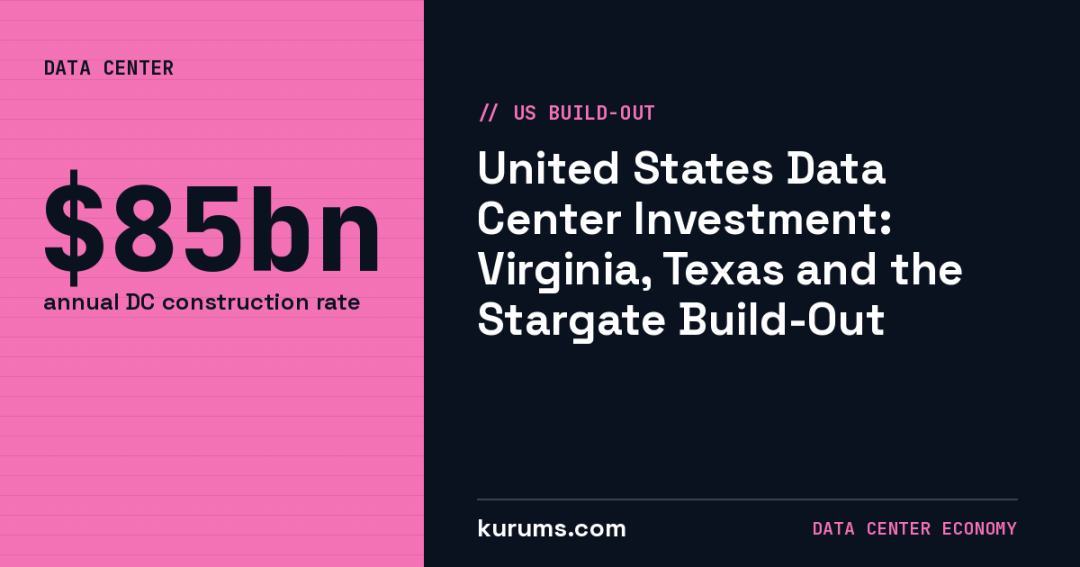
The US remains the centre of gravity for data center investment. Synergy Research Group counts 15 of the world’s 20 largest hyperscale markets in the US. CBRE reports 7,481 MW under construction across eight primary North American markets in H1 2026, with vacancy at just 1.4% and more than 80% of the pipeline preleased. Northern Virginia alone has 4,496.5 MW of inventory and 0.2% vacancy. Census Bureau data put August 2026 data center construction spending at an annualised $84.95 billion, up roughly 73% year on year. OpenAI’s Stargate programme plans more than 9 GW across seven US sites, according to Epoch AI. Texas’s ERCOT grid has logged around 438 GW of large-load requests. The limits are now power, transformers and local politics, not capital: Virginia added a $0.011/kWh data center energy tax in July 2026, and PJM’s capacity auction cleared at its $325/MW-day cap.
United States data center investment is the biggest single driver of the global AI build-out. This guide covers where the money is going and why: Northern Virginia’s Data Center Alley, the Texas and ERCOT boom, the Midwest gigawatt campuses and OpenAI’s Stargate sites. It also covers the federal and state policy levers now shaping site selection. It is part of the Data Center Economy hub; for comparison, see our country guides to Europe’s FLAP-D and Nordic markets and China’s East Data West Computing build-out.
How big is the US data center pipeline?
CBRE counts 7,481 MW under construction in eight primary North American markets in H1 2026, a record. More than 80% of it is already preleased.
Where is the money going?
Northern Virginia is still the largest market, but new capital is flowing to Texas, Ohio, Indiana, Wisconsin, Louisiana, New Mexico and Georgia, where land and power are easier to secure.
What is the main constraint?
Grid power. Dominion Energy has about 12 GW of data center load under contract, ERCOT’s large-load queue runs to hundreds of gigawatts, and PJM’s capacity auction cleared at its price cap.
How much is being invested in US data centers in 2026?
US data center investment is running at a record pace. Census Bureau construction data, as analysed by NeoTeo, show spending at a seasonally adjusted annual rate of $84.95 billion in August 2026, up about 73% from $49.05 billion a year earlier. That figure covers construction only, before servers and chips are installed.
Construction starts tell the same story. ConstructConnect’s September 2026 report puts data center starts from January to July 2026 at $84.1 billion across 136 projects, nearly three times the same period of 2025. The average start cost $1.06 billion, up from $352.8 million in 2025, and cost per square foot averaged $818, 57% higher than a year earlier, which reflects denser AI halls with heavier electrical and cooling content.
Geographically, the starts data show how far the boom has spread. North Carolina led year-to-date starts with $10.4 billion, and Indiana, Illinois and Michigan each passed $10 billion. Texas ranked fifth at $9.9 billion, and Ohio, Wisconsin, Arkansas and Georgia each logged several billion. ConstructConnect also lists 85 projects worth a combined $78.7 billion that are still in preconstruction and scheduled to start before the end of 2026. About 71% of that value sits in the South.
Behind this sits the hyperscalers’ capital spending, which covers land, buildings, power equipment and IT hardware worldwide. The largest share of it lands in the US. Our deep dive on the AI capex supercycle tracks the company-by-company numbers. The latest guidance is summarised below.
| Company | 2026 capex guidance | Latest data point | As of |
|---|---|---|---|
| Amazon | ~$220bn | Raised from ~$200bn guided in February | Q2 results, Jul 2026 |
| Alphabet | $195–205bn | Q3 2026 capex of $51.4bn, up 114% y/y | Q3 results, Oct 2026 |
| Meta | $135–145bn | Q3 2026 capex of $34.9bn; range narrowed upward | Q3 results, Oct 2026 |
| Microsoft | ~$175bn | Reported change reflects lease accounting, not lower spending | Secondary coverage of Q2 call, Jul 2026 |
Source: Company earnings releases (Meta Form 8-K exhibit 99.1, Q3 2026); Alphabet Q3 2026 results as reported by XTB; Amazon guidance as reported 31 July 2026; Microsoft figure from Next Move Strategy Consulting’s October 2026 hyperscaler capex comparison. Figures are global capex, not US-only.
Why is Northern Virginia still the world’s largest data center market?
Northern Virginia leads because its fibre density, cloud-region concentration and ecosystem effects are unmatched. CBRE puts its inventory at 4,496.5 MW in H1 2026, more than 1 GW higher than a year earlier, with vacancy at just 0.2%. Synergy Research ranks it the world’s top hyperscale market.
Data Center Alley in Loudoun County, with spillover into Prince William and other counties, hosts the original AWS US-East region and dense interconnection hubs. Almost every large cloud and colocation provider is there. CBRE’s H1 2026 report shows net absorption of 467.6 MW in the region, the highest of any primary North American market. Only 10.8 MW was available to lease, and 2,420.2 MW was under construction, up 16.5% year on year. At year-end 2025, CBRE quoted asking rents for 10 MW-plus requirements at $155–185 per kW per month and said 96% of 2026 scheduled supply was already committed.
Power is the binding constraint in Virginia
Dominion Energy, the main utility in the region, said on its Q2 2026 call that about 12 GW of data center capacity is now under electric service agreements, and that more than 53 GW is in various stages of contracting. It added over 5 GW of contracts in the first half of 2026 alone. For developers, the practical result is long waits for new substations and transmission. That is why new Virginia projects are increasingly phased against utility energisation dates rather than construction schedules.
How is Virginia changing its data center tax policy?
Virginia kept its prized sales and use tax exemption for data center equipment in 2026 but added a new energy consumption tax. HB 30, passed on 22 June 2026, levies $0.011 per kWh on data center electricity from 1 July 2026, with a sunset on 30 June 2028.
The exemption is the main reason operators chose the state. The Joint Legislative Audit and Review Commission (JLARC) estimated it was worth $928 million to the industry in fiscal 2023, and about 90% of the industry used it. JLARC found the sector supports about 74,000 jobs, $5.5 billion in labour income and $9.1 billion in GDP, mostly through construction. A typical operating facility employs about 50 full-time workers. JLARC also warned that a typical Dominion residential customer could face generation and transmission cost increases of $14 to $37 per month in today’s dollars by 2040 as data center demand grows.
The 2026 budget fight was intense. A Senate proposal to start phasing out the exemption from 1 January 2027 was not adopted. Instead, Governor Abigail Spanberger signed a package that preserves the exemption, which is scheduled to run to 2035, and adds the temporary per-kWh tax. For investors, the message is mixed. Virginia remains open for business, but the political cost of hosting data centers is rising, and the energy tax adds a new, if modest, line to operating budgets. Our guide to data center operating costs shows how power-linked taxes flow through to total cost of ownership.
Why is Texas attracting so much data center investment?
Texas offers abundant land, fast-growing wind, solar and gas generation, and its own grid, ERCOT, which runs a market that can connect large loads relatively quickly. Synergy Research says Texas hyperscale capacity grew 71% over the past year, against 36% worldwide.
Demand for grid connections has exploded. Latitude Media reported that ERCOT’s large-load queue grew from about 63 GW at the end of 2024 to about 226 GW by November 2025, with roughly three-quarters of it from data centers. By late May 2026, ERCOT’s board materials showed around 438 GW of large-load requests. More than 300 GW of those had no completed study, according to New Project Media. ERCOT’s preliminary April 2026 forecast projects peak demand of 367,790 MW by 2032, against a record actual peak of 85,508 MW in August 2023. The gap shows how much speculative and duplicate demand sits in the queue.
Texas has responded with rules rather than a moratorium. Senate Bill 6, signed in June 2025, applies to new loads of 75 MW or more. It requires them to install equipment that lets the grid operator curtail them during firm load-shed emergencies, and it introduces interconnection study fees of at least $100,000. In June 2026, ERCOT’s board moved to a batch-study approach, starting with a first combined review of data center requests known as Batch Zero. Our explainer on the grid bottleneck covers how queues like ERCOT’s and PJM’s are being reformed.
Where do the Stargate sites stand?
OpenAI’s Stargate programme, backed by Oracle and SoftBank, plans more than 9 GW across seven US sites by 2029, according to Epoch AI’s April 2026 satellite review. Only about 0.3 GW was operating at the time, all at the flagship Abilene, Texas campus developed by Crusoe.
Epoch AI’s site-by-site review shows how widely the programme is spread. Abilene is planned at 1.2 GW, with an estimated four of eight buildings running Nvidia Blackwell systems. Shackelford County, Texas (Vantage) is about 2 GW of facility power. Doña Ana County, New Mexico (STACK’s Project Jupiter) is 2.2 GW, and Milam County, Texas (SB Energy) is 1.2 GW. Port Washington, Wisconsin (Vantage’s Lighthouse) is 1.3 GW, Saline Township, Michigan (Related Digital) is 1.4 GW, and a smaller SoftBank-Foxconn site in Lordstown, Ohio is under 0.3 GW. Most are targeted for completion in late 2028. Several rely on on-site gas microgrids, which is a clear sign that grid connections cannot keep pace.
The programme has had setbacks. In March 2026, Bloomberg reported that a proposed 600 MW expansion lease at Abilene would not go ahead, after financing talks and a winter-weather disruption. Oracle called the coverage incorrect and said the broader 4.5 GW Oracle-OpenAI agreement remained on track. Epoch AI notes that Microsoft has partnered with Crusoe on an adjacent 900 MW site. For investors, Stargate shows both the scale of AI demand and how concentrated the counterparty risk is. Many of these campuses depend on a single tenant’s ability to keep raising capital. Our profile of the neoclouds, including Crusoe explains that financing chain.
Which other US states are winning gigawatt campuses?
Beyond Virginia and Texas, the biggest new US campuses are going to Louisiana, Wisconsin, Ohio, Indiana, Georgia, Oklahoma and Tennessee. These states can offer large sites, utility partners willing to build generation, and tax incentives. Synergy notes that Indiana and Tennessee have joined the world’s top 20 hyperscale markets.
Louisiana: Meta’s Hyperion
Meta said in July 2026 that its Hyperion campus in Richland Parish, Louisiana, will expand to 5 GW of compute capacity, with investment rising above $50 billion, according to Reuters. Construction began in December 2024. Meta says Louisiana businesses have already received more than $1.6 billion in contracts. Environmental groups have questioned whether utility customers could be left with costs if the project were scaled back, a debate covered in our article on who pays for grid upgrades.
Wisconsin and Georgia: Microsoft’s Fairwater
Microsoft’s Fairwater AI data center in Mount Pleasant, Wisconsin, was announced at $3.3 billion in September 2025. CEO Satya Nadella said in April 2026 that it was going live ahead of schedule. Microsoft has also planned about $4 billion for a second Wisconsin facility of similar scale, and local approvals in early 2026 covered 15 more data center buildings. Epoch AI’s frontier data center tracker lists a second Fairwater site in Atlanta among the largest AI clusters in the US. It sits alongside xAI’s Colossus 2 in Memphis, the Anthropic-Amazon campus in New Carlisle, Indiana, Google’s Pryor, Oklahoma site and Meta’s Prometheus in New Albany, Ohio.
Ohio and the PJM footprint
Central Ohio around Columbus is Synergy’s fifth-largest hyperscale market worldwide. In July 2025, the Public Utilities Commission of Ohio approved AEP Ohio’s data-center tariff, which requires large new loads to commit to paying for most of the capacity they reserve. AEP Ohio later cut its projected new data center demand from about 30 GW to about 5.7 GW, according to the Ohio Capital Journal. Supporters say this shows the tariff weeded out speculative requests; critics question whether demand was overstated in the first place. Ohio, Virginia and much of the Mid-Atlantic share the PJM grid, whose July 2026 capacity auction for 2028–29 cleared at its $325/MW-day cap and still fell about 6.8 GW short of the reserve target.
What is the federal government doing to accelerate data center construction?
Federal policy is now explicitly pro-build. The July 2025 AI Action Plan and Executive Order 14318 on accelerating federal permitting of data center infrastructure aim to speed environmental reviews, open federal land and steer financing support to large AI campuses and their power supply.
Under the executive order, a qualifying project is one adding more than 100 MW of new load, involving at least $500 million of committed capital spending, or designated for national-security reasons. It directs agencies to use and create NEPA categorical exclusions, clarifies that NEPA review is generally not triggered where federal funding is under half of project cost, and allows FAST-41 coverage. It also instructs the Commerce Department to make loans, guarantees, grants and tax incentives available. Supporting infrastructure explicitly includes dispatchable power such as gas, nuclear and geothermal.
On land, the Department of Energy selected four federal sites for public-private AI data center and energy projects: Idaho National Laboratory, the Oak Ridge Reservation, the Paducah Gaseous Diffusion Plant and the Savannah River Site. The approach links compute to on-site or nearby generation, including nuclear, which ties directly into the Big Tech reactor deals now being signed. The same policy package also created an American AI Exports programme, which underpins the chip-export arrangements behind the Gulf data center race.
Is the US data center boom sustainable?
In the near term, demand still exceeds supply: CBRE reports record-low vacancy, more than 80% preleasing and rising rents. The risks are concentration in a handful of AI tenants, power and equipment delays, and a political backlash over electricity bills, land and water.
The bull case rests on the order book. In CBRE’s H1 2026 report, fewer than 1,500 MW of capacity under construction remained available for preleasing, roughly six months of supply at the current absorption pace, and asking rents rose across every deployment size. Hyperscalers raised rather than cut their 2026 capex guidance through the year, and Alphabet’s Q3 capex more than doubled year on year.
The bear case points to signs of strain. These include the dropped Abilene expansion lease, AEP Ohio’s sharply revised demand forecast, and the hundreds of gigawatts of unstudied requests in ERCOT’s queue. Heavy reliance on debt-financed special-purpose vehicles and on a few AI labs as anchor tenants is another concern. Our bubble debate explainer sets out both sides, and our guide to how data centers are financed explains the debt structures behind the campuses.
Frequently Asked Questions
Which US state has the most data center capacity?
Virginia, driven by Northern Virginia’s Data Center Alley. CBRE put the Northern Virginia market at 4,496.5 MW of inventory in H1 2026 with only 0.2% vacancy, and Synergy Research ranks it the largest hyperscale market in the world. Texas is growing fastest among large markets: Synergy reports that Texas hyperscale capacity rose 71% in a year, roughly double the global growth rate.
How much is the US spending on data center construction?
Census Bureau data analysed by NeoTeo show August 2026 data center construction spending at a seasonally adjusted annual rate of $84.95 billion, up about 73% year on year. ConstructConnect counted $84.1 billion of construction starts in the first seven months of 2026. These figures exclude servers, GPUs and networking equipment, which often cost more than the buildings themselves.
What is Stargate and how big is it in the US?
Stargate is OpenAI’s AI infrastructure programme with Oracle and SoftBank, launched with a $500 billion headline commitment. Epoch AI counts seven US sites totalling more than 9 GW of planned capacity by 2029, in Texas, New Mexico, Wisconsin, Michigan and Ohio. Only Abilene, Texas was operating in April 2026, at about 0.3 GW of a planned 1.2 GW.
Are US states restricting data centers?
Mostly they are repricing them rather than banning them. Virginia added a $0.011/kWh energy consumption tax from July 2026 while keeping its sales tax exemption. Texas’s SB 6 requires large loads to be curtailable in grid emergencies. Ohio approved an AEP tariff requiring large users to pay for most reserved capacity. Local zoning fights and moratoria in individual counties are also increasing.
Discover more from Kurums | Business Intelligence
Subscribe to get the latest posts sent to your email.