
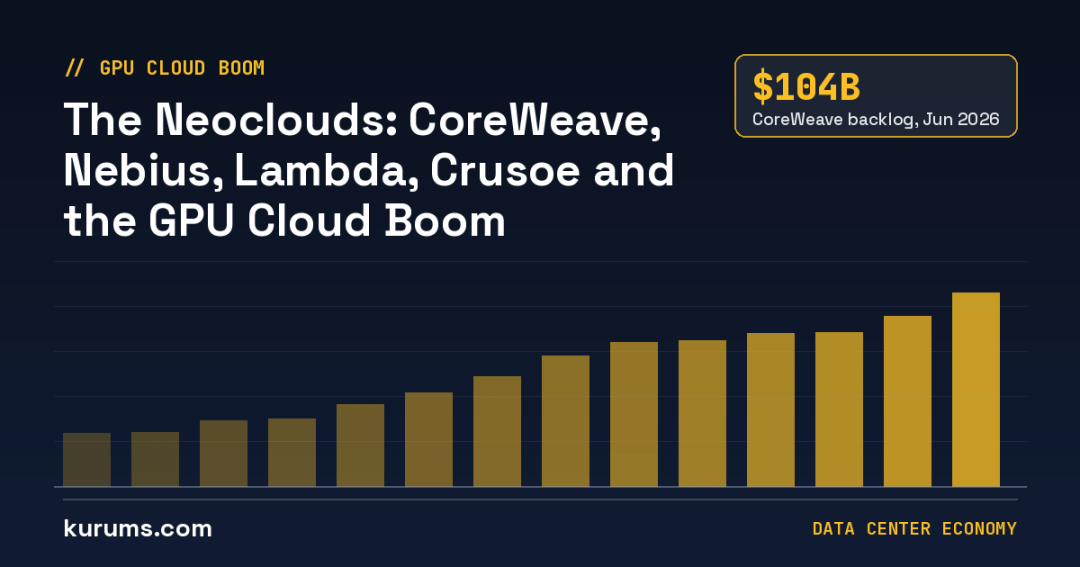
Neoclouds are specialist GPU cloud companies that rent AI computing capacity to labs, hyperscalers and enterprises. CoreWeave is the largest. Its revenue reached $2.58 billion in Q2 2026, up 112%, its backlog was about $104 billion at the end of June plus more than $25 billion of new commitments signed in early Q3, and it had about 1.5 GW of active power with 3.7 GW contracted. That growth is funded by debt: about $35 billion at mid-2026, with $640 million of interest in a single quarter. Nebius reported $530 million of 2025 revenue and has raised more than $9 billion in convertibles and credit in 2026. Crusoe raised $3.9 billion at a $30.9 billion valuation, and Lambda closed its first $1 billion debt deal. Synergy Research counts nine neoclouds among the top 40 cloud providers.
Neoclouds are the newest and most debated group of data center players. Companies like CoreWeave, Nebius, Lambda, Crusoe and Nscale grew from crypto-mining, research-computing or Yandex roots into multi-billion-dollar AI infrastructure providers in about three years. This guide explains how they make money, who their customers are, how they are financed and what could go wrong, using results and deals reported through October 2026. It is part of the Kurums Data Center Economy hub. It complements our comparison of hyperscaler footprints and our look at the AI data center bubble debate.
What is a neocloud?
A cloud provider built specifically to rent GPU computing for AI training and inference, rather than offering the broad catalogue of services sold by AWS, Azure or Google Cloud.
Who are the biggest customers?
Hyperscalers and AI labs. Microsoft supplied about 67% of CoreWeave’s 2025 revenue, and Meta, OpenAI and Anthropic have all signed multi-billion-dollar or multi-year contracts with neoclouds.
What is the main risk?
Leverage and concentration. Neoclouds borrow heavily against contracts with a handful of customers, so a slowdown in AI spending or a lost contract could strain balance sheets quickly.
What are neoclouds and how do they differ from hyperscalers?
Neoclouds are cloud companies focused almost entirely on renting Nvidia GPUs and AI infrastructure. They lack the hundreds of managed services that AWS, Azure and Google Cloud offer, but they can often deploy the newest GPUs faster, at very large scale and with software tuned for AI workloads.
Synergy Research Group, the main tracker of cloud market share, has started to treat neoclouds as a distinct and fast-growing segment. In its Q2 2026 report Synergy named CoreWeave, Crusoe, Nebius and Nscale among the highest-growth “tier two” cloud providers, and said nine neocloud companies now rank in the top 40 globally. In late 2025 Synergy identified CoreWeave as the largest neocloud, with Crusoe, Nebius and Lambda growing very rapidly. Neoclouds and Oracle were the main providers gradually gaining share from the long tail of smaller clouds.
The neocloud model exists because demand for AI computing grew faster than the hyperscalers could build. Microsoft, for example, has bought large amounts of third-party GPU capacity on top of its own build-out, and said in October 2026 that some third-party capacity deliveries had slipped. Neoclouds fill that gap. They are, in effect, a flexible extension of hyperscaler capacity, as well as a direct supplier to AI labs that want dedicated clusters. For the broader business-model context, see our guide to data center business models.
How big is CoreWeave and who are its customers?
CoreWeave is the largest neocloud. It reported Q2 2026 revenue of $2.58 billion, up 112%, a revenue backlog of about $104 billion at the end of June, and 1.5 GW of active power. Microsoft supplied about 67% of its 2025 revenue.
CoreWeave listed on Nasdaq in March 2025 after cutting its IPO size from $2.7 billion to $1.5 billion. Its 2025 revenue was about $5.13 billion, with a net loss of roughly $1.2 billion. Growth has continued: Q1 2026 revenue was $2.08 billion, and Q2 reached $2.575 billion, against $1.21 billion a year earlier. Active power rose by nearly 500 MW in Q2 alone, to about 1.5 GW, and total contracted power reached about 3.7 GW. The company ran 51 data centers across North America and Europe by 2026, up from 32 in 2025.
The customer list has broadened beyond Microsoft. OpenAI signed a five-year contract worth about $12 billion in March 2025, added $6.5 billion more later that year and bought $350 million of CoreWeave shares in the IPO. Meta signed a $14.2 billion deal in Q3 2025 and added a further $21 billion of commitments in 2026. In 2026 CoreWeave also announced a multi-year agreement with Anthropic and a commitment from trading firm Jane Street, which invested $1 billion. Nvidia, its main supplier, invested another $2 billion in January 2026.
How does CoreWeave finance its growth?
CoreWeave funds GPUs and data centers mostly with debt secured against customer contracts. Total debt was about $35 billion at the end of June 2026, and net interest expense reached $640 million in Q2 2026 alone, which is why the company still reports net losses despite strong revenue.
The numbers show the trade-off. In Q2 2026 CoreWeave’s adjusted operating income was $128 million, a 5% margin, down from 16% a year earlier, while its net loss widened to $626 million. Purchases of property and equipment were $6.4 billion in the quarter and $14.1 billion in the first half. Recent financing includes a $3.1 billion term loan and an upsized $3.5 billion convertible note offering in April 2026. Earlier in the year it also sought about $8.5 billion of financing backed by Meta contracts.
This “contract-backed” model is what makes neoclouds possible: a long-term take-or-pay agreement with an investment-grade customer such as Microsoft or Meta can be used to borrow most of the cost of the GPUs needed to serve it. The structure is efficient when demand holds, but it leaves little room for error. CoreWeave’s attempted $9 billion acquisition of Core Scientific, a bitcoin miner with large powered sites, was voted down by Core Scientific shareholders in October 2025. CoreWeave has since kept leasing and building capacity through partners. For more on these structures see how data centers are financed.
What is Nebius and how is it different?
Nebius is an Amsterdam-headquartered AI cloud company created from the international business of Yandex in 2024. It reported $530 million of 2025 revenue and a $447 million net loss, and is expanding fast in Europe and the United States with major hyperscaler contracts.
After the former Yandex N.V. sold its Russian assets in July 2024 and renamed itself Nebius Group, its shares resumed trading on Nasdaq in October 2024. Its data center footprint includes an owned site in Mäntsälä, Finland, GPU clusters in colocation facilities in Paris and Kansas City, a 300 MW campus under construction in Vineland, New Jersey, and a proposed AI data center in Birmingham, Alabama. In September 2025 Nebius signed a multi-year, multi-billion-dollar agreement to supply Microsoft with dedicated capacity from Vineland. It has also signed a GPU capacity agreement with Meta.
Financing has scaled up in 2026. Nvidia announced a $2 billion investment in March 2026. In August Nebius closed $5.75 billion of convertible notes, and in October it secured a $3.5 billion, 364-day facility from Citi, citing more than $40 billion of long-term contracts as the basis for future asset-backed borrowing. Unlike CoreWeave, Nebius sells more of its own software, including an inference platform called Token Factory expanded through small acquisitions. It reports Q3 2026 results on 12 November. Our Europe investment map covers its Nordic base.
| Neocloud | Headquarters / roots | Latest scale indicator | Key customers / partners | Recent financing (2026) |
|---|---|---|---|---|
| CoreWeave | US; ex-crypto miner | Q2 2026 revenue $2.58bn; 1.5 GW active, 3.7 GW contracted | Microsoft, OpenAI, Meta, Anthropic | ~$35bn total debt; $3.5bn converts; $2bn from Nvidia |
| Nebius | Netherlands; ex-Yandex international | 2025 revenue $530M; 300 MW Vineland build | Microsoft, Meta | $5.75bn converts; $3.5bn Citi facility; $2bn from Nvidia |
| Crusoe | US; flare-gas computing origins | Developer of Stargate Abilene with Oracle | Oracle/OpenAI, Perplexity, Thinking Machines | $3.9bn Series F at $30.9bn valuation; $700M power facility |
| Lambda | US; AI research cloud | New Oklahoma data center announced | AI developers and enterprises | $1bn senior secured financing |
| Nscale | UK | Among Synergy’s fastest-growing tier-two clouds | Hyperscalers and AI labs | $3.36bn pre-IPO converts plus ~$1bn expected from Nvidia |
Source: CoreWeave Q2 2026 results; Nebius FY2025 figures and 2026 press releases; Crusoe and Lambda newsrooms; Datacentres.com deal tracker; Synergy Research Group Q2 2026.
What role does Crusoe play in the AI build-out?
Crusoe is a vertically integrated AI infrastructure company that develops power-rich data center campuses and runs its own GPU cloud. It is best known as the developer of the Stargate campus in Abilene, Texas, for Oracle and OpenAI, and raised $3.9 billion at a $30.9 billion valuation in September 2026.
Crusoe began by using stranded natural gas to power computing, and that energy-first approach still defines it. In Abilene it builds the campus and Oracle operates the cloud for OpenAI. Oracle said in March 2026 that two of the eight buildings were fully operational and the rest were progressing as planned. Crusoe’s newer projects include a campus in Armstrong County, Texas, a 40 MW expansion with Polar in Norway, a deployment in Paraguay, and a second Tulsa factory making modular AI data center components.
Crusoe also sells capacity directly through Crusoe Cloud, with partnerships announced in September 2026 with Perplexity and with Thinking Machines Lab. In October 2026 it arranged a $700 million facility with Neuberger to finance power infrastructure, which shows how much of the neocloud challenge is about electricity rather than chips. For the energy side of the story, see why power is the new data center bottleneck.
What about Lambda, Nscale and the smaller GPU clouds?
Lambda, Nscale, Fluidstack and dozens of smaller GPU clouds make up the next tier. Lambda closed its first $1 billion-plus debt financing in October 2026, and UK-based Nscale raised $3.36 billion in pre-IPO convertible notes, with about $1 billion more expected from Nvidia.
Lambda started by selling GPU workstations and a developer-friendly cloud to AI researchers, then moved into large-scale capacity. In September 2026 it announced a new data center in Mayes County, Oklahoma, and in October it closed $1 billion of senior secured fixed-rate financing, a sign it can now borrow from institutional lenders on terms similar to larger peers. Nscale, which Synergy lists among the fastest-growing providers, is expanding in Europe and is involved in projects at Start Campus’s SINES campus in Portugal.
Former bitcoin miners are a related group. ABI Research’s 2025 US ranking already included Hut 8 (about 240 MW of active IT load) and Cipher Mining (about 231 MW) as these firms repurpose powered sites to host AI. CoreWeave itself appeared at about 212 MW of US active IT load in ABI’s dataset, which counts only operational facilities. Our article on the data center construction pipeline explains why these converted sites matter.
How do Nvidia and the hyperscalers shape the neocloud market?
Nvidia is supplier, investor and sometimes customer to the neoclouds, and the hyperscalers are their biggest clients. That circular web of relationships drives growth but also worries sceptics, who say it inflates demand signals.
Nvidia has invested $2 billion each in CoreWeave and Nebius in 2026, and is expected to add about $1 billion to Nscale. Nvidia’s chips account for most neocloud capex. Its data center revenue reached $89.0 billion in the quarter to July 2026, up 117%. Giving neoclouds early access to new platforms, such as the Vera Rubin NVL72 system CoreWeave was first to validate, helps Nvidia spread its customer base beyond the four biggest hyperscalers.
The hyperscalers, meanwhile, use neoclouds to add capacity quickly without building every site themselves. Microsoft’s heavy use of CoreWeave and its Nebius contract are the clearest examples. Meta’s $35 billion of combined CoreWeave commitments shows that even companies with $135–145 billion capex budgets are renting extra capacity. Critics of these arrangements, which we discuss in the bubble debate, argue that investment flowing from suppliers to customers and back overstates real end-demand. Supporters reply that the end customers, AI labs and hyperscalers, are paying real cash under binding contracts.
What are the biggest risks for neocloud investors and customers?
The biggest risks are customer concentration, high leverage, rapid GPU depreciation, power and construction delays, and the possibility that hyperscalers eventually bring capacity back in-house. Each could squeeze cash flow at companies that are still loss-making.
Concentration is the most visible. When one customer supplies two-thirds of revenue, as Microsoft did for CoreWeave in 2025, any change in that customer’s plans has outsized effects. Leverage is the second. Interest costs rose from $267 million to $640 million a quarter at CoreWeave within a year. Third, GPU economics change quickly: each new Nvidia generation can cut the rental value of the previous one. Contracts help, but not everything is contracted.
Delivery risk is real as well. CoreWeave’s own release notes that its backlog depends on its ability to deliver capacity. Power, transformers and construction labour are scarce, as we cover across this hub. On the other side, the bull case is strong: Synergy reports generative-AI cloud services growing 165% a year, and hyperscalers say demand will exceed supply through at least 2026. Neoclouds that deliver on time and spread their customer base could become permanent parts of the cloud market. Those that cannot may be absorbed by larger players.
Frequently Asked Questions
Is CoreWeave profitable?
Not on a net basis. CoreWeave reported a net loss of about $626 million in Q2 2026 on $2.58 billion of revenue, mainly because of $640 million of net interest expense and heavy depreciation. Its adjusted operating income was positive at $128 million, a 5% margin. Profitability depends on keeping its data centers full under long-term contracts while reducing borrowing costs.
Why does Microsoft rent capacity from neoclouds?
Because AI demand has outpaced its own construction. Renting GPUs from CoreWeave, Nebius and others lets Microsoft add capacity faster, without committing all the capital itself. Microsoft supplied about 67% of CoreWeave’s 2025 revenue and signed a multi-billion-dollar capacity deal with Nebius in 2025. It still says demand exceeds supply through at least the end of 2026.
How are neoclouds funded?
Mostly with debt secured against customer contracts and GPUs, supplemented by equity and convertible notes. In 2026 CoreWeave carried about $35 billion of debt, Nebius raised $5.75 billion of convertibles plus a $3.5 billion facility, Crusoe raised $3.9 billion of equity, and Lambda closed a $1 billion senior secured loan. Nvidia has also made direct equity investments.
Will hyperscalers replace neoclouds?
Possibly in part. If hyperscaler self-builds catch up with demand, they may need less rented capacity. But Synergy Research says neoclouds are gaining market share, and contracts signed in 2025–2026 run for several years. Neoclouds with diverse customers, strong power positions and lower borrowing costs are best placed to survive any slowdown.
Discover more from Kurums | Business Intelligence
Subscribe to get the latest posts sent to your email.