
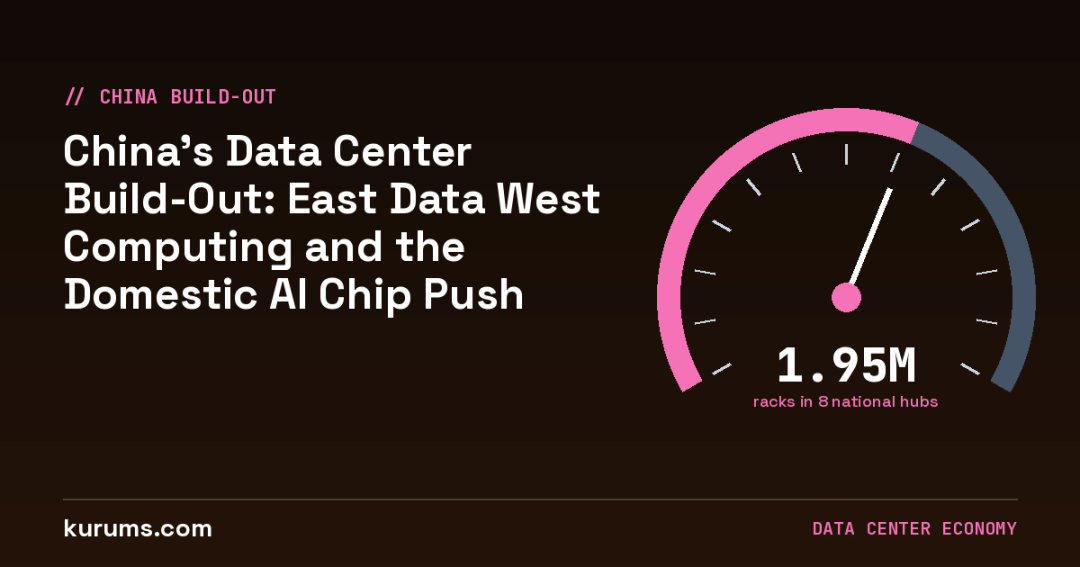
China is the world’s second-largest data center market. Synergy Research ranks Greater Beijing second only to Northern Virginia, and the two together hold 17% of global hyperscale capacity. Beijing’s East Data West Computing programme, launched in 2022, steers capacity to eight national hubs. By mid-2024 those hubs had about 1.95 million racks installed, only about 63% in use, according to the National Data Bureau. China had 230 EFLOPS of computing power at end-2023 against a 300 EFLOPS target for 2025. Investment is now AI-led. Alibaba pledged at least RMB380bn ($53bn) over three years, and Tencent’s Q2 2026 capex rose 65% to $7.8bn. US export controls are pushing operators towards domestic chips such as Huawei’s Ascend and Alibaba’s Zhenwu. Meanwhile, more than 100 projects were cancelled in 18 months amid a reported capacity glut.
China data center investment follows a different logic from the rest of the world. It is shaped by state planning, by US restrictions on advanced chips, and by a push to build a self-sufficient AI computing stack. This guide explains East Data West Computing, the national computing power targets, the capex of Alibaba, Tencent and ByteDance, the role of operators such as GDS and Chindata, and the overcapacity debate. It is part of the Data Center Economy hub; compare it with US data center investment and our Asia-Pacific investment guide.
What is East Data West Computing?
A national plan launched in February 2022 to build data center hubs in energy-rich western provinces such as Inner Mongolia, Gansu, Ningxia and Guizhou. These hubs serve demand from eastern cities like Beijing, Shanghai and Shenzhen.
Is China overbuilding data centers?
Partly. Reports cite low utilisation at many new western sites and more than 100 project cancellations in 18 months, while AI-ready capacity near eastern cities remains in demand. Beijing is now building a national platform to sell surplus compute.
How do US export controls affect China’s build-out?
They restrict access to Nvidia’s most advanced GPUs. Chinese firms are responding by deploying domestic accelerators, buying compute abroad and building clusters in Southeast Asia.
How big is China’s data center market?
China is the world’s second-largest data center and cloud market after the US. Synergy Research Group’s August 2026 ranking places Greater Beijing second globally and Shanghai in the top eight hyperscale markets. Guangdong joined the top 20 in 2026. Nationally, China had more than 8.1 million data center racks at end-2023.
Synergy’s March 2025 analysis estimated that the US held 54% of global hyperscale capacity, with China and Europe each accounting for roughly a third of the rest. That implies a China share of around 15% of hyperscale capacity, excluding the large number of state, telecom and enterprise facilities. In computing terms, figures cited at the Global Digital Economy Conference put China’s total computing power at 230 EFLOPS at end-2023. A plan issued in October 2023 by six government bodies, including the Ministry of Industry and Information Technology (MIIT), targeted 300 EFLOPS by 2025, with 35% coming from intelligent (AI) computing.
The market structure is also different. Synergy notes that all of the top ten cloud providers in China are Chinese, led by Alibaba, Tencent, China Telecom and Huawei. US hyperscalers play only a marginal role. According to a China Academy of Information and Communications Technology official quoted by Reuters, MIIT has licensed at least 7,000 computing centres. Our global data center count explains why national totals vary so much depending on what counts as a data center.
What is the East Data West Computing programme?
East Data West Computing is China’s national plan to build data center hubs in the energy-rich, cooler and cheaper western and northern provinces and link them to demand in the east. The National Development and Reform Commission approved the hub nodes in February 2022.
The programme designates eight national computing hubs. They range from the Beijing-Tianjin-Hebei region and the Chengdu-Chongqing area to Inner Mongolia, Gansu, Ningxia and Guizhou, with data center clusters around them. The idea is to place delay-tolerant workloads such as storage, backup, offline analytics and AI training where land and renewable power are plentiful, and keep latency-sensitive services near the coastal cities. The original plan targeted a maximum network latency of 20 milliseconds between hubs by 2025. Reuters reported in 2025 that many western facilities had not met it.
Investment has been substantial. In August 2024, Liu Liehong, head of the National Data Bureau, said more than 43.5 billion yuan had been invested directly in the programme, and that total investment in the hubs, including private capital, had passed 200 billion yuan, according to Xinhua. The eight hubs then had more than 1.95 million racks installed, of which about 63% were in operation. The programme also connects to China’s renewable push: Ulanqab in Inner Mongolia was tasked with supplying more than 10,000 PFLOPS of green computing to Beijing each year by 2025.
How much are Alibaba, Tencent and ByteDance investing?
China’s internet giants are the main private drivers of AI data center demand. Alibaba pledged at least RMB380 billion ($53 billion) over three years in February 2025, more than its combined AI and cloud spending of the previous decade. Tencent’s capex rose 65% year on year to $7.8 billion in Q2 2026.
Alibaba’s pledge, announced on 24 February 2025, covers cloud computing and AI infrastructure. Its spending is visible at home and abroad. In April 2026, Alibaba and China Telecom launched a 10,000-chip AI cluster in Shaoguan, Guangdong, built on Alibaba’s own Zhenwu chips and expandable to 100,000 chips. Alibaba Cloud has also added regions and data centers in Brazil, France, the Netherlands, South Korea and Malaysia’s Johor during 2026, according to w.media.
Tencent’s Q2 2026 results showed free cash flow turning negative, about minus $2 billion, as AI infrastructure spending and prepayments rose. In October 2026, reports citing the Financial Times said Tencent had agreed a five-year lease of about 100,000 AI chips housed in Oracle data centers in Southeast Asia, worth roughly $7 billion. The deal gives Tencent access to accelerators not available inside China. ByteDance has taken a similar international route. w.media reports construction of a $38.44 billion data center at Pecém in Brazil’s Ceará state, planned at 200 MW with potential to approach 1 GW, alongside large deployments in Malaysia. At home, ByteDance has invested in computing centres such as a 4.5 billion yuan facility in Datong, Shanxi.
| Company / project | Investment or scale | Detail | Source date |
|---|---|---|---|
| Alibaba | At least RMB380bn ($53bn) over 3 years | Cloud and AI infrastructure; larger than previous decade’s AI and cloud spend | Feb 2025 |
| Alibaba + China Telecom, Shaoguan | 10,000-chip cluster, expandable to 100,000 | Built on domestic Zhenwu chips | Apr 2026 |
| Tencent | Q2 2026 capex $7.8bn (+65% y/y) | Free cash flow about minus $2bn; ~$7bn chip lease from Oracle in Southeast Asia | Aug–Oct 2026 |
| ByteDance, Brazil | $38.44bn | Pecém, Ceará; 200 MW planned, potentially near 1 GW | Jul 2026 |
| Huawei Ascend cluster, Shenzhen | 10,000 cards, 11,000 PFLOPS | Ascend 910C chips; came online late March 2026 | Apr 2026 |
| Envision, Ulanqab | 2 GW AI campus | Wind and solar powered; designed for 1 million accelerators | Aug 2026 |
| GDS Holdings | 684,977 sqm in service; 79.2% utilised | Q2 2026 net revenue RMB3.09bn (+6.5% y/y) | Aug 2026 |
Source: Alizila (Alibaba, February 2025); w.media (Shaoguan and Shenzhen clusters, April 2026; Tencent–Oracle lease, October 2026; ByteDance Brazil; Envision Ulanqab, August 2026); GDS Holdings Q2 2026 results.
How are US export controls reshaping China’s AI data centers?
US export controls, first imposed in October 2022 and tightened several times since, limit China’s access to the most advanced Nvidia GPUs and chipmaking tools. Chinese operators have responded by switching to domestic accelerators, renting compute abroad and designing clusters around lower-performance chips.
The rules have shifted repeatedly. The original October 2022 Bureau of Industry and Security controls restricted advanced computing chips and chipmaking equipment for China. Later rules caught successive China-specific Nvidia products, including the H20, whose sales were halted and later allowed to resume under licences. According to w.media, Nvidia’s H200 remained restricted until limited shipments to China began in July 2026. Nvidia’s own guidance shows how uncertain the market is. Its outlook for the first quarter of fiscal 2027 assumed no data center compute revenue from China at all.
Domestic alternatives are scaling. Huawei’s Ascend 910C powers a 10,000-card cluster in Shenzhen with 11,000 PFLOPS of capacity that came online in late March 2026. Alibaba’s Zhenwu chips run the Shaoguan cluster, and Alibaba unveiled a Zhenwu V900 GPU claiming three times the performance of its predecessor. Large-scale AI infrastructure is a national priority in China’s latest five-year plan, and cities including Shenzhen and Shanghai are building their own computing networks. For the global chip supply chain, covered in our guide to data center supply chain companies, China is becoming a separate ecosystem rather than a growth market for US vendors.
Restrictions also push Chinese capital abroad. Tencent’s Oracle lease, ByteDance’s Brazil and Malaysia projects, and Chinese investment in Southeast Asian data centers, such as a planned $5 billion AI campus in Batam, Indonesia, all give Chinese firms access to compute outside China’s borders. The US has responded by tightening controls on chip shipments to some Southeast Asian countries, as covered in our Asia-Pacific guide.
Is China overbuilding data centers?
There is credible evidence of overbuilding in parts of China, especially at western sites built for training workloads that have since struggled to find tenants. But demand for modern, AI-ready capacity near eastern cities remains strong, so the picture is one of mismatch rather than a simple glut.
The bear evidence is significant. MIT Technology Review reported in March 2025 that more than 500 data center projects were announced in 2023–2024, according to KZ Consulting, and at least 150 had been completed by end-2024. Chinese tech outlets it cited claimed that up to 80% of newly built computing resources were sitting unused. Rental prices for an eight-GPU Nvidia H100 server reportedly fell to about 75,000 yuan a month from highs of around 180,000. Reuters reported in August 2025 that project cancellations rose from 11 in 2023 to more than 100 in the following 18 months. State procurement for data centers jumped to 24.7 billion yuan in 2024 from about 2.4 billion yuan in 2023.
The policy response is consolidation. Beijing is building a state-run national cloud platform, with MIIT working alongside China Mobile, China Unicom and China Telecom, to pool and sell surplus computing power. It targets standardised nationwide interconnection of public computing power by 2028. The state planner has also signalled minimum utilisation requirements for new projects. The bull view is that this is a normal clearing process. The shift from training to inference after DeepSeek’s efficient models changed where compute is needed, and operators with eastern, AI-ready sites are still signing record contracts. Our AI data center bubble debate compares China’s experience with the US.
Who are the main data center operators in China?
China’s market is led by the three state telecom carriers, China Telecom, China Mobile and China Unicom, alongside the cloud providers’ own campuses. Carrier-neutral specialists such as GDS Holdings, Chindata, VNET and Range IDC serve the hyperscalers on build-to-suit contracts.
GDS is the bellwether for listed independent operators. Its Q2 2026 results showed 684,977 square metres in service, up 10.8% year on year, utilisation of 79.2%, and net revenue of RMB3.09 billion. Chairman William Huang said the company was on track for a record year of sales commitments, driven mainly by AI demand. GDS has pioneered asset recycling in China. In March 2025, it sold a 70% interest in a portfolio of data centers into a private REIT structured as an asset-backed security led by China Life, at an implied enterprise-value multiple of about 13 times EBITDA. It has since moved towards injecting assets into a public C-REIT. GDS also sold $385 million of shares in DayOne, its former international arm, in January 2026.
Ownership is shifting from foreign to domestic capital. In September 2025, Bain Capital agreed to sell Chindata’s China operations, which serve hyperscale customers in Greater Beijing, the Yangtze River Delta and the Greater Bay Area, to a consortium led by HEC Group for $4 billion. Foreign investors still participate selectively: CapitaLand Investment launched a S$1 billion fund to develop two hyperscale projects in Greater Beijing. Our ranking of the largest colocation providers and our review of the biggest data center M&A deals put these transactions in a global context.
How is China powering its data centers?
China is pairing data centers with large wind and solar bases in the north and west, which is the core logic of East Data West Computing. New gigawatt-scale campuses such as Envision’s 2 GW Ulanqab site in Inner Mongolia are designed around direct renewable supply with storage.
Envision said in August 2026 that its Ulanqab campus, powered by wind and solar through its own transmission and storage system, is designed for up to one million AI accelerators and one million PFLOPS of computing power. Tencent has added a 10.54 MW microgrid at its Tianjin data center. China has also experimented with offshore wind-powered underwater data centers off Shanghai and Hainan. Industry commentary suggests that for Chinese operators the harder constraint is access to advanced chips rather than electricity, roughly the reverse of the situation in Virginia or Frankfurt, though grid links between western hubs and eastern demand remain a planning challenge. Our data center electricity statistics compare national consumption trends.
What is the outlook for China’s data center investment?
China’s build-out will continue, but with more emphasis on utilisation, domestic chips and AI inference near major cities, and less on speculative western capacity. Expect consolidation, more state coordination through national compute platforms, and continued overseas expansion by Chinese cloud firms.
Three questions will shape the next two years. The first is chips: how quickly domestic accelerators from Huawei, Alibaba and others can close the performance gap, and whether US policy on Nvidia shipments loosens or tightens again. The second is utilisation: whether the national compute platform can soak up idle western capacity. The third is capital: whether AI spending at Alibaba, Tencent and ByteDance keeps rising as free cash flow comes under pressure, as it did at Tencent in 2026. Foreign investors have a narrower window than before, but asset-recycling structures like GDS’s REIT transactions show that domestic institutional capital, especially insurers, is now willing to own stabilised data centers.
Frequently Asked Questions
How many data centers does China have?
Counts vary by definition. A China Academy of Information and Communications Technology official told Reuters that MIIT has licensed at least 7,000 computing centres, and China had more than 8.1 million data center racks at end-2023. Synergy Research ranks Greater Beijing as the world’s second-largest hyperscale market and Shanghai in the global top eight.
What does East Data West Computing mean?
It is China’s national plan, approved in February 2022, to build data center hubs in western and northern provinces with cheap land and renewable power, such as Inner Mongolia, Gansu, Ningxia and Guizhou, and link them to demand in eastern cities. By mid-2024 the eight hubs had about 1.95 million racks installed, around 63% in use.
Can Chinese data centers buy Nvidia chips?
Only restricted, China-specific products and only under US licensing conditions, which have changed repeatedly since 2022. Nvidia’s guidance for early fiscal 2027 assumed no China data center compute revenue. Chinese firms are increasingly using domestic accelerators such as Huawei’s Ascend and Alibaba’s Zhenwu, or leasing compute abroad, as Tencent reportedly did with Oracle in Southeast Asia.
Is there a data center bubble in China?
There are clear signs of overbuilding in some western hubs. Reports cite low utilisation, falling GPU rental prices and more than 100 cancelled projects in 18 months. However, AI-ready capacity near eastern cities remains in demand, and operators like GDS report record sales commitments. Beijing is responding with a national platform to sell surplus compute and minimum utilisation rules.
Discover more from Kurums | Business Intelligence
Subscribe to get the latest posts sent to your email.