
The open-source eBPF runtime lets agents build signed, temporary mitigations for unpatched flaws. It is promising, early, and proven in one controlled test.
Cisco and OpenAI released Shirudo on November 23, an open-source Linux runtime that lets AI agents write, test and deploy signed temporary mitigations, called shields, while a real patch is prepared. The only detailed public evidence is one controlled test that blocked a Java4Shell exploit against a running Elasticsearch service. With agencies now urging 24-hour patching against AI-driven attacks, the idea deserves a lab evaluation, but it is not yet a substitute for patching or for human approval of changes.
What Cisco and OpenAI released
On Monday, November 23, Cisco and OpenAI launched Shirudo, an open-source project that lets AI agents write, test and deploy small temporary mitigations on running Linux systems while the permanent patch is still being built and tested. Cisco’s press release describes it as a way to protect running Linux systems without a reboot, with agents doing the legwork “while people keep the keys and set the boundaries.”
The mitigations are called shields (Shirudo is Japanese for “shield”). According to OpenAI’s announcement, the problem they target is that testing and deploying a patch “can still take days or weeks”, and that blocking a vulnerable Linux operation outright can take the service offline because an exploit and a legitimate request may rely on the same operation. A shield is meant to be narrower: block the exploit path, leave the workload running.
The technical base is eBPF, the Linux facility for running small sandboxed programs inside the kernel without changing kernel source or loading modules. The Isovalent engineering post says Shirudo is a rewrite of Tetragon, the eBPF security platform Isovalent open sourced in 2022 and which underpins Cisco’s Live Protect feature. The rewrite drops the human-oriented policy language so that agents work directly in code.
How a shield is built and trusted
Isovalent describes a four-step loop, run in its example with OpenAI’s Codex as the control plane:
- Intake. The agent either searches for vulnerabilities itself or works from external disclosures.
- Generate and validate. It builds a reproducer of the exploit, picks the mitigation point (eBPF in the kernel, or the application runtime such as Java bytecode), writes the mitigation and tests it. The step repeats until a mitigation works.
- Roll out. The shield is signed and distributed to affected nodes while application health is monitored. Isovalent says this step “can be designed to be more or less autonomous.”
- Monitor. A hit count on each shield shows active exploitation attempts against the shielded flaw.
The trust model matters more to operators than the agent loop. Per OpenAI, shields are cryptographically signed and verified before loading, the kernel’s eBPF verifier checks programs against its safety rules, and a Trusted Platform Module (TPM) supports a verifiable record of protections being loaded or removed. Isovalent adds that shields ship as signed packages through an OCI registry, that the tool is a one-shot command line program instead of a permanent daemon, and that the control plane on each target is an eBPF program loaded at boot. Cisco says the signature check holds “even if an attacker has gained administrator access.” That is a vendor claim; the coverage reviewed for this article contains no independent test of it.
What the evidence shows so far
The published proof is one controlled test. Isovalent fed details of Java4Shell, a recently disclosed OpenJDK vulnerability, into the agent loop. The result was a Java bytecode shield that adds validation to Base64 input. Attached to a running Elasticsearch 9.5.5 instance, it rejected the exploit attempt and the service kept running without a restart, according to both Isovalent and OpenAI.
The sources differ slightly on scope. Cisco’s press release and a blog post by Cisco president Jeetu Patel say Shirudo has also written code that detects and blocks exploitation of the recent PHP flaw. The detailed write-ups from OpenAI and Isovalent document only the Java4Shell test, and CIO Dive’s report describes only that one. Treat the PHP result as stated by Cisco but not yet shown in detail.
Note also that the showcase shield was not an eBPF program. It modified application bytecode, which Isovalent presents as a second mitigation route for flaws that kernel-level controls do not suit.
The licensing is permissive: BSD 2-Clause for the runtime, with BPF programs dual-licensed under BSD and GPL, per OpenAI. InfoWorld notes that this allows use in commercial products. A technical webinar is scheduled for December 15.
Why the timing matters: attackers are already automating
Shirudo arrives in a week of warnings that the attack side has moved first. Patel writes that with the PHP and Java4Shell flaws, “exploit campaigns were underway within a day of disclosure, if not before.” Separate reporting this week points the same way:
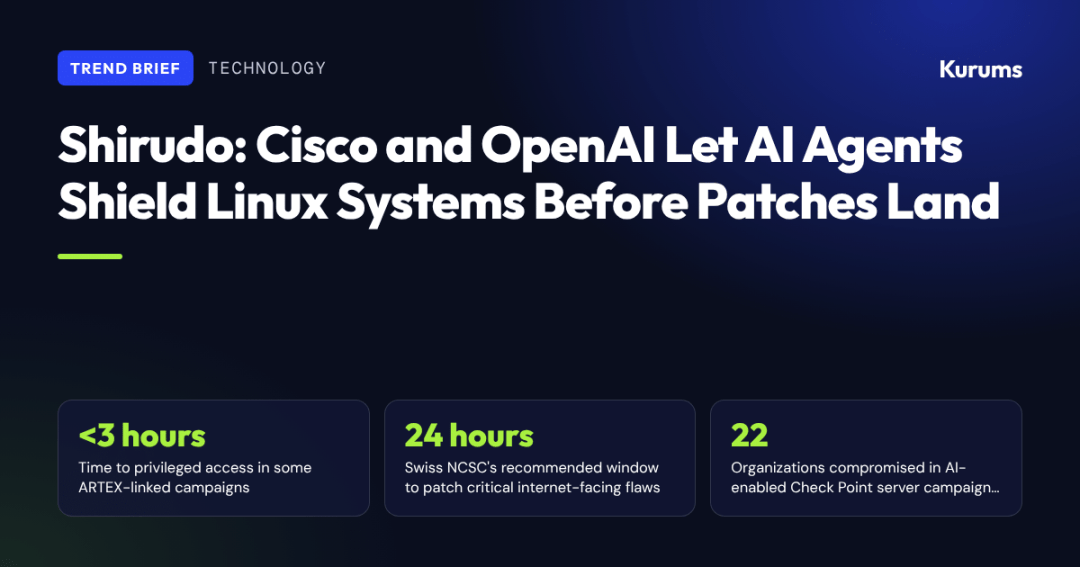
- The Register reports that Microsoft named Chinese and North Korean state-linked groups among users of ARTEX, an open-source AI penetration testing framework, with linked campaigns sometimes reaching privileged access in under three hours. The Register notes that ARTEX offers no new attack techniques; its value is automation.
- BleepingComputer reports that Italian and Swiss cyber agencies warned of autonomous AI-driven campaigns. The Swiss NCSC recommends patching critical flaws on internet-facing systems within 24 hours of release.
- Cybersecurity Dive reports that GreyNoise tracked an AI-enabled campaign against Check Point Security Management servers that compromised at least 22 organizations. The Check Point flaw involved was patched in July.
The last point is the uncomfortable one for IT leaders. Much of the damage still comes from known, patchable flaws on exposed systems. A 24-hour patch target is beyond most change processes, which is the gap temporary mitigations are meant to cover.
Search behaviour shows the launch registered, briefly. On Google Trends (US, a relative index from 0 to 100, not search volume), “shirudo” averaged 24.7 over the last seven days against 1.6 for the earlier part of the 90-day window, peaking at 100 on November 24 and falling to 14 by November 26. “ebpf” averaged 20.7 over the last seven days against 7.6 before, although its 90-day peak came on September 22, well before this launch. Rising queries included “openai shirudo” and “shirudo github”, which suggests practitioners went looking for the code.
Search interest: ebpf vs shirudo
Google Trends, United States, Aug 27, 2026 to Nov 27, 2026. Daily index, 0–100, relative to the highest point among the terms compared; it shows relative attention, not search volume.
How it compares with what you already do
| Approach | Speed | Disruption | Main risk |
|---|---|---|---|
| Vendor patch through normal change control | Days to weeks (OpenAI’s characterisation) | Often needs a restart or maintenance window | Exposure while testing |
| Take the service offline or block the operation | Immediate | High: legitimate use is blocked too | Self-inflicted outage |
| Network or perimeter rule | Fast | Low to medium | Sits outside the workload; Cisco argues it is “always a step behind” |
| Agent-built shield (Shirudo) | Designed for machine speed; no published timings | Designed for none; shown in one controlled test | New project, AI-written code running in the kernel or app runtime |
How to respond, by role
CIOs and IT leaders
Do not change patch policy on the strength of a launch. Use this as a prompt to measure your real time from disclosure to mitigation on internet-facing Linux systems, and to decide who may approve a temporary control outside the normal change window. If the answer is “nobody”, fix that first.
Security leaders
Evaluate Shirudo in a lab, not production. The questions to answer are concrete: who holds the signing keys, how a shield is revoked, what the TPM record looks like in your logging pipeline, and whether a shield retires when the patch lands as Cisco describes. Decide in advance how much of the rollout step you would ever allow to run without human approval. OpenAI’s own wording is that security teams control what gets deployed.
Platform and engineering managers
Check prerequisites before anyone promises anything. The design assumes Linux hosts with eBPF, TPM hardware, a boot-time control plane and access to an OCI registry. Cisco is explicitly asking operators to run shields against the kernel builds they use and report where legitimate traffic breaks, which tells you compatibility is still being established. Application teams should know that a shield may inject bytecode into a running JVM, and should add shield state to incident and performance triage.
Teams without Linux-heavy estates
Shirudo does nothing for Windows servers or network appliances, which featured in this week’s attack reports. The agencies’ guidance applies regardless: reduce internet-exposed systems, disable remote management interfaces that are not needed, enforce MFA or passkeys, and monitor authentication sources and outbound server traffic.
Risks and open questions
- Maturity. OpenAI calls Shirudo “a first step” and Isovalent says the project “is only the beginning”. There are no published production deployments, performance figures or false-positive rates in the material reviewed.
- Autonomy. Self-augmenting systems that adjust themselves at runtime, as Isovalent’s principles describe, are hard to reconcile with change control and audit as most organisations run them today. The signed, TPM-backed record helps with evidence, not with approval.
- False confidence. A shield is a stopgap. Isovalent states that live mitigations complement protections built into the kernel and do not replace them. An estate full of long-lived shields and deferred patches would be worse than today.
- Supply chain. OpenAI says its goal is to make tested shields available alongside vulnerability disclosures. That would create a new stream of third-party code to vet. Who publishes, signs and maintains those shields is not yet defined.
What to do next
- Measure your actual time from disclosure to mitigation for the last three critical flaws on internet-facing Linux systems.
- Name who can approve a temporary mitigation outside the normal change window, and document the rollback path.
- Stand up Shirudo in an isolated lab using the project's quickstart and test a shield against the kernel builds you run.
- Inventory which Linux hosts have eBPF enabled and TPM hardware available, since the design depends on both.
- Write a policy for agent-generated controls covering signing key custody, human approval, logging and maximum shield lifetime.
- Cut internet exposure now: disable unneeded remote management interfaces and restrict management servers to trusted networks.
- Register a security engineer for the December 15 technical webinar and ask for performance and false-positive data.
Frequently asked questions
What is Shirudo?
Shirudo is an open-source Linux runtime launched by Cisco and OpenAI on November 23, 2026. It lets AI agents build small, signed mitigations called shields that block a specific exploit path on a running system while a permanent patch is developed and tested. It is built on eBPF and is a rewrite of Isovalent's Tetragon project.
Does Shirudo replace patching?
No. Cisco and OpenAI present shields as temporary protection during the days or weeks it takes to test and deploy a patch, and Cisco says a shield retires when the real patch lands. Isovalent states that live mitigations complement kernel protections and do not replace them. Patching remains the fix.
Is Shirudo ready for production use?
The launch material does not show that. The detailed public evidence is one controlled test in which a Codex-generated shield blocked a Java4Shell exploit against Elasticsearch 9.5.5. OpenAI calls it a first step, and Cisco is asking operators to report where shields break legitimate traffic. A lab evaluation is the sensible starting point.
How is Shirudo licensed and what does it need to run?
According to OpenAI, Shirudo is licensed under BSD 2-Clause, with its BPF programs dual-licensed under BSD and GPL. Based on the Isovalent and OpenAI descriptions, it targets Linux hosts with eBPF, uses a Trusted Platform Module for verification records, and distributes signed shield packages through an OCI registry.
- Cisco Newsroom: Cisco and OpenAI Launch Shirudo, A New Project to Safeguard Agentic AI (2026-11-23)
- OpenAI: OpenAI and Cisco introduce Shirudo (2026-11-23)
- Isovalent: Cisco and OpenAI introduce Shirudo
- Cisco Blogs: Expanding the Defender's Window with Self-defending Infrastructure
- CIO Dive: OpenAI, Cisco debut tool that lets AI agents safely block vulnerability exploitation (2026-11-25)
- InfoWorld: Cisco and OpenAI dispatch AI agents to shield vulnerable systems before permanent patches arrive (2026-11-25)
- Cybersecurity Dive: AI-enabled campaign targets Check Point Security Management servers (2026-11-24)
- The Register: Microsoft: Hackers in China, N Korea using ARTEX AI tool to break into global tech systems (2026-11-26)
- BleepingComputer: Italy and Switzerland warn of autonomous AI-driven cyberattacks (2026-11-25)
Search-interest figures are from Google Trends (United States, 90 days to November 27, 2026). This article is analysis for operators, not legal, tax or investment advice. Last updated November 27, 2026.
Discover more from Kurums | Business Intelligence
Subscribe to get the latest posts sent to your email.