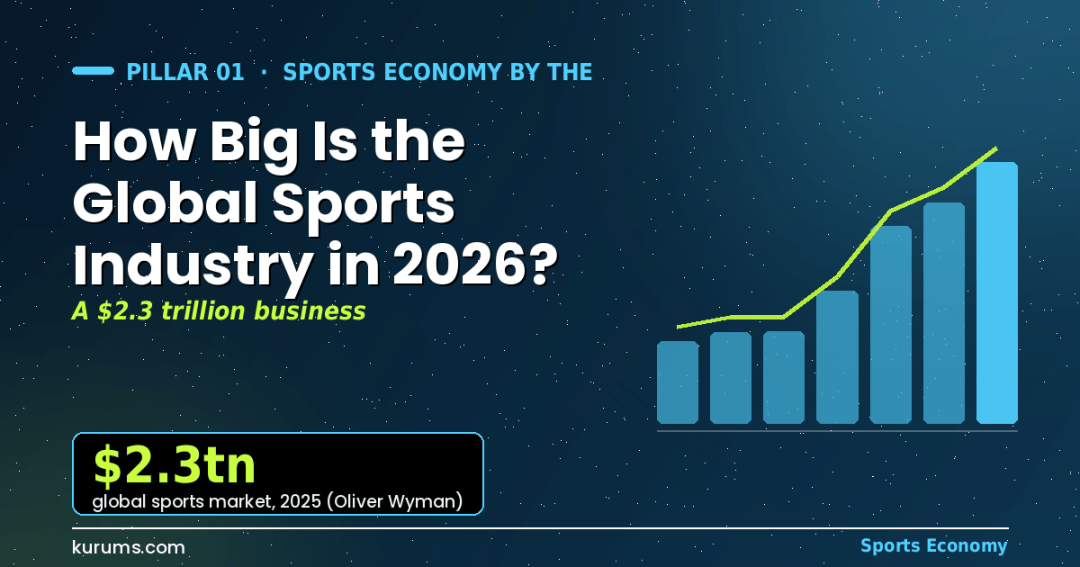
The global sports industry is worth roughly $500 billion a year on a narrow definition (spectator sport, events, clubs and leagues) and about $2.3 trillion on the broad definition used by Oliver Wyman and the World Economic Forum, which adds sporting goods, participation and sports tourism. The top 20 football clubs earned €12.4 billion in 2024/25, the NFL distributed about $14.5 billion of national revenue in 2025, media rights spend is heading past $78 billion by 2030 and women’s elite sport will clear $3 billion in 2026. PwC’s May 2026 survey expects 7.4% annual growth over the next three to five years.
Global sports industry size is one of those questions where the honest answer starts with “it depends what you count”. A football club’s ticket revenue is obviously sport; a pair of running shoes bought for the school run, a hotel room booked for a marathon weekend and a bet placed on an NBA game are counted by some analysts and excluded by others. This article pulls the main 2025 and 2026 estimates together, explains why they differ by a factor of four, and then works bottom-up through the segments that can actually be audited: league revenues, club accounts, media rights, sponsorship, betting and sporting goods. It is the opening piece of the Sports Economy hub and is complemented by our analysis of what share of GDP and jobs sport represents, which looks at the same numbers from the national-accounts side.
What is the headline number for 2026?
Roughly $2.3 trillion on the broad Oliver Wyman/WEF definition (2025 base), or about $520 billion for the narrower spectator-sport market estimated by The Business Research Company for 2026. Both are growing faster than world GDP.
Which segments are biggest?
Sports tourism ($672 billion), sporting goods ($614 billion) and consumer participation ($560 billion) dwarf professional sport itself, which Oliver Wyman puts at about $140 billion of direct revenue.
How fast is it growing?
PwC’s 2026 survey of 517 executives expects 7.4% a year to 2030; Oliver Wyman models 10% a year to reach $3.7 trillion by 2030. Media rights are the one stream executives now expect to flatten.
What is the global sports industry worth in 2026?
Depending on scope, between roughly $500 billion and $2.3 trillion a year. The narrow figure covers spectator sport, leagues, clubs and events; the broad figure, from Oliver Wyman and the World Economic Forum, adds sporting goods, participation spending and sports tourism and is forecast to reach $3.7 trillion by 2030.
The widest credible estimate comes from research published by Oliver Wyman with the World Economic Forum in 2025. It sizes the “sports economy” at about $2.3 trillion for the most recent year and projects growth of roughly 10% a year to nearly $3.7 trillion by 2030, with a long-range scenario above $8.8 trillion by 2050.
At the other end, market-research houses that count only the spectator-sport business arrive at numbers in the hundreds of billions. The Business Research Company’s Sports Global Market Report estimates the sector at about $495 billion in 2025, rising to roughly $522 billion in 2026 and $654 billion by 2030, a compound growth rate near 5.8%, with North America the largest regional market. The difference between $500 billion and $2.3 trillion is not a disagreement about the facts; it is a disagreement about where sport stops and retail, travel and leisure begin.
Why do estimates of the sports market differ so much?
Because analysts draw the boundary differently. Narrow estimates count revenue earned by sports organisations: tickets, media rights, sponsorship, merchandise. Broad estimates add everything consumers spend because of sport, including equipment, gym memberships, travel and gambling, which together are four to five times larger than professional sport itself.
Oliver Wyman’s own breakdown makes the point. Of its roughly $2 trillion core, sports tourism contributes $672 billion, sporting goods $614 billion and consumer participation (gym fees, club subscriptions, coaching, race entries) $560 billion. Professional sport, the segment that produces the headlines about transfer fees and broadcast deals, is only about $140 billion. A further $300 billion sits in adjacent sectors such as sports media, sports video games and sports nutrition. Count only the last two categories and you are near the narrow estimates; count all of it and you reach $2.3 trillion.
How much do the biggest leagues actually earn?
The NFL remains the largest single sports property, with national revenue of about $14.5 billion in 2025 and total league revenue in the $23–25 billion range. The NBA projected $14.3 billion for 2025/26, and the Premier League reached £6.8 billion in 2024/25, with Deloitte expecting it to pass £7 billion in 2025/26.
Sportico’s reporting on the NFL’s 2025 financial distributions shows gross national revenue, meaning media rights, league-wide sponsorships and the shared income of NFL Properties and NFL International, of roughly $14.5 billion, up about 5% on 2024. Each of the 32 clubs received more than $450 million before selling a single ticket, and the shared gate-receipt pool added nearly $30 million per team. The league’s 11-year, $125 billion media contracts with ESPN, Fox, CBS, NBC, Amazon and YouTube run to 2033 with opt-outs in 2029, and Sportico notes that commissioner Roger Goodell’s long-stated goal of $25 billion in annual revenue is now within reach.
The NBA has moved into second place. Sportico projected gross revenue of $14.3 billion for the 2025/26 season, up 12% from $12.75 billion the season before, with the jump driven by the first year of a $76 billion, 11-year media agreement with Amazon, ESPN/ABC and NBC. Basketball-related income, the narrower figure used to set the salary cap, was $10.25 billion in 2024/25. Major League Baseball sits a little behind at roughly $12 billion, and the NHL at about $7 billion, according to the same valuation series.
In Europe, Deloitte’s 35th Annual Review of Football Finance, published in July 2026, put the whole European football market at €40.2 billion for 2024/25, a 6% rise and the first time the market has crossed €40 billion. The “big five” leagues generated €21.6 billion of that: Premier League £6.8 billion (up 8%), Bundesliga just over €4 billion (up 12%), LaLiga €4.1 billion, Serie A €3 billion and Ligue 1 €2.2 billion, the last down 15% after the collapse of its domestic broadcasting deal. Revenue growth did not translate into profit: the Premier League’s clubs posted a combined pre-tax loss of £948 million and the big five together lost €1.5 billion before tax. For a line-by-line look at where the English money comes from and goes, see our piece on Premier League revenue distribution.
| League / market | Latest revenue | Period | Change | Source |
|---|---|---|---|---|
| NFL (national revenue only) | $14.5bn | 2025 season | +5% | Sportico |
| NBA (gross, projected) | $14.3bn | 2025/26 | +12% | Sportico |
| European football (all leagues) | €40.2bn | 2024/25 | +6% | Deloitte ARFF 2026 |
| Premier League | £6.8bn | 2024/25 | +8% | Deloitte ARFF 2026 |
| Top 20 football clubs | €12.4bn | 2024/25 | +11% | Deloitte Money League 2026 |
| Women’s elite sport (global) | $3.0bn | 2026 forecast | +25% | Deloitte |
| US commercial sports betting revenue | $16.9bn | 2025 | +22.6% | AGA via Legal Sports Report |
| Global sports media rights | ~$65bn → $78bn+ | 2025 → 2030 | +20% over period | Ampere Analysis |
How large is the club economy at the top of world football?
The 20 highest-earning football clubs generated a record €12.4 billion in 2024/25, up 11% on the year, according to Deloitte’s 2026 Football Money League. Real Madrid became the first club to pass €1.1 billion, and commercial income exceeded €5 billion across the group for the first time.
Deloitte’s January 2026 edition ranks Real Madrid first at €1.161 billion, followed by Barcelona (€974.8 million, up 27% on the back of a partial return to a rebuilt Camp Nou), Bayern Munich (€860.6 million), Paris Saint-Germain (€837 million) and Liverpool (€836.1 million). Across the 20 clubs, commercial revenue reached €5.3 billion, broadcasting €4.7 billion and matchday €2.4 billion. Commercial income is the stream clubs control most directly, which is why the biggest clubs now behave like consumer brands.
Below the top 20 growth is slowing, with some big-five leagues flat or declining in the next two seasons and the English Championship losing £355 million before tax on £942 million of revenue. That gap between the elite and the rest is the central structural fact in football economics, treated in depth in our article on club valuations and multi-club ownership.
Türkiye offers a useful mid-table reference point. Football Benchmark’s 2025 analysis of the Süper Lig puts Galatasaray’s operating revenue at €282 million for 2024/25, Fenerbahçe at €221 million and Beşiktaş at €150 million, with the league’s gross transfer spending hitting €477 million in 2025/26, the highest in five seasons. Those club revenues would place Galatasaray around the fringe of Europe’s top 30, but staff costs absorbing 63–82% of revenue at the big three show why Turkish clubs chase Champions League income and property deals so aggressively.
How big are media rights, sponsorship and betting?
Media rights are worth roughly $65 billion a year globally and will exceed $78 billion by 2030 according to Ampere Analysis; streaming platforms alone will spend $14.2 billion in 2026. US commercial sports betting produced $16.9 billion of revenue on a $167 billion handle in 2025, and sponsorship remains the fastest-growing commercial stream outside betting.
Ampere’s November 2025 forecast expects global rights spend to rise about 20% between 2025 and 2030, with the United States pushing past $36 billion by the end of the decade, Europe growing from $18.3 billion to $21.3 billion and Asia from $7.2 billion to $9.9 billion on the strength of Indian cricket deals due in 2027. Streamers are the marginal buyer: Ampere’s separate projection, reported by TheWrap in early 2026, has Amazon Prime Video overtaking DAZN as the single largest global spender on sports rights, with streaming services collectively paying $14.2 billion in 2026, up from about $12.5 billion in 2025. The full picture, including why PwC’s executives now expect rights values to plateau, is in our article on the sports media rights market.
Betting grew fastest from a legal base: American Gaming Association data analysed by Legal Sports Report show US commercial sportsbooks took $166.9 billion in wagers in 2025, up 11.3%, and kept $16.9 billion, up 22.6%, which is why PwC’s respondents rank betting-related rights as the fastest-growing revenue line at 7.7% a year, ahead of commercial and sponsorship (6.5%) and merchandising and ticketing (6.2% each). Sponsorship is harder to size because most deals are private, but the direction is clear: commercial income at the top 20 clubs passed €5 billion, Premier League commercial revenue rose 13% to £2.4 billion, and industry research cited by Goal and MediaPost estimated a $4.5 billion sponsorship economy across the 2026 World Cup host cities. Global sports sponsorship estimates for 2025 cluster between $100 billion and $115 billion, but methodologies vary enough that these are order-of-magnitude figures rather than audited totals.
How much of the industry is sporting goods and participation?
Roughly half. Oliver Wyman puts sporting goods at $614 billion and consumer participation at $560 billion, together about $1.17 trillion of the $2.3 trillion total. The two largest listed companies, Nike and adidas, alone booked around $70 billion of combined revenue in their 2025 fiscal years.
Nike reported revenue of about $46.3 billion for the fiscal year ended May 2025 in its 10-K, down roughly 10% as it reset wholesale relationships, while adidas posted record revenue of €24.81 billion for 2025, up 10% in euro terms, with operating profit rising to €2.05 billion. Add Puma, Lululemon, Anta, Decathlon and the long tail of specialist brands and sporting goods is a consumer sector in its own right.
Which parts of the sports industry are growing fastest?
Women’s sport, betting-related rights, Asian markets and franchise valuations. Deloitte expects women’s elite sport to grow 25% to $3 billion in 2026; PwC’s executives forecast 9.4% annual growth in Asia versus 6.7% in Europe; and Sportico’s 2025 valuations show NFL and NBA teams up 20% in a year.
Deloitte’s April 2026 report puts women’s elite sport at $2.4 billion in 2025 and above $3 billion in 2026, 54% of it in North America, with football and basketball each about 35% of the total. PwC’s ninth Global Sports Survey, published in May 2026 from responses by 517 senior executives in 48 countries and 7,250 fans in 17 markets, expects the industry to grow 7.4% a year over the next three to five years, with Asia at 9.4%, North America at 8.5%, Australasia at 7.3% and Europe at 6.7%. Team and franchise valuations are expected to compound at 7.9%. Media rights are the one line executives expect to fall slightly, which marks a turning point after two decades in which broadcast money did most of the heavy lifting.
Asset prices have run ahead of revenues. Sportico’s 2025 valuations put the average NFL franchise at $7.13 billion, up 20% in a year, the average NBA team at $5.51 billion, up 113% since 2022 after Mark Walter’s $10 billion purchase of the Los Angeles Lakers, and Formula 1 teams up 48%. Those multiples are discussed in our regional comparison of sports economies.
What will the sports industry be worth by 2030?
Between roughly $650 billion (narrow) and $3.7 trillion (broad). The Business Research Company projects spectator sport at $654 billion by 2030; Oliver Wyman projects the whole sports economy at $3.7 trillion; and PwC’s executives expect 7.4% annual growth. All three imply sport outgrowing world GDP.
The growth engines are well mapped: media rights still rising in absolute terms, betting legalisation spreading through the Americas and Asia, women’s sport compounding at 20–25% a year, Gulf and private-equity capital, and an event calendar anchored by the 2026 World Cup, the 2028 Los Angeles Olympics and the 2030 and 2034 World Cups. So are the risks: Oliver Wyman’s downside scenario removes $517 billion from the 2030 total if inactivity and climate disruption are not addressed, PwC’s respondents expect media rights to dip, and the US franchise valuation boom assumes the next media cycle at least matches the current one once opt-outs arrive in 2029.
For a detailed scenario analysis, including what the main forecasters assume and where they disagree, read our forecast article on where the sports economy is heading by 2030.
Frequently Asked Questions
Is the global sports industry really worth $2.3 trillion?
Only on the broad definition used by Oliver Wyman and the World Economic Forum, which includes sporting goods ($614 billion), sports tourism ($672 billion) and consumer participation ($560 billion). Professional sport itself, meaning leagues, clubs and events, is about $140 billion, and the wider spectator-sport market is around $500 billion. Always check which definition a figure uses before comparing it with another.
Which is the richest sports league in the world in 2026?
The NFL, with national revenue of about $14.5 billion in 2025 and total revenue in the $23–25 billion range according to Sportico. The NBA is second with projected gross revenue of $14.3 billion for 2025/26, ahead of Major League Baseball at roughly $12 billion. The Premier League is the largest football league at £6.8 billion in 2024/25, expected to pass £7 billion in 2025/26.
How fast is the sports industry growing?
PwC’s 2026 Global Sports Survey expects 7.4% annual growth over the next three to five years, with Asia fastest at 9.4% and Europe slowest at 6.7%. Oliver Wyman models about 10% a year for the broad sports economy to 2030. Narrower spectator-sport estimates grow at 5–6% a year. All of these exceed expected world GDP growth of roughly 3%.
Why is professional sport such a small part of the total?
Because far more money is spent playing, equipping and travelling for sport than watching it professionally. Hundreds of millions of people buy shoes, pay gym fees and travel to events, while professional revenue is concentrated in a few hundred clubs and leagues. Professional sport is nevertheless the segment that drives media attention, sponsorship pricing and the demand for goods and participation around it.
Discover more from Kurums | Business Intelligence
Subscribe to get the latest posts sent to your email.