Buyer's guide · Corporate Governance
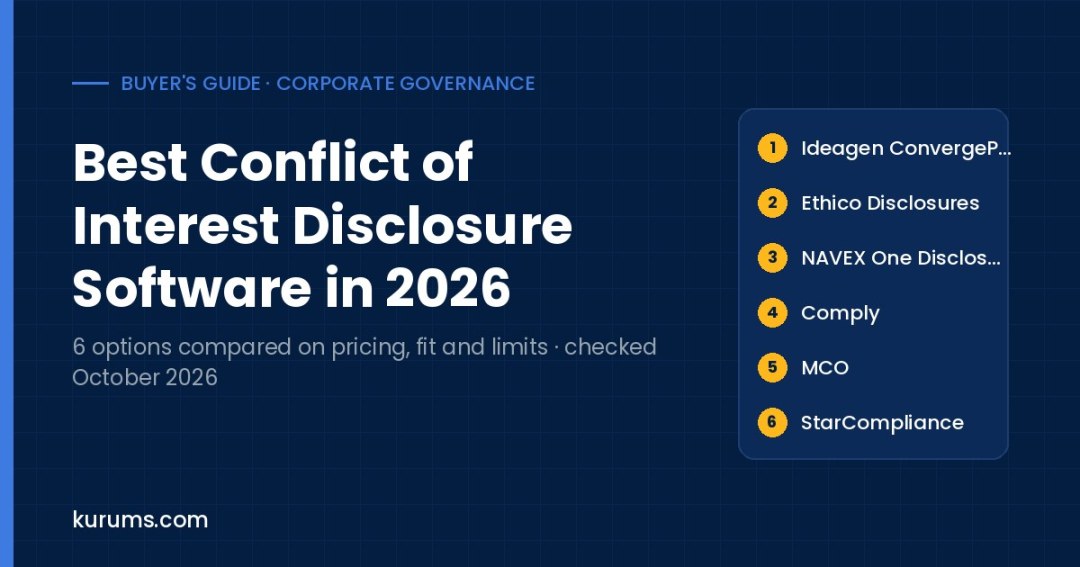
We compared six conflict of interest disclosure platforms on pricing model, trials, disclosure types, review workflow, sector fit and the main limitation buyers should test before rollout.
- Microsoft 365 organization: Ideagen ConvergePoint — Its COI disclosure module is built on Microsoft 365 SharePoint with Active Directory integration, so it runs inside your tenant.
- Healthcare or mid-size enterprise: Ethico Disclosures — HRIS-driven campaigns connect to Workday, ADP, UKG and SAP SuccessFactors, and concerns escalate into Ethico's MyCM case management.
- Large enterprise across industries: NAVEX One Disclosure Management — Disclosures connect to NAVEX One training, onboarding and GRC workflows, with proxy submissions and AI-assisted summaries.
- RIA, private fund or broker-dealer: Comply — The Comply Platform (formerly ComplySci) covers conflicts, outside business activities, gifts, trade monitoring and political contributions.
- Global bank or asset manager: StarCompliance — StarCompliance cites more than one million users in 114 countries and offers a mobile app for trade pre-clearance and disclosures.
Conflict of interest (COI) disclosure software collects, reviews and records the outside interests, relationships, gifts and activities that could influence how employees, executives or directors make decisions. It replaces spreadsheets and email attestations with scheduled disclosure campaigns, role-based questionnaires, review workflows and an audit trail you can show to auditors, regulators or a board audit committee. General corporate buyers use it for annual COI certifications and gift, travel and entertainment approvals. Financial services firms need more: personal trading pre-clearance, outside business activities, political contributions and accountability regimes. Buyers are usually chief compliance officers, ethics and compliance teams, general counsel and, in regulated firms, compliance operations. The right tool depends heavily on whether you are a general employer or a regulated investment firm.
We compared each platform on six fields: published pricing, free plan or trial, disclosure types covered, review workflow and integrations, sector fit, and the main limitation. Products appear in buyer order, starting with general-purpose tools for mid-size organizations, then enterprise ethics platforms, then financial services employee compliance suites. The order is not a quality ranking. None of the six vendors publishes prices, so we describe each pricing model as stated on official pages, checked on 12 October 2026. Third-party price estimates were not used.
Conflict compared at a glance
| Platform | Pricing | Best for | Link |
|---|---|---|---|
| 1. Ideagen ConvergePoint | Quote-based; demo request | Microsoft 365 organizations | Site → |
| 2. Ethico Disclosures | Quote-based; priced on employee count and campaign frequency | HRIS-driven annual COI campaigns | Site → |
| 3. NAVEX One Disclosure Management | Quote-based; Get Pricing form | Enterprises on the NAVEX One platform | Site → |
| 4. Comply (formerly ComplySci) | Quote-based; schedule a demo | RIAs, private funds and broker-dealers | Site → |
| 5. MCO (MyComplianceOffice) | Quote-based; modular, request a demo | Modular financial services compliance | Site → |
| 6. StarCompliance | Quote-based; priced by users and products, no free trial | Global banks and asset managers | Site → |
Pricing checked 12 October 2026 on each vendor's official pricing or product pages. Prices are list prices in USD unless stated; "Quote-based" means the vendor does not publish a price. Order follows buyer fit and pricing transparency, not a quality score. Confirm billing basis, minimums and taxes with the vendor before you buy. Methodology is described below.
The 6 options in detail
Ideagen ConvergePoint
Best for Microsoft 365 organizationsBest for: Mid-size organizations standardized on Microsoft 365 that want COI disclosures, approvals and records inside SharePoint rather than another external system.
| Attribute | Ideagen ConvergePoint |
|---|---|
| Published pricing | Quote-based; no prices on the product page |
| Free plan or trial | No free trial mentioned; demo request |
| Disclosure types covered | Gifts, entertainment, financial interests and outside engagements via nested questionnaires |
| Review workflow and integrations | Role-based routing, recurring reminders, escalations, dashboards; Active Directory integration |
| Sector fit | Cross-industry; ConvergePoint names Samsung, Paysafe, KeyBank and Ameren as customers |
| Main limitation | Requires Microsoft 365 and SharePoint Online; no trading pre-clearance for investment firms |
- Running inside SharePoint Online keeps disclosure records in your own Microsoft 365 environment and permissions model.
- Forms carry prior responses forward, so annual recertification is faster for employees with stable interests.
- It depends on SharePoint; organizations not on Microsoft 365 gain little from its main design choice.
Our take: ConvergePoint, acquired by Ideagen in June 2025, builds compliance applications inside SharePoint Online in Microsoft 365. Its COI disclosure module lets employees submit gift, entertainment, financial interest and outside engagement disclosures through nested questionnaires, while compliance teams schedule campaigns and managers review and escalate potential conflicts. Approvals route by employee role and responses, and dashboards support audits and risk assessments. Because it uses Active Directory, user lists and roles come from systems you already manage. Pricing is quote-based. It suits mid-size organizations, often in utilities, financial services or manufacturing, whose IT teams prefer tools that live in their Microsoft tenant. In a demo, check how the questionnaire logic handles family relationships and vendor ties, what reporting looks like for the audit committee, and how Ideagen's ownership affects support and roadmap. Compared with Ethico and NAVEX, it is more contained; compared with the financial services suites, it does not handle trading.
Ethico Disclosures
Best for HRIS-driven annual COI campaignsBest for: Healthcare systems and mid-size to large employers that want COI and gifts disclosures driven by HR data and linked to hotline and case management.
| Attribute | Ethico Disclosures |
|---|---|
| Published pricing | Quote-based; Ethico says pricing depends on employee count and campaign frequency, with a proposal after demo |
| Free plan or trial | No free trial; demo first |
| Disclosure types covered | Financial interests, family relationships, outside employment, business ties, gifts, travel, entertainment, political activity |
| Review workflow and integrations | Branching logic and risk routing; HRIS links to Workday, ADP, UKG, SAP SuccessFactors; escalation to MyCM |
| Sector fit | Healthcare, higher education, financial services, manufacturing, government contractors and more |
| Main limitation | No personal trading pre-clearance; less suited to investment firms with trading rules |
- HRIS integration enrolls new hires, changes forms when roles change and removes leavers automatically.
- Prior-year disclosures pre-populate, so reviewers see what is new, changed or resolved year over year.
- Campaign frequency affects price, so frequent pre-clearance programs may cost more than a once-a-year certification.
Our take: Ethico Disclosures is designed around the annual COI campaign and the gifts, travel and entertainment workflow. HRIS integrations with Workday, ADP, UKG, SAP SuccessFactors and more keep distribution lists current, role-based forms ask executives and procurement staff different questions from other employees, and branching logic routes high-risk answers, such as a family member at a vendor, to enhanced or committee review. Pre-clearance requests handle outside board seats and gifts before they happen. When a disclosure raises a concern, it can be escalated into Ethico's MyCM case management with the original context. Ethico says pricing is based on employee count and campaign frequency. It fits healthcare systems, universities and mid-size enterprises that already run an ethics hotline. In a demo, test the HRIS sync with a sample of role changes and review the committee workflow. Compared with NAVEX, Ethico is a narrower but focused choice; compared with ConvergePoint, it does not require Microsoft 365.
NAVEX One Disclosure Management
Best for enterprises on the NAVEX One platformBest for: Large enterprises that already use NAVEX for hotline, policy or training and want COI disclosures in the same GRC platform with configurable review paths.
| Attribute | NAVEX One Disclosure Management |
|---|---|
| Published pricing | Quote-based; product page links to a Get Pricing request form |
| Free plan or trial | No free trial; demo request |
| Disclosure types covered | Annual and in-year COI disclosures, gifts, travel and entertainment, onboarding reaffirmation |
| Review workflow and integrations | Review paths by disclosure and employee attributes, escalation alerts, proxy submissions, AI-assisted summaries |
| Sector fit | Enterprises across industries; connects to NAVEX One training and GRC |
| Main limitation | Best value when other NAVEX One modules are in use; no trading pre-clearance |
- Authorized admins can submit disclosures on an employee's behalf with an audit trail, which helps executives and field staff.
- Reports break down trends by employee group, role, location or category for audit and leadership reporting.
- As a standalone purchase it competes with simpler tools; the platform benefit depends on other NAVEX modules.
Our take: NAVEX One Disclosure Management is the COI module of the NAVEX One GRC platform, which also includes the EthicsPoint hotline, policy management and training. It supports annual campaigns, in-year updates and reaffirmation during onboarding, with targeted follow-up questions by disclosure type for gifts, travel and entertainment. Review paths can be set by combinations of disclosure and employee attributes, delayed reviews trigger escalation notices, and reviewers can request missing details through direct messaging. Supporting documents, amendments and notes stay linked to the original disclosure, and AI-assisted summaries help reviewers handle volume. Pricing is quote-based. It fits large enterprises that want disclosures linked to training completion and other compliance records. In a demo, ask which modules are needed for the integrations you want and how proxy submissions are logged. Compared with Ethico it offers broader platform reach; compared with StarCompliance and MCO, it does not cover personal trading or regulatory registrations.
Comply (formerly ComplySci)
Best for RIAs, private funds and broker-dealersBest for: SEC-registered advisers, private fund managers and broker-dealers that want employee conflicts, trading and political contribution monitoring alongside compliance consulting.
| Attribute | Comply (formerly ComplySci) |
|---|---|
| Published pricing | Quote-based; no prices published |
| Free plan or trial | No free trial; demo scheduling |
| Disclosure types covered | Code of ethics attestations, conflicts, outside business activities, gifts and entertainment, personal and digital asset trading |
| Review workflow and integrations | Case management and reporting; political contribution monitoring via illumis; consulting and managed services available |
| Sector fit | Private funds, wealth managers, RIAs, broker-dealers, investment banks, endowments |
| Main limitation | Built for SEC-regulated finance; overkill for a general employer's annual COI survey |
- Software and consulting come from one firm, which helps small compliance teams that need policies and testing as well as tools.
- Political contribution monitoring supports pay-to-play compliance for advisers serving public pension clients.
- Recent rebranding from ComplySci and other acquired products means you should confirm which platform and login your modules use.
Our take: Comply brings together several financial services compliance products under one brand: the Comply Platform (formerly ComplySci) for employee compliance, Comply for RIA (formerly RIA in a Box), illumis for political contribution monitoring and ComplianceGuardian. For conflicts, the platform covers code of ethics attestations, outside business activity disclosures, gifts and entertainment, and personal and digital asset trade monitoring, with case management and reporting. Comply also sells regulatory consulting, filings and managed services, which matters for smaller advisers without a large in-house team. Pricing is quote-based. It fits RIAs, private fund managers and broker-dealers subject to SEC and FINRA rules. In a demo, test broker feed coverage for your employees' accounts, how OBA approvals are documented and how political contributions are screened. Compared with MCO and StarCompliance, Comply is more focused on US advisers and funds and pairs software with consulting; it is not designed for a general corporate COI survey.
MCO (MyComplianceOffice)
Best for modular financial services complianceBest for: Asset managers, banks and pension funds that want to buy only the employee compliance modules they need now and add more on one platform later.
| Attribute | MCO (MyComplianceOffice) |
|---|---|
| Published pricing | Quote-based; MCO describes modular pricing but publishes no figures |
| Free plan or trial | No free trial; demo or contact |
| Disclosure types covered | Conflicts, connected persons, gifts and entertainment, outside activities, personal and crypto trading, attestations |
| Review workflow and integrations | Structured disclosure workflows with audit trail; political contributions, registrations, eComms archiving modules |
| Sector fit | Financial services firms of many sizes; MCO cites 1,500+ clients in 125+ countries |
| Main limitation | Breadth of modules means configuration effort; scope the first phase tightly |
- Connected persons and relationships are monitored, which helps find conflicts that a single annual survey would miss.
- Modules for registrations, roles and responsibilities and eComms sit on the same platform as disclosures.
- Pricing and implementation scope grow with each module, so phase planning is needed to control cost.
Our take: MCO positions its platform as a modular suite of roughly 30 compliance products, so firms can start with employee conflicts and add trading, registrations or communications surveillance later. For conflicts, employees submit disclosures through structured workflows, compliance teams assess risk and document decisions, and connected persons and relationships are monitored. Gifts and entertainment, outside business activities, attestations and personal trading with crypto capture sit in the same employee compliance area. MCO says it has more than 1,500 client companies in over 125 countries. Pricing is quote-based and depends on modules. It fits asset managers, banks, insurers and public pension funds that want one platform for conduct risk across regions. In a demo, ask which modules you need for your regulatory regime, how broker feeds are sourced in each country and how the audit trail exports for regulators. Compared with StarCompliance, MCO's modular approach may suit firms phasing in coverage; compared with Comply, it is less US-adviser specific.
StarCompliance
Best for global banks and asset managersBest for: Large financial institutions with employees in many countries that need trade pre-clearance, conflicts, gifts and accountability regimes on one enterprise platform.
| Attribute | StarCompliance |
|---|---|
| Published pricing | Quote-based; StarCompliance says price depends mainly on users and products selected, plus integrations |
| Free plan or trial | No free trial, per the vendor FAQ; demo required for a quote |
| Disclosure types covered | Personal and crypto dealing, outside interests, gifts and hospitality, political donations, private investments |
| Review workflow and integrations | Rules engine for automated approvals; broker feed, HR and case management integrations; Star Mobile app |
| Sector fit | Banks, asset managers, broker-dealers, private equity; vendor cites 1M+ users in 114 countries |
| Main limitation | Enterprise scope and pricing; small firms may not need the depth |
- The Star Mobile app lets employees pre-clear trades, submit disclosures and complete certifications from a phone.
- Data is hosted in Azure regions in the US, UK, EU, Canada and UAE, which helps with data residency requirements.
- There is no trial and pricing is quote-only, so evaluation requires a structured RFP and demo cycle.
Our take: StarCompliance, founded in 1999, focuses on employee conflict of interest management for regulated financial institutions. Its modules cover personal account dealing and crypto dealing, outside business interests, gifts and hospitality, political donations, private investments and firm trade surveillance, plus accountability regimes such as UK SMCR and Singapore IAC. A configurable rules engine automates approvals, denials and case creation, and integrations cover broker feeds, HR systems and case management tools. Employees use the Star Mobile app for pre-clearance and disclosures. The vendor FAQ says pricing depends mainly on user numbers and products, and there is no free trial. It fits global banks, asset managers and broker-dealers with many employees across jurisdictions. In a demo, test the pre-clearance flow against your restricted list, broker feed coverage in your countries and data residency options. Compared with MCO and Comply, StarCompliance is most clearly aimed at large, multi-country institutions.
How to choose conflict of interest disclosure software
Define who must disclose and what
List the populations in scope: all employees, executives, directors, procurement staff, researchers or investment personnel. Then list what each group must disclose: financial interests, family relationships, outside employment, board seats, gifts, travel and entertainment, political activity or personal trades. General employers can usually stop at annual COI and gifts. Regulated investment firms need trading pre-clearance and outside business activity approvals. This list decides whether you need a general tool like Ethico or ConvergePoint or a financial services suite like StarCompliance, MCO or Comply. Document the scope in your policy before configuring any tool.
Integrations with HR and identity systems
Disclosure programs fail when distribution lists are stale. Check how the tool learns about new hires, role changes and leavers. Ethico connects to Workday, ADP, UKG and SAP SuccessFactors, and ConvergePoint uses Active Directory. Financial services suites also need broker feeds for trade data. Ask which connectors are standard, which cost extra, and how often data syncs. Run a pilot with a sample of real role changes to see whether forms and reviewers update correctly without manual work. Include contractors and board members in the test if they disclose too.
Review workflow and escalation
Collecting disclosures is easy; reviewing them consistently is hard. Look for risk-based routing that sends high-risk answers to legal or a committee and lets routine ones be approved in batches. Check escalation alerts for overdue reviews, the ability to request more information, and how decisions and mitigation plans are recorded. If disclosures can turn into investigations, confirm how they move into case management, as with Ethico's link to MyCM or NAVEX One's GRC modules, without losing context. Ask to see how a reviewer's decision appears to the employee who disclosed.
Audit trail and reporting
Auditors, regulators and the board want evidence that the program ran and that conflicts were managed. Ask for sample reports showing completion rates, open conflicts, decisions and mitigation by department, role and location. Check that amendments and reviewer notes stay linked to the original disclosure, and that records export cleanly. For regulated firms, confirm record retention periods match your regulatory obligations. This article is informational and is not legal or regulatory advice. Test a sample export with your internal auditors.
Scope creep and pricing
All six vendors here quote prices, and most price by users, modules or campaign frequency. Decide what phase one covers and what can wait, then ask for pricing on that scope plus indicative pricing for later modules. Ask about implementation fees, configuration hours and charges for additional forms or languages. For multi-year deals, request caps on renewal increases. A focused phase one, such as annual COI plus gifts, usually reaches go-live faster and builds the data you need for later phases. Keep the first rollout simple and expand after one full cycle.
How conflict of interest disclosure software pricing works
None of the six vendors in this comparison publishes list prices, which is typical for compliance software sold to regulated or large organizations. Instead, vendors state the factors behind a quote. Ethico says its price depends on employee count and campaign frequency, with a proposal after a demo. StarCompliance says price depends mainly on the number of users and products selected, plus integration requirements such as data warehouse connections, and that it offers no free trial. MCO describes modular pricing so firms buy only the products they need. NAVEX routes buyers to a pricing request form.
In practice, quotes for general COI tools are driven by the number of employees in scope, the number of forms and campaigns, and integrations with HR systems. Financial services suites add costs for each module, such as personal trading, political contributions or registrations, and for broker feed connections, which can carry their own fees. Implementation and configuration are often priced separately from the annual subscription. Ask every vendor to separate subscription, implementation, integrations and premium support, and to state whether pricing is per employee, per active discloser or per module, so you can compare like for like.
Budget internal time as well: compliance staff to design questionnaires and review rules, HR or IT to set up data feeds, and legal to approve the policy language. Treat this article as informational only, not legal, regulatory or financial advice on how to structure a COI program. Plan for one full annual cycle before judging cost per disclosure, because first-year configuration effort is usually higher than steady state.
Kurums Match: which one fits you?
Pick the situation closest to yours. Each answer jumps to the matching card above.
I need annual COI certifications and we run on Microsoft 365SharePoint-based organization
Ideagen ConvergePoint → ConvergePoint runs inside SharePoint Online with Active Directory, keeping disclosures in your own tenant.
I run compliance at a hospital systemHotline already in place
Ethico Disclosures → Ethico drives campaigns from HRIS data and escalates concerning disclosures into its MyCM case management.
We already use NAVEX for hotline and trainingEnterprise, multi-industry
NAVEX One Disclosure Management → NAVEX One Disclosure Management links disclosures to training, onboarding and other NAVEX One GRC records.
I'm the CCO of an SEC-registered adviserSmall team, needs consulting too
Comply (formerly ComplySci) → Comply combines employee conflicts, trading and political contribution monitoring with compliance consulting services.
I oversee conduct risk at a global bankMany countries and employees
StarCompliance → StarCompliance handles trade pre-clearance, conflicts and accountability regimes, with Azure hosting in several regions.
Buying tip
Run your pilot on last year's real disclosures with names masked. Feeding known conflicts through each vendor's questionnaire and routing rules shows quickly whether high-risk cases reach the right reviewer and whether the final report would satisfy your audit committee.
Conflict: frequently asked questions
What is conflict of interest disclosure software?
It is software that collects, reviews and records employee, executive and director disclosures of outside interests, relationships, gifts and activities that could affect business decisions. It replaces email and spreadsheet attestations with scheduled campaigns, role-based questionnaires, review workflows and audit trails. Financial services versions also handle personal trading pre-clearance, outside business activities and political contributions.
How much does COI disclosure software cost?
None of the six vendors here publishes prices, as checked on 12 October 2026. Ethico prices by employee count and campaign frequency, StarCompliance by users and products, and MCO by modules. Expect separate implementation and integration fees. Ask for itemized quotes that show subscription, set-up, connectors and support so you can compare offers on the same basis.
Do small organizations need dedicated COI software?
Not always. A small nonprofit or private company with a few dozen disclosers can often manage annual COI forms with a well-designed form tool and a documented review process. Dedicated software becomes worthwhile when you have many disclosers, multiple review levels, gifts pre-clearance, regulatory obligations or audit committee reporting that needs reliable, consistent records.
What is the difference between COI software and employee trading compliance?
COI software for general employers focuses on disclosures such as financial interests, family relationships, outside jobs and gifts. Employee trading compliance, used by investment firms, adds personal account dealing pre-clearance, broker feed reconciliation, restricted lists and holdings reports. StarCompliance, MCO and Comply cover both, while ConvergePoint, Ethico and NAVEX focus on general disclosures.
How often should employees disclose conflicts of interest?
Most organizations run an annual certification and require in-year updates when circumstances change, such as a new outside role or a family member joining a vendor. Regulated firms add event-driven pre-clearance for trades, gifts or outside activities. Your policy, sector rules and regulators set the frequency; this article is informational and is not legal advice, so confirm requirements with counsel.
Can COI software integrate with our HR system?
Most enterprise tools can. Ethico lists connectors for Workday, ADP, UKG and SAP SuccessFactors, ConvergePoint uses Active Directory, and StarCompliance and MCO integrate with HR systems and broker feeds. Ask whether connectors are standard or extra cost, how often data syncs, and how the system handles role changes, leavers and contractors.
Related comparisons
Last updated 13 October 2026 · Pricing checked 12 October 2026.
Disclosure: Kurums is reader-supported through advertising. We currently have no affiliate, sponsorship or partnership relationship with any product compared on this page; if that changes, this page will say so and affected links will carry sponsored attributes.
Discover more from Kurums | Business Intelligence
Subscribe to get the latest posts sent to your email.