
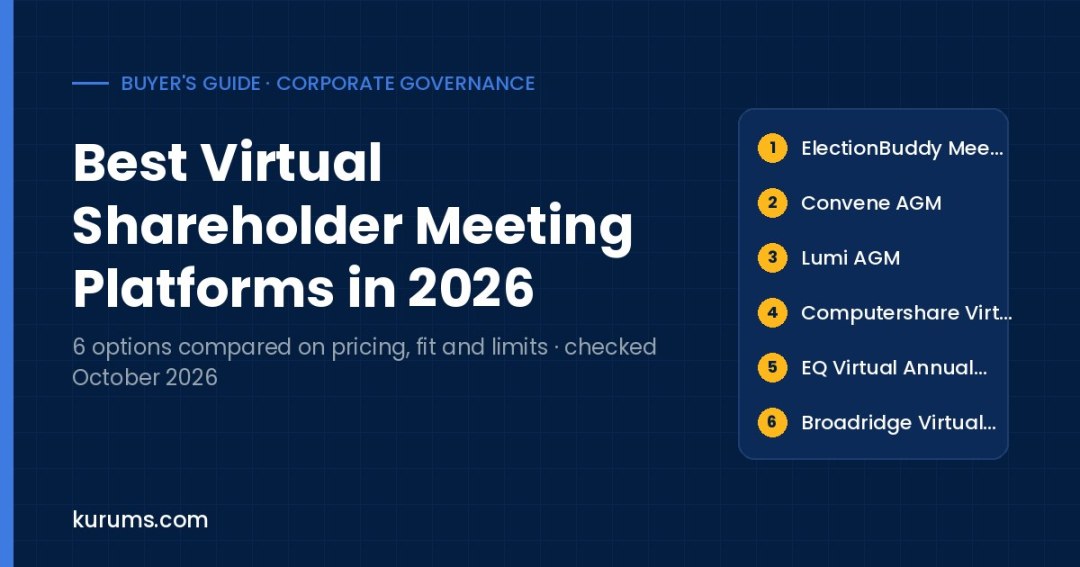
Buyer's guide · Corporate Governance
We compared six virtual and hybrid shareholder meeting platforms on published pricing, meeting formats, voting and Q&A tools, shareholder authentication, typical buyer and the main limitation you should test before you sign.
- Small private company or association: ElectionBuddy MeetingVote — Per-meeting pricing is published, from a free tier for up to 20 voters to Professional from $797 for up to 20,000 voters.
- Listed company running in-room plus online: Lumi AGM — One platform covers in-room, hybrid and fully virtual AGMs, with keypads for the room and text, video or voice questions online.
- Issuer already on a Computershare register: Computershare Virtual Meeting Solution — It can integrate with your share register so validated shareholders are admitted, and offers a moderated speaker lobby.
- US issuer with registered and street-name holders: EQ Virtual Annual Meeting Services — The service sheet lists access for registered and street-name holders and in-meeting voting with unique identifiers.
- Large US public company: Broadridge Virtual Shareholder Meeting — Broadridge cites 12,000+ virtual shareholder meetings since inception and real-time vote and quorum monitoring.
A virtual shareholder meeting platform lets a company hold its annual general meeting (AGM), an extraordinary meeting or a members' vote online, either fully virtual or hybrid with an in-room audience. The software has to do more than stream video. It must confirm that each attendee is a shareholder or valid proxy, let them ask questions and vote on resolutions in real time, count votes against the register, and produce an audit trail that the chair, the scrutineer and auditors can rely on. Buyers range from small private companies, cooperatives and associations that need a defensible vote for a few dozen members, to listed issuers with thousands of registered and beneficial holders. In listed companies the buyer is usually the company secretary or general counsel, often alongside the registrar.
We compared each platform on six fields: published pricing, free plan or trial, meeting formats, voting and Q&A tools, typical buyer and coverage, and the main limitation. Products are listed in buyer order, from a self-serve tool with published prices for small organizations to quote-based services built for large listed issuers. The order is not a quality ranking. Prices and capabilities were checked on official vendor pages and vendor documents on 12 October 2026. Where a vendor does not publish prices, we say quote-based rather than repeating third-party estimates.
Virtual Shareholder Meeting Platforms compared at a glance
| Platform | Pricing | Best for | Link |
|---|---|---|---|
| 1. ElectionBuddy MeetingVote | Free up to 20 voters; Plus $197, Premium $397, Professional from $797 per meeting | Small private companies and associations | Site → |
| 2. Convene AGM (Azeus) | Quote-based; contact Azeus for pricing | Mid-size issuers needing weighted voting | Site → |
| 3. Lumi AGM | Quote-based; Lumi lists cost drivers but no prices | Hybrid AGMs with in-room voting | Site → |
| 4. Computershare Virtual Meeting Solution | Quote-based; delivered at competitive market prices per Computershare | Issuers on a Computershare register | Site → |
| 5. EQ Virtual Annual Meeting Services | Quote-based; contact EQ new business | US issuers on EQ registers | Site → |
| 6. Broadridge Virtual Shareholder Meeting | Quote-based; contact a Broadridge specialist | Large US public companies | Site → |
Pricing checked 12 October 2026 on each vendor's official pricing or product pages. Prices are list prices in USD unless stated; "Quote-based" means the vendor does not publish a price. Order follows buyer fit and pricing transparency, not a quality score. Confirm billing basis, minimums and taxes with the vendor before you buy. Methodology is described below.
The 6 options in detail
ElectionBuddy MeetingVote
Best for small private companies and associationsBest for: Small private companies, cooperatives and member organizations that need verified motion voting alongside a Zoom, Teams or Google Meet call at a published per-meeting price.
| Attribute | ElectionBuddy MeetingVote |
|---|---|
| Published pricing | Yes. MeetingVote per meeting: Free (20 voters), Plus $197 (75), Premium $397 (350), Professional from $797 (up to 20,000 voters) |
| Free plan or trial | Free plan for up to 20 voters and 5 motions; you can build and test a meeting before paying |
| Meeting formats | Voting layer for in-person, video and hybrid meetings; runs alongside Zoom, Google Meet or Microsoft Teams |
| Voting and Q&A | Motion voting with credentials and registration that establishes quorum; weighted voting from Plus; no built-in webcast |
| Typical buyer and coverage | Associations, unions, clubs, credit unions and for-profit companies; vendor cites use in 184 countries |
| Main limitation | Not a registrar-integrated AGM service; proxy transfers are listed only for ElectionVote Premium, not MeetingVote |
- Published per-meeting tiers let you budget before talking to sales, and you only pay when the meeting starts.
- Voters register in advance, which records quorum, then vote motion by motion from a phone or laptop while the video call runs.
- It does not provide the video stream, shareholder register integration or moderated Q&A that a listed-company AGM usually needs.
Our take: ElectionBuddy is a voting tool, not a full AGM service, and that is the point for a small company or member organization. You keep your existing Zoom, Teams or Google Meet call for discussion, and MeetingVote handles the parts that create legal risk: issuing credentials, recording registration for quorum and running each motion with an auditable, anonymous ballot. The MeetingVote Plus tier at $197 per meeting covers up to 75 voters and adds weighted voting, which matters when votes follow shareholdings rather than one person, one vote. In a trial, upload your member or shareholder list with share weights, run a mock resolution and check the results report your board or auditor will receive. Compared with Lumi, Computershare, EQ or Broadridge on this page, you give up webcast production, registry links and a moderated question queue, so it fits private companies and associations far better than any listed issuer. Confirm with counsel that your articles allow electronic voting before you rely on it.
Convene AGM (Azeus)
Best for mid-size issuers needing weighted votingBest for: Mid-size listed and unlisted companies in Asia-Pacific and other regions that want registration, a two-way webcast and weighted voting in one quote-based platform.
| Attribute | Convene AGM (Azeus) |
|---|---|
| Published pricing | Quote-based; no prices published on the Convene AGM page |
| Free plan or trial | No free trial mentioned; demo and enquiry form |
| Meeting formats | Physical, virtual and hybrid AGMs, EGMs, creditors' meetings and elections |
| Voting and Q&A | Real-time weighted voting, live two-way webcast and live Q&A, with audit trail and reporting |
| Typical buyer and coverage | Companies and organizations holding general meetings; 24/7 global support is stated |
| Main limitation | Registry integration depends on your registrar; proxy handling is not described on the product page |
- Shareholder registration, information collection, webcast and voting sit in one workspace rather than separate tools.
- The vendor states AWS partnership, CMMI Level 5 certification and 24/7 global customer support.
- The product page does not describe proxy voting, so you need to confirm how appointed proxies and corporate representatives vote.
Our take: Convene AGM comes from Azeus, which also sells the Convene board portal, and it is aimed at companies that want a single vendor for registration, a two-way webcast and weighted resolution voting. That combination sits between ElectionBuddy's voting-only model and the registrar-led services from Computershare, EQ and Broadridge. It covers annual and extraordinary general meetings, creditors' meetings and elections, in physical, virtual or hybrid form. Because pricing is quote-based, ask for a written quote that separates platform licence, webcast production and on-day support. In the demo, test how shareholders are pre-registered from your register file, how proxies and corporate representatives are handled, and how quickly weighted results appear after a poll closes. It fits mid-size issuers, especially in markets where the registrar does not bundle a meeting platform, and organizations that already use Convene for board meetings and want one supplier relationship.
Lumi AGM
Best for hybrid AGMs with in-room votingBest for: Listed companies and large membership bodies that run an in-room meeting plus online attendance and want one platform for keypads, online voting and moderated Q&A.
| Attribute | Lumi AGM |
|---|---|
| Published pricing | Quote-based; Lumi's cost guide names drivers (shareholder base, in-room element, webcast, voting) but no figures |
| Free plan or trial | No free trial; book a demo or talk to an expert |
| Meeting formats | In-room, hybrid and fully virtual AGMs on one platform, with Lumi keypads and devices for the room |
| Voting and Q&A | Pre-meeting and live voting with instant tallying; moderated questions by text, video or voice |
| Typical buyer and coverage | Listed companies and membership bodies; headquartered in Hampshire, UK, with offices in 11 countries |
| Main limitation | Webcast production and in-room hardware add cost; confirm registry data feeds for your market |
- Remote attendees get the same voting and question rights as in-room attendees, which supports a genuine hybrid format.
- Exportable reports and full audit trails are included, and voting can stay open after the meeting ends where rules allow.
- Pricing depends heavily on production level and in-room hardware, so early quotes can move once the run sheet is fixed.
Our take: Lumi is the option on this page most focused on the meeting itself rather than the share register. It supports in-room, hybrid and fully virtual AGMs on one platform, and it can supply keypads for the room so that in-person and online votes land in the same tally. Shareholders can submit questions by text, video or voice, and the chair sees a live, labelled question dashboard. That makes Lumi a fit for listed companies and large membership bodies that still hold a physical meeting but want online attendees to have equal rights. Lumi does not publish prices; its own cost guide says price depends on the size of the shareholder base, the in-room component, webcast versus audio-only and voting complexity. In a demo, ask how authentication links to your registrar, how video questions are moderated before they go live, and what production crew is included. Compared with Computershare and EQ, you may need to coordinate Lumi with a separate registrar.
Computershare Virtual Meeting Solution
Best for issuers on a Computershare registerBest for: Listed companies whose share register is already with Computershare and who want shareholder validation and a moderated Q&A and speaker queue from the same provider.
| Attribute | Computershare Virtual Meeting Solution |
|---|---|
| Published pricing | Quote-based; Computershare says services are delivered at competitive market prices via enquiry |
| Free plan or trial | No free trial; technical support provided before the event |
| Meeting formats | Virtual and hybrid meetings, with remote webcam video or on-location video from a venue |
| Voting and Q&A | Organizer dashboard for live and typed questions, one-to-one messaging and a moderated speaker lobby |
| Typical buyer and coverage | Listed issuers; Computershare cites 75 million+ shareholder accounts for 25,000+ clients worldwide |
| Main limitation | Its product pages describe Q&A and video in detail but not the voting flow; confirm voting for your market |
- Integration with the issuer's share register lets validated shareholders be admitted without a separate data transfer.
- Shareholders who ask to speak wait in a lobby queue where organizers can run an audio and video check first.
- It is most efficient when Computershare already runs your register; as a standalone platform the value is less clear.
Our take: Computershare's main advantage is that it often already holds your shareholder register. Its Virtual Meeting Solution can integrate with that register so validated shareholders are admitted directly, which removes a fragile file transfer on meeting day. The Q&A tools are detailed: questions can be submitted live or typed before and during the meeting, organizers can sort, group and revise questions, and a separate chairperson's view lets the chair and board prepare answers privately. Shareholders who want to speak join a lobby queue for an audio and video check. Video can come from remote webcams or HD streaming from one location. The product pages we checked do not walk through the voting screen, so ask for a recorded demo of a poll and the scrutineer report. It fits issuers in the UK, Australia, Europe and North America that already use Computershare, and compares with EQ and Broadridge as a registrar-led option rather than Lumi's meeting-first model.
EQ Virtual Annual Meeting Services
Best for US issuers on EQ registersBest for: US public companies that use Equiniti Trust Company as transfer agent and want registered and street-name holders to attend, ask questions and vote online.
| Attribute | EQ Virtual Annual Meeting Services |
|---|---|
| Published pricing | Quote-based; the service sheet lists no prices and directs you to EQ new business |
| Free plan or trial | No free trial; technical support before and during the meeting |
| Meeting formats | Virtual and hybrid annual meetings on desktop, tablet or mobile, with branded meeting pages |
| Voting and Q&A | In-meeting voting with unique identifiers per shareholder or proxy; private or posted Q&A responses |
| Typical buyer and coverage | US issuers via Equiniti Trust Company, LLC; EQ reports clients across five markets |
| Main limitation | Information is US-focused; issuers in other markets should confirm local service scope |
- Registered and street-name shareholders can attend, which matters for US companies with mostly beneficial holders.
- Security uses one-time logins and encrypted transmissions, with detailed reporting for auditability.
- The published material is a short information sheet, so many details only surface in a demo or proposal.
Our take: EQ, through Equiniti Trust Company in the US, offers virtual annual meeting services as an extension of its transfer agent business. The information sheet lists access for both registered and street-name shareholders, unique identifiers for each shareholder or proxy, in-meeting voting, document hosting and Q&A where answers can be private or posted to all attendees. Issuers control guest access, messaging and attendee permissions, and the meeting can be branded. EQ also notes that virtual and hybrid meetings are permitted under US state law but rules vary by state, so the sheet itself recommends legal advice. In a demo, ask how beneficial holders obtain credentials, how late-arriving proxies are handled, and what the final vote report looks like for your inspector of elections. Compared with Broadridge, which also serves beneficial holders at large scale, EQ is a natural fit when it already runs your register, and it gives a single relationship for registry and meeting day.
Broadridge Virtual Shareholder Meeting
Best for large US public companiesBest for: Large and mid-cap US public companies with many beneficial holders that want the meeting tied to Broadridge proxy distribution, vote tabulation and quorum tracking.
| Attribute | Broadridge Virtual Shareholder Meeting |
|---|---|
| Published pricing | Quote-based; no prices published, contact a Broadridge specialist |
| Free plan or trial | No free trial; delivered as a managed service |
| Meeting formats | Virtual, in-person or hybrid channel options for the annual meeting |
| Voting and Q&A | Real-time vote monitoring and quorum progress; online questions before and during the meeting, with phone lines as an option |
| Typical buyer and coverage | US public companies; Broadridge cites 12,000+ virtual shareholder meetings since inception and 5,500+ public US companies served |
| Main limitation | Built around the US proxy system; less relevant for private companies or non-US-only registers |
- Beneficial shareholders can attend using their proxy credentials without obtaining a separate legal proxy, per Broadridge's platform brochure.
- Issuers see progress toward quorum and vote goals in real time, connected to the same proxy process that distributes materials.
- Pricing and scope are bundled with wider proxy services, so a like-for-like comparison with meeting-only vendors is hard.
Our take: Broadridge sits at the center of the US proxy system for beneficial holders, and its Virtual Shareholder Meeting service extends that role into the meeting itself. The company launched the platform in 2009 and now cites more than 12,000 virtual shareholder meetings since inception. Because Broadridge already distributes proxy materials and tabulates votes for street-name holders, beneficial shareholders can join and vote with their existing proxy credentials, and issuers can watch quorum and vote progress in real time. Q&A can run through an online text box before or during the meeting, and some issuers add a live phone line. Pricing is quote-based and usually discussed alongside wider proxy services. In a demo, ask how questions are screened, how the replay is archived, and what hybrid support costs. Compared with EQ and Computershare, Broadridge is less about the register and more about the beneficial-holder voting chain, which is why it suits large US public companies.
How to choose a virtual shareholder meeting platform
Start with your legal basis
Before comparing software, confirm what your jurisdiction, articles of association or bylaws allow. Some companies may hold virtual-only meetings, others must offer a physical location, and some require specific identification or voting rules. The platform must support the format you are allowed to run, not the one that looks easiest. Ask counsel which records the chair and scrutineer need after the meeting, then check that the vendor's audit trail produces them. This article is informational and is not legal advice; local company law and listing rules vary widely and change over time.
Shareholder authentication and register data
The hardest technical step is proving that each attendee is a shareholder or valid proxy. Registrar-led services such as Computershare, EQ and Broadridge can draw on register or proxy data they already hold. Meeting-first platforms such as Lumi or Convene need a clean file or data feed from your registrar, with share weights and proxy appointments. Ask how late transfers, joint holders, corporate representatives and lost credentials are handled, and who on the vendor side resolves access problems in the first ten minutes of the meeting.
Voting mechanics and weighting
Check whether votes are weighted by shareholding, whether pre-meeting proxy votes are merged with live votes, and how quickly results can be shown after a poll closes. Small organizations should confirm that weighted voting is included in the tier they buy; ElectionBuddy, for example, lists it from the Plus tier. Ask for a sample results report and a sample audit log, and run a mock resolution with test shareholders to see how abstentions, withheld votes and changed votes appear in the final count.
Q&A moderation and speaker access
Shareholder questions are where meetings go wrong in public. Look for a moderator view that lets you group, edit for clarity and queue questions, and a separate view for the chair. If you allow live audio or video questions, check whether there is a waiting room or lobby with a technical check, as Computershare describes. Decide your policy on unanswered questions in advance, and confirm the platform can export all submitted questions so you can publish answers after the meeting if your governance policy requires it.
Production, support and rehearsal
Ask exactly what the vendor provides on the day: a producer, a technical director, help-desk staff for shareholders, and backup streaming. Hybrid meetings add in-room cameras, audio and possibly voting keypads, which change both cost and risk. Insist on at least one full rehearsal with the chair, company secretary and scrutineer using real devices and real network conditions. Confirm the vendor's support hours cover your time zone and that you have a named contact who can make decisions during the live meeting.
How virtual shareholder meeting pricing works
Pricing splits into two models. Self-serve voting tools publish per-meeting prices tied to voter counts and features. ElectionBuddy's MeetingVote runs from a free tier for up to 20 voters and 5 motions, to Plus at $197 for 75 voters, Premium at $397 for 350 voters and Professional from $797 for up to 20,000 voters. These prices cover the voting layer only; you supply the video call. That model suits private companies, associations and cooperatives that need a defensible vote but not a broadcast production, a registrar data feed or a moderated question queue run by a vendor team.
Full AGM services for listed companies are quote-based. Lumi, Computershare, EQ, Broadridge and Azeus do not publish prices, and Lumi's own cost guide explains why: price depends on the size of the shareholder base, whether there is an in-room element, webcast versus audio-only production, and voting complexity. Registrar-led providers may also bundle the meeting with proxy distribution, tabulation or transfer agent fees, which makes the meeting line item harder to isolate. Ask every vendor to split licence, production crew, help desk, hardware and any per-shareholder or per-proxy charges, and to state what happens to price if you add a hybrid venue late.
Hidden costs usually come from rehearsals, extra production days, interpreters, captioning, venue audio and video, and post-meeting replay hosting. Budget time for your registrar and legal team too. Get the quote in writing at least three months before the notice of meeting goes out, because the notice must describe how shareholders join and vote. Finally, ask whether the replay, question log and results report are retained for a set period at no extra charge, since you may need them for minutes or disputes.
Kurums Match: which one fits you?
Pick the situation closest to yours. Each answer jumps to the matching card above.
I run a small private company and need a vote on a few resolutionsUnder 75 voting shareholders
ElectionBuddy MeetingVote → MeetingVote Plus at $197 per meeting covers up to 75 voters with weighted voting, and you keep your existing video call.
I need a hybrid AGM with a physical room and online attendeesEqual rights in room and online
Lumi AGM → Lumi combines in-room keypads with online voting and text, video or voice questions on one platform and one tally.
My register is already with ComputershareRegistrar continuity matters
Computershare Virtual Meeting Solution → Computershare can integrate the meeting with your share register so validated shareholders are admitted directly.
I am a US issuer with mostly street-name holdersLarge beneficial-holder base
Broadridge Virtual Shareholder Meeting → Broadridge links the meeting to its proxy distribution and tabulation, so beneficial holders join with their existing credentials.
I need registration, webcast and weighted voting from one vendorOutside the big registrar bundles
Convene AGM (Azeus) → Convene AGM combines shareholder registration, a two-way webcast and real-time weighted voting in one quote-based platform.
Buying tip
Ask each vendor for the audit log and results report from a recent anonymized meeting before you sign. Those two documents show more about authentication, proxy handling and vote counting than any demo, and they are what your scrutineer will rely on.
Virtual Shareholder Meeting Platforms: frequently asked questions
Are virtual-only shareholder meetings legal?
It depends on your jurisdiction and your company's constitution. Many US states permit virtual or hybrid meetings, and EQ's own information sheet notes that rules vary by state. Other countries may require a physical venue or specific shareholder rights online. Check your articles or bylaws, company law and any listing rules before choosing a format. This article is informational only and is not legal advice; ask your corporate counsel to confirm what is permitted for your next meeting.
How much does a virtual AGM platform cost?
Small-organization voting tools publish prices: ElectionBuddy MeetingVote ranges from free for up to 20 voters to Professional from $797 per meeting for up to 20,000 voters, as checked on 12 October 2026. Listed-company services from Lumi, Computershare, EQ, Broadridge and Azeus are quote-based. Their prices depend on shareholder numbers, production, hybrid hardware and voting complexity, so request itemized quotes.
What is the difference between virtual and hybrid shareholder meetings?
A virtual meeting happens entirely online, with no physical venue. A hybrid meeting has an in-room audience plus online attendees who can follow, ask questions and vote. Hybrid meetings are more complex because in-room and online votes must be combined in one tally and both groups need fair access to questions. Lumi, Convene AGM, Computershare and Broadridge all describe hybrid support.
How do beneficial or street-name shareholders join a virtual meeting?
In the US, beneficial holders usually join using the control number from their proxy materials. Broadridge's platform brochure says beneficial shareholders can attend without obtaining a separate legal proxy, and EQ lists access for registered and street-name holders. Outside the US, the process depends on your registrar and custody chain, so confirm it with your provider well before the notice of meeting.
Can I use Zoom or Teams for a shareholder meeting?
You can use a general video tool for discussion, but it does not verify shareholders or count weighted votes on its own. Small organizations often pair a video call with a voting tool such as ElectionBuddy MeetingVote, which handles credentials, quorum registration and motion votes. Listed companies normally need a dedicated platform with registry links, moderated Q&A and a formal audit trail.
How far ahead should I book a virtual AGM provider?
Allow at least three months before the notice of meeting is sent, because the notice must explain how shareholders join, ask questions and vote. That leaves time to agree the register data feed, test authentication, script Q&A moderation and run a full rehearsal with the chair and scrutineer. Registrar-led providers can be booked heavily during peak proxy season, so earlier is safer.
Related comparisons
Last updated 13 October 2026 · Pricing checked 12 October 2026.
Disclosure: Kurums is reader-supported through advertising. We currently have no affiliate, sponsorship or partnership relationship with any product compared on this page; if that changes, this page will say so and affected links will carry sponsored attributes.
Discover more from Kurums | Business Intelligence
Subscribe to get the latest posts sent to your email.