
Buyer's guide · Corporate Governance
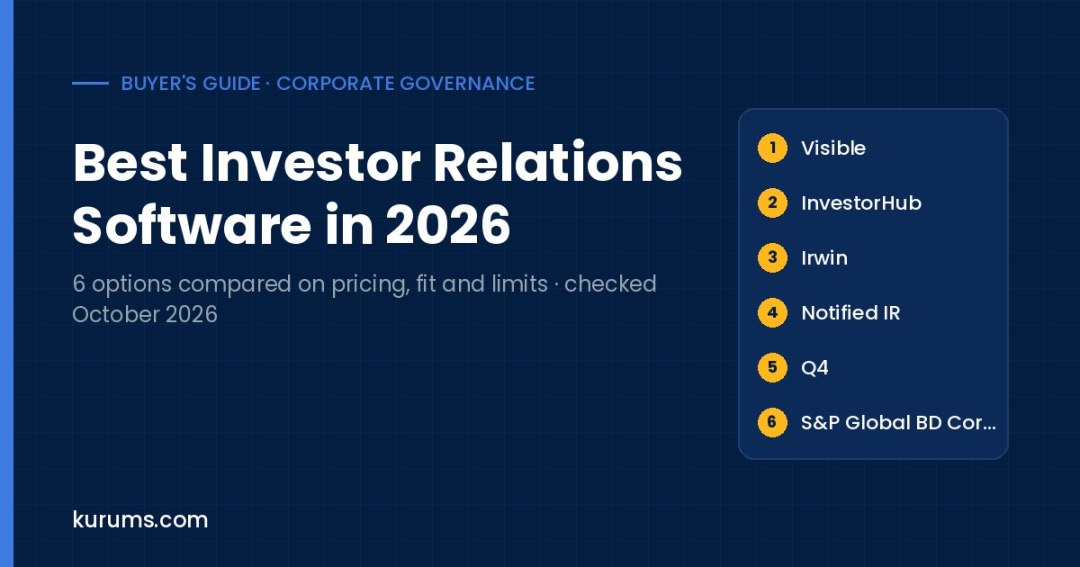
We compared six investor relations platforms on published pricing, free plans, core IR modules, investor and ownership data, company size fit and the main limitation to test in a demo.
- Private startup reporting to investors: Visible — A free-forever Starter plan covers updates to 100 recipients, and paid plans start at $59 per month billed annually.
- ASX or LSE small and mid cap: InvestorHub — It combines a branded investor hub, a unified register and email campaigns, and cites 300+ listed company users on ASX and LSE.
- IR team wanting targeting plus CRM: Irwin — Irwin pairs investor targeting, shareholder monitoring and CRM, and is now part of FactSet after a deal announced in October 2024.
- Large-cap IR team standardizing on one platform: Q4 — Q4 says 2,600+ public companies use its software and launched an AI-native IR CRM in April 2026.
- Global issuer needing deep ownership data: S&P Global BD Corporate — BD Corporate combines an IR CRM with global contacts, cross-asset ownership data and proxy contacts for governance roadshows.
Investor relations software helps a company manage its relationships with shareholders, prospective investors and analysts. For listed companies that usually means an IR website, earnings event and webcast tools, an investor CRM for meetings and roadshows, investor targeting databases and shareholder identification or surveillance. For private, venture-backed companies the job is simpler but still real: sending regular investor updates, tracking KPIs and running a fundraising pipeline. Buyers include heads of IR, CFOs, company secretaries and founders. The products in this category vary widely in scope, from self-serve tools with monthly subscriptions to enterprise platforms that bundle data, services and advisory work, so matching the tool to your listing status and team size is the first decision.
We assessed each product on six fields: published pricing, free plan or trial, core IR modules, investor and ownership data, company size and markets, and the main limitation. Products appear in buyer order, starting with a self-serve tool for private companies with published prices, then moving to quote-based platforms for listed issuers of increasing size. The order is not a quality ranking. We checked prices, plans and capabilities on official vendor websites and press releases on 12 October 2026, and we mark any product without published prices as quote-based.
Investor Relations Software compared at a glance
| Platform | Pricing | Best for | Link |
|---|---|---|---|
| 1. Visible | Free Starter; Base $59, Core $129, Growth $199 per month billed annually | Private startups updating investors | Site → |
| 2. InvestorHub | Quote-based; book a demo | ASX and LSE small caps | Site → |
| 3. Irwin (FactSet) | Quote-based; request a demo | Small IR teams needing targeting | Site → |
| 4. Notified IR (an EQ company) | Quote-based; request a demo or tour | IR websites, webcasts and releases | Site → |
| 5. Q4 | Quote-based; request a demo | Public companies wanting one suite | Site → |
| 6. S&P Global BD Corporate | Quote-based; request information or call sales | Global issuers needing ownership data | Site → |
Pricing checked 12 October 2026 on each vendor's official pricing or product pages. Prices are list prices in USD unless stated; "Quote-based" means the vendor does not publish a price. Order follows buyer fit and pricing transparency, not a quality score. Confirm billing basis, minimums and taxes with the vendor before you buy. Methodology is described below.
The 6 options in detail
Visible
Best for private startups updating investorsBest for: Venture-backed private companies that need investor updates, KPI tracking and a fundraising pipeline at a published monthly price.
| Attribute | Visible |
|---|---|
| Published pricing | Yes. Base $59, Core $129, Growth $199 per month billed annually ($69, $149, $249 monthly) |
| Free plan or trial | Starter plan free forever for updates to 100 recipients; 30-day refund on paid plans |
| Core IR modules | Investor updates, KPI dashboards, fundraising pipeline CRM, data rooms and pitch deck sharing |
| Investor and ownership data | Free database of 20k+ verified VCs; no public-market ownership or surveillance data |
| Company size and markets | Private startups; vendor states 7,000+ founders use it |
| Main limitation | Not built for listed companies: no IR website, earnings webcasts or shareholder ID |
- Each tier names its recipient limit (100, 250, 500, 1,000), so cost scales with your cap table and investor list.
- Fundraising pipelines, data rooms and per-slide deck analytics sit next to investor updates in one tool.
- Advanced analytics and dashboard sharing start at the Core plan, and custom branding is not in the free tier.
Our take: Visible is the only product on this page built for private companies, and it is useful precisely because it does not try to be a public-company IR suite. Founders use it to send regular investor updates, track KPIs without spreadsheets and run a fundraising pipeline that works like a light CRM. The free Starter plan allows unlimited updates to 100 recipients; Base at $59 per month billed annually adds custom domain and branding, and Core at $129 adds advanced analytics and dashboard sharing. In a trial, connect your accounting or metrics source, build one monthly update template and check how open and engagement data appear. Compare it with the listed-company tools here only if you are preparing for an IPO: once listed, you will need an IR website, disclosure workflows and shareholder data that Visible does not provide. For seed to growth-stage companies, it covers the core investor communication job at a predictable cost.
InvestorHub
Best for ASX and LSE small capsBest for: Small and mid-cap companies listed on the ASX or LSE that want a branded investor hub, retail investor engagement and register analytics in one product.
| Attribute | InvestorHub |
|---|---|
| Published pricing | Quote-based; no prices on the website |
| Free plan or trial | No free trial listed; demo booking |
| Core IR modules | Branded investor hub website, announcements, Q&A, email and social campaigns, webinars, AI analyst (Ivy) |
| Investor and ownership data | Unified investor register combining holdings, trading and engagement, with 30-day movement tracking |
| Company size and markets | Listed companies of roughly $5m to $5b market cap on ASX and LSE; 300+ listed companies per vendor |
| Main limitation | Focused on ASX and LSE; US and Canadian issuers should confirm register integration |
- The hub turns website visitors into a known investor list with sign-up forms, so you can see who engages with announcements.
- Register data and engagement data are combined per investor, which helps small IR teams prioritize outreach.
- It is aimed at retail and register engagement more than institutional targeting and roadshow CRM.
Our take: InvestorHub is built for small and mid-cap listed companies, particularly explorers, biotechs and growth companies on the ASX and LSE, where retail shareholders matter and IR teams are small. The core is a branded investor hub with live share price, announcements, investor questions and sign-up forms, so engaged visitors become a contactable list. That list is merged with share register data into one record per investor showing holdings, trading activity and engagement. The Ivy AI analyst suggests which holders are moving and who to contact next. InvestorHub does not publish prices, so ask for a quote with set-up, hub design and any per-user fees. In a demo, check how register data is imported from your registry, how announcements are pulled from the exchange feed and how campaigns are tracked to hub visits. Compared with Q4, Irwin or BD Corporate, it puts more weight on retail engagement and less on institutional databases.
Irwin (FactSet)
Best for small IR teams needing targetingBest for: Small and mid-sized IR teams at public companies that want investor targeting, shareholder monitoring and a CRM in one tool backed by FactSet data.
| Attribute | Irwin (FactSet) |
|---|---|
| Published pricing | Quote-based; no prices published, request a demo |
| Free plan or trial | No free trial mentioned on the website |
| Core IR modules | Investor targeting, shareholder monitoring, investor CRM with roadshow tools, IR website analytics (Irwin IQ) |
| Investor and ownership data | Institutional, hedge fund and family office database; filings, NOBO data and stock surveillance |
| Company size and markets | Public companies and advisors; FactSet announced the acquisition on 28 October 2024 |
| Main limitation | Post-acquisition roadmap ties it to FactSet; confirm contract terms and data licensing |
- Targeting, monitoring and CRM share one investor record, so outreach and ownership changes stay linked.
- Irwin IQ shows which investors and peer companies visit your IR website and which content they read.
- It does not host your IR website or run earnings webcasts, so you still need another provider for those.
Our take: Irwin started in Toronto in 2017 as a CRM and targeting tool for IR teams, and FactSet announced its acquisition in October 2024. Today it combines a searchable investor database covering institutions, hedge funds and family offices, shareholder monitoring including NOBO data and surveillance, and a CRM that tracks interactions, roadshow itineraries and investor tear sheets. Irwin IQ adds website visitor intelligence. The product suits IR teams of one to five people who want targeting and CRM in one place without the cost of a full enterprise suite. Pricing is quote-based. In a demo, ask what FactSet data is included in the base licence, how surveillance is priced and how quickly ownership data refreshes. Compared with Q4, Irwin does not provide the IR website or earnings events layer; compared with BD Corporate, it is lighter weight. Pair it with a website and webcast provider such as Notified or Q4 if you need those.
Notified IR (an EQ company)
Best for IR websites, webcasts and releasesBest for: Listed companies that want one provider for IR websites, earnings webcasts, earnings release distribution and regulatory filings, with optional EQ registry services.
| Attribute | Notified IR (an EQ company) |
|---|---|
| Published pricing | Quote-based; no prices published |
| Free plan or trial | No free trial; free demo or personalized tour |
| Core IR modules | IR Hub with AI IR Assistant, IR websites, earnings events and webcasts, earnings release distribution, filings |
| Investor and ownership data | Market intelligence for earnings prep and media monitoring; ownership data not a core focus |
| Company size and markets | Listed companies; Equiniti agreed to acquire Notified in March 2025 |
| Main limitation | Integration with EQ products is still developing; confirm which contract entity you sign with |
- Earnings day is covered end to end: release distribution through GlobeNewswire, webcast production and website updates.
- Consultative support includes editorial, webcast production and onsite AV, which helps lean IR teams on event days.
- Investor targeting and CRM depth are lighter than Irwin, Q4 or BD Corporate.
Our take: Notified, now an EQ company after Equiniti agreed to buy it in March 2025, focuses on the outward communication side of IR. Its offering covers custom IR websites with analytics and secure hosting, earnings events delivered as online or hybrid webcasts, earnings release distribution through the GlobeNewswire network, regulatory news distribution and filings, and an IR Hub with an AI-powered IR Assistant. Notified also sells social listening and media monitoring, and a SOX-compliant whistleblower hotline. Pricing is quote-based. It suits listed companies that want earnings day handled by one vendor, especially those also using EQ as transfer agent. In a demo, ask how the IR website pulls filings and releases automatically, what webcast production includes, and whether IR Hub includes any CRM or ownership data. Compared with Q4, the scope overlaps on websites and events; compared with Irwin and BD Corporate, Notified is less about targeting and more about distribution.
Q4
Best for public companies wanting one suiteBest for: Mid and large-cap public companies that want IR website, earnings events, CRM, surveillance and analytics from one vendor with AI built in.
| Attribute | Q4 |
|---|---|
| Published pricing | Quote-based; no prices published |
| Free plan or trial | No free trial; demo request |
| Core IR modules | IR websites, earnings events, AI-native CRM, consensus management, engagement analytics |
| Investor and ownership data | CRM database of 1,000,000+ contacts and institutions refreshed quarterly; surveillance and shareholder ID services |
| Company size and markets | Public companies globally; Q4 says 2,600+ use it, including more than half of the S&P 500 |
| Main limitation | Broad suite; buying only one module may not deliver the connected-data benefit |
- The AI-native CRM launched in April 2026 lets users query and log meetings in plain language and sync Outlook events.
- Website, events, surveillance and CRM share engagement data, so you can see which investors attended calls and read releases.
- Value depends on adopting several modules; as a single-module purchase it competes with lighter tools.
Our take: Q4 is the broadest IR suite on this page, covering IR websites, earnings events and webcasts, consensus management, engagement analytics, surveillance and shareholder ID services and, since April 2026, an AI-native CRM built around its Q agent. The CRM lets users summarize an investor's position, see who attended recent earnings calls, log meetings from chat or uploaded files, sync Outlook events and build briefing books, with access to more than one million contacts and institutions refreshed quarterly. Q4 says more than 2,600 public companies use its software. Pricing is quote-based and typically multi-module. It fits mid and large-cap IR teams that want one connected data model across website, events and outreach. In a demo, test the CRM with your own roadshow schedule and ask how AI outputs are sourced and partitioned. Compared with Irwin, Q4 adds website and events; compared with BD Corporate, it relies less on a separate market data terminal.
S&P Global BD Corporate
Best for global issuers needing ownership dataBest for: Large and global issuers whose IR teams want an IR CRM sitting on top of S&P Global's investor contacts, ownership data and shareholder identification services.
| Attribute | S&P Global BD Corporate |
|---|---|
| Published pricing | Quote-based; request information or call sales |
| Free plan or trial | No free trial listed |
| Core IR modules | IR CRM, targeting and engagement, event management, measurement and board reporting |
| Investor and ownership data | Global contacts, investor profiles, cross-asset ownership data, proxy contacts; Capital Surveillance and Shareholder ID available |
| Company size and markets | Companies of all market caps and regions, with regional support lines in Americas, Europe, APAC and Japan |
| Main limitation | Data-heavy and enterprise priced; does not provide an IR website or webcast platform |
- Institutional proxy contacts and voting information support governance roadshows ahead of contested votes.
- 24/7 live support from a dedicated account team is listed on the product page.
- It is an enterprise data product; smaller IR teams may pay for data depth they do not use.
Our take: BD Corporate is S&P Global Market Intelligence's IR CRM, and its strength is the data underneath: global institutional contacts and investor profiles, investor ranking and suitability scores, cross-asset ownership data, and institutional proxy contacts with voting information for governance roadshows. It handles event planning across cities and produces reports on outreach effectiveness for management and the board. S&P Global also sells Capital Surveillance and Shareholder ID, perception analytics and IR advisory alongside it. Pricing is quote-based. It fits large and global issuers, dual-listed companies and teams preparing for activist or say-on-pay engagement, where proxy contact data matters. In a demo, ask which data sets are included versus add-on, how ownership data is sourced for your markets, and how the CRM syncs with email and calendar. Compared with Q4, BD Corporate is more data-centric and less about websites and events; compared with Irwin, it suits larger teams with bigger budgets.
How to choose investor relations software
Listing status and investor mix
Start with who your investors are. A private company reporting to a dozen funds needs investor updates and a fundraising pipeline, which is what Visible offers. A small-cap listed company with many retail holders needs a website, announcements and engagement tools, closer to InvestorHub. A large-cap company with institutional holders across regions needs targeting data, a CRM, surveillance and governance contacts. Mapping your shareholder register by investor type before demos keeps you from paying for a database built for a different investor base. Revisit the mix each year, because an IPO, index inclusion or a capital raise can change it quickly.
CRM depth and data coverage
An IR CRM is only as useful as the contact and ownership data inside it. Ask how many institutions and contacts are covered in your key markets, how often data refreshes and whether ownership comes from filings, surveillance or both. Q4 states a database of more than one million contacts refreshed quarterly, while BD Corporate draws on S&P Global data. Check calendar and email sync, roadshow scheduling and meeting notes, because adoption depends on how little manual entry the team must do. Ask for a data match test on your own holder list before signing.
Website, events and disclosure workflow
If you are listed, your IR website and earnings events are the public face of the program. Decide whether you want one vendor for website, webcasts and release distribution, as with Notified or Q4, or separate specialists. Check how filings and announcements flow to the website automatically, how accessibility is handled and what happens on earnings day if the webcast fails. Ask for uptime history and named support contacts for event days. Review sample pages from current clients in your sector to judge design quality and speed.
Analytics and AI features
Most vendors now market AI assistants for earnings preparation, investor targeting or CRM entry. Ask what data each AI feature uses, whether your data trains external models and how outputs are cited back to source. Engagement analytics should show which investors read releases, attended calls and visited the website, linked to ownership changes. Treat ROI figures in vendor studies as context, not evidence, and test AI features with your own data during the trial or pilot. Keep a human reviewer on any AI-drafted script or summary that will reach investors.
Contract scope and total cost
Enterprise IR platforms are often sold as bundles of software, data and services. Ask each vendor to list modules, data licences, user seats and service hours separately, and to state renewal uplift terms. Check whether surveillance or shareholder ID is a separate service fee. If a vendor has recently been acquired, such as Irwin by FactSet or Notified by EQ, ask about product roadmap, contracting entity and data migration rights before signing a multi-year term. Ask for references from customers of a similar size who renewed in the last year.
How investor relations software pricing works
Only the private-company tool on this page publishes prices. Visible offers a free Starter plan for updates to 100 recipients, then Base at $59, Core at $129 and Growth at $199 per month when billed annually, or $69, $149 and $249 when billed monthly. Tiers step up by recipient limit, integrations, analytics and users. That transparency reflects a self-serve market of founders and finance leads at private companies, where buyers expect to start without a sales call and upgrade as their investor list grows. Annual billing works out about 13 to 20 percent cheaper than monthly, depending on the tier.
Listed-company IR platforms are quote-based. InvestorHub, Irwin, Notified, Q4 and S&P Global BD Corporate all direct buyers to a demo or sales contact. Pricing usually depends on modules bought, the number of users, market capitalization or complexity, data licences such as ownership and contacts, and services such as surveillance, webcast production or website build. Multi-year contracts and bundles are common. Ask for itemized quotes so you can compare a CRM licence with a CRM bundled with surveillance and a website, and get renewal caps in writing before you commit to a multi-module deal.
Plan for one-off costs too: website design and migration, CRM data import, training, and event production for investor days. If you switch providers, budget time to migrate meeting history and contact notes, and confirm in the contract that you can export them. Also check who owns the website domain, design files and content if you leave, and how long webcast archives stay hosted after the contract ends.
Kurums Match: which one fits you?
Pick the situation closest to yours. Each answer jumps to the matching card above.
I'm a startup founder sending monthly updates to investorsPrivate, venture-backed company
Visible → Visible's free Starter plan covers updates to 100 recipients, and paid plans from $59 per month add branding and analytics.
I'm an ASX-listed small cap with many retail holdersRetail engagement matters most
InvestorHub → InvestorHub combines a branded investor hub, register analytics and campaigns built for ASX and LSE companies.
I'm a one-person IR team needing targeting and CRMLean team, institutional focus
Irwin (FactSet) → Irwin combines investor targeting, shareholder monitoring and a roadshow-ready CRM in one tool backed by FactSet.
I want website, earnings events and CRM from one vendorMid or large-cap issuer
Q4 → Q4 covers IR websites, earnings events, surveillance and an AI-native CRM on one connected platform.
I need proxy contacts for a governance roadshowLarge or global issuer
S&P Global BD Corporate → BD Corporate includes institutional proxy contacts and voting information alongside its IR CRM and ownership data.
Buying tip
Before any demo, export your top 50 holders and the last quarter's meeting list. Ask each vendor to load them into a trial or sandbox so you can judge data match rates and CRM usability on your own investors instead of a polished sample account.
Investor Relations Software: frequently asked questions
What does investor relations software do?
It helps companies manage communication with shareholders and potential investors. For listed companies that includes IR websites, earnings webcasts, investor CRM, targeting databases, shareholder identification and analytics. For private companies it usually means investor updates, KPI reporting and fundraising pipelines. Products range from self-serve tools like Visible to enterprise suites like Q4 and S&P Global BD Corporate.
How much does investor relations software cost?
Private-company tools can be inexpensive: Visible is free for up to 100 update recipients and starts at $59 per month billed annually for paid plans, as checked on 12 October 2026. Listed-company IR platforms from InvestorHub, Irwin, Notified, Q4 and S&P Global are quote-based. Their price depends on modules, users, data licences and services, so request itemized quotes.
Do I need an IR CRM if I already use Salesforce or HubSpot?
A general CRM can store contacts and meetings, but it lacks institutional ownership data, investor profiles, filings and surveillance that IR teams rely on. IR CRMs such as Irwin, Q4 and BD Corporate combine relationship tracking with that market data. Some teams keep a general CRM for corporate contacts and use an IR CRM for investors; check integration options before deciding.
What is shareholder identification?
Shareholder identification, sometimes called surveillance, analyzes trading and custody data to show who is buying and selling your stock, beyond what public filings reveal. Irwin lists filings, NOBO data and stock surveillance, Q4 offers surveillance and shareholder ID services, and S&P Global sells Capital Surveillance and Shareholder ID. It is often priced as a service on top of the software licence.
Is investor relations software regulated?
The software itself is not usually regulated, but what you publish with it is. Listed companies must follow disclosure rules such as fair disclosure and market abuse regulations in their market. Your IR website, release distribution and webcast archive need to support timely, equal access to material information. This article is informational and is not legal or financial advice; involve counsel when setting disclosure workflows.
Can private companies use IR platforms built for listed companies?
They can, but most listed-company platforms assume exchange feeds, filings and public ownership data that private companies do not have. Pre-IPO companies sometimes adopt an IR website and CRM six to twelve months before listing to build processes early. Before that stage, a private-company tool such as Visible usually covers investor updates, metrics and fundraising more efficiently.
Related comparisons
Last updated 13 October 2026 · Pricing checked 12 October 2026.
Disclosure: Kurums is reader-supported through advertising. We currently have no affiliate, sponsorship or partnership relationship with any product compared on this page; if that changes, this page will say so and affected links will carry sponsored attributes.
Discover more from Kurums | Business Intelligence
Subscribe to get the latest posts sent to your email.