
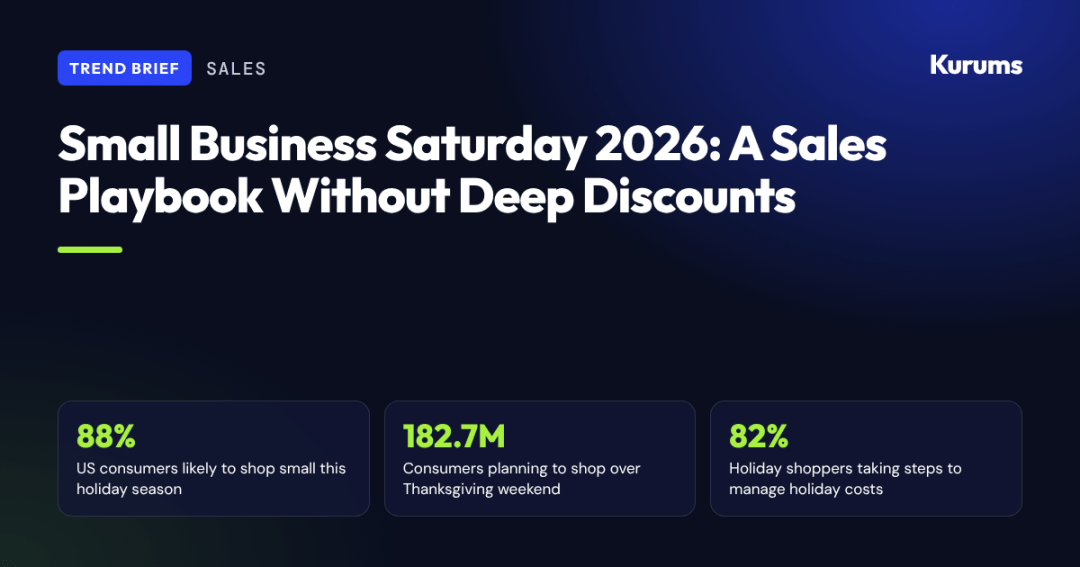
Shoppers intend to support small businesses on November 28 but are spending selectively, so the weekend rewards sellers who protect margin and collect customers for January.
Small Business Saturday falls on November 28, 2026. American Express reports 88% of consumers say they are likely to shop small this season, the highest since 2012, while NRF finds 82% of holiday shoppers are taking steps to manage costs. Last year's event brought in less than the year before. Treat the day as customer acquisition: promote early, build offers around bundles and bonuses instead of blanket markdowns, capture contact details at checkout, and measure repeat purchases through December.
What the week's data says
Small Business Saturday is November 28 this year. American Express founded it in 2010, and the Small Business Administration has cosponsored it since 2011, according to the U.S. Census Bureau.
The stated demand is strong. The American Express Shop Small Impact Study, fielded in September, found 88% of consumers likely to shop at small businesses this holiday season, the highest reading since 2012. The Conference Board index of consumer confidence rose 11.4 points in November to 103.3, its highest level since January 2025.
Intent is not revenue, though. WBEZ reports that American Express estimated last year’s Small Business Saturday spending at $18 billion, about 19% below the $22 billion reported for 2024. One Chicago gift-shop owner told the station that October was the top-selling month at one of her locations and November had been slow.
Shoppers are spending, but selectively
The National Retail Federation expects 182.7 million people to shop over Thanksgiving weekend, slightly below last year’s 186.9 million. In the same survey, 82% of holiday shoppers said they are taking steps to manage costs: 25% are buying less expensive gifts, 24% are cutting back elsewhere and 20% are buying for fewer people.
NRF’s holiday forecast calls for sales of $1.013 trillion, up 4.2%. NRF’s chief economist said inflation and rising gas prices will affect income groups differently, and the Conference Board notes that consumers’ written comments still express frustration with high prices.
For a small seller the useful detail is who shows up. An NRF survey summary says one in five holiday shoppers plan to buy from small or local businesses. Among them, 71% cite supporting community businesses, 56% unique gifts, 37% handmade work and 33% quality. None of the leading reasons is price.
Owners are under margin pressure too
The NFIB Small Business Economic Trends report for October put its Optimism Index at 97.8, essentially flat. A net 33% of owners reported raising average selling prices, against a historical average of net 14%, and a net 37% plan increases over the next three months. A net negative 4% reported higher nominal sales over the past three months.
In the Fort Worth Report, the local chamber’s chief executive said higher input costs are tightening margins, and an NFIB state director said many small businesses rely on year-end sales for 25% to 30% of annual revenue. With costs up and that much revenue concentrated in a few weeks, a blanket discount is an expensive way to buy traffic.
Design offers that protect margin
The arithmetic is simple. On an item with a 50% gross margin, a 20% markdown cuts gross profit per unit from 50 cents to 30 cents on each original dollar of price, so the store must sell about 67% more units to earn the same gross profit. That is an illustration, not a forecast; run it with your own margins.
| Offer type | Margin effect | Best use |
|---|---|---|
| Storewide percentage off | Cuts profit on items that would have sold anyway | Clearing aged stock only |
| Gift bundle at a set price | Raises ticket size; discount hidden in the set | Shoppers buying less expensive gifts |
| Gift with purchase over a threshold | Costs you the item’s cost, not its retail price | Lifting average ticket |
| Bounce-back voucher for January | Costs nothing unless a second visit happens | Building repeat business |
| Limited or local-only product | Full price; cannot be price-compared | Shoppers seeking unique gifts |
Retail owners interviewed for a preparation guide carried by WBAY made the same point: create an experience customers remember, and do not simply put up sale tags. One advised treating the day as a trust-building event instead of a sale event. Gift-card promotions deserve a second look as well: NRF says 39% of shoppers plan to give gift cards, the lowest share in the survey’s history.
What Google Trends shows about attention
Google Trends reports relative search interest on a 0 to 100 scale, not search volumes. For US searches from August 26 to November 26, 2026, “small business saturday” averaged 5.5 over the 90 days, 8.2 over the prior 30 days and 34.7 over the last seven days. That is roughly a fourfold rise in a week. The peak so far, 45, came on Tuesday, November 24, four days before the event.
“Shop small” ran high and steady, averaging 80.1 over 90 days and 88.3 in the last week, with its peak on September 21. The phrase is ambiguous, since it also covers searches for small sizes, so it should not be read as holiday demand. “Holiday sales” averaged 27.4 in the last week and peaked on November 2. In a separate comparison, “black friday” hit 100 on November 26 and dwarfs all of these terms.
The practical reading: attention to the event builds early in the week, and it competes with a much larger Black Friday conversation. Promotion should start by Monday, not on Friday night.
Search interest: small business saturday vs holiday sales
Google Trends, United States, Aug 26, 2026 to Nov 25, 2026. Daily index, 0–100, relative to the highest point among the terms compared; it shows relative attention, not search volume.
Running the day in store and online
Promote early and directly. One sneaker retailer quoted by NRF said the approach is to tell customers early through social posts and email. A Massachusetts hardware store is hosting pop-ups from a local brewery, winery and doughnut shop.
Work the discovery channels shoppers name. In the American Express study, recommendations from friends and family lead at 65%, followed by customer reviews at 45% and social media posts at 39%. A Pennsylvania jeweler told WITF that customer reviews on Google have expanded the shop’s reach. Check that listed hours and Saturday details are correct, and ask satisfied buyers for a review.
Capture the customer. A first-time buyer who leaves without giving an email address or phone number cannot be invited back. Offer a digital receipt, a loyalty sign-up or a January voucher that requires contact details, and tag those records with the date. B2B sellers can apply the same logic: equip retail customers with bundle-ready stock and reorder terms now.
The four weeks after, and what to measure
In the American Express study, 80% of owners said the day can help build relationships that extend beyond the holidays. That only happens with follow-up.
- Week 1: thank-you message to new customers, with last shipping dates and gift ideas under set price points.
- Weeks 2–3: restock the bundles that sold; promote gift cards and local pickup for late buyers.
- Week 4: send the January voucher reminder and plan the exchange and gift-card redemption period.
Track five numbers: transactions, average ticket, gross margin dollars (not just sales), new contacts captured, and the share of November 28 buyers who purchase again by the end of January. Compare them with last year’s figures if you have them. This is analysis, not financial advice; each business’s margins and cash position differ.
What to do next
- Send the Small Business Saturday email and social posts now; search interest is already climbing.
- Replace storewide markdowns with two or three priced gift bundles and one spend-threshold bonus.
- Calculate the extra units any planned discount needs to break even on gross profit.
- Set up contact capture at checkout: digital receipts, loyalty sign-up or a January voucher.
- Verify hours, address and event details on your Google listing and ask buyers for reviews.
- Schedule three follow-up messages for the four weeks after November 28.
- Record transactions, average ticket, margin dollars, new contacts and repeat purchases.
Frequently asked questions
When is Small Business Saturday in 2026?
It is Saturday, November 28, 2026, the day after Black Friday. American Express created the event in 2010 and the U.S. Small Business Administration has cosponsored it since 2011, according to the Census Bureau. Many chambers of commerce and downtown associations run local events around it.
Do small businesses need to discount to compete with Black Friday?
Not necessarily. NRF survey data shows shoppers who choose small or local businesses mainly cite community support, unique gifts, handmade goods and quality. Bundles, gifts with purchase and limited local products can add value while giving up less margin than a storewide markdown.
Is shopper demand for small businesses actually strong this year?
Stated intent is strong: 88% of consumers told American Express they are likely to shop small, the highest since 2012. But WBEZ reports that American Express estimated 2025 Small Business Saturday spending at $18 billion, down from $22 billion in 2024, so intent may not convert.
What customer data should a small seller collect on the day?
At minimum an email address or mobile number with permission to contact, the purchase date and what was bought. That is enough to send a thank-you, a gift reminder in December and a January offer, and to measure how many new buyers return.
How should the weekend be measured?
Look beyond sales. Track transaction count, average ticket, gross margin dollars, new contacts captured and the share of first-time buyers who purchase again by the end of January. A lower-revenue day with healthy margin and many new contacts can be worth more than a heavily discounted one.
- American Express: More Consumers Say They Plan to Shop Small This Holiday Season Ahead of Small Business Saturday (2026-11-12)
- National Retail Federation: 183 Million Consumers Expected to Shop During Thanksgiving Weekend (2026-11-19)
- National Retail Federation: How small retailers are preparing for Small Business Saturday (2026-11-05)
- National Retail Federation: NRF Forecasts 2026 Holiday Sales Growth as Consumers Remain Resilient (2026-10-15)
- The Conference Board: US Consumer Confidence Index, November 2026 (2026-11-24)
- NFIB: Small Business Economic Trends, October 2026 (2026-11-10)
- WBEZ Chicago: Chicago-area businesses' feelings are mixed about Small Business Saturday (2026-11-25)
- Fort Worth Report: Small Business Saturday kicks off end-of-year earnings season (2026-11-25)
- WITF: Central Pa. business owners optimistic about Small Business Saturday, holiday season (2026-11-25)
- WBAY: How businesses can (and should) prepare for Small Business Saturday (2026-11-07)
- U.S. Census Bureau: Small Business Saturday: November 28, 2026 (2026-11-23)
Search-interest figures are from Google Trends (United States, 90 days to November 26, 2026). This article is analysis for operators, not legal, tax or investment advice. Last updated November 26, 2026.
Discover more from Kurums | Business Intelligence
Subscribe to get the latest posts sent to your email.