
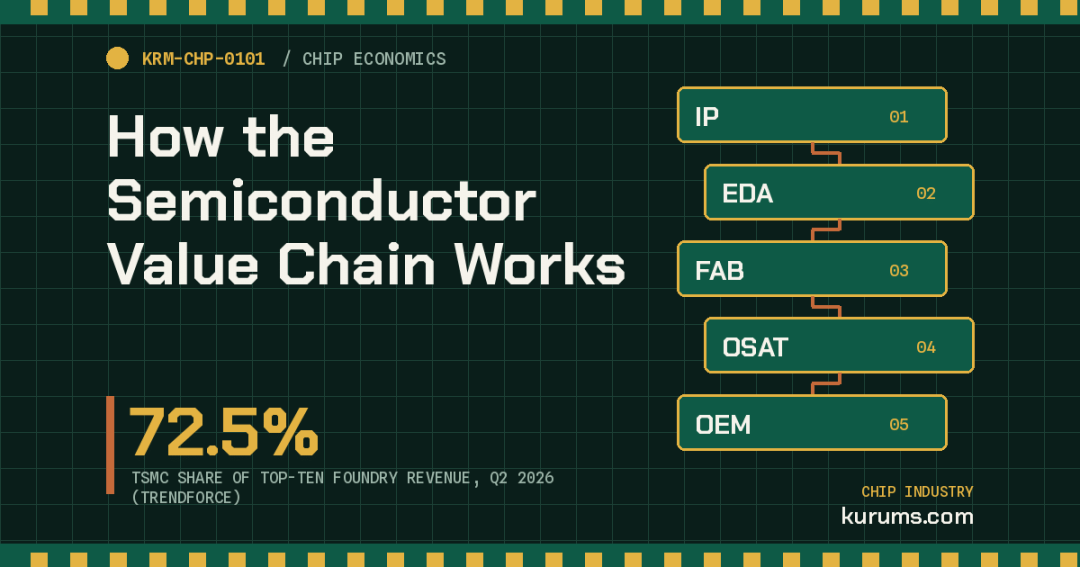
Design and manufacturing are usually separate companies.
Most leading chip brands own no factories. They design, and a foundry builds.
Every stage is an oligopoly.
Three software vendors, a handful of equipment makers and one dominant foundry sit between an idea and a finished chip.
Value has moved to artificial intelligence and memory.
Nvidia became the first chip vendor above $100 billion in annual revenue in 2025, and memory makers are the fastest growers in 2026.
Geography is the main risk.
Design clusters in the United States, leading-edge fabrication in Taiwan and South Korea, key tools in the Netherlands and Japan.
What is the semiconductor value chain?
The semiconductor value chain is the sequence of specialised companies that turn a chip design into a working component: designers, tool and material suppliers, manufacturers, packaging and test providers, and distributors. No single company, and no single country, performs every step for advanced chips.
The chain became this fragmented because each step grew too expensive to do in-house. A leading-edge factory costs tens of billions of dollars, a design can cost hundreds of millions, and the machines that print the smallest features come from one supplier. Specialisation spread those costs across the whole industry. It also created dependencies that boards, buyers and governments now watch closely. The industry at the end of this chain is large: the World Semiconductor Trade Statistics organisation forecast in June 2026 that sales would reach $1.51 trillion this year, as our guide to semiconductor market size explains.
Who designs chips?
Chips are designed by three kinds of company. Fabless firms design chips and outsource manufacturing. Integrated device manufacturers design and build their own. And large technology companies increasingly design chips for their own products and data centres.
Fabless companies include Nvidia, Qualcomm, Broadcom, AMD and MediaTek. Apple designs the processors in its phones and computers and appears in Gartner's ranking of the ten largest chip vendors by revenue. Around them sit two supporting industries. Intellectual-property suppliers license ready-made building blocks: Arm's processor designs are the best-known example, and the Arm company story shows how a licensing model became an industry standard. Electronic design automation vendors supply the software that every designer uses. Synopsys, Cadence and Siemens EDA together hold more than 85% of that market, according to SemiAnalysis. Our comparison of the best EDA software for chip design covers how those tools are bought.
Who manufactures chips?
Wafers are fabricated either by foundries, which manufacture for other companies, or by integrated device manufacturers that build their own designs. For the most advanced logic chips, the foundry model dominates, and one company dominates the foundry model.
| Foundry | Q2 2026 revenue | Share of top ten |
|---|---|---|
| TSMC (Taiwan) | About $40.2 billion | 72.5% |
| Samsung Foundry (South Korea) | About $3.26 billion | 5.9% |
| SMIC (China) | More than $3.0 billion | 5.4% |
| UMC (Taiwan) | About $2.18 billion | 3.9% |
| GlobalFoundries (USA) | About $1.79 billion | 3.2% |
Source: TrendForce, 9 September 2026. Top-ten foundry revenue totalled nearly $53.49 billion in the quarter, up 11.5% on the previous quarter.
TSMC's share has risen from 64.4% in 2024 to 69.9% in 2025 and above 72% in 2026, because demand for artificial intelligence processors is concentrated on the most advanced processes, where it has the most capacity. SMIC grew 20% in the quarter and is closing on Samsung's foundry business for second place. The TSMC business story and the SMIC story cover the two companies in depth.
Integrated manufacturers remain central in other segments. Memory chips are made almost entirely by companies that both design and manufacture, led by Samsung, SK Hynix and Micron. Intel builds most of its own processors. Analog and power chips for cars and industry come largely from integrated makers in Europe, Japan and the United States.
What do equipment and materials suppliers do?
Equipment makers build the machines inside a chip factory, and materials suppliers provide the silicon wafers, gases and chemicals that those machines consume. A modern factory needs hundreds of process steps, each with its own tool.
A few companies supply most of the critical equipment. ASML of the Netherlands is the only maker of the extreme-ultraviolet lithography machines needed for leading-edge chips, as the ASML story describes. Applied Materials, Lam Research and KLA in the United States, and Tokyo Electron in Japan, supply deposition, etching, inspection and coating tools. Demand is strong: Lam Research reported revenue of $8.22 billion for its September 2026 quarter, up from $6.72 billion the quarter before. Our profile of Tokyo Electron explains the Japanese side of this segment.
What happens in packaging and test?
After fabrication, a wafer is cut into individual chips, which are mounted in a protective package, connected to the outside world and tested. Companies that do this for others are called outsourced semiconductor assembly and test providers, or OSATs. ASE and Amkor are the largest.
Packaging used to be a low-margin final step. It is now a constraint. Artificial intelligence processors combine a logic chip with stacks of high-bandwidth memory on one substrate, and the capacity to assemble those packages has repeatedly limited how many processors can ship. Foundries and memory makers have therefore moved into advanced packaging themselves. Gartner reported that high-bandwidth memory represented 23% of the DRAM market in 2025, with sales above $30 billion.
Where is each stage located?
The chain is spread across a small number of countries, each strong in different steps.
| Stage | Main locations |
|---|---|
| Chip design and design software | United States, with major centres in Taiwan, the United Kingdom and China |
| Leading-edge logic fabrication | Taiwan and South Korea, with new capacity in the United States and Japan |
| Memory fabrication | South Korea, the United States, Japan and China |
| Lithography and process equipment | Netherlands, United States and Japan |
| Packaging and test | Taiwan, China, Malaysia, Vietnam and elsewhere in Southeast Asia |
This geography explains most chip policy. Governments subsidise factories to bring fabrication closer to home, and export controls restrict the flow of tools and advanced chips. Our stories on Taiwan's semiconductor geopolitics, TSMC's overseas fabs and Malaysia's packaging industry follow those moves country by country.
Who captures the most value?
Revenue has concentrated in companies tied to artificial intelligence. Gartner's preliminary figures for 2025 show the ten largest vendors holding about 62% of a $793 billion market.
| Rank | Vendor | 2025 revenue | Growth |
|---|---|---|---|
| 1 | Nvidia | $125.7 billion | +63.9% |
| 2 | Samsung Electronics | $72.5 billion | +10.4% |
| 3 | SK Hynix | $60.6 billion | +37.2% |
| 4 | Intel | $47.9 billion | -3.9% |
| 5 | Micron Technology | $41.5 billion | +50.2% |
| 6 | Qualcomm | $37.0 billion | +12.3% |
| 7 | Broadcom | $34.3 billion | +23.3% |
| 8 | AMD | $32.5 billion | +34.6% |
| 9 | Apple | $24.6 billion | +19.9% |
| 10 | MediaTek | $18.5 billion | +15.9% |
Source: Gartner, January 2026 (preliminary). Foundries such as TSMC are excluded because their output is counted in their customers' revenue.
Nvidia became the first vendor to pass $100 billion in semiconductor revenue. Intel's share fell to 6%, half its level in 2021. The table also hides a point that matters for understanding the chain: TSMC does not appear, yet its 2025 revenue of about $122.5 billion would place it second. Its sales are counted inside the revenue of the fabless companies it serves.
Where do distributors fit in?
Distributors connect chipmakers to the tens of thousands of companies that build electronic products. Large customers buy directly from manufacturers. Almost everyone else buys through distribution.
Volume distributors such as Arrow and Avnet manage production supply, while catalogue distributors such as DigiKey and Mouser sell small quantities from stock. For a business buyer this is the visible end of the chain, and it is where shortages are felt first. Our guide to the best electronic component distributors compares the main options.
What are the choke points and risks?
Three dependencies stand out. Leading-edge fabrication depends on TSMC. Leading-edge lithography depends on ASML. And design at any scale depends on three software vendors. A disruption at any of them cannot be worked around quickly, because qualifying a second source takes years.
Policy adds a fourth risk. Export controls on advanced chips and tools have been extended several times, and tariffs on electronics have changed repeatedly since 2025. Capacity is a fifth: when factories shift production toward artificial intelligence processors and high-bandwidth memory, supply of ordinary memory and mature-process chips tightens, as our note on the 2026 memory chip shortage describes.
What does the value chain mean for business buyers?
For a company that buys electronics, the chain suggests four habits. Know which of your products depend on a single-source chip. Ask suppliers where their critical components are fabricated and packaged. Hold more stock of long-lead parts than a spreadsheet says is efficient. And budget for price changes, because the cost increases described in our guide to chip fab costs and wafer prices pass down the chain to servers, phones, vehicles and industrial equipment. The companies behind the data centres that absorb most of this output are covered in the Data Center Economy hub.
How long does it take to make a chip?
Longer than most buyers expect. Designing a complex chip takes one to three years. Fabricating a wafer on an advanced process takes about three months from bare silicon to finished wafer, and packaging and testing add several more weeks. Building a new factory to add capacity takes two to three years before the first wafer.
Those timescales are why supply cannot respond quickly to demand. An order placed today for a chip that is not already in production queues will not arrive for months, and a shortage caused by too little capacity lasts until new factories open. It is also why chipmakers ask large customers for forecasts and commitments a year or more ahead, and why companies without that visibility rely on distributor stock.
Frequently asked questions
What is a fabless semiconductor company?
A company that designs chips and sells them under its own name but outsources manufacturing to a foundry. Nvidia, Qualcomm and AMD are examples.
What is the difference between a foundry and an IDM?
A foundry manufactures chips designed by other companies. An integrated device manufacturer, or IDM, designs and manufactures its own chips. Some companies, including Samsung and Intel, do both.
What does OSAT mean?
Outsourced semiconductor assembly and test. OSAT companies cut, package and test chips after wafer fabrication.
Why is TSMC so important?
It manufactures most of the world's advanced logic chips. In the second quarter of 2026 it held 72.5% of top-ten foundry revenue, according to TrendForce.
Discover more from Kurums | Business Intelligence
Subscribe to get the latest posts sent to your email.