
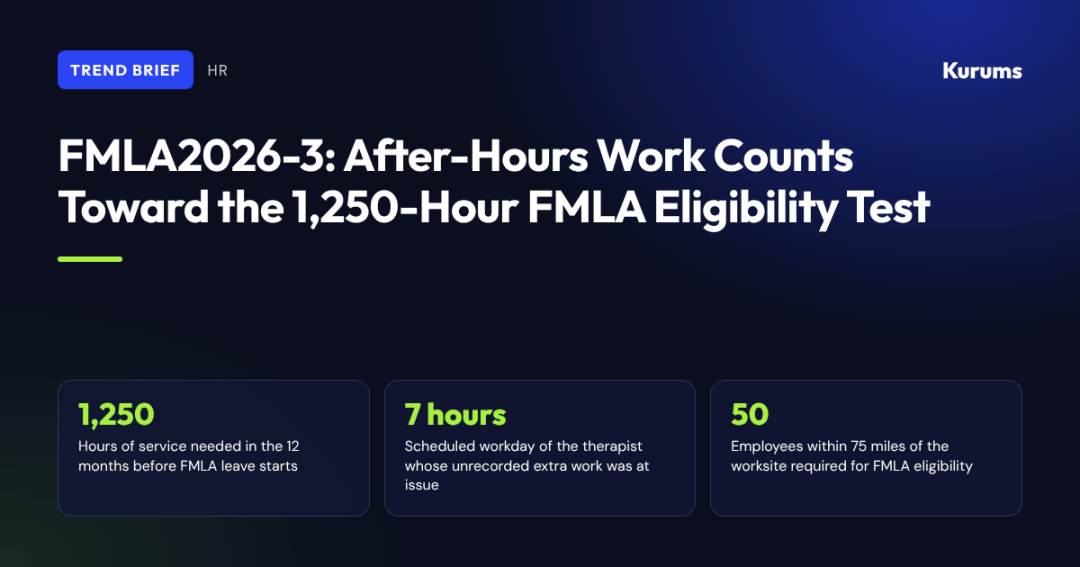
Opinion letter FMLA2026-3 applies existing rules to a school therapist's unrecorded paperwork and travel, and restates that employers carry the burden of proof when hours records are missing.
On November 17, 2026 the US Labor Department's Wage and Hour Division issued opinion letter FMLA2026-3. It says mandatory work done outside scheduled hours, including at home with the employer's knowledge, counts toward the 1,250 hours of service needed for FMLA eligibility, and that travel between worksites likely counts too. Where hours were never recorded, the employer must show the employee fell short. The letter applies existing rules to one therapist's facts and creates no new timekeeping mandate.
What the Labor Department said on November 17, 2026
The US Department of Labor’s Wage and Hour Division (WHD) issued opinion letter FMLA2026-3 on November 17, 2026, signed by Administrator Andrew B. Rogers. It answers a salaried public school occupational therapist’s question about how her hours count for eligibility under the Family and Medical Leave Act (FMLA), the federal law giving eligible employees unpaid, job-protected leave for specified family and medical reasons.
According to the Wage and Hour Division letter, the therapist has a seven-hour scheduled day. Outside that schedule she completes mandatory tasks, including Individualized Education Program (IEP) assessments and documentation and quarterly progress reports, and she travels between schools. She told the agency her supervisors know the paperwork is done outside scheduled hours, and that neither she nor the employer records the travel or the work done at home.
The agency reached three conclusions. Time spent on mandatory work tasks outside scheduled hours counts toward the FMLA hours-of-service requirement. Travel from worksite to worksite during the workday likely counts as well. And where an employer has not kept accurate records of actual hours worked, the employer has the burden of showing the employee has not met the requirement.
A second letter was issued the same day. Fisher Phillips reports that FLSA2026-14 addresses whether seasonal concession workers at fairs and concerts fall under an FLSA exemption for seasonal amusement or recreational establishments, a separate and narrower question.
How the 1,250-hour test works
An employee of a covered employer is eligible for FMLA leave after working for the employer for at least 12 months, working at a site where the employer has at least 50 employees within 75 miles, and logging at least 1,250 hours of service in the 12 months before the leave starts. Those conditions are set out in 29 CFR 825.110. Spread evenly across 52 weeks, 1,250 hours is about 24 hours a week.
The regulation does not define hours of service by reference to a schedule or a payroll code. It says the question is decided under the Fair Labor Standards Act (FLSA) principles for compensable hours of work, and adds: “The determination is not limited by methods of recordkeeping, or by compensation agreements that do not accurately reflect all of the hours an employee has worked for or been in service to the employer.”
The FLSA defines “employ” to include “to suffer or permit to work.” The letter applies the long-standing rule in 29 CFR 785.11 and 785.12, which covers work away from the employer’s premises, including at home: “If the employer knows or has reason to believe that the work is being performed, he must count the time as hours worked.” Because the therapist’s employer knew about the after-hours paperwork, the Wage and Hour Division concluded that the time is hours worked under the FLSA and therefore hours of service under the FMLA.
| Type of time | Position in FMLA2026-3 | Rule the letter relies on |
|---|---|---|
| Mandatory paperwork done outside the scheduled day, including at home, with the employer’s knowledge | Must be counted as hours of service | 29 CFR 785.11 and 785.12 |
| Travel between worksites during the workday | Likely counts; the agency lacked detail for a definitive answer | 29 CFR 785.38 |
| Normal commute between home and work | Not compensable hours worked | 29 CFR 785.35 |
| Hours that nobody recorded | Employer must show the employee did not reach 1,250 hours | 29 CFR 825.110(c)(3) |
The burden of proof when records are missing
When eligibility is disputed, the letter says WHD looks to the employer’s records of hours worked, and in most cases those records settle the matter. If the records are inaccurate or do not resolve the question, the employer must demonstrate that the employee has not worked the necessary hours.
The text of 29 CFR 825.110 makes clear this covers employees who are exempt from the FLSA requirement that a record be kept of their hours, such as bona fide executive, administrative and professional employees. The regulation uses full-time teachers as its example, noting that they often work outside the classroom or at home, and says an employer must be able to clearly demonstrate they did not work 1,250 hours in order to treat them as ineligible.
The letter describes the employer’s burden, citing a 2012 Second Circuit decision, as one that “is not heavy, but it is specific.” The employer must show either that the hours claimed outside the workplace did not or could not have occurred, or that they are not compensable under FLSA principles.
The letter also cites 29 CFR 825.500(f): where an employee is not covered by the FLSA, so the employer has no duty to keep hours records, eligibility is presumed after 12 months of employment. HR Dive highlighted this presumption in its report, and HR Morning told payroll readers that the burden reaches exempt employees whose hours need not be recorded.
What the letter does not decide
An opinion letter is an agency interpretation applied to the facts a requester describes. FMLA2026-3 states that it is based exclusively on the facts and circumstances in the request, and that “The existence of any other factual or historical background not contained in your letter might require a conclusion different from the one expressed herein.” The employer was not part of the exchange, so the agency worked only from the therapist’s account.
Several limits follow from the text of the Wage and Hour Division letter:
- Travel is not settled. The agency said it lacked enough detail to analyse the worksite-to-worksite travel definitively and described the result only as likely.
- Exempt status is not decided. The therapist said she is paid on a salary basis but did not say whether she is classified as exempt. WHD made no determination and said its analysis would be the same either way.
- Employer knowledge is central. The conclusion rests on the representation that supervisors knew about, and expected, the after-hours work.
- The tasks were mandatory. The letter addresses required IEP and reporting work, not every activity an employee might choose to do outside working hours.
- It concerns eligibility only. The letter does not rule on pay owed or on any state leave law.
Fisher Phillips notes that opinion letters are not binding on courts, though they can be used as persuasive authority or to demonstrate good faith. It adds that federal guidance does not affect state laws with broader wage or leave protections.
Why it matters beyond schools
The facts involve a school district, but the rules applied are general. Public agencies, schools and private-sector employers with 50 or more employees are covered employers under the FMLA, according to the letter.
Fisher Phillips names teachers, therapists and multi-site staff and suggests employers find a practical way to capture that time and train managers and HR staff to look beyond a typical schedule.
Eric B. Meyer, writing on The Employer Handbook on November 19, 2026, argues that a salary does not resolve the eligibility question and that managers may know about evening or weekend work that HR does not. He also cautions against over-reading the letter: “Employers don’t necessarily need to introduce timekeeping requirements for exempt employees because of this opinion letter.” In his words, “Missing records require more investigation, not less.”
The exposure is greatest for part-time and reduced-schedule employees near the threshold. Someone scheduled for 23 hours a week falls short of 1,250 hours on paper over a year, yet a modest amount of known, unrecorded work at home or travel between sites could carry the total past it.
What search interest in FMLA eligibility shows
Google Trends data for the United States over the 90 days to November 28, 2026 shows steady but uneven interest in the eligibility question. The term “fmla eligibility” reached its 90-day peak of 100 on October 6, well before the letter. In the week the letter was issued it registered daily readings of 41 to 51 between November 16 and 19, and its average over the last seven days was 22.3. The narrower term “fmla 1250 hours” peaked at 94 on October 5 and averaged 3.0 over the last seven days.
The daily series is sparse, with many zero days, so the figures show relative interest, not search volume, and do not prove the letter drove any change. Related queries are practical: “fmla eligibility requirements”, “fmla hours eligibility” and “fmla eligibility notice”. The only rising query was “ct fmla eligibility”, up 80%.
Search interest: fmla eligibility vs fmla 1250 hours
Google Trends, United States, Aug 28, 2026 to Nov 28, 2026. Daily index, 100 = peak interest across both terms.
What HR, payroll and leave administrators should do now
- Identify the roles at risk. List positions where scheduled hours understate actual work: salaried professionals with take-home documentation, staff who cover several sites, and part-time employees scheduled near 24 hours a week.
- Check how eligibility is calculated today. Confirm whether the leave system counts scheduled hours, paid hours or hours actually worked.
- Add a manager check before any denial based on hours. Where an employee is close to 1,250 hours, ask the supervisor and the employee about known work outside the schedule and about travel between worksites before the eligibility notice goes out.
- Separate commuting from worksite travel. The letter treats the ordinary trip between home and work as non-compensable, and travel between worksites during the workday as likely hours worked.
- Decide what evidence can stand in for time records. For exempt staff with no timesheets, identify the sources that could reconstruct hours, such as calendars, schedules, emails, system logins and travel records.
- Brief employment counsel. Hours that count as FLSA hours worked are also relevant to pay for nonexempt staff, so refer any unrecorded time found for hourly employees, and check state leave laws that apply their own eligibility tests.
Frequently asked questions
Does work done at home count toward the 1,250 hours for FMLA eligibility?
According to opinion letter FMLA2026-3, yes, when the employer knows or has reason to believe the work is being performed. FMLA hours of service follow Fair Labor Standards Act rules on hours worked, and those rules cover work performed away from the employer's premises, including at home. The letter applied this to mandatory paperwork a school therapist completed outside her seven-hour scheduled day.
Does travel time count toward FMLA hours of service?
Normal commuting between home and work does not count. Travel between worksites during the workday is generally treated as part of the day's work under 29 CFR 785.38. In FMLA2026-3 the Wage and Hour Division said the therapist's travel between schools likely counts, but it did not have enough detail to reach a definitive conclusion on her facts.
Do salaried exempt employees have to meet the 1,250-hour requirement?
Yes, the 1,250-hour requirement applies, but the proof rules favour the employee when records are missing. Under 29 CFR 825.110(c)(3), an employer that lacks an accurate record of hours, including for employees exempt from FLSA recordkeeping, has the burden of showing the employee did not work the required hours. The letter says the analysis is the same for exempt and nonexempt employees.
Is a DOL opinion letter binding on employers?
An opinion letter states how the Wage and Hour Division applies the law to the facts a requester presents. FMLA2026-3 says it is based exclusively on those facts and that other facts might require a different conclusion. Fisher Phillips notes such letters are not binding on courts but can serve as persuasive authority and help show good faith.
- US Department of Labor, Wage and Hour Division: Opinion Letter FMLA2026-3 (2026-11-17)
- eCFR: 29 CFR 825.110 Eligible employee (2026-11-28)
- HR Morning: After-Hours Work and FMLA Eligibility: New DOL Opinion Letter FMLA2026-3 (2026-11-25)
- HR Dive: Work done outside regular hours may count toward FMLA eligibility (2026-11-18)
- Fisher Phillips: 2 New DOL Opinion Letters Cover FMLA Eligibility for Salaried Staff and Wages for Seasonal Concession Workers: Key Takeaways for Employers (2026-11-24)
- The Employer Handbook (Eric B. Meyer): Before You Deny FMLA Leave, Are You Sure the Employee Hasn't Worked 1,250 Hours? (2026-11-19)
Search-interest figures are from Google Trends (United States, 90 days to November 28, 2026). This article is analysis for operators, not legal, tax or investment advice. Last updated November 28, 2026.
Discover more from Kurums | Business Intelligence
Subscribe to get the latest posts sent to your email.