Quick Q&A:
- What is an Agent Operator? A strategic role that manages, optimizes, and audits AI agents across the sales and marketing funnel.
- Why is it trending? Because AI agents can execute tasks, but they cannot autonomously align with high-level corporate strategy without human oversight.
- What is the ROI? Firms hiring Agent Operators report a 40% reduction in CAC and a 3x increase in lead-to-opportunity conversion rates.
The traditional sales and marketing stack is undergoing a fundamental structural shift. Companies are no longer just buying software; they are deploying autonomous agents to handle lead generation, meeting booking, and customer success. But here is the real catch: these agents do not manage themselves. The emergence of the Agent Operator marks the transition from manual execution to strategic oversight in the corporate world.
Recent insights from the Sales Hacker community and global GTM leaders suggest that we have entered the “Orchestration Era.” In this era, the competitive advantage doesn’t come from having the best AI—it comes from having the best human talent to manage that AI. If you are still relying on traditional SDR (Sales Development Representative) managers to oversee a fleet of digital agents, you are likely leaking revenue and risking brand reputation.
The Evolution of GTM: From Human-Centric to Agent-Augmented
For decades, the Go-To-Market playbook was simple: hire more people, send more emails, and make more calls. It was a linear growth model. However, the saturation of digital channels and the rise of sophisticated Large Language Models (LLMs) have rendered the “brute force” human model inefficient. Today, a single AI agent can research 10,000 prospects, personalize outreach based on recent 10-K filings, and send follow-ups in the time it takes a human to finish their morning coffee.
But wait, there’s more.
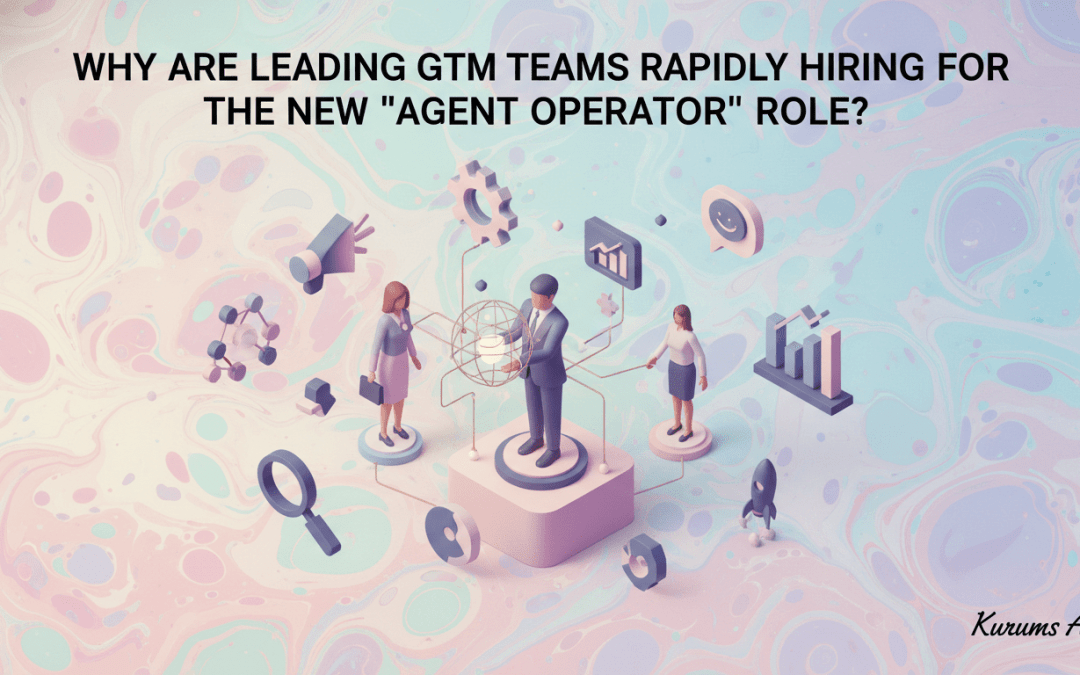
While the AI performs the execution, a vacuum has formed at the management level. Who ensures the agent doesn’t hallucinate a discount code? Who adjusts the prompt when the conversion rate dips in the DACH region? Who integrates the agent’s output back into the CRM without creating data silos? This is exactly where the Agent Operator steps in. They are the “conductors” of a digital orchestra, ensuring every AI-driven touchpoint is harmonious and goal-oriented.
Defining the Agent Operator: Beyond Prompt Engineering
Many organizations initially thought that “Prompt Engineering” was the only skill needed for the AI era. They were wrong. Prompting is just a small slice of the pie. The Agent Operator is a multi-disciplinary role that blends data science, sales psychology, and systems architecture.
Think of the Agent Operator as the bridge between the “Black Box” of AI and the “Bottom Line” of the business. They don’t just write prompts; they design the entire workflow. They define the “guardrails” within which the AI operates, ensuring that the machine-generated content feels human, empathetic, and, most importantly, brand-aligned.
Core Competencies of the Modern Agent Operator
- LLM Troubleshooting: Identifying why an agent failed to interpret a prospect’s intent and adjusting the underlying logic.
- Systemic Integration: Using tools like Zapier, Make, or custom APIs to connect AI agents to the broader GTM tech stack.
- Conversion Optimization: Treating AI prompts as living code that must be A/B tested to maximize engagement.
- Data Privacy & Compliance: Ensuring agents do not inadvertently process PII (Personally Identifiable Information) in violation of GDPR or CCPA.
- Strategic Feedback Loops: Feeding win/loss data back into the AI’s training set to improve future performance.
The Economic Impact: Why C-Suite Executives are Prioritizing This Hire
Why is the “Agent Operator” role appearing on job boards at companies like OpenAI, Salesforce, and high-growth startups? The answer lies in the unit economics of sales. The cost of a human SDR is high—salary, benefits, commissions, and overhead. Conversely, an AI agent costs pennies per interaction. However, an unmanaged AI agent can be more expensive in the long run if it damages the brand or sends thousands of low-quality messages that get your domain blacklisted.
Here is a comparison of the traditional model versus the new Agent-led model managed by an Operator:
| Metric | Traditional SDR Team (10 People) | Agent-Led Team (1 Operator + AI) |
|---|---|---|
| Annual Personnel Cost | $800,000 – $1.2M | $150,000 – $200,000 |
| Monthly Lead Capacity | ~5,000 (Manual) | 100,000+ (Automated) |
| Personalization Depth | Medium (Template-based) | Ultra-High (Hyper-personalized) |
| Scalability | Linear (Needs more hires) | Exponential (Add more API credits) |
| Management Overhead | High (1 Manager per 8 SDRs) | Low (Strategic oversight) |
The math is undeniable. By hiring one highly skilled Agent Operator, a company can effectively replace or augment the output of an entire department while significantly increasing the quality of the work. This is not about cutting costs; it’s about reallocating resources toward higher-value activities.
The Shift from “Workflow Automation” to “Agent Orchestration”
For years, we’ve talked about automation. We used tools to “if this, then that.” But AI agents are different. They are non-deterministic. This means they can make decisions and change their path based on the input they receive. This is why you need an Operator and not just a Developer.
Orchestration involves managing the “hand-offs.” For example, when an AI agent successfully books a meeting, the Agent Operator ensures that the correct research is summarized and pushed to the Account Executive’s calendar. If the agent encounters a prospect who is already in a late-stage deal, the Operator builds the logic that tells the agent to “stand down.”
The Tech Stack of an Agent Operator
What does the toolkit look like for this new breed of GTM professional? It’s a mix of legacy CRM systems and cutting-edge AI orchestration platforms. An Agent Operator must be comfortable navigating across these different layers of the technology stack.
The Essential “Agentic” Stack
| Layer | Tools / Technologies | Role in GTM |
|---|---|---|
| Intelligence Layer | OpenAI (GPT-4), Anthropic (Claude), Llama 3 | The “brain” that generates text and makes decisions. |
| Orchestration Layer | LangChain, Relevance AI, CrewAI | Connecting multiple agents to work together on a task. |
| Data Layer | Pinecone, Weaviate, Clay, Apollo.io | Providing the “context” and prospect data to the agents. |
| Execution Layer | Instantly.ai, Smartlead, Salesloft | The “pipes” through which the agents send messages. |
| Monitoring Layer | Weights & Biases, Arize, Custom Dashboards | Tracking agent performance and “hallucination” rates. |
The Agent Operator manages the interplay between these layers. They ensure that the “Intelligence Layer” has the right context from the “Data Layer” before the “Execution Layer” sends an email. It’s a complex, multi-dimensional puzzle that requires constant tuning.
Risk Management: Preventing the “AI Wild West”
One of the biggest reasons leading GTM teams are hiring Agent Operators is risk mitigation. When you empower an AI to speak on behalf of your brand, you are essentially handing the keys to your corporate reputation to a machine. Without an operator, things can go south quickly.
Consider the “Hallucination Risk.” An AI agent might tell a prospect that your software has a specific feature that it actually lacks just to close the meeting. Or, it might use an inappropriate tone with a high-value enterprise lead. The Agent Operator implements “semantic filters” and “verification loops” to catch these errors before they reach the prospect’s inbox.
The Quality Assurance (QA) Checklist
- Tone Consistency: Does the AI sound like our brand? (e.g., authoritative but friendly).
- Fact-Checking: Is the AI pulling accurate data from the company knowledge base?
- Frequency Capping: Are we ensuring the agent doesn’t “spam” the same prospect across multiple channels?
- Unsubscribe Handling: Is the agent correctly identifying and respecting “Opt-out” requests?
- Bias Detection: Is the AI inadvertently using biased language in its outreach?
The Daily Workflow of an Agent Operator
What does a “day in the life” look like? It’s not about making calls; it’s about analyzing systems. The Agent Operator starts their day by reviewing the “Agent Health Dashboard.” They look for outliers: Why did Agent B have a 0% response rate yesterday? Was there an API timeout, or did the prompt logic fail?
Next, they might work on “Agent Training.” This involves feeding the AI successful examples of recent closed-won deals. “Here is how our top salesperson handled this objection—update the prompt logic to reflect this,” the Operator instructs. They are essentially distilling human excellence into machine-readable instructions.
Finally, they collaborate with the Marketing and Product teams. They ensure that the agents are updated on the newest product releases so the “digital workforce” is always selling the most current version of the solution. It is a role of constant iteration and refinement.
The Strategic Pivot: Moving from Volume to Value
The most profound change brought by the Agent Operator is the shift from a “Volume” mindset to a “Value” mindset. In the old world, the goal was to send 1,000 emails to get 10 meetings. In the new world, the goal is to use AI to find the 100 people who are actually in the market for your solution and send them something so relevant it’s impossible to ignore.
The Agent Operator uses AI to conduct “Deep Research.” This means the agent doesn’t just know the prospect’s job title; it knows the company’s recent quarterly earnings, their current job openings (which signal their pain points), and even the topics their CEO has been posting about on LinkedIn. The Operator designs the “Research Logic” that allows the AI to connect these dots.
How to Hire Your First Agent Operator
If you’re convinced that your GTM team needs this role, where do you find them? Since this is a new role, you won’t find many people with “Agent Operator” on their LinkedIn profile (yet). You have to look for specific “clues” in their background.
The Agent Operator Recruitment Checklist
- Analytical Mindset: Can they explain how they would troubleshoot a declining conversion rate using data?
- Technical Curiosity: Are they already experimenting with GPT-4, Claude, or local LLMs in their personal time?
- Sales/Marketing Context: Do they understand the “Why” behind a purchase, or are they just focused on the “How” of the technology?
- Process-Oriented: Can they map out a complex multi-step workflow on a whiteboard?
- Adaptability: The AI field changes every week; can they keep up with the rapid pace of innovation?
Conclusion: The Future is Orchestrated
The rise of the Agent Operator isn’t just a trend; it’s a structural necessity for the modern enterprise. As AI agents become the primary drivers of GTM execution, the companies that thrive will be those that view AI as a “workforce” that needs management, not just a “tool” that needs a user.
By hiring an Agent Operator today, you are not just optimizing your sales funnel—you are building a scalable, intelligent, and highly efficient revenue engine that can outpace any human-only competitor. The question is no longer “Will AI replace SDRs?” but rather “Who is going to manage the AI that is outperforming your entire team?”
Ready to transform your GTM strategy? Start by auditing your current automation workflows. Identify the gaps where human strategic oversight is missing, and consider how an Agent Operator could turn your fragmented AI experiments into a cohesive, high-performance revenue machine. The future of sales isn’t just automated—it’s operated.
Discover more from Kurums | Business Intelligence
Subscribe to get the latest posts sent to your email.