
An architecture practice asks its project leads to give “more regular feedback” after an engagement survey. Tariq, a project lead, takes this seriously. After a client presentation he tells Emma, a junior architect: “Great work overall. I think you need to be more confident, you came across as a bit unsure of yourself. But really good.”
Emma thanks him. That evening she replays the presentation, trying to work out which moment made her look unsure. She cannot identify it. In the next presentation she speaks faster and louder, loses her place twice and afterwards avoids Tariq. He concludes that she “doesn’t take feedback well”. He had meant to help. He gave her a judgment about what kind of person she is, wrapped in praise she discounted, with nothing she could act on. Her work became worse, and she became more guarded.
Most management advice treats feedback as straightforwardly good: give more of it, more often. Organisations invest in feedback training, feedback apps and feedback cultures on that assumption.
The research is less comfortable. Feedback has a positive effect on average, but a very uneven one, and a substantial share of feedback leaves people performing worse than if nothing had been said. This guide explains why, and what distinguishes the feedback that works. It is part of the HR Psychology hub.
Feedback often fails.
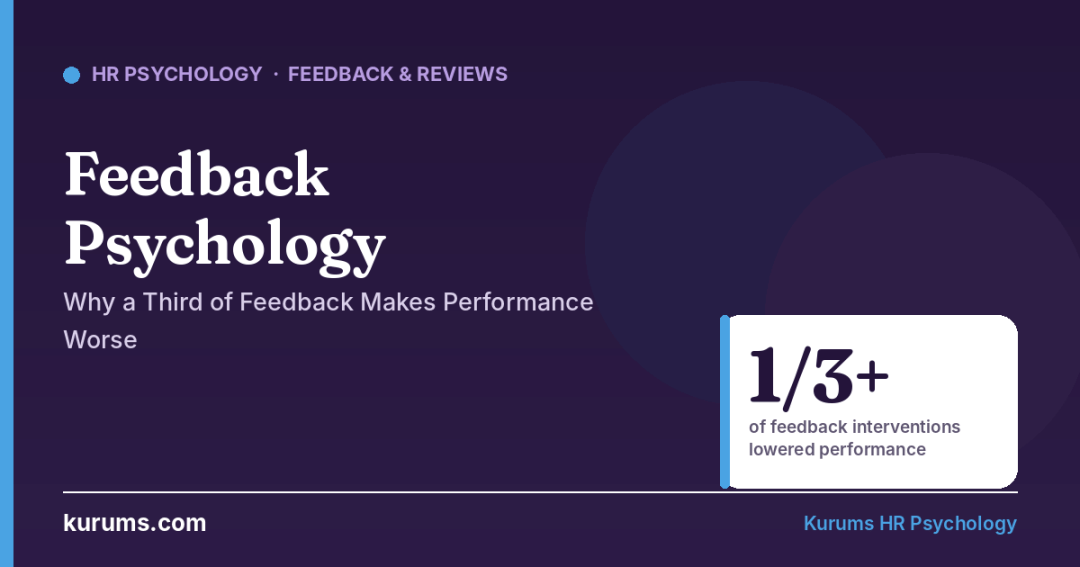
In the largest review of the evidence, more than a third of feedback interventions made performance worse.
Keep attention on the task.
Feedback about the work helps. Feedback about the person triggers self-protection.
Ask first, be specific, look forward.
Start with their view, describe behaviour and impact, and agree what to do next time.
What does the evidence say?
The most important single study is a review published in 1996.
Analysing 607 effect sizes from decades of experiments on feedback, covering more than 23,000 observations, the authors found that feedback improved performance on average. But in over one third of cases, feedback reduced performance. The direction of the effect was not explained by whether the feedback was positive or negative.
That last sentence surprises people. Praise did not reliably help and criticism did not reliably hurt. What mattered was where the feedback sent the recipient’s attention.
Kluger and DeNisi proposed that attention can sit at three levels: the details of the task, the motivation to do the task, and the self. Feedback that kept attention on the task and how to do it tended to improve performance. Feedback that pulled attention up to the self, to questions such as “what does this say about me?” and “what do they think of me?”, tended to harm it, because the person’s mental effort went into managing the threat or the pride instead of the work.
“You need to be more confident” is feedback aimed squarely at the self. Emma spent her next presentation monitoring how she was coming across.
Why does feedback feel like a threat?
Because, socially, it often is one. Being evaluated by someone with power over your pay and prospects engages the same systems as other threats to standing. Heart rate rises, attention narrows and the mind moves to defence: explaining, justifying, counter-attacking or shutting down.
Several well-established tendencies shape what happens next.
- Self-serving attribution. People credit their successes to themselves and their failures to circumstances. Critical feedback collides with that habit.
- Negativity bias. One critical comment outweighs several positive ones in memory. People leave a balanced review recalling the criticism.
- Identity protection. The more central a skill is to someone’s sense of who they are, the harder it is to hear that they fall short at it.
- Source discounting. Feedback from someone the recipient does not trust or respect is dismissed, whatever its accuracy.
When others fall short, we tend to blame their character. When we fall short, we blame the situation. A manager sees a missed deadline as carelessness. The employee sees three conflicting priorities. Feedback built on the manager’s attribution will be rejected by the employee, who knows things the manager does not.
None of this means people do not want feedback. Surveys regularly find that employees say they want more of it, including the corrective kind. What they want is information that helps them get better. What they resist is a verdict.
What makes feedback useful?
The research and practice literature converge on a small number of features.
| Feature | Less useful | More useful |
|---|---|---|
| Focus | The person (“you’re disorganised”) | The task or behaviour (“the report went out without the cost table”) |
| Specificity | General (“be more strategic”) | Concrete (“open with the recommendation, then the three reasons”) |
| Timing | Stored up for the annual review | Soon after the event, while details are fresh |
| Direction | What went wrong | What to do next time |
| Amount | A comprehensive list | One or two points the person can act on |
| Dialogue | A pronouncement | A conversation that starts with their view |
A widely used structure is Situation, Behaviour, Impact, developed at the Center for Creative Leadership. Describe the situation, describe what the person did in observable terms, and describe the effect. “In the client presentation on Tuesday (situation), when the client asked about the cost increase you paused and looked at me before answering (behaviour). The client then directed the next two questions to me, not to you (impact).” Emma could have done something with that.
Does the “feedback sandwich” work?
Not well. The sandwich, praise, then criticism, then praise, is designed to make the giver more comfortable. Recipients learn the pattern quickly. The opening praise becomes a warning signal and is discounted, and the closing praise lets both parties leave without having dealt with the middle. Emma’s “great work overall… but really good” is a small sandwich, and she heard only the filling.
Praise and criticism each work better when they are separate and specific. Positive feedback is not a softener. It is information about what to repeat, and it deserves the same precision as correction.
Give specific positive feedback far more often than you think necessary, and at times when no criticism is attached. People can hear a hard message from someone who has shown they notice what goes well. They cannot hear it from someone who only appears when something is wrong.
How should the conversation run?
Ask before you tell. Opening with the other person’s view accomplishes three things. They often identify the issue themselves, which is far easier to accept than being told. You learn the circumstances you did not know, which guards against the attribution error. And the conversation becomes a joint examination of a piece of work.
Choose the setting. Critical feedback is given privately. It is given soon, but not in the heat of the moment. And it is given when the person has the capacity to hear it: not five minutes before they present to the board.
Should feedback look backward or forward?
Both have a place, but the balance in most organisations is too far toward the past. The past cannot be changed, and detailed discussion of it invites defence. The executive coach Marshall Goldsmith popularised “feedforward”: suggestions for the future in place of judgments on the past. Research on performance conversations by Kluger and colleagues similarly finds that discussing the conditions under which the person has been at their best can do more for later performance than standard review feedback.
In practice, spend a third of the conversation on what happened and two thirds on what to do next.
Why do managers avoid giving feedback?
Because it is uncomfortable and the costs of avoidance are deferred. Psychologists call the reluctance to deliver bad news the mum effect. Managers also overestimate how badly the other person will react. Experiments by Nicole Abi-Esber and colleagues found that people consistently underestimated how much others wanted to receive constructive feedback, even about something as simple as a mark on their face.
The consequences of silence are familiar. Small problems grow. The employee is the last to learn what everyone else has noticed. And when feedback finally comes, in an annual review or a formal process, it is a shock. The escalation path is described in our guide to the psychology of a PIP.
Feedback that an employee hears for the first time in a formal review or disciplinary meeting is a management failure, whatever its accuracy. The rule is no surprises: anything in the review should already have been discussed.
Does everyone receive feedback the same way?
No, and three differences are worth knowing.
Experience. Novices tend to benefit from encouragement and clear direction. Experts want to know precisely what to refine. Giving a specialist generic praise is mildly insulting.
Mindset. Carol Dweck’s work suggests that people who believe ability can be developed treat criticism as information, while those who see ability as fixed treat it as a verdict. Managers influence this by what they praise. Praising effort, strategy and improvement supports the first belief. Praising talent supports the second.
Who is being addressed. Analyses of written performance reviews, including work by Shelley Correll and Caroline Simard at Stanford, have found that women tend to receive vaguer feedback than men, with fewer references to specific business outcomes, and more comments about communication style. Vague feedback cannot be acted on, so it slows development. The remedy is the same specificity for everyone; the wider pattern is covered in our guide to performance review bias.
What does the organisation need to do?
Individual technique matters less than climate. People take in feedback from managers they trust in teams where admitting a mistake is safe. Where a mistake leads to blame, people hide problems and treat every comment as an attack. Building that climate is the subject of our guide to psychological safety.
Managers also need to ask for feedback themselves and visibly act on it. A manager who says “what is one thing I could do differently in these meetings?” and then does it has demonstrated more about how feedback works than any training course.
- Is it about the work or behaviour, not the person’s character?
- Can I describe exactly what I saw or heard?
- Do I know their side of what happened?
- Is it one or two points, not a list?
- Does it include what to do next time?
- Is this the right time and a private place?
- Have I given this person specific positive feedback recently?
Tariq went back to Emma a few weeks later, on the advice of a colleague, and tried again. He told her about the pause before the cost question and asked what had been going on. She said she had not been sure she was allowed to answer for the practice on fees. No amount of confidence would have fixed that. A two-minute conversation about what she was authorised to say did.
Frequently asked questions
Why does feedback sometimes make performance worse?
When feedback directs attention to the self, by judging the person’s character or worth, mental effort shifts from the task to managing the threat. Vague, personal or badly timed feedback has this effect whether it is positive or negative.
What is the most effective way to give feedback?
Be specific and timely, describe the behaviour and its effect, focus on the task not the person, limit it to one or two points and agree what to do differently. Start by asking for the other person’s view.
Is the feedback sandwich effective?
Generally not. Recipients learn to expect criticism after the opening praise and discount it, and the main message is often lost. Give positive and corrective feedback separately and make both specific.
How often should managers give feedback?
Frequently and close to the event. Short, regular conversations work better than a large annual session, and nothing in a formal review should come as a surprise.
Discover more from Kurums | Business Intelligence
Subscribe to get the latest posts sent to your email.