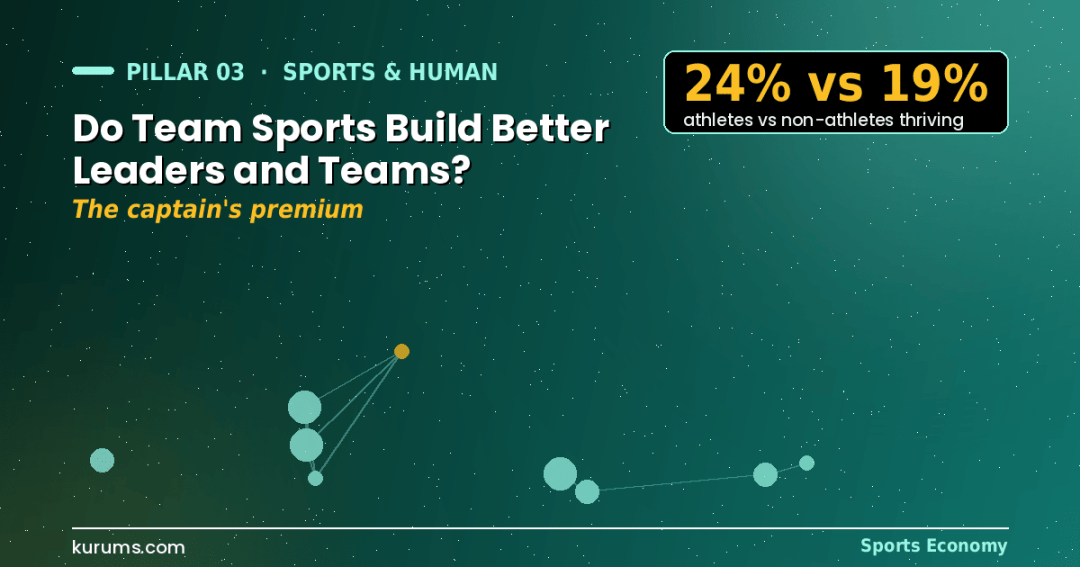
Team sport correlates with leadership outcomes, but the causal story is weaker than the recruiting folklore. Gallup’s study of 74,385 US graduates found former NCAA athletes thriving at 24% against 19% for non-athletes and 39% earning advanced degrees against 32%; Cornell’s Kniffin, Wansink and Shimizu found men who played varsity sport showed more leadership and higher-status careers six decades later; EY and espnW’s survey of female executives reported that roughly 94% of C-suite women had played sport. Against that, Gallup’s 2025 State of the Global Workplace puts employee engagement at 20% and manager engagement at 22%, costing about $10 trillion a year, which is the problem team-sport-trained leaders are hired to fix. The evidence supports hiring for what sport trains, not for the trophy.
Team sports and leadership are linked in every second CEO profile, from the rowing captain turned bank chief to the point guard running a software firm. The question for an HR director is whether the link is causal and bankable: does playing in a team actually build the skills that make better leaders and better teams, or do ambitious people simply play sport? This article weighs the longitudinal studies, the executive surveys and the 2025 engagement data, and sets out what companies can reasonably borrow from the pitch. It is part of the Sports Economy hub and complements why companies hire athletes and the evidence on workplace sport and productivity.
Do former team-sport players lead more?
The best long-run data says yes: Kniffin and colleagues’ 2015 study in the Journal of Leadership & Organizational Studies found former varsity athletes reported more leadership, higher-status careers and more volunteering some 60 years after school.
Is the effect causal?
Only partly. Selection explains a large share: confident, competitive people choose team sport. The studies that control for this still find a residual skills effect, but it is smaller than the raw gap.
What should employers do with it?
Hire and promote for the trainable behaviours team sport produces (role clarity, feedback tolerance, performance under scrutiny) and build those into management development, rather than treating a sporting CV as a credential.
What does the long-run evidence say about team sports and leadership?
It says former team-sport players lead more and earn higher-status positions decades later. Kniffin, Wansink and Shimizu’s “Sports at Work” study, published in the Journal of Leadership & Organizational Studies in 2015, found men who played varsity high-school sport reported more leadership and more prosocial behaviour roughly 60 years on.
The Cornell study ran two experiments. The first asked respondents what they expected of former student-athletes compared with peers active in band or yearbook; they predicted more leadership, self-confidence and self-respect, which describes the hiring heuristic rather than the truth. The second used biographical data from men who had played varsity sport about six decades earlier and found they reported more leadership positions, higher-status careers and more volunteering and charitable giving than non-athletes from the same cohorts. The authors conclude that sport builds skills and values beyond signalling the traits recruiters expect.
Gallup’s 2020 study for the NCAA, covering 74,385 US adults with a bachelor’s degree who graduated between 1975 and 2019, is the largest comparison of former college athletes with non-athletes. Among those graduating from 1990 onwards, 24% of former student-athletes were thriving in all measured elements of wellbeing against 19% of non-athletes; 39% went on to an advanced degree against 32%; and 35% strongly agreed a professor had cared about them as a person against 28%. The wellbeing and degree gaps are modest in absolute terms but consistent across cohorts and sports, and they survive controls for institution type and field of study.
The female executive data is the most-cited and the least rigorous. EY and espnW’s 2014 survey of several hundred senior businesswomen reported that roughly 94% of women in C-suite roles had played sport, around half at university level, and that most believed sport had helped their careers. It is a cross-section of people who already reached the top, so it cannot separate cause from selection, but it is consistent with the longitudinal findings and it prompted EY to build its Women Athletes Business Network, which recruits and mentors former elite athletes into professional services.
How much of the link is selection rather than skill?
A large share, probably more than half of the raw gap. Children with higher confidence, competitiveness, health and family income are more likely to play organised team sport, and all of those predict leadership outcomes on their own. The residual effect after controls is real but smaller than the recruiting folklore implies.
The selection problem has two layers. Entry: competitive team sport requires time, money, transport and parental support, so former athletes come disproportionately from households that supply other advantages too. Survival: those still playing at 21 have coped with cuts, injuries and public failure, which filters for resilience before any training effect occurs. Gallup’s sample controls for the first layer imperfectly and the second not at all, and Cornell’s biodata from one generation of American men cannot be assumed to transfer to a 2026 workforce in Istanbul or Singapore.
What the better studies do show is a residual that looks like trained behaviour rather than inherited trait. The Cornell prosocial finding, that former athletes volunteer and donate more, is not something ambition alone predicts, and it matches what coaches describe as the daily practice of team sport: subordinating individual output to a shared result, accepting role assignments you did not choose, and giving and receiving blunt performance feedback in front of peers. Those are the specific capabilities that organisational psychology links to effective team leadership, and they are the ones employers can plausibly credit to sport rather than to selection.
The practical conclusion is to stop asking whether athletes make better leaders and start asking which behaviours team sport trains, and whether a candidate has them from any source. The rugby captain and the student who ran a theatre company through a funding crisis may have the same skills; the sporting CV is just the more familiar signal.
Which specific skills does team sport actually train?
Five behaviours with reasonable evidence: role clarity (knowing your job in a system), feedback tolerance (hearing criticism without defensiveness), performance under observation, rapid recovery from failure, and coordination under time pressure. Team sport trains these daily from childhood in a way few other youth activities do.
Role clarity is the one most directly transferable to management. A football or basketball team is a system of interdependent, explicitly assigned roles with constant visible feedback on whether the system works; players learn early that doing someone else’s job is as damaging as not doing your own. Gallup’s engagement research identifies “I know what is expected of me at work” as the single most predictive item in its Q12 survey, and managers who played team sport tend to set and communicate roles more explicitly, which is a measurable advantage when global manager engagement is 22% and falling, per Gallup’s 2025 State of the Global Workplace.
Feedback tolerance is the second. Elite youth sport involves daily correction from coaches in front of teammates, video review of mistakes and selection decisions that are public and immediate. Employees from that background typically find performance conversations less threatening and are more likely to give direct feedback to peers, which is precisely the behaviour that psychological-safety research finds in high-performing teams. The risk, visible in some athlete-heavy sales cultures, is that the same people normalise a harshness that non-athletes experience as hostility.
Recovery and coordination under pressure complete the set. Athletes lose often, visibly and on a schedule, and those who continue have practised the reset between a bad result and the next fixture. Coordinating in real time without a meeting is the sporting default. None of these skills is unique to sport, but sport is the only mass activity that trains all five from age eight.
| Behaviour trained by team sport | Workplace equivalent | Evidence base | Failure mode if over-indexed |
|---|---|---|---|
| Role clarity within a system | Clear expectations, RACI discipline | Gallup Q12: strongest single engagement predictor | Rigidity; refusal to work outside the lane |
| Feedback tolerance | Direct performance conversations | Psychological-safety research; Cornell 2015 self-confidence finding | Harsh culture that excludes non-athletes |
| Performance under observation | Presenting, client-facing delivery | EY/espnW executive survey (correlational) | Over-reliance on charisma over analysis |
| Recovery from visible failure | Post-mortems, resilience after lost deals | Gallup NCAA 2020: 24% vs 19% thriving | Normalising burnout as toughness |
| Prosocial contribution | Mentoring, citizenship behaviour | Cornell 2015: more volunteering and donating 60 years on | In-group loyalty that shades into cliques |
Do teams that play sport together perform better?
Modestly, and mainly through trust and communication rather than fitness. Corporate team sport builds the weak cross-departmental ties that formal structures do not, and Gallup’s engagement data links “having a best friend at work” to higher productivity and retention. The effect is real but hard to isolate from self-selection.
The engagement context makes the question commercially serious. Gallup’s 2025 State of the Global Workplace puts global employee engagement at 20%, the lowest since 2020, with manager engagement at 22% (down from 27% a year earlier) and the cost of disengagement at roughly $10 trillion in lost productivity, or 9% of global GDP. Only 34% of employees worldwide describe themselves as thriving. Any intervention that raises team cohesion by a few points is worth money at that baseline, and company sport is among the cheapest available.
The mechanism is social rather than physiological. A corporate football league team or a B2Run relay squad (Germany’s series drew more than 240,000 runners from over 11,800 companies in 2024) puts a finance analyst, a warehouse supervisor and a marketing manager in the same unit with a shared, low-stakes goal. The relationships that form are the informal channels through which problems get solved before they escalate, and they are the reason participants in company sport report higher belonging in employee surveys. Istanbul’s Corporate Games, holding its 24th edition in June 2026 with 15 sports at Istanbul Technical University, serves Türkiye’s banks and holdings for exactly this purpose, and Germany’s 89,000 sports clubs with roughly 27 million members, per the DOSB, are where much of that country’s professional networking happens.
The limits are the same as for workplace sport generally: company teams draw disproportionately on people who already have social capital, and a team-sport culture can alienate those who cannot or do not want to play. Companies that get the cohesion benefit without the exclusion cost run several formats in parallel and measure participation across the whole workforce rather than celebrating the trophy cabinet.
What do coaches know about building teams that managers do not?
Three things with transferable evidence: they select for role fit rather than individual talent, they practise more than they perform, and they review performance on film with the whole unit present. Most corporate teams do the opposite on all three counts.
Selection for fit is the clearest lesson. A football squad is assembled to cover positions and tactical phases, and a club that signs eleven strikers loses. Corporate hiring still over-rewards individual output and under-weights the system a person must slot into, which is why high-performing individuals so often fail when promoted into management; Gallup’s long-running finding is that companies choose the wrong manager candidate most of the time. Coaches also treat the bench as part of the team and plan for rotation; managers tend to run their best people until they leave.
The practice-to-performance ratio is the second. A professional team spends most of its working week training for a few hours of competition, and the training is deliberate: specific situations, repeated, with immediate feedback. Corporate teams perform almost continuously and practise almost never; the pre-mortem, the dry run and the simulated negotiation are rare. The sports model suggests shifting even 5% of working time into structured rehearsal of the moments that matter (a product launch, a board presentation, a crisis response) would improve outcomes more than another offsite.
Film review is the third. Elite teams watch their own performance together, with the coach pausing on both errors and successes, and the norm is that the critique is of the play, not the person. The corporate equivalent, the blameless post-mortem, exists in engineering cultures and almost nowhere else. Leaders who played team sport tend to introduce it more readily, which is one of the concrete ways the “athletes make better leaders” claim shows up in practice.
How do companies use sport in leadership development?
Three ways: hiring former athletes into leadership tracks, bringing coaches and captains in to teach team practice, and running internal sport as a development tool. The first is the most common and the least evidence-based; the second and third have better support.
Athlete hiring pipelines are now standard at the large professional services firms, which run dedicated programmes for former elite sportspeople and recruit heavily from university sport. The logic is that selection into elite sport has already done the hard screening for resilience and coachability. We examine those programmes in detail in why companies hire athletes; the short version is that they work best when paired with explicit skills training, because the transition from a tightly scheduled sporting life to an ambiguous corporate one is where most athlete hires struggle.
Coach-led development is the growth area. Rather than booking a retired star for a keynote, companies increasingly contract working coaches to run sessions on selection, rotation, review and role design, the mechanics of team-building rather than the inspiration. The evidence is practitioner-level, but it addresses a documented gap: Gallup finds only a minority of managers have received any training in managing people.
Internal sport as development is the oldest form and the cheapest. Asking a junior employee to captain the corporate-games team or organise the running club is a low-risk leadership rehearsal with real stakes: recruiting participants, scheduling around work, handling the colleague who stops turning up. The participation data it generates doubles as the engagement measurement that a credible wellness ROI model requires.
Where does the sports-leadership analogy break down?
At scale, ambiguity and tenure. A sports team has 11 to 50 people, a clear scoreboard and a fixture list; a company has thousands, contested metrics and no final whistle. Leaders who import sporting methods without adapting them for ambiguity and long time horizons tend to burn out their teams.
The scoreboard problem is the most important. Sport’s clarity is what makes its feedback loops effective, and most corporate work lacks it: a strategy’s success is known years later, a product’s metrics are disputed, the counterfactual is invisible. Managers who treat quarterly numbers as a scoreboard create short-termism, and the “win at all costs” framing that works in a 90-minute match corrodes judgement when the game never ends.
The tenure problem is subtler. Elite sport careers are short and intense; the average professional footballer retires in his mid-thirties, and the training culture assumes total commitment for a limited period. Corporate careers run 40 years and reward sustainable pace. Athlete-heavy teams can normalise sprint intensity as a permanent state, which Deloitte’s 2024 UK analysis of mental-health costs (about £51bn a year for employers, with presenteeism at £23.8bn) suggests is expensive. The sporting disciplines that transfer best are the ones about rest, periodisation and recovery, which are also the ones most often left behind.
Finally, the analogy underweights individual contributors. The deep specialist who prefers solitary work is as valuable to a firm as the captain, and a leadership model built entirely on team sport will misread that person as disengaged, an error no coach would make about a goalkeeper.
Frequently Asked Questions
Do former athletes earn more or get promoted faster?
The long-run evidence points to higher-status careers and more leadership positions: Cornell’s 2015 study found former varsity athletes reported more leadership and higher-status roles decades later, and Gallup’s NCAA data shows higher rates of advanced degrees and wellbeing. Earnings premiums in other studies are typically modest, in the low single digits of percentage points, and shrink once family background and education are controlled for.
Which team sports are most associated with leadership?
There is no robust evidence that one sport beats another. The transferable behaviours (role clarity, feedback tolerance, performance under observation, recovery, prosocial contribution) are trained by any sustained, competitive team activity, from football to rowing to volleyball. What matters more is the level and duration: several years of competitive play with coaching and selection pressure, rather than the specific code.
Should companies run their own sports teams to build leadership?
Yes, if they treat captaincy and organising roles as recorded development experiences and run several formats so that participation is broad. Company teams in corporate leagues or events such as B2Run and the Istanbul Corporate Games cost little, build cross-departmental ties and give junior staff a low-risk leadership rehearsal. The benefit disappears if the team becomes an exclusive club for the already athletic.
Is it legal to prefer candidates with a sports background?
Preferring the competencies sport trains is defensible; preferring the sporting background itself is risky. Access to competitive team sport is uneven by income, gender, geography and disability, so using it as a selection criterion can amount to indirect discrimination under EU, UK and many other equality regimes. Score candidates on behaviourally evidenced competencies and accept evidence from any source.
Discover more from Kurums | Business Intelligence
Subscribe to get the latest posts sent to your email.