
The CFO of a mechanical subcontractor near Rouen has just signed a supply agreement for the Penly EPR2 site. The order book is the best in a decade, but the plant cannot find certified welders.
In Lille, a logistics coordinator has watched two colleagues lose their roles to a warehouse-management system. She is weighing a QHSE master’s against a cybersecurity bootcamp and wants to know which the French market will reward.
France enters 2026 with a labour market cooling at the top and tight at the bottom. Insee put unemployment at 8.3% in the second quarter of 2026, up 0.7 point on the year, with youth unemployment at 21.6%. Yet France Travail’s BMO 2026 survey still counts 2.28 million planned hires, 43.8% of them expected to be hard to fill.
That paradox defines the rising professions in France: fewer vacancies than in 2024, but persistent shortages in AI, nuclear and defence, industrial trades, environmental compliance and care. This guide, part of the Rising Professions 2026 hub, ranks the professions gaining ground, explains the drivers, benchmarks pay and sets out what employers and career changers should do.
Which profession is rising fastest in France in 2026?
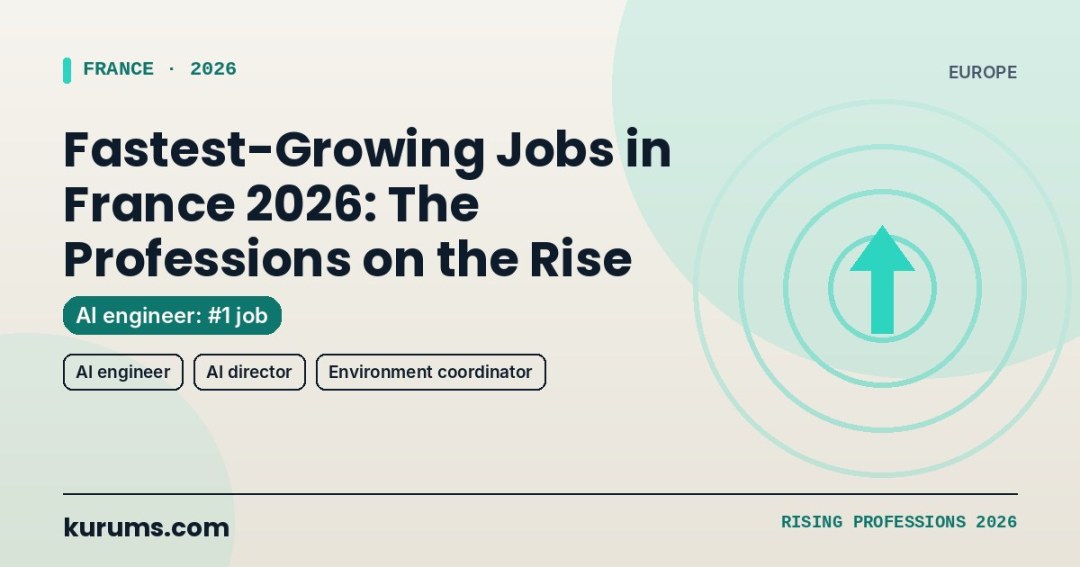
AI engineer tops LinkedIn’s 2026 ranking of growing jobs in France, ahead of AI director and environment coordinator.
Where are the biggest volume shortages?
Care and trades: BMO 2026 counts 69,500 planned hires of home-care aides (+13.3%), and over 70% of planned hires of machinists, roofers and welders are judged difficult.
What is pulling demand upward in a soft economy?
The six-reactor EPR2 nuclear build (Gifen expects 100,000 hires in ten years), the defence plan targeting 100,000 hires by 2030, and AI adoption keeping IT the top cadre hiring function.
Which jobs are rising fastest in France in 2026?
AI engineer, AI director and environment coordinator lead LinkedIn’s 2026 ranking of growing jobs in France, followed by HSE, continuous-improvement and quality managers. By volume, France Travail’s BMO 2026 points to home-care aides and nurses, while nuclear and defence programmes drive demand for technicians.
| Rank | Profession | Why it is rising | Demand signal (source) | Typical advertised pay |
|---|---|---|---|---|
| 1 | AI engineer | AI moving to production | LinkedIn Jobs on the Rise 2026 France #1 | €45,000–50,000 junior (~$52,000–57,500), Page Group |
| 2 | AI director | Single owner for AI roadmap and AI Act compliance | LinkedIn 2026 #2 | Not benchmarked in 2026 guides |
| 3 | Environment coordinator | CSRD reporting, permitting, decarbonisation | LinkedIn 2026 #3 | Not benchmarked in 2026 guides |
| 4 | HSE, quality and continuous-improvement manager | Reindustrialisation, safety enforcement | LinkedIn 2026 #6, #7, #8 | Not benchmarked in 2026 guides |
| 5 | Cybersecurity engineer | NIS2, defence contracts, ransomware | Apec: 61,160 IT cadre hires in 2026 (+4%) | €45,000 junior to €70,000–80,000 at 10 yrs (~$52,000–92,000), Page Group |
| 6 | Data engineer / scientist | Every AI project starts with data pipelines | Dares: +115,000 IT engineers by 2030 (+26%) | €45,000–50,000 junior, up to €75,000 at 5–10 yrs (~$52,000–86,000), Page Group |
| 7 | Nuclear engineer and maintenance technician | Six EPR2 reactors, fleet life extension | LinkedIn 2026 #22; Gifen: ~100,000 hires in ten years | Not benchmarked in 2026 guides |
| 8 | Nurse and midwife | Ageing population, hospital staffing gaps | BMO 2026: 36,700 hires, 60.2% difficult | Public pay grids |
| 9 | Home-care aide | Home-based elderly care | BMO 2026: 69,500 hires (+13.3%), 62.3% difficult | Sector agreements near the SMIC |
| 10 | Welder, boilermaker, machinist | Nuclear, defence and aerospace compete for trades | BMO 2026 difficulty: 71.3%, 77.7%, 80.6% | Not benchmarked in 2026 guides |
Two things stand out. The French list is heavy in control functions: environment, HSE, quality, continuous improvement, risk and public affairs take six of LinkedIn’s 25 places, where the German list is engineering-led. And the growth and volume stories are different populations: LinkedIn’s risers are cadre roles in Paris, Lyon and Toulouse; the BMO shortage list is care and trades everywhere. See how to read job-growth data.
What is driving demand for these professions?
Five forces are pulling French hiring upward as total vacancies fall: AI adoption, the EPR2 nuclear programme, defence rearmament, an ageing population, and an environmental-compliance wave landing on a pre-existing shortage of industrial trades.
AI adoption and data infrastructure
LinkedIn’s Economic Graph ranked AI engineer first and AI director second in France’s 2026 list, with machine-learning researcher 16th and data centre technician 18th. The methodology excludes roles recruited by only a few companies, so these are broad shifts.
Apec forecasts 61,160 cadre hires in IT in 2026, up 4% and the largest of any function. Page Group notes that AI engineer pay now almost matches data-engineer pay: the two talent pools have merged.
The nuclear renaissance
Six new EPR2 reactors, with an option for eight, make nuclear France’s largest industrial employment programme. Gifen, the sector federation, puts employment at around 250,000 in 2025, up more than 10% from 2023, and expects roughly 100,000 hires over ten years, two-thirds of them technicians.
The most-recruited roles include maintenance technician, nuclear safety engineer, welder and certified non-destructive-testing inspector. With the first EPR2 pair at Penly due in 2038, this demand runs well beyond 2026.
Defence rearmament
In September 2026 the Ministry of Labour launched an employment plan for the defence industrial base, which employs about 220,000 people. It targets 100,000 hires between 2026 and 2030, around 70,000 replacing retirees, across 27 employment areas under strain.
The need is mainly technicians: electronics technicians, automation maintenance specialists, machinists and fitters. Thales alone announced 3,300 French hires for 2026, four in ten in software, cybersecurity and AI.
Ageing and the care economy
Health and social care is France’s largest recruiting sector in 2026, with about 322,000 planned hires in the BMO survey, ahead of hospitality. Home-care aides account for 69,500 projects, up 13.3%; 54% of the sector’s hires are judged difficult, 78.8% for doctors.
The Dares and France Stratégie “Métiers en 2030” projections expect about 410,000 net new care posts by 2030, with nurses and midwives adding 113,000 (+18%). LinkedIn’s list echoes this: Ehpad director is 17th and medical physicist 11th.
Environmental compliance meets the skilled-trades deficit
Environment coordinator at third place is the surprise of the 2026 ranking, and HSE (6th), continuous-improvement (7th), quality (8th) and risk (25th) managers make 2026 the year of control functions. New industrial sites and sustainability-reporting rules require someone accountable for permits and audits; the energy and waste sector is the BMO survey’s fastest-growing recruiter, up 24.8%.
Beneath these sectors lies the shortage they all draw on. BMO 2026 judges 80.6% of planned hires of skilled machinists difficult, with roofers at 79.7%, boilermakers 77.7% and welders 71.3%. A certified welder in Normandy can choose between an EPR2 subcontractor, a naval yard and an aerospace plant.
What do the rising jobs pay in France?
Junior AI, data and cybersecurity engineers in Île-de-France typically start at €45,000–50,000 gross and reach €70,000–90,000 with ten years’ experience, according to Page Group’s 2026 study. Senior security and data leaders reach €90,000–130,000 in Robert Walters’ projections; regional roles pay up to 20% less.
| Role | Typical advertised range (gross annual) | Source / year |
|---|---|---|
| AI engineer / developer | Junior €45,000–50,000 (~$52,000–57,500); “almost equivalent” to data roles | Page Group 2026 (Île-de-France) |
| Cybersecurity engineer | €45,000 at 0–2 yrs; €55,000–70,000 at 2–5 yrs; €70,000–80,000 at 10 yrs (~$52,000–92,000) | Page Group 2026 |
| Data engineer / scientist | €45,000–50,000 junior; up to €75,000 at 5–10 yrs (~$52,000–86,000) | Page Group 2026 |
| Lead data scientist | €90,000–120,000 at 6–10 yrs; €100,000–130,000 at 10–15 yrs (~$104,000–150,000) | Robert Walters 2026 |
| Cloud engineer / architect | €45,000–55,000 early career; up to €90,000 at 10 yrs (~$52,000–104,000) | Page Group 2026 |
| Technical IT architect | €75,000–90,000 at 6–10 yrs; up to €115,000 at 10–15 yrs (~$86,000–132,000) | Robert Walters 2026 |
| CISO (RSSI) | €90,000–105,000 at 6–10 yrs; €100,000–120,000 at 10–15 yrs (~$104,000–138,000) | Robert Walters 2026 |
| Programme / transformation director | €105,000–140,000 at 10–15 yrs (~$121,000–161,000) | Robert Walters 2026 |
Pay growth has slowed but not stopped. Robert Walters projects a 4% average rise for tech cadres in 2026, one point above 2025 but below the 7% of 2024. Page Group expects IT salaries to stay stable except in cybersecurity, data and AI, where junior cybersecurity pay rose 12.5% since 2024.
Two structural factors matter for 2026 budgets. The EU pay-transparency directive applies from June 2026, adding salary-range disclosure in adverts to France’s Index de l’égalité professionnelle. And geography still sets the price: Page Group reports gaps of up to −20% in Nouvelle-Aquitaine and Occitanie for traditional IT roles. See our country-by-country salary comparison.
Which skills, degrees and certifications unlock these roles?
Most rising roles in France pair a state diploma with a professional certification: a CTI-accredited engineering degree plus a cloud ML certificate for AI engineers, a QHSE master’s plus ISO lead-auditor status for HSE roles, the Diplôme d’État for nurses.
- AI engineer / ML researcher: a CTI-accredited diplôme d’ingénieur or data-science master’s, plus AWS Certified Machine Learning – Specialty or Azure AI Engineer Associate.
- Cybersecurity engineer / CISO: ANSSI-labelled SecNumedu master’s programmes; CompTIA Security+, CISSP, CISM and ISO/IEC 27001 Lead Implementer.
- Cloud engineer / data centre technician: AWS Certified Solutions Architect; a BTS in electrotechnics plus the habilitation électrique (NF C18-510) for site technicians.
- Environment coordinator / HSE manager: a QHSE master’s; ISO 14001 and ISO 45001 lead-auditor certificates, NEBOSH for international groups, plus ICPE permitting and CSRD reporting.
- Nuclear engineer / technician: nuclear-specialised engineering degrees or a licence professionnelle; ISO 9606-1 for welders, COFREND for NDT inspectors and CEFRI radiation-protection training. EDF’s CAP EPR2 pathway at Penly is an entry route for career changers.
- Nurse / nursing aide / home-care aide: the Diplôme d’État d’Infirmier with Ordre National des Infirmiers registration; the Diplôme d’État d’Aide-Soignant; the DEAES for home care.
Providers are listed in the kurums Courses & Certifications directory and the MBA & Business Education directory; our guide to certifications for 2026’s rising jobs compares cost and duration.
Where are the jobs? Regional hotspots
Île-de-France still absorbs almost half of cadre hiring, with more than 143,000 planned in 2026 according to Apec, but the fastest growth is in Occitanie (+6%), while Normandy and Brittany host the nuclear and defence build-out driving technician demand.
| Region | Signal (source) | Rising roles concentrated there |
|---|---|---|
| Île-de-France | 143,000+ cadre hires in 2026 (+5%), Apec; over half of Thales’s French hires | AI, cybersecurity, data, finance |
| Occitanie | About 19,500 cadre hires (+6%, strongest growth), Apec | Aerospace and defence engineering, quality, supply chain |
| Normandy | Penly EPR2 pair; Flamanville and Gravelines forums in the 2026 Nuclear Careers Week | Welders, boilermakers, nuclear safety engineers, NDT inspectors |
| Brittany | About 10,200 cadre hires (+2%), Apec | Naval, sonar and drone engineering |
AI and data talent can be hired remotely or relocated to Paris and Lyon; welders, nurses and home-care aides cannot, which is why the defence plan names 27 employment areas under strain.
Which professions are losing ground?
Routine administrative, banking back-office and low-qualification roles are declining structurally, while construction and junior cadre hiring are falling cyclically. Dares and France Stratégie expect jobs held by people with no qualification above the baccalauréat to fall by nearly 800,000 by 2030.
The “Métiers en 2030” study is explicit about where employment will not grow: agriculture continues its decline, general administrative services keep retreating, and bank and insurance cadre employment stagnates as branches digitalise. Yet the same study finds secretaries hard to recruit, a reminder that decline and shortage can coexist.
Two cyclical declines deserve attention. Construction intentions fell 16.4% in BMO 2026, the steepest drop of any sector, though Dares still expects +190,000 construction jobs by 2030. And Apec reports hires of cadres with under one year of experience down 12%, so the squeeze is landing on graduates. This is reallocation toward specialised, certified roles, not collapse.
How should employers in France hire for scarce rising roles?
Benchmark pay against 2026 guides, hire on skills rather than diplomas, build alternance and POEI pipelines, use the Talent permit and the métiers en tension list for international hires, and use specialists where the market is thin.
- Benchmark against movers, not stayers. Robert Walters projects a 4% average rise for tech cadres in 2026, but movers command more. Prepare salary bands now; pay-transparency rules put them in every advert from June 2026.
- Hire on skills for QHSE and tech. Environment coordinator was a rare title five years ago; the people who can do it come from production and maintenance. Advertise on ISO 14001 competencies and accept non-linear CVs.
- Build alternance pipelines. With junior cadre hiring down 12% at Apec, companies still taking apprentices in 2026 will own the 2028 market. Defence firms can draw on 15,000 POEI places.
- Use the real immigration routes. For cadre roles, the carte de séjour “Talent” (successor to the Passeport Talent, including the EU Blue Card) is the standard path; for trades and care, the métiers en tension list updated in 2025 eases work-permit approval. Our Expat HR France guides cover the details.
- Use specialists where the market is thin. For nuclear-qualified welders or ANSSI-grade security engineers, a specialised agency pays for itself; see our guide to recruitment agencies in France. Groups without a French entity can use an employer of record (see our recruiting in France playbook).
What should job seekers and career changers do in 2026?
Target roles on both the growth list and the shortage list, obtain the one French credential employers filter on, use CPF and POEI funding to retrain in under a year, and price yourself with 2026 data. Generative-AI literacy now helps in every function, as the skills behind 2026’s rising jobs shows.
- Pick a role that is both rising and scarce. Cybersecurity engineer, HSE manager, nuclear maintenance technician, nurse and data engineer appear in both the growth rankings and the BMO difficulty tables.
- Secure the gatekeeper credential first. A CTI-accredited degree or SecNumedu master’s for tech, ISO lead-auditor status for QHSE, the Diplôme d’État for care, COFREND for nuclear trades.
- Use the funding that exists. The Compte Personnel de Formation covers most of these certifications, and France Travail’s POEI pays for pre-hire training when an employer commits to hire.
- Follow the programmes, not the headlines. EPR2 runs to 2038, the defence plan to 2030 and care demand to at least 2030; a role attached to a funded programme is safer than one attached to a funding round.
- Price yourself with 2026 data. Use the Page Group and Robert Walters ranges above, remember the regional discount for traditional IT roles, and ask for the salary band employers must disclose from June 2026.
Frequently Asked Questions
What is the fastest-growing job in France in 2026?
AI engineer. LinkedIn’s sixth annual ranking of growing jobs in France, published in January 2026, placed AI engineer first, followed by AI director and environment coordinator. The ranking covers 25 titles that grew more than 25% between 2023 and mid-2025.
Which professions are hardest to recruit in France in 2026?
According to France Travail’s BMO 2026 survey, skilled machining operators (80.6% of planned hires judged difficult), roofers (79.7%), doctors (78.8%), boilermakers (77.7%) and welders (71.3%) top the table.
How much does an AI or cybersecurity engineer earn in France?
Page Group’s 2026 study puts junior data and AI engineers in Île-de-France at €45,000–50,000 gross and cybersecurity engineers at €45,000, rising to €70,000–80,000 at ten years. Robert Walters projects €90,000–120,000 for CISOs and lead data scientists. These are typical advertised ranges, not guarantees.
Is France still hiring despite rising unemployment?
Yes, selectively. Insee reported unemployment at 8.3% in the second quarter of 2026, yet France Travail counts 2.28 million planned hires and Apec forecasts 305,800 cadre recruitments, up 4%. Growth is concentrated in IT, care, nuclear and defence.
Sources and method
- Le classement LinkedIn des métiers en croissance 2026 — LinkedIn Actualités / Economic Graph, 2026
- Classement 2026 des métiers en croissance en France par LinkedIn — RH Matin, 2026
- Besoins en main-d’œuvre 2026 : 2,28 millions de postes à pourvoir — France Travail, 2026
- Le secteur sanitaire et médico-social premier recruteur en 2026 — Infirmiers.com, 2026
- Quels sont les cadres qui seront les plus recrutés en 2026 ? — Apec, 2026
- Plus de 300 000 recrutements de cadres en 2026, sauf si… — Apec, 2026
- Informations rapides n°192 : chômage au deuxième trimestre 2026 — Insee, 2026
- Les Métiers en 2030 — France Stratégie and Dares, 2022
- Nucléaire : 100 000 postes à pourvoir d’ici 2035 (Gifen) — L’Usine Nouvelle, 2026
- Thales annonce un plan de 9 000 recrutements pour 2026, dont le tiers en France — Clubic, 2026
- Défense : 100 000 recrutements d’ici 2030 (national defence-industry employment plan) — TPE Actu, 2026
- Des salaires toujours élevés pour les profils IT qualifiés en 2026 (Page Group) — Le Monde Informatique, 2025
- Les salaires IT repartent doucement à la hausse en 2026 (Robert Walters) — Le Monde Informatique, 2025
Method: the ranked table combines LinkedIn’s January 2026 growth ranking, France Travail’s BMO 2026 projects and difficulty rates, Apec’s 2026 cadre forecast and the Dares/France Stratégie 2030 projections. Pay ranges come from the Page Group and Robert Walters 2026 studies; USD uses an indicative €1 = US$1.15. Figures checked November 2026.
Discover more from Kurums | Business Intelligence
Subscribe to get the latest posts sent to your email.