
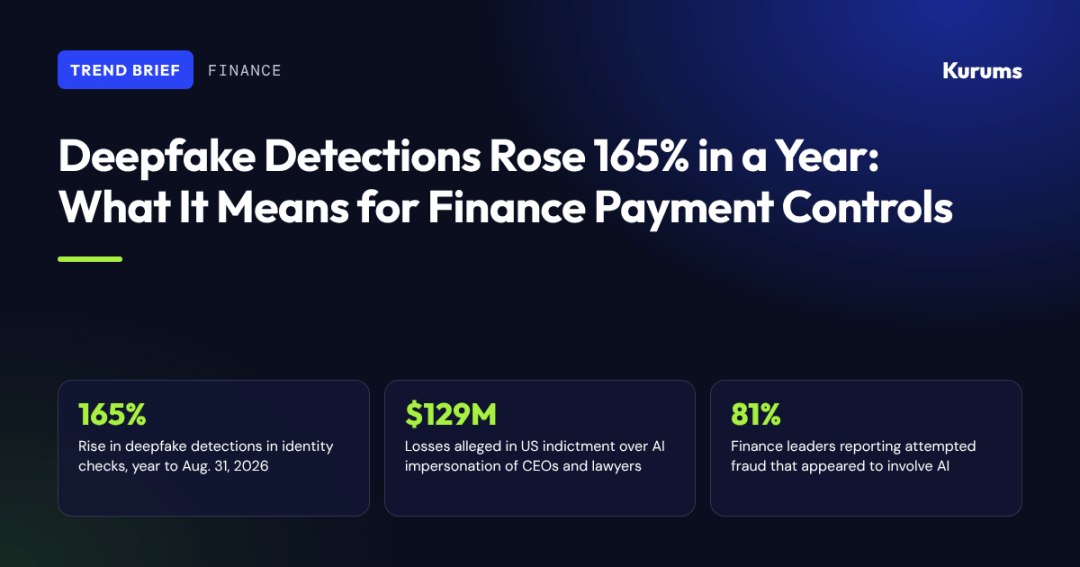
New identity fraud data, a $129 million federal indictment and two finance surveys point the same way: a familiar voice, face or writing style no longer verifies a payment request.
Entrust reported a 165% rise in deepfakes detected during identity checks in the year to Aug. 31, 2026, and a 224% rise in injection attacks. Separately, US prosecutors allege that three men used AI impersonations of CEOs and lawyers to take at least $129 million from companies through wire transfers. Surveys show most finance leaders have seen AI-linked fraud attempts, yet only half are confident of catching one before money leaves. Procedure, not recognition, is the control that holds.
What the Entrust report found
Deepfake detections rose 165% in the 12 months ended Aug. 31, 2026, compared with the year before, according to an identity fraud report from data security firm Entrust covered by CFO Dive on Nov. 25, 2026. Entrust’s systems detected such an attack about once every three minutes on average. Here a deepfake means an AI-generated image, video or document presented as real during an identity check.
The report, titled The Professionalization of Fraud: 2027 Identity Fraud Report, draws on Entrust’s own data from more than 20 industries in 195 countries between Sept. 1, 2025, and Aug. 31, 2026, CFO Dive reported. It reflects what one vendor’s systems saw, not fraud across the whole economy.
A second measure grew faster. Injection attacks rose 224% in 2026, per CFO Dive. Help Net Security, which reviewed the report on Nov. 18, describes an injection attack as feeding images or video directly into verification software and bypassing the device camera, for example through a virtual camera.
Financial services accounted for 93.5% of deepfake activity in the dataset, with crypto platforms and digital-first banks targeted most, CFO Dive reported. The report’s stated reason: verified accounts can be used to steal funds, launder money and support money mule activity.
Where the numbers come from, and what they do not measure
The Entrust figures describe attacks on identity verification, mostly at account opening. They do not count fake payment requests sent to accounts payable or treasury staff. The sources below measure different things over different periods.
| Source | What it measures | Key figure | Period |
|---|---|---|---|
| Entrust identity fraud report | Deepfakes detected in identity checks (vendor data, 195 countries) | Up 165%; injection attacks up 224% | Sept. 2025 to Aug. 2026 |
| Certos survey | 230 senior finance leaders reporting attempted fraud that involved or appeared to involve AI | 81% | Surveyed Aug. 7-21, 2026 |
| AFP Payments Fraud and Control Survey | 465 US treasury practitioners; organizations affected by business email compromise | 74% | Calendar 2025 |
| FBI Internet Crime Complaint Center | Reported US losses from business email compromise | $3 billion | Calendar 2025 |
| US Justice Department indictment | Alleged losses in one AI executive-impersonation scheme | At least $129 million | July 2024 to Feb. 2026 |
Not every line in the Entrust report points up. Help Net Security reported that the document fraud rate fell 19% year over year, and fraud rates at traditional banks declined 81% over two years, which the report attributed to investment in verification and fraud prevention, per CFO Dive.
From identity checks to payment approvals: the $129 million case
The same technology is appearing in payment fraud aimed at corporate finance staff. On Nov. 5, 2026, the US Justice Department announced charges against three men over a scheme that allegedly took at least $129 million from companies by using AI to imitate the voices and images of chief executives and of lawyers at large international law firms, CyberScoop reported on Nov. 6.
According to CyberScoop’s account of the unsealed indictment in the Southern District of New York, the scheme ran between July 2024 and February 2026 and targeted employees with enough authority to approve large wire transfers, typically accounting staff. It usually began with an email from an e-signature company in which the impersonated CEO described a confidential transaction and asked the employee to sign a non-disclosure agreement before contacting a purported attorney, who was also an impersonator.
Reported losses included almost $11.6 million at a UK financial technology company, $5.2 million at a Florida pet food company, $4.8 million at a Missouri hospital system and nearly $2.7 million at a Rhode Island bank.
Jacob Soall, Sharon Hazan and Guy Sheetrit face seven counts including wire fraud, aggravated identity theft and money laundering. These are allegations. Bitdefender noted that extradition was pending and that the defendants are presumed innocent, and Sheetrit’s lawyers told CyberScoop that he had no involvement in the matter.
For controllers, the detail that matters is the secrecy step: the non-disclosure agreement gave the employee a reason not to check with colleagues.
What surveys of finance teams show
A survey of 230 senior finance leaders by Certos, the fraud prevention brand of Early Warning Services, found that 81% said their company had experienced an attempted fraud in the past year that involved, or appeared to involve, AI-generated or AI-enhanced content, CFO.com reported on Oct. 8, 2026. As their biggest concern, 43% named payment diversion and 21% executive deepfake impersonation.
The same survey found a confidence gap. While 87% believed they were very or somewhat prepared for AI-enabled fraud, only half were confident they could identify an attempt before money left the organization. The survey excluded banks and other financial services firms.
The Association for Financial Professionals (AFP), surveying 465 US treasury practitioners in January 2026, found that 76% of organizations experienced attempted or actual payments fraud in 2025 and 74% were affected by business email compromise, per its April 14 press release. Business email compromise, or BEC, is fraud in which a criminal poses as a trusted party, usually by email, to redirect a payment. Nacha noted that the 74% figure was up from 63% in 2024.
On deepfakes specifically, an AFP article published July 22 said only 6% of respondents reported a confirmed deepfake-related incident, but 40% were unsure whether one had happened to them. Only 30% of victims recouped more than 75% of stolen funds, and 20% recouped nothing.
The FBI’s Internet Crime Complaint Center recorded $3 billion in BEC losses in 2025 within total reported cybercrime losses of nearly $20.9 billion, the ABA Banking Journal reported on April 7, 2026. Its first section on AI-facilitated fraud covered more than 22,000 complaints and nearly $893 million in losses.
Why this matters for payment and identity controls
Most payment fraud of this kind is what Nacha, which governs the US ACH network, calls credit-push fraud: the company itself authorizes the payment, but on false information. In an Oct. 28, 2026 post, Nacha said its operating rules now require risk-based processes reasonably intended to identify ACH credits initiated under false pretenses, under monitoring rules that took effect earlier in 2026.
As AI imitation improves, recognition stops working as a control. Chris Ward, head of enterprise payments at Truist, said in the AFP article that spelling and grammar errors once gave fraudulent emails away and no longer do.
AFP’s panel concluded that the defensive move is not to out-tech the fraudster but to require verification through channels that are harder to fake, such as an independent call to a known number, a recorded video session or physical confirmation.
The Entrust finding on injection attacks adds a caution about video itself. If fabricated footage can be fed into a verification flow as though it came from a live camera, a video call alone is weaker evidence of identity than it appears. The report says defenses need to consider where content came from and how it entered the process, not only whether an image looks manipulated, according to CFO Dive.
Open questions and limits of the data
None of these sources gives a reliable count of deepfake payment fraud against companies. Entrust’s figures are vendor detections in identity checks. The Certos and AFP numbers are self-reported, and the FBI figures cover only what victims report.
AFP’s own materials differ slightly. Its press release says 74% of organizations were affected by BEC, while its July article says 70% of respondents cited BEC as the top avenue of attempted or actual fraud. These may be answers to different questions.
The 40% of AFP respondents who could not say whether they had faced a deepfake suggests many organizations cannot classify an impersonation attempt after the fact, which weakens trend reporting to the board.
What search interest in deepfakes and wire fraud shows
Google Trends data for the United States over the 90 days to Nov. 28, 2026, puts the two terms on one scale where 100 is the highest daily value. Searches for “deepfake” peaked at 100 on Oct. 31, after an earlier high of 83 on Sept. 20, and averaged 33.6 over the last seven days. “Wire fraud” never rose above 19, a level it reached on Sept. 2 and Sept. 10, and averaged 8.1 in the last week.
The index is relative, not a count of searches, and most deepfake interest is consumer driven: rising queries include a streamer controversy and AI deepfake generators. One rising query, “deepfake enabled social engineering” (up 160%), points to workplace concern. Rising wire fraud queries mostly name individual criminal cases, along with “wire fraud lawyer” (up 80%).
Search interest: deepfake vs wire fraud
Google Trends, United States, Aug 28, 2026 to Nov 28, 2026. Daily index, 100 = peak interest across both terms.
What finance teams should do this week
- Make callback verification mandatory. Any new payee, change of bank details or urgent executive payment request should be confirmed by calling a number already on file, never one supplied in the request.
- Treat secrecy as a red flag in policy. The indictment describes non-disclosure agreements used to keep employees from consulting colleagues. State in writing that no confidentiality request overrides dual approval or the right to escalate.
- Require a second approver for unusual or high-value transfers. Nacha lists additional approvals for higher-risk transactions among basic operational controls.
- Review how vendors and customers are identified. Ask identity verification providers whether they detect injection attacks and virtual cameras, not only manipulated images, and do not rely on a video call alone to confirm bank details.
- Rehearse the first hour after a bad payment. Nacha’s guidance is to contact the financial institution immediately about recovery options, notify management, and report to the FBI’s Internet Crime Complaint Center and local law enforcement.
- Start logging impersonation attempts. Record suspected deepfake or AI-assisted requests in a simple register so the organization is not among the 40% unsure whether it has been targeted.
Frequently asked questions
What is deepfake-enabled social engineering?
It is fraud in which criminals use AI-generated voice, video or images to pose as a trusted person and persuade an employee to act, usually to approve a payment or share information. In the case US prosecutors announced on Nov. 5, 2026, the alleged impersonations were of chief executives and law firm attorneys, aimed at staff able to authorize wire transfers.
How common is deepfake fraud against companies?
No source gives a full count. Entrust reported a 165% rise in deepfakes detected in identity checks in the year to Aug. 31, 2026. In a Certos survey, 81% of 230 finance leaders reported an attempted fraud that involved or appeared to involve AI. AFP found only 6% of respondents confirmed a deepfake incident, while 40% were unsure.
What is an injection attack in identity verification?
An injection attack feeds images or video directly into verification software instead of capturing them through the device camera. Help Net Security's summary of the Entrust report says a virtual camera can present fabricated footage as a live recording, while device emulation software imitates the phone or computer. Entrust reported injection attacks rose 224% in 2026, faster than deepfakes.
Can a company recover money sent in a deepfake wire fraud?
Sometimes, but not reliably. AFP's 2026 survey found 30% of payments fraud victims recovered more than 75% of stolen funds and 20% recovered nothing. Nacha's guidance for payments made under false pretenses is that speed matters: review the transaction, contact the financial institution immediately to discuss recovery options, and report to the FBI's Internet Crime Complaint Center.
- CFO Dive: Deepfake detections surge as fraudsters utilize AI, report finds (2026-11-25)
- Help Net Security: Fraudsters feed the right face into identity checks through virtual cameras (2026-11-18)
- CyberScoop: Authorities accuse trio of using AI deepfakes to defraud $129M from businesses (2026-11-06)
- Bitdefender: Three charged over alleged $129 million AI deepfake CEO scam (2026-11-12)
- CFO.com: 1 in 5 finance leaders fear deepfake impersonation (2026-10-08)
- Association for Financial Professionals: Over 75% of US Firms Experienced Payments Fraud in 2025, While AI Adoption for Fraud Mitigation Lags (2026-04-14)
- Association for Financial Professionals: From BEC to Deepfakes, Payments Fraud Is Only Getting More Sophisticated (2026-07-22)
- Nacha: Practical Steps for Corporate Payment Practitioners to Reduce Credit-Push Payments Fraud (2026-10-28)
- Nacha: Business Email Compromise Attempts Rose Sharply in 2025, Report Finds (2026-05-13)
- ABA Banking Journal: FBI: Cybercrime losses increased 26% in 2025 (2026-04-07)
Search-interest figures are from Google Trends (United States, 90 days to November 28, 2026). This article is analysis for operators, not legal, tax or investment advice. Last updated November 28, 2026.
Discover more from Kurums | Business Intelligence
Subscribe to get the latest posts sent to your email.